
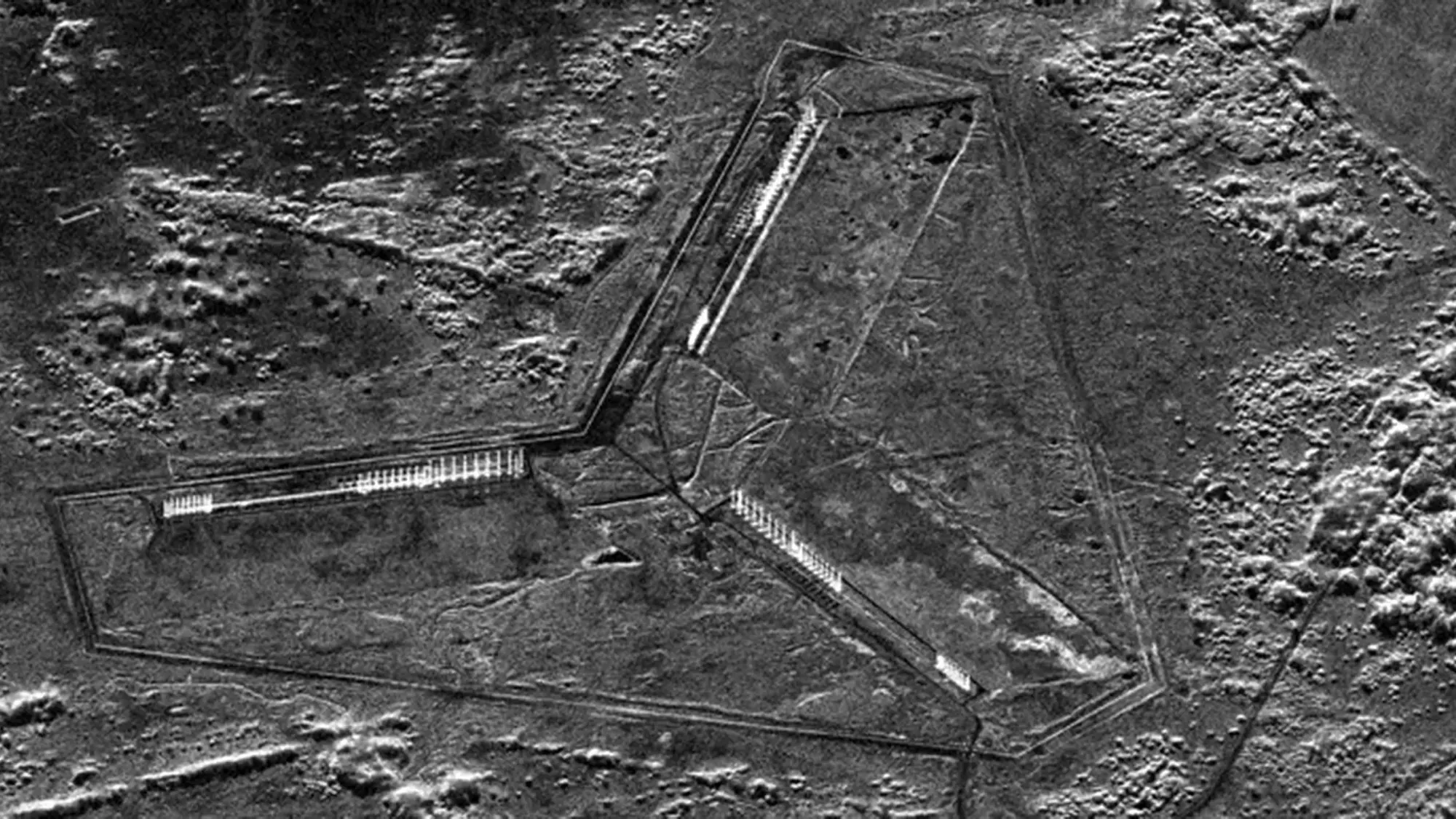
ICEYE imagery reported by the Frankfurter Allgemeine Zeitung shows a long-range radar under construction near Gvardeysk, matching a project Lithuanian intelligence identified in March. It sits among more than 20 surveillance and electronic-warfare sites in an exclave already spoofing satellite navigation across seven countries.
Russia is building a radar installation in Kaliningrad designed to detect aircraft and missiles thousands of kilometres away, adding to a network of more than 20 surveillance and electronic-warfare sites in the exclave identified by the Finnish satellite company ICEYE.
Radar imagery captured by ICEYE at the end of August and reported by the Frankfurter Allgemeine Zeitung (FAZ) on 19 October 2026 shows three antenna rows, each more than 500 metres long, converging in a star pattern behind a double fence near the town of Gvardeysk. FAZ reported that the over-the-horizon radar could detect aircraft and missiles at 900 to 3,000 kilometres. Lithuania's intelligence agencies wrote in March that Russia was building elements of a 29B6 Container over-the-horizon radar at several locations in Kaliningrad.
Lithuania's communications regulator said in May that Russian electronic-warfare equipment in Kaliningrad was already falsifying navigation signals up to 450 kilometres away, after Russia increased its GPS spoofing antennas there from three in early 2025 to 36. The affected area covers Estonia, Latvia, Lithuania, most of Poland and parts of Finland, Sweden and Belarus.
Kaliningrad's position
Kaliningrad, home to about one million people, lies on the Baltic coast separated from mainland Russia and bordered by Poland and Lithuania, both NATO members. It hosts air defence, missile and naval forces, including the Baltic Fleet base at Baltiysk. A Russian defence industry source told the state news agency TASS in March 2020 that a Container radar based there would watch the air situation over all of Europe including Great Britain.
Measured from Gvardeysk town centre, Paris and London lie about 1,450 kilometres away and Madrid about 2,420 kilometres, inside the 900 to 3,000-kilometre band FAZ reported. Berlin, at about 560 kilometres, and Warsaw and Vilnius, at about 270 kilometres each, fall short of that band's lower limit, which places the radar's reported coverage over Western Europe and the Atlantic approaches rather than the states bordering the exclave.
The radar project
"For several years now, the construction of the over-the-horizon radar station 29B6 'Container' has been ongoing, elements of which are being built in several locations in the region," Lithuania's State Security Department (VSD) and Defence Intelligence and Security Service (AOTD) wrote in their National Threat Assessment 2026. "Once completed, it will increase Russia's capabilities to monitor airspace at long range."
Lithuanian Defence Minister Dovilė Šakalienė told the Baltic News Service in September 2025 that the project was "a radar station, elements of which are being built in several locations in the exclave", designed "to detect aircraft and missiles in airspace several thousand kilometres away" and still under construction.
The Gvardeysk installation is consistent with Lithuania's description of the 29B6 project, although the available reporting does not establish which component is being built there. The dts news agency's summary of the FAZ article calls the site an over-the-horizon radar without naming the model, and ICEYE has not published its report or imagery.
NIIDAR, the Russian institute that designed the system, built the 29B6 to watch airspace up to 100 kilometres in altitude and about 3,000 kilometres away. The first unit, at Kovylkino in Mordovia, went on experimental combat duty on 2 December 2013, with a receiving field of 144 masts at a site separate from its transmitter. Ukrainian drones struck the Kovylkino radar on 11 April and 17 April 2024, according to Ukrainian intelligence sources cited by Ukrainska Pravda.
Skywave radars of this type bounce high-frequency signals off the ionosphere and must constantly retune as its conditions change. Published estimates dating to 1974 put their range resolution at 20 to 40 kilometres, accuracy described as sufficient for early warning but too coarse for directing weapons. The Static Brief, an independent assessment of Kaliningrad published on 16 October, wrote that using surveillance data to strike a moving target requires precise tracks, processing and a connection to an engagement system. A 3,000-kilometre detection range measures surveillance reach, while interception would depend on separate tracking radars and missiles.
FAZ reported that the Gvardeysk radar is still being built, and Lithuania's agencies describe its capability in the future tense. Satellite imagery records the antenna field's construction; whether transmitters have been installed or the site has begun radiating would show up only in radio monitoring of the high-frequency band.
A wider listening network
ICEYE counts more than 20 signals-intelligence and electronic-warfare sites in Kaliningrad, with more being added, among them the Gvardeysk radar and a large circular antenna array near Chernyakhovsk. An unpublished ICEYE report on Baltic security, excerpted by FAZ, says the sites together give Russia a wide range of ways to monitor the region, from intercepting satellite communications to detecting aircraft movements and ballistic missiles.
The Chernyakhovsk array, about 50 kilometres east of Gvardeysk and 25 kilometres from the Polish border, consists of six concentric rings about 1.6 kilometres across. Tochnyi, an open-source research project, dated the start of work to March 2023 using Sentinel-2 imagery and found the rings, radial roads, a perimeter fence and a checkpoint in place by July 2025. Tochnyi assessed it as a 29B6 transmitting site and said six of its eight antenna sets matched the frequencies of a Krug signals-intelligence system. Other open-source accounts describe it as a high-frequency array for intercepting and locating radio transmissions in NATO territory.
An over-the-horizon radar sends out its own signal and listens for reflections from aircraft and missiles. Signals-intelligence stations collect other parties' communications and emissions and locate their sources. Electronic-warfare systems transmit to disrupt or deceive enemy electronics, including satellite navigation.
Interference already affecting civilians
Lithuanian intelligence wrote in March that Russia uses electronic-warfare equipment in Kaliningrad, separate from the radar under construction, to jam satellite navigation signals, drowning them out, and to spoof them, broadcasting false signals that lead receivers to calculate the wrong position. The agencies assessed that the main purpose is to protect military and civilian sites in the exclave from drones, that Russia knows the interference spills over into civil aviation and shipping, and that it continues regardless.
Darius Kuliešius, deputy head of Lithuania's communications regulator, told Reuters on 26 May 2026 that the 450-kilometre estimate came from analysis of disturbances in aircraft ADS-B transmissions. Interference began occasionally with the NATO summit in Vilnius in 2023 and had become a "systemic, permanent, unending Russian provocation against European security", he said. Mobile networks on the Lithuanian side of the border are degraded, and online bus timetables in Klaipėda, 50 kilometres from Kaliningrad, stop working during spikes, which coincide with Ukrainian drone attacks on Russia.
A Spanish military aircraft carrying Defence Minister Margarita Robles experienced GPS disturbance near Kaliningrad in 2025. Russia's embassy in Vilnius did not reply to Reuters, and Russian officials have previously denied responsibility for such interference. The European Union has sanctioned the Baltic Fleet's 841st Separate Electronic Warfare Centre, based in the exclave.
Fewer soldiers, more sensors
ICEYE's automated detection found raised launchers at a mobile S-400 surface-to-air missile position near Baltiysk, which FAZ took to mean the battery had been readied for use. Kaliningrad already hosts a Voronezh-DM early-warning radar near Pionersky, launched in November 2011, and Lithuania's assessment lists a new type of arsenal with reinforced-concrete storage and a logistics base of Russia's strategic reserve.
Lithuania's 2026 assessment described Russia's ground forces in the exclave as temporarily weakened and staffed mainly by conscripts after most professional soldiers and equipment went to Ukraine, while the naval infantry brigade at Baltiysk is being expanded into a division.
About 25 NATO aircraft, including two US EA-37B Compass Call electronic-attack aircraft and an E-3A early-warning aircraft, flew an unannounced operation near Kaliningrad on 18 August 2026, according to flight-tracking data compiled by Militarnyi. A Western military source told Reuters the operation demonstrated an ability to cut off the exclave's radio and radar links and its air defences. NATO's Allied Air Command said the alliance was "constantly improving its defensive capabilities" and gave no details.
Russia warned NATO on 30 September that it would be ready to use nuclear weapons if the alliance tried to cut off or attack Kaliningrad, Reuters reported. President Vladimir Putin said at the Valdai Discussion Club on 1 October that a direct attack on Kaliningrad would immediately raise the question of Russia using "all the weapons at its disposal".
Under construction
Russian officials have given no completion date for the Gvardeysk radar, and its role within the 29B6 system rests on Lithuanian intelligence and open-source analysis. Russia's navigation interference from Kaliningrad is already measured across seven countries and the Baltic Sea, and the radar being built near Gvardeysk would extend Russia's watch over aircraft and missiles to airspace up to 3,000 kilometres away.