Dutch military intelligence captured Jared Kushner's iPhone screen from early 2018 and watched him log in to a bank account in the United Arab Emirates that had taken in hundreds of millions of US dollars through a bank in Azerbaijan, investigative journalist Matthew Cole writes in an excerpt from his book published by Vanity Fair on 22 October 2026. The excerpt alleges that Saudi Arabia and the UAE paid roughly US$750 million into that account from 2017, and that the UAE ruler Mohamed bin Zayed moved about US$1 billion more into Israel's central bank for Kushner by spring 2018. The excerpt appeared two days after Kushner, now Donald Trump's special envoy for peace, joined Ukraine talks in Oslo by video link on 20 October, and eight days after a watchdog group sued to remove him from that role. Kushner's counsel said Kushner "has no idea" about any such account and that "there are no accounts and never were."
The excerpt's claims rest on unnamed sources, including people the author says knew of the arrangement and people involved in moving the money; the excerpt publishes none of the bank statements or screenshots it describes. The author wrote in September that a lawyer for Kushner had denied every element of the book and threatened to sue.
The phone
In late 2017, according to the excerpt, the Netherlands Defence Intelligence and Security Service, known by its Dutch initials MIVD, turned a GRU hacker who specialised in stolen bank data, after asking the British government to detain him on arrival in the UK. The Russian officer, offered the choice between working for the Dutch and facing espionage charges in Britain, gave MIVD access to a GRU server in Rostov. On it, Dutch officers found screenshots of Kushner's phone.
MIVD then found its own way into the phone, an iPhone X, by early 2018, the excerpt says. The access let the service see Kushner's screen whenever he used the device and save each image to its own servers. On 13 April 2018, inside that period, MIVD disrupted a GRU cyber operation in The Hague with help from British counterparts, the Dutch defence ministry announced that October. Its civilian sister service, the AIVD, had infiltrated the Russian hacking group Cozy Bear in mid-2014 and watched it take files from the Democratic National Committee, de Volkskrant and Nieuwsuur reported in January 2018.
Elijah Cummings, then chairman of the House Oversight Committee, wrote on 21 March 2019 that Kushner's lawyer, Abbe Lowell, had told the committee Kushner used WhatsApp as part of his official duties; Lowell said he had never confirmed contact with foreign "leaders" or "officials" on the app. Agnes Callamard, then a UN special rapporteur, said in January 2020 that Kushner should check and replace his phone after a forensic analysis linked a hack of Jeff Bezos's phone to a WhatsApp message from Saudi Crown Prince Mohammed bin Salman. Trump had overruled intelligence officials in May 2018 to give Kushner top-secret clearance.
The author's first source told him in spring 2020 that the Dubai account had sent money to a warlord, a mercenary and a one-time hit man, a story he writes that he first found preposterous; the excerpt names none of the recipients.
Alpha
The account the excerpt calls Alpha was held at First Abu Dhabi Bank, the UAE's largest lender, whose board lists Tahnoon bin Zayed, Deputy Ruler of Abu Dhabi, as chairman. Tahnoon is Mohamed bin Zayed's brother and the country's national security adviser. According to the excerpt, Saudi and Emirati money reached Alpha in US dollars from a bank in Azerbaijan that charged a fee of 6 to 7 per cent to convert riyals and dirhams and send the dollars on from a separate account, a route that leaves auditors seeing only an Azerbaijani sender. The Organized Crime and Corruption Reporting Project documented that route in 2017: the Azerbaijani Laundromat moved about US$2.9 billion through four UK shell companies at Danske Bank's Estonian branch, much of it from accounts at the state-owned International Bank of Azerbaijan.
The excerpt says Kushner did not own Alpha but was a signatory on an account owned by the Watani Al Emarat Foundation, a government-funded Emirati charity that runs national identity and youth programmes under its executive director, Dherar Belhoul Al Falasi, a member of the Federal National Council. Mohamed bin Rashid Al Maktoum, Ruler of Dubai, created the foundation by decree on 26 May 2018 as a public-benefit body that took over the assets, staff and obligations of the earlier Watani Programme. The law lets the foundation open branches outside Dubai, join entities abroad and set its own accounting rules, and has the Ruler of Dubai appoint its board. A source with direct knowledge quoted in the excerpt says the charity also served as cover for secret Emirati weapons purchases. A lawyer for Kushner said Kushner had no knowledge of or connection to Al Falasi, the charity or any UAE bank account.
Mohamed bin Zayed and Mohammed bin Salman first discussed a fund of more than US$10 billion with Kushner early in Trump's first term, according to the excerpt, and the plan shrank as Mohamed bin Zayed lobbied the administration to back Mohammed bin Salman's bid to become crown prince. The two rulers, and later Mohamed bin Zayed alone, put at least US$2 billion into at least two accounts for Kushner, it says. A person who discussed the arrangement with senior Emirati and Israeli officials is quoted as saying "Jared promised MBZ that he'd push their agenda with Trump if they participated in a fund."
Four senior officials of Trump's first administration, two national security advisers, a White House chief of staff and a former CIA director, said they knew of no presidential authorisation for Kushner to use a foreign government's account, according to the excerpt. Kushner's counsel said every arrangement Kushner made with foreign leaders had the president's agreement.
Beta
By spring 2018, Mohamed bin Zayed had moved roughly US$1 billion to Israel via Azerbaijan for Kushner, according to a person briefed on the account the excerpt calls Beta. That person said Benjamin Netanyahu, Israel's prime minister, encouraged Kushner to hold the money at Israel's central bank, where it would sit in what appeared to be a government account, and that its allocation was for Kushner's personal benefit. Netanyahu required notice of any transfer, the excerpt says. The Bank of Israel is sole banker to the Israeli government and, under section 50 of its law, may also keep accounts for foreign central banks, monetary authorities and foreign banks with the approval of the governor and its Monetary Committee; it does not take accounts from private customers in Israel.
The excerpt says Kushner sent those notices through David Friedman, who presented his credentials as US ambassador to Israel on 16 May 2017. "I know absolutely nothing about any of these allegations," Friedman said, calling the claims about his role "100% false." A person who worked with Kushner to move money out of Israel is quoted as saying much of it went to bank accounts in Cyprus.
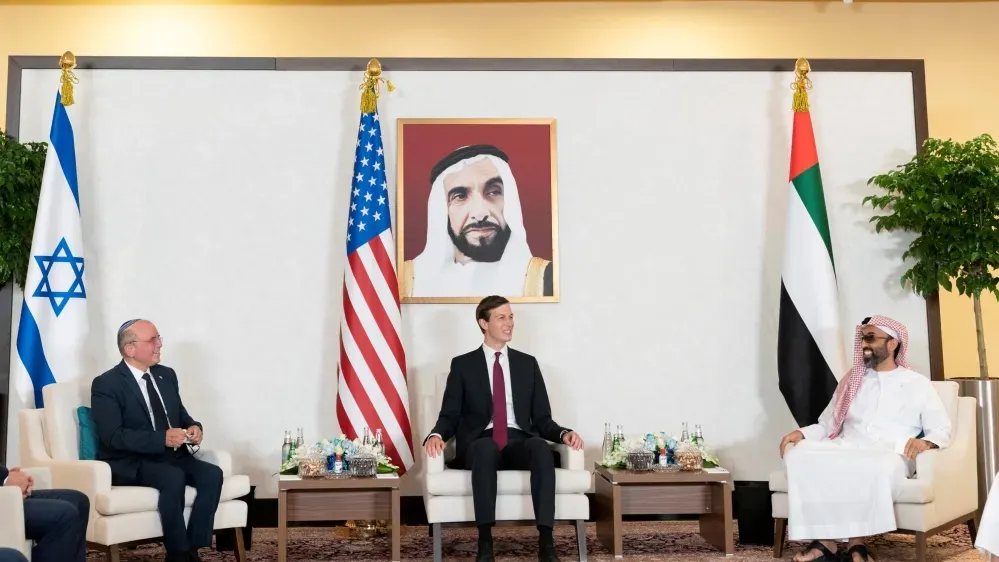
The excerpt describes a third transfer, separate from Kushner's use: an Emirati payment into Israel's central bank to cover the cost of Israeli military help in the event of a major Iranian attack on the UAE, a defence agreement it says Kushner negotiated while Israel and the UAE kept their contacts secret. The two countries normalised relations publicly in the Abraham Accords of 2020, which Kushner negotiated. Early in this year's war with Iran, Netanyahu sent the UAE an Iron Dome battery and several dozen Israeli troops to operate it after a call with Mohamed bin Zayed, Israeli officials told Axios in April; the battery intercepted dozens of Iranian missiles, and a senior Israeli official called it the first time Israel had sent the system abroad.
The envoy
Trump named Kushner an "envoy of peace" on 19 February 2026 at the first meeting of his Board of Peace, giving him the title Steve Witkoff holds. A White House official said Kushner volunteers his time. Since February he has met Iranian negotiators in Geneva, spent more than four hours with Netanyahu on 17 August pressing him on the stalled Gaza plan and joined the Oslo meeting on 20 October with Ukraine's president, Volodymyr Zelenskyy, at Ukraine's request.
Robert Garcia, the senior Democrat on the House Oversight Committee, and Senator Ron Wyden wrote to White House chief of staff Susie Wiles on 19 March 2026 asking whether Kushner had registered under the Foreign Agents Registration Act, whether he had filed a public financial disclosure and which foreign governments he had discussed US policy with, with answers due by 2 April. Citizens for Responsibility and Ethics in Washington sued on 14 October, arguing that Kushner exercises federal power without Senate confirmation and without having filed a single financial disclosure. Chad Mizelle, Kushner's lawyer and a former Justice Department chief of staff, called the suit "without merit" and said government and outside ethics lawyers had approved Kushner's volunteer arrangement. White House spokeswoman Anna Kelly called CREW "unserious" and "Trump-deranged".
Kushner's name also sits at the centre of a February 2026 whistleblower complaint over an intercepted 2025 conversation between two foreign nationals; senior administration officials called the claims about him demonstrably false, the Wall Street Journal reported.
The Gulf money on file
The excerpt's US$2 billion is a separate allegation from the US$2 billion that Saudi Arabia's Public Investment Fund, chaired by Mohammed bin Salman, put into Kushner's private equity firm, Affinity Partners, after he left the White House in 2021. The fund's screening panel objected to that investment over Affinity's inexperience and fees, and a board led by the crown prince approved it anyway. The Senate Finance Committee found in September 2024 that Affinity had collected as much as US$157 million in fees from foreign clients, US$87 million of it from the Saudi government, while returning nothing to investors as of July 2024. Affinity had told regulators that 99 per cent of the money it manages comes from abroad, mainly the sovereign funds of Saudi Arabia, the UAE and Qatar.
George Nader, whom the Justice Department describes as an adviser to senior UAE government officials, was sentenced on 18 July 2023 for funnelling at least US$3.5 million of UAE money into US political committees in 2016 to gain access to a presidential candidate, disguised as a software licensing deal, and for reporting on his US political work to a senior UAE official by encrypted app.
The excerpt says that when the Gulf rulers first approached Kushner, his family company faced a loan of about US$1.2 billion due in February 2019 on 666 Fifth Avenue in Manhattan. Brookfield Asset Management, in which the Qatar Investment Authority held a stake, paid Kushner Companies US$1.2 billion for a 99-year lease on the tower in 2018, according to Wyden. Brookfield has said Qatari entities had no role in the deal.
The law
The excerpt says that as a senior adviser with a security clearance Kushner had to disclose any account where he held signatory or beneficiary access, on his annual OGE Form 278e and to the Internal Revenue Service. In July 2017 Kushner amended his disclosure to add 77 assets worth at least US$10.6 million that his lawyers said had been inadvertently omitted. His final White House disclosure, covering 2020 and early 2021, lists US$1.8 million a year from his family's Westminster Management and stakes in apartment and office buildings in New York, New Jersey and Chicago. Kushner's lawyer said Kushner complied with all legal requirements when dealing with foreign governments and broke no laws in the White House.
The Foreign Agents Registration Act defines an agent of a foreign principal as anyone who acts at the request or under the direction or control of a foreign government and engages in political activity in the United States in its interests. The federal bribery statute, 18 USC 201, bars a public official from corruptly seeking or accepting anything of value in return for being influenced in an official act. A former Mueller prosecutor quoted in the excerpt said any promise by Kushner in return for the money, "even if it was just speaking to his father-in-law", could fall under both.
The documents
First Abu Dhabi Bank's account mandate for the Watani Al Emarat Foundation, and for the Watani Programme before May 2018, with its signatory cards from 2017 to 2021, would show whether Kushner could sign for Alpha. Bank of Israel account approvals under section 50 and its transfer logs from 2018 would show whether a UAE-funded account existed and who authorised payments to Cyprus. Kushner's Treasury foreign account filings and confidential security forms from 2017 to 2020 would show what he declared. The MIVD screenshots sit with the Dutch service, whose work is overseen by the Review Committee on the Intelligence and Security Services.