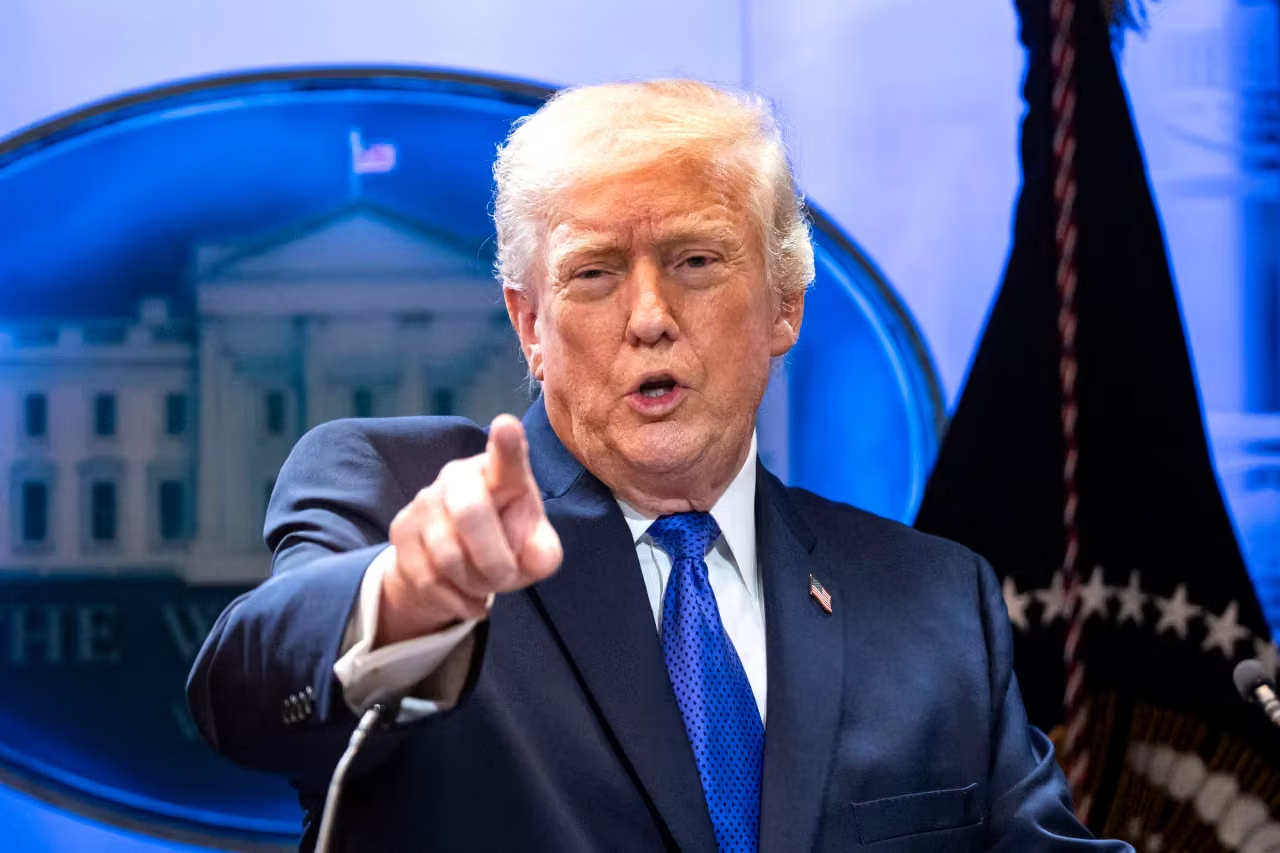
Donald Trump said on 3 September 2026 that the United States will ask European governments to repay it for weapons sent to Ukraine under Joe Biden, and that munitions sales to allies are suspended while US stocks are rebuilt.
The Truth Social post carrying the demand was timed at 10.56am eastern time. Trump wrote that "Hundreds of Billions of Dollars was given to Ukraine and NATO, free of charge, that Europe would have paid for" and that "we will be asking for that money, though somewhat belatedly". He wrote in the same post that the United States holds "virtually unlimited amounts of Mid to High Grade Ammunition", that "we are taking them for ourselves, the U.S.A., rather than selling them to others, but the sales to Allies will soon again, begin", and that the Biden administration "gave far more Munitions away to Ukraine, at no cost to them, whatsoever, than we have used in Iran".
Trump wrote in the post's opening line that reporters covering the war with Iran are "treasonous SCUM that refuses to accurately report on our Military Operation in Iran". US forces struck air defences, radar sites, maritime assets and communications facilities across southern Iran on 1 September, killing at least 11 people including five at a wedding gathering in Kuhestak, and Iran fired ballistic missiles and drones at US bases in Jordan, Bahrain and Iraq in reply.
Trump named no country in the post, attached no sum to the claim and described no mechanism for collecting the money.
European Commission spokesman Olof Gill told a briefing in Brussels on 4 September that the Commission had received no formal request, Ukrainska Pravda reported.
Rosa DeLauro, ranking Democrat on the House Appropriations Committee, returned from a bipartisan congressional visit to Ukraine on 4 September and said the demand was "extraordinary" and "an outrageous commentary". She said of Trump: "I don't believe he even knows or understands what he's speaking about."
What Congress appropriated
Congress appropriated $45.8 billion to replace equipment drawn from US stocks and sent to Ukraine, against $31.7 billion of drawdowns the president authorised between December 2021 and January 2025, the Government Accountability Office reported on 15 May 2025. Of that replacement money, $25.7 billion had been placed on contract by 31 January 2025. The contracts went to US manufacturers.
The Ukraine Security Supplemental Appropriations Act, enacted on 24 April 2024, carried $60.78 billion and remains the last supplemental Congress has passed for the war, the special inspector general for Operation Atlantic Resolve reported for the quarter ending 30 June 2026. The last presidential drawdown notification to Congress was sent on 26 September 2024. About $4.96 billion of drawdown balance was still available at the end of June 2026, unused.
Of the $33.51 billion appropriated under the Ukraine Security Assistance Initiative, $32.40 billion had been obligated and $19.83 billion disbursed by 30 June 2026, with delivered equipment costed at 57.3 per cent of the total as of August 2026, the same report recorded.
Total war-related appropriations reached $195 billion by 31 March 2026, of which 59 per cent had been disbursed and $164 billion came from five bills, the Council on Foreign Relations calculated. Mark Cancian of the Center for Strategic and International Studies put the domestic share of the $175.2 billion appropriated between 2022 and early 2025 at 60 per cent, against 25 per cent spent in Ukraine and 15 per cent elsewhere, in an analysis published on 11 February 2025. The domestic share covers replenishment contracts, industrial expansion and the cost of extra US forces in Europe.
What the auditors found
The Defense Department overstated the value of the equipment it sent to Ukraine by $8.1 billion, across two admissions. Deputy press secretary Sabrina Singh disclosed a $6.2 billion error in June 2023 covering the 2022 and 2023 fiscal years, after the services costed transfers at replacement price rather than net book value. An audit released on 13 June 2024, DODIG-2024-095, found a further $1.9 billion, split between $653 million in general equipment and $1.25 billion in ammunition and supplies. Inspector general Robert Storch said components "lacked a full understanding of the accounting principles" in the revised valuation policy.
Net book value, the measure the department adopted in March 2023, is historical cost minus depreciation, and it falls to zero once equipment passes its service life.
A July 2024 report from the Government Accountability Office, numbered GAO-24-106934, found that many of the articles sent to Ukraine were past their useful life. A sample of 10 vehicles carried a combined valuation of $7.05 million and no documented net book value at all. A cargo truck bought in 2012 could be booked at anything from $0 to $497,562 depending on the method chosen. The full reconciliation of drawdown valuations that the inspector general ordered in June 2024 has not been published.
What the Trump administration has delivered
US military aid to Ukraine fell 99 per cent in 2025 against the previous year, the Kiel Institute reported on 11 February 2026. The last new US assistance the institute recorded was a €480 million package the Biden administration announced on 9 January 2025. NATO donors bought €3.7 billion of US weapons for Ukraine during 2025 through the Prioritised Ukraine Requirements List, at their own expense.
No presidential drawdown package has been notified to Congress since 26 September 2024, four months before Trump took office, and the $4.96 billion of drawdown authority still available at 30 June 2026 has not been used. The United States pays nothing into the NATO buying mechanism it manages.
Scott Bessent and deputy prime minister Yulia Svyrydenko signed the US-Ukraine Reconstruction Investment Fund on 30 April 2025, under which Ukraine contributes half the revenue from new natural resource licences and production sharing agreements. Seed capital is $75 million from the US Development Finance Corporation and $75 million from Ukraine. Economy minister Oleksii Sobolev said the government aims to invest in at least three projects within 18 months. No dollars had been deployed and no project completed by October 2025, the Carnegie Endowment for International Peace found in a six-month assessment.
What Europe has already paid
The Prioritised Ukraine Requirements List, the NATO mechanism through which allies buy US weapons for Ukraine, raised $6.7 billion from 29 countries in its first year, Ukraine's defence ministry said on 23 July 2026. Norway contributed $1.36 billion, the Netherlands $1.163 billion, Germany $900 million, Canada $834 million and Sweden $546 million. The contributors are 26 NATO members and three partner states. Ukraine assembles packages of roughly $500 million each, the United States draws the weapons from its own stocks and delivers them, and more than 10 packages had been funded by July.
Allies had transferred $4.8 billion of that money to the US Treasury by 30 June 2026 against $6.3 billion announced, the special inspector general recorded, with the money then allocated to replace materiel from US stocks or to buy new articles. Trump, NATO secretary general Mark Rutte and Volodymyr Zelenskyy agreed the mechanism on 14 July 2025 on one condition: the United States does not pay for the assistance it supplies.
Ukraine's defence ministry said on 23 July 2026 that about 95 per cent of the Patriot interceptors reaching Ukraine arrive through the mechanism. A NATO spokesperson put the share at 75 per cent of Patriot missiles and 90 per cent of air defence ammunition on 4 September, and said that equipment funded under the list "continues to arrive in Ukraine". NATO declined to comment on Trump's post and the US mission to NATO did not answer questions, UA.NEWS reported. Presidential adviser Dmytro Lytvyn declined to give delivery details.
European donors bought at least €3 billion of weapons from US companies in the first half of 2026, about 30 per cent of their military aid, the Kiel Institute found on 13 August 2026, and more than 90 per cent of the equipment moving through the NATO mechanism came from US stocks. European governments allocated nearly €11 billion in May and June alone, €4.3 billion of it military.
European military aid in 2025 was 67 per cent above the 2022 to 2024 annual average, the Kiel Institute reported on 11 February 2026, while total military aid to Ukraine fell 13 per cent because US contributions stopped. Military aid has averaged just over €2 billion a month in 2026, down from more than €2.5 billion in earlier years. The United Kingdom has pledged £16 billion in military financing, £13.7 billion of it gifted, and Germany has spent or committed €57.6 billion, the House of Commons Library recorded on 13 August 2026.
What Europe is borrowing
The Council of the EU finalised a €90 billion loan to Ukraine on 23 April 2026, split between €60 billion for defence industrial capacity and procurement and €30 billion for budget support. The money is raised by EU borrowing on capital markets against headroom in the EU budget, and is to be repaid out of reparations owed by Russia. Disbursements in 2026 total €45 billion, of which €28.3 billion goes to defence industrial support, €8.35 billion through macro-financial assistance and €8.35 billion through the Ukraine Facility.
Munitions and the war with Iran
US forces expended virtually all of the army's ATACMS and Precision Strike Missile stocks during the war with Iran, Reuters reported on 4 August 2026, citing three people with access to the data. Patriot interceptor holdings fell about 65 per cent between February and July, THAAD interceptors by at least 38 per cent and Tomahawk stocks by a little under half of global supply. Defense Department spokesman Sean Parnell said the military "has everything it needs to execute at the time and place of the President's choosing."
Cancian and Chris Park of the Center for Strategic and International Studies put first-phase expenditure at more than 1,000 Tomahawks and about 1,100 JASSM-ER cruise missiles, over half the prewar JASSM inventory, in an assessment published on 21 April 2026. THAAD came out as the most depleted of the seven munitions examined, with production rising from 96 interceptors a year toward 400 and deliveries resuming in April 2027. The cycle from appropriation to delivery takes about 52 months.
US Patriot stocks held in Europe are "beyond critical", US and NATO officials told the Associated Press, which reported that roughly 1,500 of 2,330 interceptors were consumed and that European-held stocks were moved to the Middle East. Army colonel Martin O'Donnell said that characterisation is "simply not the case."
Rebuilding the stocks
Trump invoked the Defense Production Act in a memorandum on 11 June 2026 to speed munitions production. The act allows suppliers to coordinate output without antitrust exposure. Assistant secretary of defense Michael Cadenazzi said: "We brought all of the solid rocket motor companies in … for discussions around our goals and how to achieve this." A munitions acceleration council set up in 2025 by deputy secretary Stephen Feinberg found that eight of 11 critical munitions depend on a single supplier. The government put $1 billion into L3Harris's missile solutions unit in January, convertible to equity at a planned share sale in the second half of 2026.
The Defense Department announced advance agreements with Lockheed Martin and Northrop Grumman on 3 August 2026 to triple PAC-3 Patriot interceptor output and quadruple THAAD output, toward a procurement objective of nearly 14,000 interceptors of the two types combined. The agreements are worth about $3 billion and cover a second source for Patriot solid rocket motors, ignition safety devices for PAC-3 interceptors and structural parts for THAAD. Michael Duffey, under secretary of defense for acquisition and sustainment, said agreements with component suppliers "are vital to accelerating production". RTX holds a $22.9 billion seven-year Tomahawk agreement and Lockheed Martin a $35 billion undefinitised THAAD agreement.
None of those agreements binds the government until Congress appropriates the money and contracting officers write the contracts. Companies holding them raised capital investment by 31 per cent between the second quarter of 2025 and the second quarter of 2026, the Center for Strategic and International Studies calculated. The American Enterprise Institute put the time needed to reach the department's THAAD inventory goal at 27 years at maximum current production rates, Defense One reported in August 2026. Lockheed Martin's cheaper PAC-3 ACE interceptor is not expected to fly before early 2028, with production 18 months after that.
The interceptors allies funded
The Defense Department weighed redirecting about $750 million of PAC-3 MSE interceptors funded by allies through the NATO mechanism, to replenish stocks drained by Middle East operations, the Washington Post reported on 26 March 2026. No final decision was recorded. Trump told reporters that day: "We do this all the time." Rutte said the air defence ordered under the mechanism would reach Ukraine regardless.
Trump threatened in March 2026 to withdraw from the mechanism and from Ukraine altogether unless European governments helped reopen the Strait of Hormuz, the Financial Times reported. Rutte pressed for a joint statement issued on 19 March in which France, the United Kingdom and Germany said they were ready "to contribute to appropriate efforts to ensure safe passage" through the strait. Trump described Ukraine as "a test" and said of European governments: "They weren't there for us."
In June 2025 the Defense Department redirected proximity fuzes for APKWS guided rockets, a cheap counter-drone weapon Ukraine relies on, to Air Force Central Command.
Sales to allies
Elbridge Colby, then a senior Defense Department official, opposed a Patriot sale to Denmark in September 2025 on the grounds that the interceptors were in limited supply and should be retained for US use, The Atlantic reported. Colby put US holdings at about a quarter of the interceptors existing military plans required. Cancian said: "We tell Europeans we want them to send weapons to Ukraine and buy replacements."
A $14 billion arms sale to Taiwan was paused to conserve munitions for the war against Iran, acting navy secretary Hung Cao told a Senate hearing on 19 May 2026. Breaking Defense reported in June 2026 that allied orders across several categories were slipping.
The legal claim
Drawdowns under section 506 of the Foreign Assistance Act move articles out of US stocks without reimbursement to the services. Neither that authority nor the Ukraine Security Assistance Initiative creates a repayment claim against Ukraine, and neither creates one against third states that were not party to the transfers. No European government signed an instrument obliging it to cover Biden-era drawdowns, and no mechanism exists through which a demand could be enforced or the proceeds spent without an act of Congress.
Trump has put the sum owed at $300 billion and, on other occasions, at $500 billion. The audited figure for drawdowns authorised through January 2025 is $31.7 billion, before correction for the $8.1 billion of overvaluation the Defense Department and its inspector general have conceded, and Congress separately appropriated $45.8 billion to buy new equipment from US manufacturers to replace it.
What the United States owes
The United States owed the United Nations about $5 billion in August 2026, more than $2 billion on the regular budget and roughly $3 billion for peacekeeping, and notified Congress on 21 August 2026 of an $850 million payment, $725 million of it against the regular budget and $125 million against peacekeeping in Haiti and the Democratic Republic of the Congo. US arrears in February 2026 stood at $2.19 billion on the regular budget, $2.4 billion on peacekeeping and $43.6 million to the UN tribunals, with the United States holding more than 95 per cent of all regular budget arrears. Ambassador Michael Waltz said in February that an initial tranche would come "in a matter of weeks". Secretary general António Guterres warned that the organisation could exhaust its reserves by July.
Ukraine held the world's third largest nuclear arsenal at independence in 1991, an estimated 1,900 strategic warheads, 176 intercontinental ballistic missiles and 44 strategic bombers. The United States, the United Kingdom and Russia signed the Budapest Memorandum on 5 December 1994, undertaking to respect Ukraine's sovereignty and existing borders, to refrain from the threat or use of force against it, to refrain from economic coercion and to seek UN Security Council action if Ukraine were threatened with nuclear weapons. Ukraine transferred the last warhead to Russia by 1 June 1996 and destroyed its last strategic delivery vehicle on 30 October 2001. The United Kingdom, one of the governments Trump would bill, signed the same document.
The memorandum gives assurances rather than guarantees, carries no enforcement clause and creates no compensation mechanism. US payments under the 1994 package were $175 million promised for dismantlement assistance and compensation for the commercial value of the highly enriched uranium recovered from the warheads.
Zelenskyy said at the Munich Security Conference on 19 February 2022, five days before the invasion: "I am initiating consultations in the framework of the Budapest Memorandum." He said that if the consultations did not happen or failed to secure Ukraine, then "all the package decisions of 1994 are in doubt". No meeting of the signatories under the memorandum has been convened since.
In Congress
The House passed a Ukraine bill on 4 June 2026 by 226 votes to 195, carrying more than $1 billion in security and reconstruction aid, $8 billion in defence loans and sanctions on Russian economic sectors. Gregory Meeks sponsored it and supporters forced it to the floor with a discharge petition of 218 signatures, over the objections of House leaders. Don Bacon said during the debate: "Are we going to stand with good or are we going to stand with evil?" Brian Mast said the bill was "crafted to fight against President Trump". Supporters said it is unlikely to reach 60 votes in the Senate without Trump's endorsement.
DeLauro said on 4 September that she would work to increase Ukraine appropriations with Senate support if Democrats take the House.
What can be done
Members of Congress can ask under which authority a reimbursement claim would be brought, given that drawdown transfers carry no reimbursement to the services and that Congress has already appropriated $45.8 billion to replace the equipment.
Members can ask why $4.96 billion of drawdown authority sat unused at the end of June 2026 while no new package has been notified since 26 September 2024.
Publication of the reconciliation of drawdown valuations that the inspector general ordered in June 2024 would establish the corrected book value of everything transferred.
The signatories of the Budapest Memorandum can convene the consultations Ukraine requested on 19 February 2022, which have never been held.
National parliaments funding the NATO mechanism can require their governments to publish transfer receipts and delivery confirmations against each tranche.