Donald Trump's investment accounts bought between $1 million and $5 million of debt issued by SpaceX on 18 August 2026. Two days later Trump signed a presidential memorandum directing federal agencies to expand commercial space launches, open government launch sites to private operators and favour commercial providers for government missions, in an industry SpaceX leads by a wide margin.
SpaceX reported more than $6 billion in multi-year Starshield contracts from the US government in the second quarter of 2026, and the Space Force awarded it $6.45 billion for two parts of Golden Dome, Trump's missile defence programme, in May. Elon Musk, who controls about 82 per cent of SpaceX's voting power, was the largest individual donor to Trump's 2024 campaign.
Davis Ingle, a White House spokesman, said independent managers make every investment decision in the president's portfolio and that there are no conflicts of interest. The White House has not identified the managers, has not said who selected the SpaceX notes and has not said whether a computer model or a person made the purchase.
The president is exempt from 18 USC 208, the criminal statute that bars most other executive branch officials from acting on matters in which they hold a financial interest. He is not exempt from the STOCK Act, which since 2012 has imposed on the president and every other executive branch employee a duty not to trade on material nonpublic information gained through public office.
The purchase
Trump's periodic transaction report for August, received by the Office of Government Ethics on 25 September and published on 8 October, lists 517 trades. One of them, dated 18 August, is a purchase of SpaceX senior unsecured notes valued between $1,000,001 and $5,000,000. The notes pay 5.35 per cent a year and mature on 15 July 2031.
SpaceX sold those notes on 23 June 2026 as the shortest of five tranches in a $25 billion bond issue, its first public debt sale, 11 days after a stock market listing that raised about $85.7 billion. The 2031 tranche totalled $7 billion. Investors placed orders worth about $89 billion, and SpaceX said most of the proceeds would repay a $20 billion bridge loan taken out in March.
Trump's earlier SpaceX positions were far smaller, Yahoo News reported, and most purchases on his recent disclosures have been company shares. The August report also shows his accounts buying between $5 million and $25 million of Meta Platforms shares and up to $6 million of Microsoft shares on 21 August, weeks before Trump hosted Musk, Mark Zuckerberg and other technology executives at a White House summit on artificial intelligence.
Federal law gave Trump 45 days to report the trade, until 2 October. The report reached the Office of Government Ethics on 25 September, inside the deadline, and was published 51 days after the purchase.
Who chose the bonds
Ingle said third-party financial institutions manage the portfolio in discretionary accounts using "computer-based model portfolios" that replicate indexes such as the Schwab 1000. He said neither Trump nor any family member can direct or influence what is bought or sold. Ingle issued a near-identical statement on 22 August after Trump's June report listed more than 1,000 trades worth between $78.1 million and $263.1 million.
The Schwab 1000 is a stock index covering the largest US companies. It holds no corporate bonds, so replicating it could not have produced the SpaceX purchase. Ingle did not answer The Washington Post when it asked who decided to buy the SpaceX debt or whether a model had made the trade. Some bond indexes do include SpaceX debt. A financial adviser who spoke to the Post on condition of anonymity said buying individual bonds to follow a bond index would be unusual.
Trump has not placed his assets in a blind trust or divested them, unlike his recent predecessors. The Hill reported that his assets sit in a trust managed by his children. Eric Trump has described the arrangement as a blind trust, a description the disclosures do not support, since Trump's individual trades are reported and published every month.
Trump's accounts have made about 28,700 securities trades in roughly 17 months since he returned to office, Fortune reported, about 80 for each day the market is open. His 2025 annual disclosure listed more than 21,000 trades worth between $600 million and $1.86 billion across eight accounts holding at least $858 million. In 2017, his first year in office, he disclosed 86 stock transactions.
No public record identifies the institution that bought the SpaceX notes, the date the decision was made, whether the manager knew a launch policy was about to be signed or whether anyone at the firm communicated with administration officials or SpaceX before the purchase.
What was known before 20 August
NSPM-17, The National Space Transportation Policy, was signed and released on 20 August. Reports on SpacePolicyOnline, the Space Foundation and RTTNews published that day and the next describe the signing as news. None of the coverage reviewed for this article reported the memorandum's contents, scheduling or drafting before its release, and the White House has not said when drafting began, which officials reviewed it or when the signing date was set.
The memorandum assigns implementation to the assistant to the president for science and technology, Michael Kratsios, who directs the Office of Science and Technology Policy. Neither his office nor the White House has said whether any company, SpaceX included, was consulted on the text.
Trump signed Executive Order 14335, Enabling Competition in the Commercial Space Industry, on 13 August 2025, a year before the purchase, setting out the same deregulatory direction. The Federal Aviation Administration proposed in July 2026 to waive some environmental reviews for launch infrastructure. Musk had spoken publicly about launch rates on the scale of the new target. The specific measures and the signing date were not public on 18 August, according to the available record.
Securities law treats advance knowledge of a presidential action as material nonpublic information if a reasonable investor would weigh it. Whether a general policy on launch infrastructure, which names no company, would move the price of one company's bonds is a question for securities lawyers and, if anyone opens an inquiry, investigators. Timing alone does not establish that anyone involved in the purchase knew what Trump would sign.
Whether the bonds gained
NSPM-17 sets a goal of more than 1,000 launches and reentries a year from US ranges by 2030. The Federal Aviation Administration recorded 204 licensed commercial operations in fiscal year 2025, 195 of them launches, and the US launched 193 rockets in 2025. Reaching the target would require roughly five times the current activity. A larger market, faster permitting and an instruction for the Defense Department and NASA to favour commercial launch services could all raise SpaceX's future revenue, which would in turn support its ability to repay debt.
SpaceX's 2056 notes, priced at 175 basis points over Treasuries in June, had widened to 231 basis points by mid-July. In their first nine trading days in the ICE BofA index they were the worst performer among BBB-rated dollar benchmark bonds. On 5 August, 13 days before Trump's purchase, the 2033 notes widened to 186 basis points and the 2046 notes to 238. By 7 October the 2056 spread stood at 238 basis points, and the cost of insuring SpaceX debt against default for five years reached a record of about 195 basis points a year, Bloomberg reported.
No public price series for the 2031 notes around 20 August was available for this article. The published data on SpaceX's other tranches shows no rally after the memorandum was signed and points to SpaceX credit weakening over the period. On the available evidence, NSPM-17 gave SpaceX a potential long-term benefit and Trump's accounts a potential interest in that benefit. No evidence shows the bonds rose in value because of the policy.
Trump's accounts receive 5.35 per cent a year on the notes, between about $53,500 and $267,500 annually depending on the size of the holding, regardless of the bonds' market price.
The federal money
The Space Force awarded SpaceX $2.29 billion on 26 May 2026 to build the backbone of the Space Data Network, a military satellite communications system tied to Golden Dome. On 29 May it awarded SpaceX $4.16 billion for the Space-Based Airborne Moving Target Indicator, Golden Dome's first contract to track aircraft from orbit by 2028. Both awards used Other Transaction Authority, which sits outside standard federal acquisition rules. The Government Accountability Office has said the Defense Department does not track enough data to judge whether such agreements work as intended.
In April the Space Force named SpaceX among 12 companies sharing prototype contracts worth up to $3.2 billion to develop space-based interceptors for Golden Dome. SpaceX's share was not disclosed. The Wall Street Journal reported in August that SpaceX had won more than $8 billion in Golden Dome contracts this year, at least a third of the programme's budget. The two May awards account for $6.45 billion of that figure.
SpaceX told investors on 6 August, 12 days before Trump's purchase, that it had been awarded more than $6 billion in multi-year US government contracts for Starshield, its military satellite service. The company did not say whether that total includes any Golden Dome satellite work, so the Starshield and Golden Dome figures may overlap and cannot be added together.
NASA's inspector general reported that SpaceX's Commercial Crew contract has grown to $4.9 billion, mainly through a 2022 modification adding eight flights to the International Space Station.
No public evidence shows that Trump or White House staff intervened in any of these awards, or that SpaceX received terms other bidders were denied. The Space Force said it would not rely on a single provider for the tracking layer. The Golden Dome awards came months before the bond purchase, and the bond purchase gives Trump's accounts a creditor's interest in SpaceX's ability to pay, which federal contracts directly support.
The law
Federal conflict-of-interest law, 18 USC 208, makes it a crime for an executive branch official to participate personally and substantially in a matter in which the official has a financial interest. Congress excluded the president and vice president from that statute. The Ethics in Government Act requires the president to disclose holdings and trades, which Trump has done, but sets no rule on what he may own.
The STOCK Act, passed in 2012, extended the definition of an executive branch employee to include the president and vice president for its purposes. Section 9(b)(1) states that executive branch employees owe a duty arising from a relationship of trust and confidence over material nonpublic information derived from their position. Trading on such information, or passing it to someone who trades, can be securities fraud under Rule 10b-5, enforced by the Justice Department and the Securities and Exchange Commission.
Five securities law professors writing as the Shadow SEC, among them John Coates of Harvard and John Coffee of Columbia, wrote in a statement published on 8 September 2026 that the STOCK Act covers the president and that Congress's decision to exclude him from other conflict statutes but not this one was deliberate. They were addressing a separate matter, the distribution of Trump's Truth Social posts to paying traders, and said that the Supreme Court's 2024 immunity ruling in Trump v. United States would complicate any prosecution involving official acts.
A STOCK Act case would require evidence that the person making the trade possessed material nonpublic information about NSPM-17 and owed a duty not to use it. If an independent manager with no knowledge of the memorandum chose the bonds, there is no insider trading. No inquiry by the Justice Department, the Securities and Exchange Commission or the Office of Government Ethics into the purchase has been reported.
Richard Painter, chief White House ethics lawyer under George W. Bush and now a law professor at the University of Minnesota, told CNN the purchase was a conflict of interest. Painter said he was not alleging that the purchase broke the law. He said it created the appearance of corruption and that he would have told Bush not to buy the bonds.
Musk and the administration
Musk spent at least $277 million backing Trump and other Republicans in the 2024 election and then ran Trump's Department of Government Efficiency. The two fell out in June 2025 and have since reconciled. Musk has given more than $276 million to Republican groups since July 2025, making him the largest known donor of the 2026 midterm elections.
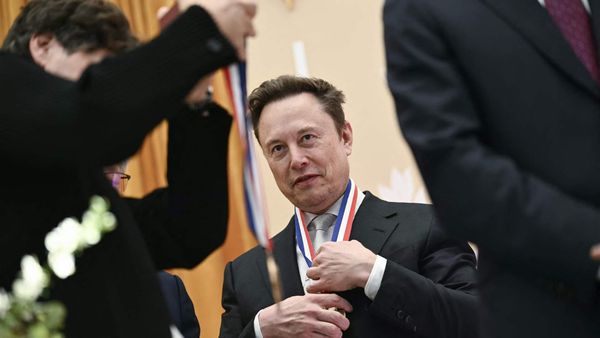
Trump's August disclosure was published on 8 October, the day he presented Musk with the National Medal of Science at the White House for work on space exploration, communications and intelligent systems.
SpaceX's prospectus warns investors that Musk's public statements and actions could affect the company's relations with customers and regulators, and that the company depends heavily on him. SpaceX's space segment, which includes launch and NASA crew services, generated $4 billion of revenue in 2025.
Elizabeth Warren, the Democratic senator from Massachusetts, told CNN, "That's corruption, plain and simple," and called on Congress to ban stock ownership and trading by its members and the president. No congressional committee has announced an inquiry into the purchase, and Republicans control both chambers.