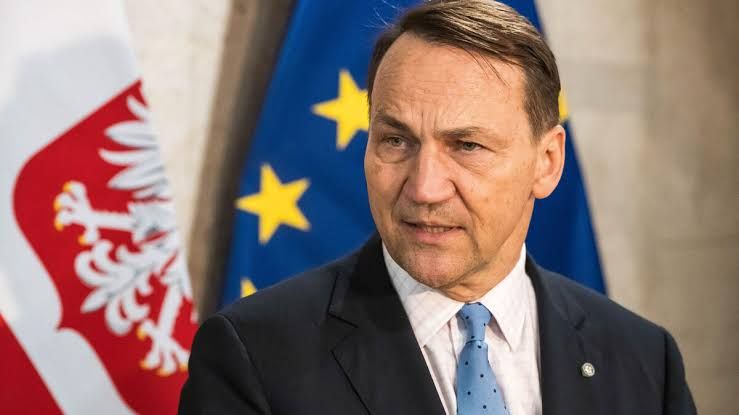
Radosław Sikorski, Poland's deputy prime minister and foreign minister, told Al Jazeera in an interview broadcast on 18 October 2026 that the United States stopped financing Ukraine's defence in January 2025 and that European governments have carried the cost since. The English version of his remarks quoted most widely reads: "The US no longer finances this war since January of last year. In other words, for more than a year and a half. The US has not contributed a single cent to the defense of Ukraine. We are doing it. Europe." A second published translation has him saying the US had not allocated a single cent for Ukraine's defence and "the maintenance of the Ukrainian state", and reports that he acknowledged several small US support packages in the same conversation.
Congress has made no significant new money available for the Ukraine response since April 2024, according to the Special Inspector General for Operation Atlantic Resolve. Sikorski's date matches the last US military package recorded by the Kiel Institute, announced in January 2025 before Joe Biden left office. Since then European governments have become Ukraine's main financial backers while US stockpiles and US manufacturers remain the main source of the Patriot interceptors Ukraine needs most. Money Europe spends on those interceptors through NATO's PURL mechanism passes through the US Treasury and the Pentagon, and the Trump administration threatened in October to cut that channel off.
The collapse in new US assistance
US aid to Ukraine in 2025 was 99 per cent below its 2022 to 2024 annual average and included no new financial or humanitarian allocations, according to the Kiel Institute's Ukraine Support Tracker. Between 2022 and 2024 the United States provided on average €17.3 billion a year in military aid and €13.3 billion in financial and humanitarian support.
Presidential drawdown authority, the power to send weapons from existing US stocks, carried most of the earlier aid. Congress raised the annual cap to $11 billion for fiscal 2022, $14.5 billion for 2023 and $7.8 billion for 2024, and the cap fell back to $100 million for fiscal 2025 and 2026. Biden announced 74 drawdown packages between August 2021 and January 2025. The $4.96 billion of drawdown authority still available on 31 March 2026, according to the Special Inspector General, is permission to transfer existing stock rather than money spent.
The Trump administration kept delivering some aid committed under Biden and paused deliveries twice in 2025 before resuming them, according to the Congressional Research Service, which also records new security assistance announced at levels below those of 2022 to 2024.
Congress authorised $400 million a year for the Ukraine Security Assistance Initiative in fiscal 2026 and 2027 in the defence authorisation act passed in December 2025. The appropriations act enacted in January 2026 added $400 million for "European capacity building" without naming the initiative. Mitch McConnell, who chairs the Senate subcommittee on defence spending, wrote in an April opinion column that the money was "collecting dust at the Pentagon." Defence Secretary Pete Hegseth told a House committee on 29 April that it had been released the previous day, and Jules Hurst, the acting Pentagon comptroller, told the same committee it had not been assigned to any contract.
Senator Jeanne Shaheen said at a hearing on 30 April that her committee had received only a notification that the money would go to Ukraine, with no list of equipment or delivery dates. She asked why the Pentagon planned to route it through PURL, the mechanism built for European purchases, when Congress intended it for Ukraine directly. A Pentagon letter sent to lawmakers in May said the $400 million would be obligated by 30 September 2026 and fully delivered only in fiscal 2029, the year Donald Trump leaves office. The Pentagon had still not put the money on contract by late July, according to a person familiar with the letter.
The Defense Security Cooperation Agency approved possible arms sales to Ukraine worth more than $3 billion between May 2025 and May 2026, partly funded through US Foreign Military Financing. Those approvals set ceilings for sales Ukraine may make, and CRS records about $2.2 billion of Foreign Military Financing disbursed for Ukraine across the whole period from February 2022 to March 2026.
Europe takes on the bill
European donors provided about €29 billion in military aid to Ukraine in 2025. European military aid rose 67 per cent against the 2022 to 2024 average and European financial and humanitarian aid rose 59 per cent, according to Kiel. Germany was the largest single military donor in 2025 and the German government plans to raise its military aid to €11.5 billion in 2026. Between January 2022 and February 2026 European countries allocated more than €200 billion in military, financial and humanitarian aid against about €115 billion from the United States.
The EU's €90 billion Ukraine Support Loan covers Ukraine's budget and defence needs in 2026 and 2027. European institutions allocated nearly €11 billion through it in May and June 2026, of which €4.3 billion was military aid and €6.7 billion financial and humanitarian aid. The EU plans €16.7 billion in budget support for 2026. Financial and humanitarian aid from all donors in the first half of 2026 still ran 41 per cent below the 2025 monthly average.
Canada has put $834 million into PURL, and Australia and New Zealand also contribute. Ukraine's ambassador to NATO, Alona Hetmanchuk, said in February 2026 that 25 countries took part in the mechanism: 23 NATO members plus Australia and New Zealand.
How European money buys US weapons
PURL, the Prioritized Ukraine Requirements List, began on 14 July 2025 when Trump and NATO Secretary General Mark Rutte announced that allies would pay for US-made weapons for Ukraine. Ukraine draws up a priority list of needs and agrees it with the United States and NATO, and the three sides assemble packages worth about $500 million each paid for by NATO members other than the United States.
PURL contributions are paid to the US Treasury. By March 2026 allies and partners had committed more than $4.8 billion and transferred about $4.2 billion, according to CRS. Kiel found that existing US military stocks supplied more than 90 per cent of PURL military aid in the first half of 2026, and the Treasury transfers reimburse the Pentagon for replacing that stock, according to Defence Ukraine's reference guide to the mechanism.
Matthew Whitaker, the US ambassador to NATO, put pledges at more than $4.5 billion in February 2026. Ihor Zhovkva of Ukraine's presidential office put commitments at nearly $5.5 billion in May. Ukraine's defence ministry said in July that PURL had raised nearly $7 billion across more than 10 packages and listed Norway ($1.36 billion), the Netherlands ($1.163 billion), Germany ($900 million), Canada ($834 million) and Sweden ($546 million) as the largest contributors.
Two US officials said in March 2026 that the Pentagon had told Congress it intended to use about $750 million of PURL contributions to replenish US stocks, and one said it was unclear whether the contributing governments knew how their money was being used. The Pentagon was also weighing whether to send air defence interceptors bought for Ukraine to the Middle East, the officials said. Trump told reporters on 27 March: "We do this all the time." Rutte said PURL weapons would reach Ukraine regardless of the war in the Middle East.
A Pentagon official said in April 2026 that the United States would keep helping through PURL but that the support "must not rely on significant U.S. contributions."
Who receives the money
Lockheed Martin builds the PAC-3 MSE, the Patriot interceptor designed to stop Russian Iskander-M and Kinzhal missiles. The US Army awarded Lockheed a $4.76 billion PAC-3 MSE contract on 9 April 2026, with about $4.5 billion of it drawn from foreign military sales funds whose source countries the Pentagon did not name. RTX makes the older GEM-T Patriot interceptor and booked more than $5 billion in GEM-T orders from unnamed customers in the second quarter of 2026.
Lockheed raised its 2026 revenue forecast to between $79.75 billion and $81.75 billion on 23 July and reported a backlog of $230.4 billion. Revenue in its missiles and fire control division rose nearly 20 per cent to $4.1 billion on higher PAC-3 and Precision Strike Missile production. RTX raised its 2026 sales forecast to between $95 billion and $96 billion. Sales at its Raytheon unit rose 18 per cent to $8.27 billion on Patriot, Standard and AMRAAM demand, and about half of Raytheon's $10 billion in first-half bookings came from international customers, $7 billion of it from Europe. Both companies tied the higher forecasts to restocking after the Russia-Ukraine war and the US war on Iran, which began on 28 February 2026.
European donors bought at least €3 billion in military aid from US defence companies between January and June 2026, about 30 per cent of the military aid Europe supplied through industry purchases, according to Kiel. Sikorski said at the Munich Security Conference in February 2026 that Europe was spending real money "whereas the U.S. is actually making money on this war." PURL payments reimburse the US government for stock it has already bought, and the contracts that replace that stock become revenue for manufacturers such as Lockheed and RTX.
Trump's numbers
Trump has repeatedly said the Biden administration gave Ukraine $350 billion. The Special Inspector General puts the total Congress made available for the Ukraine response at $195 billion as of 31 March 2026. CRS breaks out the largest parts of that sum: $67.8 billion in defence articles and services committed to Ukraine, $45.8 billion to replenish US stocks sent to Ukraine and $50.8 billion for US military activity, mainly US European Command and the European Deterrence Initiative. The Council on Foreign Relations, citing Kiel, puts US aid that directly supported Ukraine at about $127 billion.
Trump told reporters on 5 January 2026 that the United States would recover all of its spending on Ukraine or more through the minerals agreement and that allies now pay for US weapons: "Whenever we send anything, they pay." The US-Ukraine Reconstruction Investment Fund created under that agreement made its first investment, in drone radio control systems, in March 2026.
Trump wrote on 3 September 2026 that he would ask European governments to repay the United States for military aid and munitions sent to Ukraine under Biden, without naming an amount, a country or a legal mechanism. The same post said the United States was keeping newly produced munitions for itself and would resume sales to allies later. US assistance to Ukraine came mostly as non-repayable grants that Congress appropriated for Ukraine, according to the European Parliament's research service, so any repayment by European governments would need an agreement that does not exist in the public record.
Congress and the White House
The Senate passed the fiscal 2026 defence authorisation by 77 votes to 20 with the $400 million for Ukraine included. The act also bars the Pentagon from reclassifying weapons already contracted for Ukraine as US stock and requires it to notify Congress immediately if intelligence sharing with Ukraine is suspended.
The House passed H.R. 2913, the Ukraine Support Act introduced by Representative Gregory Meeks on 14 April 2025, by 226 votes to 195 on 4 June 2026 after a discharge petition forced it to the floor over the objections of the Republican leadership. As passed by the House it provides $1.3 billion in military aid, up to $8 billion in loans, money to replenish US stocks and new sanctions on Russia. Senate leaders placed it on the Senate calendar on 20 July 2026 and had scheduled no floor vote by 22 July.
What the United States still controls
Around 95 per cent of the Patriot interceptors reaching Ukraine arrive through PURL, according to Ukraine's defence ministry. Rutte said in February 2026 that 90 per cent of the missiles Ukraine uses for air defence had come through the mechanism.
Trump turned down Volodymyr Zelenskyy's request for hundreds of additional Patriot interceptors at an Oval Office meeting in late July 2026, citing US stocks needed to protect US forces and allies in the Middle East, according to people familiar with the meeting. Trump had said on 8 July 2026 that he was considering letting Ukraine coproduce Patriot missiles and later backed away from the idea.
Ukraine produced more than half of its own weapon systems by January 2026, Patriot interceptors excluded, and its officials estimated domestic defence production capacity at $55 billion for the year, according to CRS.
US officials told Ukraine and European governments on 10 and 11 October 2026 that the Trump administration would suspend PURL and stop sharing intelligence unless Ukraine halted strikes on Russian energy infrastructure, according to European officials; the White House declined to comment. Trump announced an "ENERGY CEASEFIRE" on 11 October, Zelenskyy's office said it knew of no such agreement and Russian forces struck Kharkiv's power plant after the announcement. Sikorski said in the Al Jazeera interview that Ukraine has sources of intelligence other than the United States.