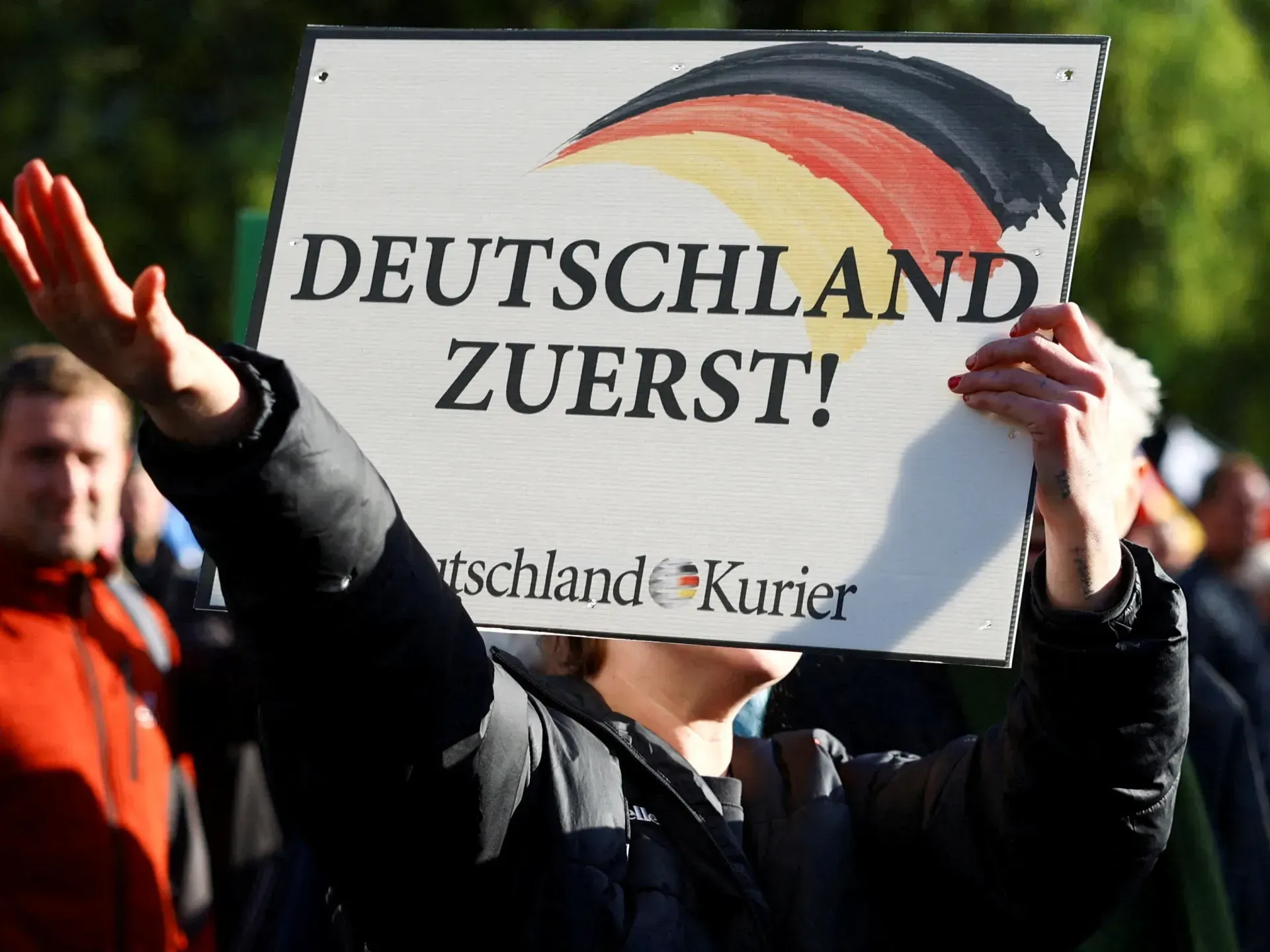
The Alternative for Germany won 44.4 per cent of the vote in Saxony-Anhalt on 6 September 2026 on the ZDF projection issued at 23:22 on election night, taking 39 of the 83 seats in the Magdeburg Landtag and falling three short of the 42 needed to govern alone.
Counted returns put the share lower. Tabulated results give 44.1 per cent, or 568,497 votes, with 99.1 per cent of districts reporting at 00:55 on 7 September, and NPR reported 43.8 per cent as a preliminary final figure. Turnout was reported between 76 and 77.8 per cent, against 60.3 per cent in 2021.
Saxony-Anhalt's Office for the Protection of the Constitution has classified the state AfD as a confirmed right-wing extremist organisation since 2023. Its 2025 report, presented on 2 June 2026, states that office holders and mandate holders in the branch maintain connections into the entire right-wing extremist spectrum.
Ten days before polling, prosecutors at the Staatsanwaltschaft Halle searched premises in five federal states in an investigation into the continued running of the Artgemeinschaft, a Nazi-worship association banned by the federal interior ministry in September 2023. Two of the 15 suspects were AfD candidates for the Landtag election: Sebastian Koch at list position 8 and Simon Lansmann at position 19. On 39 seats both entered the parliament. No charges have been filed.
The NSDAP polled 43.8 per cent in Magdeburg
Two Reichstag electoral districts covered the territory of the present state in the Weimar Republic. Magdeburg, district 10, took in the Prussian administrative region of Magdeburg and the Free State of Anhalt. Merseburg, district 11, took in Halle, Weissenfels, Zeitz, Naumburg, Merseburg, Wittenberg and Eisleben.
NSDAP results in those two districts were 19.5 and 20.5 per cent in September 1930, 43.8 and 42.6 per cent in July 1932, 39.0 and 34.5 per cent in November 1932 and 47.3 and 46.4 per cent in March 1933. National figures for the same four elections were 18.3, 37.3, 33.1 and 43.9 per cent.
The AfD's 44.1 per cent is higher than the NSDAP recorded in either district at the last Reichstag election held without state terror against opposition candidates, in July 1932, and lower than the NSDAP took in March 1933, an election held after the Reichstag fire decree with Communist candidates in custody. Neither Magdeburg nor Merseburg was among the eight districts where the NSDAP won an absolute majority in March 1933, and neither was among the NSDAP's strongest in July 1932, when Magdeburg ranked tenth of 35 districts and Merseburg sixteenth.
Ulrich Herbert, professor of modern history at the University of Freiburg, told the Süddeutsche Zeitung on 17 January 2024 that the line of descent runs through the concept of citizenship. He said of the völkisch idea that only a member of the people can be a citizen: "Das war im völkischen Denken um 1900 so, um 1933, und das finden wir auch bei der AfD." Herbert also set out the differences in the same interview: the NSDAP polled 2.6 per cent in 1928 in conditions of economic collapse, while the AfD draws middle-class support inside a functioning and prosperous democracy.
Charlotte Knobloch, 93, head of the Jewish community of Munich and Upper Bavaria and a former president of the Central Council of Jews in Germany, told Stern in an interview published on 19 August 2026: "Ich sehe in vielen Bereichen keinen Unterschied mehr zur NSDAP, bevor diese an die Macht gekommen ist." She said: "Auch die NSDAP hat einmal klein angefangen und ausprobiert, was alles möglich ist. Exakt das passiert bei der AfD." The taz published a rebuttal under the headline "Die AfD ist nicht die NSDAP".
The CDU lost half its vote
The Christian Democratic Union fell to about 17 per cent from 37.1 per cent in 2021, losing roughly 20 points and half its support in a state it had governed for 24 years. The Social Democrats took 9.3 per cent, the Greens 8.9 per cent and the Left 8.5 per cent. The Sahra Wagenknecht Alliance cleared the threshold with 5.3 per cent and entered the Landtag for the first time. The Free Democrats took 2.6 per cent and lost every seat.
Seat allocation gave the AfD 39, the CDU 15, the SPD, Greens and Left eight each and the Wagenknecht Alliance five. The absolute majority is 42. The four parties that have refused to govern with the AfD hold 39 between them. No combination that excludes the AfD reaches 42 without the Wagenknecht Alliance, and no combination that includes the AfD reaches it without a partner that has ruled one out.
Saxony-Anhalt elects its Landtag with 41 constituency seats and 42 list seats, expanding by levelling seats where overhang occurs. Tabulated returns give the AfD 38 of the 41 constituencies, against one in 2021, a sweep produced by first-past-the-post arithmetic against a fragmented opposition.
Ulrich Siegmund had said before the vote that he would not take the office of minister-president on anything under 45 per cent, and that he would not govern in coalition. Alice Weidel, the AfD federal co-chair, said the result was a mandate to govern. Sven Schulze, the CDU minister-president who took office in January 2026 after Reiner Haseloff stood down following 14 years in the post, said some called it a dark day for Saxony-Anhalt and that he called it democracy.
No party, election observer or state body has alleged irregularities in the conduct of the vote, and no legal challenge to the result had been filed by 7 September.
Ulrich Siegmund
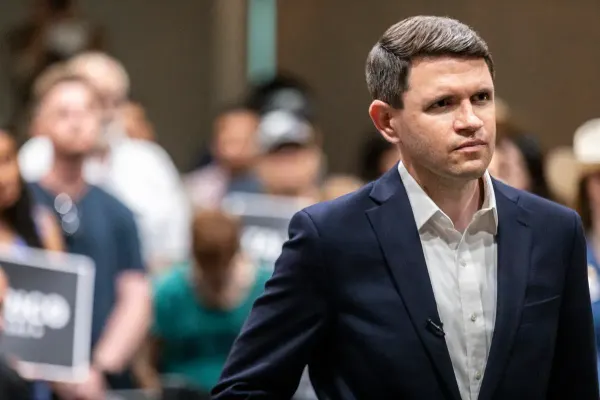
Ulrich Siegmund, 35, joined the AfD in 2014, entered the Landtag in April 2016 and became co-leader of its parliamentary group in 2022. He trained as a wholesale and foreign trade clerk, ran a business selling room fragrances and later took a distance degree in business psychology. He was confirmed as lead candidate with 98.3 per cent at a party conference.
Siegmund built his campaign on TikTok, arrived at his polling station on a Simson moped in party colours and traded on nostalgia for the German Democratic Republic. Der Spiegel put him on its cover in August 2026 under the line "the most dangerous man in Germany". He signed copies of the issue and used them as campaign material.
Siegmund attended the meeting of 25 November 2023 at the Landhaus Adlon on the Lehnitzsee near Potsdam, where about 22 people heard the Austrian Identitarian activist Martin Sellner present a plan for what he called remigration, directed at asylum seekers, at foreigners holding residence rights and at German citizens deemed unassimilated. Correctiv published the investigation on 10 January 2024 and reported that Siegmund told the meeting the streetscape had to change within the shortest possible time and that foreign-run restaurants should be squeezed. More than 900,000 people demonstrated across Germany on the weekend of 20 and 21 January 2024, and by June 2024 the cumulative total across more than 1,200 rallies exceeded three million. The Saxony-Anhalt Landtag removed Siegmund as chair of its social affairs committee in February 2024.
Roland Hartwig, then personal adviser to Alice Weidel, also attended the Potsdam meeting and ceased working for her around 15 January 2024. The Kammergericht Berlin ruled on 8 May 2026, in case 10 U 1/26, that the meeting may lawfully be described as a deportation conference, overturning an injunction of 25 November 2025 that had called the description baseless. The court held that the terms expulsion and remigration both carry at their core the element of forced rather than voluntary departure. Separate rulings have gone the other way on narrower questions: the Landgericht Hamburg granted Ulrich Vosgerau a partial injunction against Correctiv in February 2024, and in July 2024 enjoined a claim by tagesschau.de that the deportation of German citizens was discussed at the meeting.
Magdeburg Regional Court issued an enforceable order against Siegmund and his co-leader Oliver Kirchner in January 2024, threatening a fine of up to 250,000 euros or six months' detention if they again barred accredited journalists from party events. The order followed their attempt to exclude ARD reporters from an AfD gathering.
Who works for him
Four employees of the AfD parliamentary group in Saxony-Anhalt are former members of the Heimattreue Deutsche Jugend, a youth organisation banned by the federal interior ministry in 2009. Laurens Nothdurft, the group's legal officer, a member of the party arbitration court and mayor of Rosslau since 2024, was the Heimattreue Deutsche Jugend's second federal leader from 1999 and its organisational head in 2002, and published a call in 2003 for members to occupy decisive positions in institutions. Through his lawyer he said he distances himself from National Socialist ideas and has nothing to apologise for. Patrick Harr, the group's managing director and spokesman for both group and party, is listed in a 2002 publication of the organisation as head of its procurement department and accompanied Siegmund to Potsdam. Eric Kaden, an adviser on education, culture and science, wrote a 2009 biography of the SS officer Kurt Eggers that was indexed as glorification of National Socialism. No convictions are alleged against any of them.
Torsten Görke, an activist of the Identitarian Movement, runs Siegmund's campaign merchandise and online shop and produces campaign media through a collective staffed by right-wing extremist activists, Correctiv reported on 17 August 2026. The AfD maintains an incompatibility list intended to bar members of named organisations, including the Identitarian Movement.
Sebastian Koch, list position 8, appears in photographs taken at a 2009 solstice celebration of the National Democratic Party and later organised youth events after the dissolution of the AfD's Junge Alternative. Simon Lansmann, position 19, owns the farm at Ipse near Gardelegen where a solstice gathering was held on 20 June 2026 that prosecutors are investigating as a continuation of the banned Artgemeinschaft. Correctiv reported that former members of the association were present and that Hitler Youth songs were sung, and that attendees included a figure connected to Ralf Wohlleben, who supplied the weapon used by the National Socialist Underground. Lansmann's lawyer denied any illegality and said a Hitler Youth song may have been sung without being programmed. Siegmund said of the reporting: "Die Berichterstattung ist bekannt, aber ich werde sie nicht kommentieren."
Searches on 27 August 2026 covered Brandenburg, Berlin, Lower Saxony, North Rhine-Westphalia and Saxony-Anhalt, targeting 16 people. Documents, laptops, phones and storage media were seized, and a further investigation for firearms offences was opened after weapons were found. Two suspects cooperated and the rest declined to make statements. Prosecutors had not decided whether to charge.
The Bundesverwaltungsgericht upheld the Artgemeinschaft ban on 29 April 2026 in case 6 A 18.23, holding that the association taught a doctrine incompatible with human dignity under the Basic Law. Findings recorded in the judgment include membership restricted by racial category, adoption of Nazi racial ideology and symbolism, indoctrination of children and the seizure of Nazi-era material and swastika objects from members. The association had about 150 members.
Hans-Thomas Tillschneider, third on the AfD list and deputy state chair, wrote the state election programme. Josef Schuster named him on 6 September 2026 as the likely candidate for the education ministry.
What the courts found
The Saxony-Anhalt Office for the Protection of the Constitution recorded the state AfD as a suspected case in January 2021 and upgraded it to a confirmed right-wing extremist organisation in 2023. The designation permits the use of intelligence methods against the branch. It does not remove the party from the ballot, strip mandates or end state party funding. The branch's challenge has been stayed pending the parallel federal case.
Cologne Administrative Court ruled on 26 February 2026, in case 13 L 1109/25, that the federal Office for the Protection of the Constitution may not for now describe the national AfD as a confirmed extremist organisation, and may not publish such a designation, until the main proceedings conclude. The court said there was strong suspicion that the party pursues aims against the constitutional order, and found the 2025 federal programme contained discriminatory demands aimed at Muslims, but held that these did not yet establish an extremist character governing the party as a whole. The party reverts to the status of suspected case. Both sides may appeal to the higher administrative court in Münster.
Thomas Haldenwang, then president of the federal office, announced on 12 March 2020 that the AfD faction known as Der Flügel had been classified as a proven extremist endeavour, and named Björn Höcke and Andreas Kalbitz as its leading figures. Haldenwang quoted Höcke's call for a large-scale remigration project in which, in Höcke's words, human hardships and unpleasant scenes cannot always be avoided. Der Flügel announced its dissolution on 24 March 2020, effective 30 April.
The Oberverwaltungsgericht Nordrhein-Westfalen dismissed the AfD's appeal against that classification on 13 May 2024 in case 5 A 1216/22. The court could not establish that Der Flügel still existed as a grouping, and recorded that its former members now pursue their aims directly within the party as a whole. The court also found that the faction's political concept was directed at the exclusion, denigration and extensive deprivation of rights of foreigners, migrants and in particular Muslims.
Halle Regional Court convicted Björn Höcke on 14 May 2024, in case 5 KLs 6/23, of using "Alles für Deutschland", a slogan of the Nazi SA, at an election rally in Merseburg in Saxony-Anhalt on 29 May 2021, and fined him 13,000 euros. The same court convicted him again on 1 July 2024, in case 5 KLs 8/24, after he said "Alles für" at a gathering in Gera on 12 December 2023 and used arm gestures to prompt an audience of about 350 to complete the phrase, and fined him 16,900 euros. The Bundesgerichtshof rejected both appeals by decision of 20 August 2025 in cases 3 StR 484/24 and 3 StR 519/24, published on 11 September 2025, holding that the ban on public use of National Socialist symbols is a permissible restriction on freedom of expression and that Höcke's parliamentary status gave no protection because the words were spoken at campaign and party events. Section 86a of the criminal code carries up to three years' imprisonment; prosecutors had asked for an eight-month custodial sentence and a two-year ban from holding office.
Verwaltungsgericht Meiningen held on 26 September 2019, in case 2 E 1194/19 Me, that demonstrators may lawfully call Höcke a fascist, striking down a ban imposed by the city of Eisenach. The court found the value judgment was not baseless but rested on a verifiable factual basis, citing among other things Höcke's own writing on population replacement.
The Junge Alternative, the AfD's youth organisation, was classified as confirmed right-wing extremist in April 2023 and dissolved on 31 March 2025. Its replacement, Generation Deutschland, was founded on 29 November 2025 in Giessen under Jean-Pascal Hohm and is a legally dependent sub-organisation of the party rather than an independent association. The federal interior ministry stated on 3 February 2026 that it had found no moderation compared with the predecessor, that the great majority of the new body's personnel were already members or functionaries of the old one, and that its representatives had said they would maintain previous positions. Generation Deutschland carries no formal extremism classification.
Article 21 of the Basic Law reserves to the Federal Constitutional Court the power to ban a party that seeks to undermine the free democratic basic order. A cross-party motion to prepare ban proceedings was tabled in the Bundestag in 2025 and has not been carried to a vote in Karlsruhe. The Cologne ruling of February 2026 raised the evidentiary bar that any such application would have to clear.
229 attacks in one year
Stephan Balliet, then 27, attempted to force the door of the synagogue in Halle on 9 October 2019, Yom Kippur, with 51 people inside. Unable to enter, he shot Jana Lange, 40, in the street and killed Kevin Schwarze, 20, at a nearby kebab shop, using partly 3D-printed firearms and homemade explosives, and livestreamed about 35 minutes of the attack. The Oberlandesgericht Naumburg sentenced him to life imprisonment on 21 December 2020 with a finding permitting preventive detention. He took two prison officers hostage at the prison in Burg in December 2022 and was sentenced to a further seven years by the Landgericht Stendal on 27 February 2024; one of the officers developed post-traumatic stress disorder and could no longer work.
Mobile Opferberatung, the state's counselling service for victims of the far right, recorded 229 right-wing, racist, antisemitic and queerphobic violent attacks in Saxony-Anhalt in 2025, affecting 307 people including 68 children and adolescents. The service put the rate at 6.7 attacks per 100,000 residents, which it said was about three times the western German regional average. Assaults accounted for 135 cases, threats and coercion for 82 and arson for seven. Attacks on political opponents rose 27 per cent to 61. Halle recorded 67 attacks and Magdeburg 62.
Politically motivated crime in Saxony-Anhalt reached 4,144 offences in 2025, the highest since records began in 2001, of which 3,007 were classified as right-wing. Antisemitic offences rose 36.2 per cent to 158. Violent offences fell 13.9 per cent to 130, of which 90 were right-wing. Tamara Zieschang, the CDU interior minister, said: "Die besorgniserregende Rekordzahl politisch motivierter Straftaten in Sachsen-Anhalt ist ein ernstzunehmendes Warnsignal."
The state Verfassungsschutz report presented on 2 June 2026 put the right-wing extremist potential in Saxony-Anhalt at 5,100 people, up from 4,000 a year earlier, out of a total extremist potential of 7,310. Membership of the AfD state association grew to 3,500 from 2,580. The report names the groups Jung & Stark, Deutsche Jugend Voran, Deutsche Jugend Zuerst and Harz Verteidigen, the last led by Alexander Deptolla.
Six people died and about 300 were injured when a car was driven into the Magdeburg Christmas market at about 19:04 on 20 December 2024. The dead included a nine-year-old boy, André Gleissner. The driver, Taleb al-Abdulmohsen, a Saudi psychiatrist working at a correctional facility in Bernburg, was sentenced to life imprisonment by the Landgericht Magdeburg on 26 June 2026 with a finding of particular gravity of guilt. He had campaigned against Islam, expressed sympathy for the AfD and shared material from Alice Weidel's account; the court found he had no serious ideological goals and acted from personal motives.
Magdeburg police recorded nine incidents against migrants in the fortnight after the attack, five of them assaults. A Syrian family found a swastika painted on their door. Brahim B., a 31-year-old disc jockey, was attacked by six people with a telescopic baton at the Neustadt tram stop on 1 January 2025 and suffered head and knee injuries. About 1,000 people joined a far-right demonstration in the central square on 21 December 2024 carrying remigration banners. The AfD held a rally in the city on 23 December 2024 with 3,500 participants by police estimate, addressed by Weidel and by the party's general secretary Jan Wenzel Schmidt, with repeated chants of "Abschieben"; a counter-demonstration and human chain at the Alter Markt drew about 4,000.
Saaeid Saaeid, spokesman for the refugee council of Saxony-Anhalt, told ZDF on 27 August 2026: "Die Stimmung hat sich massiv geändert."
Alexander Dobrindt banned the Reichsbürger organisation Königreich Deutschland on 13 May 2025 and four men were arrested, among them its founder Peter Fitzek. Raids covered seven states including Saxony-Anhalt. The group had about 6,000 members.
What happened to the reporters
The journalists' union dju within ver.di documented more than 30 incidents of intimidation, obstruction and violence against media workers during the Saxony-Anhalt campaign between early May and 3 September 2026, affecting at least 47 journalists, television teams and political influencers. The union recorded 25 of the incidents in the final three weeks before the vote and five as physical attacks. A convicted far-right streamer pushed a Spiegel TV reporter aside amid hostile chanting in Merseburg. Security staff at an AfD event in Lützen grabbed the arm of the POLITICO correspondent Anne McElvoy, forced her against a kerb and shoved her away. Outlets affected included RTS, SRF, CBC News, ProSieben, rbb, WDR, MDR, Spiegel TV, POLITICO and Bild.
Lucas Munzke, deputy regional sector head of ver.di for Saxony, Saxony-Anhalt and Thuringia, said the AfD is a media-hostile party that obstructs independent reporting at its events, demonstrations and campaigns.
Arno Bausemer, 43, an AfD member of the European Parliament and a Stendal city councillor, is under investigation by the Saxony-Anhalt state criminal police over an incident on the evening of 14 August 2026 in which he is alleged to have pursued two teenagers who had damaged an AfD poster and struck one of them, aged 14, with a baseball bat. The boy suffered a mild concussion, bruising and injuries to lip and gums. Prosecution would require a waiver of parliamentary immunity. Bausemer wrote on Facebook that he detained the youth and denied a physical confrontation. No charge has been brought.
Think German
Immigration and what the AfD calls remigration occupied the largest chapter of the state programme, which demanded an end to what it described as culturally alien mass migration and proposed a dedicated deportation task force. Party figures campaigned on remigration in the millions, a scope that reaches beyond foreign nationals to naturalised citizens and German-born descendants of migrants.
Siegmund promised to pull Saxony-Anhalt out of the public broadcaster MDR, to ban rainbow flags in schools, to stop wind farm construction and to replace the state's "Think Modern" slogan with "Think German". The programme also proposed armed security staff in schools, separate classes for refugee children, an end to compulsory school attendance and a history curriculum reoriented towards the German Empire.
The MDR treaty binds Saxony, Saxony-Anhalt and Thuringia, and can be terminated with effect from 31 December 2028 by a state giving notice before the end of 2026. A constitutional amendment passed in Saxony-Anhalt in spring 2026 requires Landtag approval for any such termination. Hubertus Gersdorf, professor of media law at the University of Leipzig, said existing treaties continue until replacement public broadcasting is established, and that a starved budget or a pay model would breach the constitutional requirement to provide full public service broadcasting. The Federal Constitutional Court fixed the licence fee at 18.36 euros a month in its decision of 20 July 2021, after Saxony-Anhalt blocked the increase the other states had agreed, and no single state can terminate that ruling.
Members of the Saxony-Anhalt constitutional court are elected by the Landtag, seven of them for seven-year terms, on a two-thirds majority of those present and at least an absolute majority of all members. A bloc of 39 of 83 seats is enough to deny any candidate the two-thirds threshold.
Foreign nationals made up about nine per cent of the population of Saxony-Anhalt at the end of 2025, one of the lower shares among German states, though the refugee council puts the current figure at 11 per cent. Economic output per head runs at roughly three quarters of the national average, unemployment sits above it and median full-time earnings fall below it. About 800,000 of the state's 2.1 million residents hold jobs subject to social insurance contributions.
Voters told Infratest dimap that they considered the AfD more competent than the CDU on the economy and on education, the two issues they ranked highest. Migration supplied the campaign's language; the ranking of concerns did not put it first.
The refinery at Leuna
The TotalEnergies refinery at Leuna processes up to 12 million tonnes of crude a year, produces a million litres of petrol and diesel an hour, employs between 600 and 700 people directly plus several hundred contractors and supplies about 1,300 filling stations across Saxony-Anhalt, Saxony and Thuringia. It ran on Russian crude delivered through the northern branch of the Druzhba pipeline for about 25 years. A company spokesperson told dpa on 30 December 2022: "Wir haben den Import von russischem Rohöl komplett gestoppt." Crude now arrives by tanker at Gdansk and travels roughly 1,000 kilometres by pipeline, on a delivery cycle of about 25 days. The spokesperson said in the same interview that the logistics system was considerably more complex and time-consuming and the costs considerably higher.
Germany halted Druzhba deliveries from 1 January 2023 as a national measure on top of the EU embargo on seaborne Russian oil that had applied since 5 December 2022. More than a billion tonnes of Russian crude had passed through that line into the former East Germany over the preceding decades.
Russia stopped the transit of Kazakh crude to Germany from 1 May 2026, cutting the last pipeline flow into the PCK refinery at Schwedt in Brandenburg, which supplies roughly 90 per cent of the fuel used in Berlin and Brandenburg. Alexander Novak, the Russian deputy prime minister, cited technical capacities and said: "The Germans have given up on Russian oil, so they are doing fine." Volumes lost were 2.1 million tonnes in 2025 and about three million tonnes planned for 2026. PCK was running at about 80 per cent of capacity by July 2026, the minimum rate the company describes as viable. The federal government put the expansion of the Rostock to Schwedt pipeline, planned to reach nine million tonnes a year with up to 400 million euros of federal money, back under review on 21 July 2026.
Rosneft Deutschland, which holds 54.17 per cent of PCK, has been under the trusteeship of the Federal Network Agency since 16 September 2022. The trusteeship was renewed at six-month intervals until 28 February 2026, when it was made permanent under an amendment to the foreign trade act derived from the EU's 18th sanctions package of July 2025.
The AfD state programme demands an immediate end to what it calls economically harmful sanctions against Russia, Iran and Belarus, cheap energy through coal, nuclear power and gas via Nord Stream, the restoration of Russian language teaching in schools and the revival of school and student exchanges with Russia. A state government has no competence over sanctions or pipelines, both of which are decided at federal and EU level.
The AfD federal programme of February 2025 states that the surviving intact string of Nord Stream 2 should be brought into service as quickly as possible and that the damaged strings of Nord Stream 1 and 2 are to be repaired promptly. On 25 June 2025 the Bundestag rejected a Greens motion to rule out any return to Nord Stream gas by 443 votes to 85 with 55 abstentions. On 20 May 2026 the AfD tabled motion 21/6025 seeking a committee of inquiry into the pipeline attacks, and motion 21/6030, which asks the Bundestag to stop the transfer of the Lubmin gas power plant to a Ukrainian or third recipient and to preserve the plant as pre-heating infrastructure for Nord Stream 2. Both were rejected by the other parties.
The federal government answered an AfD parliamentary question on 7 January 2026, in document 21/3514, stating that the EU's 18th sanctions package of July 2025 imposes a complete transaction ban on the Nord Stream pipelines that prevents any repair or reactivation, that certification of Nord Stream 2 was refused and the pipeline never brought into service, that Germany directly imports no Russian pipeline gas or liquefied natural gas and that Germany indirectly imported record volumes of Russian liquefied gas through France and Belgium in 2024.
Christian Günther, managing director of the Leuna chemical park, told Bloomberg in February 2025 that if peace prevailed the other damage caused by the conflict would have to be repaired as well. Sven Schulze, then the state's economics minister and now its minister-president, said in the same reporting that if peace were achieved and long-term confidence built that Europe was not threatened by Russia, Germany would have to be open to talking about future gas deliveries from Russia. Manuela Grieger, former chair of the InfraLeuna works council, said: "Wir brauchen Frieden."
An INSA poll of 1,000 eligible voters in Mecklenburg-Western Pomerania, conducted between 4 and 11 August 2026 for the Nordkurier, found 51 per cent in favour of resuming Russian gas and oil imports and 35 per cent against. Support ran at 81 per cent among AfD voters and 88 per cent among Wagenknecht Alliance voters, and at 55 per cent among CDU voters. No equivalent survey of Saxony-Anhalt voters has been published.
No documented financial link exists on the public record between any AfD figure and a Russian energy company or a sanctioned energy entity.
The trips to Russia
Hans-Thomas Tillschneider, third on the AfD list and the author of its state programme, has written columns for the Moscow newspaper Vedomosti since early 2023 and says he receives no payment for them. He told the taz in May 2024 that history teaches that Germany fared well when it maintained good relations with Russia, and he has said that every affirmation of German-Russian friendship is an act of sovereignty. He founded the association Wastok to promote relations with Russia and used it to organise a trip of about 18 AfD members, five of them state parliamentarians, to Kaliningrad between 16 and 21 June 2024, where they demonstrated on Victory Square with combined German and Russian flags and gave statements to Russian broadcasters. Frank-Otto Lizureck, list position 23 in the 2026 election, was among them. Tillschneider, Lizureck and Florian Schröder, list position 16, attended a celebration of Vladimir Putin's birthday at the Russian embassy in Berlin in 2025.
Tillschneider also joined a Russian-organised trip towards the occupied Donbas in September 2022 with Daniel Wald of the Saxony-Anhalt Landtag and Christian Blex of North Rhine-Westphalia. He said at the time that in the face of distorted and one-sided reporting the group wanted to form its own picture of the situation. Correctiv reported that the AfD federal leadership blocked the onward leg. The Saxony-Anhalt Landtag passed a resolution calling the trip an act of non-solidarity towards Ukraine. No criminal proceedings followed.
Steffen Kotré, the AfD parliamentary group's energy spokesman in the Bundestag, travelled to Sochi in November 2025 for a conference organised by the Russian Academy of Sciences, with the MEP Hans Neuhoff and the Saxon state chairman Jörg Urban. Kotré called there for Germany to return to nuclear power, coal and Russian oil and gas, and gave interviews to the Russian state outlets RBK, Zvezda and Ruptly in defiance of conditions Weidel had set before the trip.
Four of 80 AfD members of the Bundestag voted in favour of supplying heavy weapons to Ukraine in 2022. The party has since campaigned for an end to arms deliveries and for the lifting of sanctions, and its 2025 federal programme carried demands to leave the euro and to dissolve the European Union in its present form.
Petr Bystron, an AfD member of the European Parliament, has had his immunity lifted three times by the Parliament: on 1 April 2025 over a photomontage prosecutors read as a Hitler salute, on 6 May 2025 over at least six counts of passive corruption, money laundering and fraud and at least five of tax evasion connected to the Prague-registered website Voice of Europe, and in February 2026 over an allegation that he billed a private cleaner to the Bundestag employee allowance. The Bundestag lifted his immunity on 16 May 2024 and searches followed the same day at his parliamentary office in Berlin, at addresses in Bavaria and at an apartment on Mallorca, involving 11 prosecutors and about 70 state criminal police officers. Investigators are at the Generalstaatsanwaltschaft München. Reported sums range from 20,000 to more than 34,000 euros and none has been tested in court. Bystron denies all the allegations, said the removal of his immunity was a targeted political manoeuvre rather than a lawful procedure, and said the proceedings would be dismissed once the election was over. No charge has been filed in any of the three matters and no trial has begun.
The Czech government sanctioned Viktor Medvedchuk, Artem Marchevskyi and Voice of Europe on 27 March 2024 over a network alleged to have paid politicians in at least five EU member states. Petr Fiala, the Czech prime minister, said the operation was also focused on the European Parliament and pointed to long-term efforts by the Russian Federation to interfere in democratic processes in Europe. The Council of the European Union listed all three on 27 May 2024 under Decision 2024/1508. Two and a half years after the Czech announcement, no one has been charged over Voice of Europe payments in any jurisdiction.
Jian Guo, parliamentary assistant to the AfD MEP Maximilian Krah since 2019, was convicted at the Oberlandesgericht Dresden on 30 September 2025 of intelligence agent activity for a foreign secret service and sentenced to four years and nine months. The court found he had worked for Chinese intelligence since 2007, identified Chinese dissidents in Germany, gathered information about the AfD including material on Weidel and on the co-chair Tino Chrupalla, and collected details of flights, cargo and passengers at Leipzig/Halle Airport, in particular military transports. A co-defendant, a Chinese national working in logistics at the same airport, received one year and nine months suspended. The presiding judge, Hans Schlüter-Staats, said there was no question that Guo was an employee of a Chinese intelligence agency.
The Generalstaatsanwaltschaft Dresden opened an investigation into Krah himself on 9 May 2025 on suspicion of bribery and money laundering over payments allegedly received from China, with a separate preliminary investigation reported over alleged Russian payments. The Bundestag lifted his immunity on 11 September 2025 and searches followed at his Bundestag office, his home and business premises in Dresden and his former European Parliament offices in Brussels. Krah said the accusations were absurd and politically motivated, that he had acted as Guo's lawyer and billed accordingly and that he had committed no criminal offence. No charges have been brought. In an interview with La Repubblica in May 2024 Krah said he would never say that anyone who wore an SS uniform was automatically a criminal; the Identity and Democracy group in the European Parliament expelled the AfD delegation on 23 May 2024, citing both those remarks and the Chinese espionage allegations.
Verwaltungsgericht Berlin ruled on 7 May 2026, in case VG 2 K 410/25, that a donation of about 2.35 million euros that paid for more than 6,000 AfD posters before the February 2025 federal election was impermissible, and that the party must forfeit the money. The declared donor, the Austrian former FPÖ politician Gerhard Dingler, had received 2.6 million euros from the German property billionaire Henning Conle in December 2024 under a gift contract. The court found objective uncertainty about the true donor's identity at the time of acceptance. An appeal to the higher administrative court is permitted. The Bundestag administration had already imposed penalties totalling 577,000 euros on the party in December 2020, including 396,000 euros over Swiss-routed donations to Weidel's constituency association. No German or EU investigation into Russian financing of the AfD as a party has been opened.
The bots and the drone
Germany's federal domestic intelligence service published a statement on 12 August 2026 headed "Deutschland erneut im Visier ausländischer Einflussnahme", naming the Russian-aligned influence operation Matryoshka and the elections it was targeting: the Landtag votes in Saxony-Anhalt and Mecklenburg-Western Pomerania, the Berlin House of Representatives election and municipal elections in Lower Saxony. The office described manipulated video and artificially generated content aimed at politicians at federal, state and local level, fabricated page layouts imitating established German outlets and seeder and amplifier accounts. It cited fabricated headlines including "Rebuild the wall!" and a hashtag campaign pushing renewed partition of Germany as a historical necessity, and recorded that local politicians were being targeted in such an operation for the first time.
The Institute for Strategic Dialogue counted 269 posts across 21 days between 24 June and 1 September 2026 from the same operation, in an investigation published on 4 September by Pablo Maristany de las Casas. The campaign attacked the CDU, the SPD, the Greens, the Left and the Free Democrats, and left the AfD and the Wagenknecht Alliance untouched. Fabricated content impersonated 31 outlets, 20 of them German. About 40 per cent of the videos used artificially generated voiceovers, some mimicking voices lifted from celebrity booking profiles. Posting ran Monday to Friday between 09:00 and 21:00 Central European Summer Time, with 61.2 per cent of posts between 15:00 and 19:00.
Eric Stehr, a Left candidate in Saxony-Anhalt, was falsely accused in the campaign of murder and of organising illicit parties. He said the accusations were so absurd they would not sway voters. Manuela Schwesig, the SPD minister-president of Mecklenburg-Western Pomerania, was the subject of fabricated videos.
Correctiv analysed more than 90 of the posts on 4 September 2026 and found more than 11 million cumulative views inflated by bot interaction, with very low organic reach. The federal interior ministry said most posts appeared so constructed that they likely aimed at pickup and amplification by media, fact-checkers and political actors rather than at credibility, and that the campaign achieved no noteworthy resonance.
An airport worker at Leipzig/Halle found a drone carrying 800 grams of the explosive PETN beside a Ukrainian Antonov An-124 freighter on the evening of 4 August 2026. The device had struck the aircraft's wing and failed to detonate. A second drone was struck by a freighter during a go-around the following day, and a third carrying 50 grams of RDX was found at Kabelsketal on 14 August.
Johann Wadephul, the foreign minister, and Alexander Dobrindt, the interior minister, attributed the attempted attack to Russia at a joint press conference on 1 September 2026. Dobrindt said the federal government concluded that Russia was responsible for the hybrid attack. Wadephul said the Russian consulate-general in Bonn would be closed as of 18 September, that the contract for the Russia House in Berlin was being terminated, that he had ordered the Russian ambassador to be summoned and that entry controls for Russian nationals were being tightened. Germany also pressed for EU sanctions listings of those involved. Leipzig/Halle sits 40 kilometres from the Saxony-Anhalt border, handles cargo bound for Ukraine and is the airport whose military freight movements Jian Guo was convicted of reporting to Chinese intelligence.
Vladimir Putin rejected the accusation and suggested the German government had fabricated evidence for domestic political reasons. Sergey Lavrov, the Russian foreign minister, said on 3 September 2026 that Russia would close Goethe-Institut centres in Moscow, St Petersburg and Yekaterinburg.
A drone-security research facility opened at Cochstedt in Saxony-Anhalt on 18 August 2026, alongside 150 additional personnel for national drone defence.
Gut gemacht
Elon Musk wrote "Gut gemacht" on X shortly before 01:00 on 7 September, replying to a post by Alice Weidel and tagging her, Ulrich Siegmund and the AfD's Saxony-Anhalt association. The two words carried no qualification. German outlets dated the post 7 September and English-language outlets 6 September, a split produced by the time difference rather than by two separate posts.
Musk wrote "Only the AfD can save Germany" on X in December 2024, published a guest article in Welt am Sonntag on 28 December 2024 saying the party could save Germany from becoming a shadow of its former self, and spoke to Weidel for more than an hour on X on 9 January 2025 in a livestream that drew about 200,000 concurrent listeners. He addressed the AfD's federal campaign launch by video on 25 January 2025 at the Halle-Messe in Halle, in Saxony-Anhalt, before about 4,500 people, and said there was "zu viel Fokus auf vergangene Schuld" and that it was fine to be a proud German. Yad Vashem condemned the remarks. 19 months later the party took about 44 per cent in the state where he said them.
Siegmund replied to Musk on X thanking him for his support and for what he called a clear and important perspective on the politics of the time, and said that if the AfD took responsibility in Saxony-Anhalt he would welcome strong and constructive cooperation, adding that Germany would then again be a place worth investing in.
Donald Trump posted a bar chart of the Saxony-Anhalt projection on Truth Social at 19:57 Central European Summer Time on 6 September, showing the AfD ahead of the CDU. He added no words of his own.
Richard Grenell, the former US ambassador to Germany and Trump's envoy for special missions, wrote on X at 02:23 on 7 September: "A huge win and a new day in Germany. While the government sponsored media in Germany (most TV stations) collapse, the people are ready for change no matter what names you call them."
Viktor Orbán wrote on X on the evening of 6 September: "A huge night for Germany and Europe! Congratulations to Alice Weidel, Ulrich Siegmund and the entire AfD on their landslide victory in Saxony-Anhalt! Buckle up. This is just the beginning!"
Matteo Salvini, the Italian deputy prime minister and leader of the Lega, wrote on X at 19:06 on 6 September congratulating his friend Alice Weidel and the whole of the AfD on a triumph in Saxony-Anhalt, calling it a sensational success that showed a strong demand for change, security and work, in the face of those on the left who had stoked fears and catastrophic scenarios. He posted again: "Paura? Terrore? Pericolo? No, si chiama Democrazia." Santiago Abascal of Vox wrote that the result was a great hope for Germany and for Europe. Geert Wilders posted the single German word "Gratuliere" with a screenshot of the result. Herbert Kickl of the Austrian Freedom Party issued a statement calling the result a democratic word of power from the sovereign that would be felt far beyond Germany, and said: "Die Wähler haben heute nicht nur die AfD gewählt, sondern vor allem auch die versammelte Front der Systemparteien abgewählt." André Ventura of Chega called it a historic victory. Éric Zemmour of Reconquête wrote that the sanitary cordon had never protected anyone, and misidentified the state as Saxony. Sarah Knafo, a Reconquête member of the European Parliament, wrote that an entire continent was rising.
Marine Le Pen and Jordan Bardella said nothing about the result. Bardella had told the Cernobbio forum in Italy the day before the vote that a number of disagreements had led the Rassemblement National to distance itself from the AfD. Jean-Philippe Tanguy, an RN deputy, told French television that taking note of a popular vote is not the same as being satisfied with a political party. The Rassemblement National drove the AfD out of the Identity and Democracy group in the European Parliament in 2024 over Maximilian Krah's remarks about the SS and the party's remigration plans.
Tomio Okamura, speaker of the Czech Chamber of Deputies and leader of the SPD there, congratulated the AfD on Czech Television on the evening of 6 September and said: "Doufám, že hlavně bude součástí té nové vládní koalice." Andrej Babiš, the Czech prime minister, said after a cabinet session on 7 September that the result means nothing for the Czech Republic, and blamed Germany's nuclear phase-out and Angela Merkel's 2015 migration decision as two fatal mistakes. Robert Fico, the Slovak prime minister, wrote that the vote was the sovereign decision of voters in a sovereign country and that it was inappropriate to portray the result as the end of democracy.
Kirill Dmitriev, Russia's special presidential representative for investment and economic cooperation and chief executive of the Russian Direct Investment Fund, wrote on X that the AfD's win humiliates the arrogance, narrow-mindedness, warmongering, ineptitude and hypocrisy of the discredited German ruling coalition, and that the Germans had spoken and Germany had awoken. He called the party pragmatic and a voice of reason. TASS carried the post as news. Alexei Pushkov, a Russian senator, wrote on Telegram late on 6 September that part of Germany seemed to be waking up. RT published an explainer on 7 September quoting Vladislav Belov of the Russian Academy of Sciences, who said he had predicted that anti-Russian positions taken by Wadephul and Dobrindt would benefit the AfD among certain groups of voters. The Russian presidential press service had issued no formal comment on the result by the time of writing.
Donald Tusk, the Polish prime minister, wrote on X on the evening of 6 September: "In Poland, only idiots or traitors can rejoice at the triumph of the AfD." Radosław Sikorski, the Polish foreign minister, called the AfD's proximity to an absolute majority a very worrying sign. Benjamin Haddad, the French Europe minister, wrote that it was a grave moment in Europe and that nationalism and xenophobia will never be a solution. Antonio Tajani, the Italian deputy prime minister who sits in the same cabinet as Salvini, called the AfD antithetical to liberal and Western values and the result very bad news. The Buchenwald and Mittelbau-Dora memorial foundations issued a joint statement noting that for the first time since 1945 a far-right party could take government responsibility. No statement on the result from Emmanuel Macron or from the European Commission had been published by the time of writing.
Friedrich Merz said at a press conference on 7 September that the previous day's result had changed Saxony-Anhalt and Germany with it, that "wir sind alle zutiefst schockiert" and that there would have to be consequences. He said nobody could simply move on to the order of the day, called German institutions defensible and stable, noted that close to 60 per cent of voters had chosen parties questioning democratic principles and accepted personal responsibility.
The intelligence files
Konstantin von Notz, the Greens member of the Bundestag who serves as deputy chair of the parliamentary panel that oversees the intelligence services, said right-wing extremists with strong ties to dictatorial regimes could gain access to highly sensitive security information. A state interior ministry directs the state police and the state Office for the Protection of the Constitution, appoints its president and sets its reporting priorities. The AfD has promised to overhaul the Saxony-Anhalt office and has said it would abolish it outright given an absolute majority.
Wolfgang Merkel of the Berlin Social Science Centre said passing classified material to Russia would amount to treason and called it unlikely. Luca Manns of the University of Cologne said disputes between a state government and the federation would more probably end at the Federal Constitutional Court than in federal intervention. Article 37 of the Basic Law allows the federal government, with the consent of the Bundesrat, to compel a state to meet its federal obligations and to appoint a commissioner to enforce them.
Bloomberg reported on 18 July 2026 that German authorities were already moving to protect intelligence holdings against the prospect of AfD access at state level, seven weeks before the vote.
Senator Tom Cotton wrote to Director of National Intelligence Tulsi Gabbard on 7 May 2025 asking her to pause intelligence sharing with the German domestic service that could be used against the AfD, to refuse German requests for assistance in monitoring the party and to report to the Senate on any cooperation under the previous administration. The letter said Germany would be better advised to consider why the AfD keeps gaining ground.
Three ballots
Article 65 of the Saxony-Anhalt constitution requires a majority of the Landtag's members to elect a minister-president in the first and second ballots. If both fail, the Landtag votes within 14 days on dissolving itself. If that vote fails, a third ballot elects whoever wins a majority of the votes cast, a relative majority. Constitutional lawyers writing on the procedure said the 2020 reform removed the deadline for calling the first ballot, leaving no fixed date by which the process must begin and allowing the outgoing cabinet to continue in a caretaker capacity.
AfD votes in a third ballot in Thuringia in February 2020 elected a Free Democrat as minister-president with CDU support, a result that collapsed within days and cost the federal CDU leader her position. A third ballot in Magdeburg would be decided by whichever bloc holds the largest number of votes actually cast, and abstentions would shape the outcome.
Siegmund rejected the Wagenknecht Alliance as part of the problem, ruled out a minority government or a toleration arrangement and raised the option of new elections, saying the AfD would take 50 to 55 per cent in a repeat. He has also spoken of persuading individual CDU members to break ranks.
Claudia Wittig of the Wagenknecht Alliance said her party would judge proposals one by one and that on energy policy work with the AfD was possible. Amira Mohamed Ali, the party's co-chair, floated a non-party minister-president governing on shifting majorities with support from both the AfD and the Wagenknecht Alliance. Siegmund dismissed it.
Tino Chrupalla, the AfD federal co-chair, said after the result that the party wants good relations with Russia again and that sanctions policy needs to change, and that the AfD would have to address the question primarily in the Bundesrat by putting pressure on the federal government. TASS carried those remarks on 7 September 2026.
Four votes in the Bundesrat
Saxony-Anhalt casts four votes in the Bundesrat under Article 51 of the Basic Law, which allots four to states with more than two million inhabitants. A state delegation votes as a block on the instruction of its cabinet, and legislation touching state administration or state finances requires Bundesrat consent. A government seated in Magdeburg on AfD votes would sit in the chamber that approves federal action under Article 37, the provision that allows the federation to compel a state to meet its obligations.
The Federal Constitutional Court excluded Die Heimat, formerly the National Democratic Party, from state party funding for six years in its judgment of 23 January 2024 in case 2 BvB 1/19. Article 21, paragraph 3 of the Basic Law permits that exclusion where a party is oriented against the free democratic basic order, on a lower evidentiary standard than a ban and without dissolving the party. The remedy has never been sought against the AfD, which drew tens of millions of euros in federal party funding after its 2025 result.
The European Union sanctions regime for hybrid threats has listed 69 individuals and 17 entities since it was established on 8 October 2024. No listing has been made specifically over interference in the 2026 German state elections.
The AfD stands at about 28 per cent nationally, against the 20.8 per cent and 152 Bundestag seats it won on 23 February 2025. Friedrich Merz has restated the CDU's refusal to govern with the AfD at every level while his party has slipped behind it in national polling.
61 per cent of workers
Workers backed the AfD by 61 per cent, roughly double their support five years ago. Nearly half of salaried employees did the same, and the party won an absolute majority among the self-employed. Among men, more than 50 per cent voted AfD against 16 per cent for the CDU. Among women the split was 40 per cent to 20 per cent.
Voters aged 35 to 44 and 45 to 59 gave the AfD absolute majorities. Among those under 25 the party took 42 per cent, a cohort the CDU had led at the previous election. Among voters over 60, about a third chose the AfD, its weakest age group and the only one where the older parties held ground.
The AfD drew about 170,000 votes from people who did not vote in 2021, about 82,000 from the CDU and about 19,000 from the Free Democrats. The CDU lost voters to every other party on the ballot.
The people the programme names
Josef Schuster, president of the Central Council of Jews in Germany, said he was personally appalled by the result, and said he feared the influence the party would have on children and young people through a radically changed education policy. Charlotte Knobloch said that on days like these it is hard to recognise her homeland, and that she could not have imagined in her worst nightmares that right-wing extremists would win elections in Germany in this way again. Eva Umlauf, president of the International Auschwitz Committee and a survivor of Auschwitz, said the result frightens her committee and asked what road Germany is on. Friedrich Kramer, bishop of the Evangelical Church in Central Germany, said a rift runs deep through society. Gerhard Feige, the Catholic bishop of Magdeburg, called for resistance to a nationalist and xenophobic spirit.
Muslim residents face a programme that opposes the call to prayer, restricts mosque construction, ends Islamic religious instruction in state schools and separates refugee children into their own classes. Reporting from migrant communities in the state before the vote described people disengaging from politics rather than mobilising against the party.
Lars Klingbeil, the SPD chair and federal finance minister, said many people are afraid. Siegmund said the AfD would not be bent out of shape by the reaction.
Voters in Berlin and in Mecklenburg-Western Pomerania go to the polls on 20 September 2026, and the Landtag in Magdeburg has no constitutional deadline by which it must hold the first ballot for minister-president.