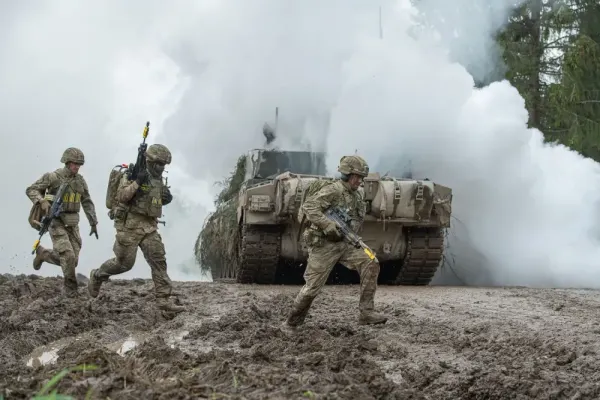
The Pentagon is weighing the withdrawal of about 25,000 US troops from Europe, close to a third of the 80,000 stationed there, NBC News reported on 17 September, citing seven current and former US and Western officials. One US official and another person with knowledge of the deliberations told reporters the figure could reach 40,000, half the force. Aircraft, ships and weapons would go with the troops.
Germany, Italy and Spain would lose the most, according to three US officials, a Western official and a former US official who spoke to media. Germany hosts about 36,000 US personnel and Italy about 12,000. Spain hosts the US naval station at Rota and the air base at Morón.
A cut of 25,000 would be the largest reduction in the US military presence in Europe since the drawdown after the Cold War in the 1990s. US numbers on the continent passed 100,000 after Russia's full-scale invasion of Ukraine in February 2022. About 68,000 of the current force is permanently based, and the rest rotates in and out.
Grynkewich briefs Hegseth, final call due 6 November
General Alexus Grynkewich, who commands US European Command and serves as NATO's Supreme Allied Commander Europe, joined a virtual briefing on the review on 18 September, Reuters reported from Brussels. Elbridge Colby, the Pentagon's policy chief, took part. The review is to give Hegseth at least four sets of options, and Grynkewich's first analysis was due to him the same day.
Hegseth announced the review at NATO headquarters on 18 June. "Make no mistake about it, this will be a real review," he said. "America cannot care for or pay more for Europe's defense than our allies." He said it would take up to six months and include consultations with Congress, and threatened to withhold US contributions to NATO from allies that miss their spending commitments, Reuters reported.
A final recommendation is due on 6 November, three days after the US midterm elections, before any proposal goes to Trump. The options cover air, naval and ground forces, and some units could move to NATO's eastern flank instead of going home. Officials have made no final decision.
Colby wrote on 29 July that the review aims to push NATO fast and irreversibly toward Europe taking primary responsibility for its own conventional defence, with the United States as a strategic and nuclear backstop. US officials call the plan NATO 3.0.
Congress wrote a 76,000 minimum into law
Congress set a floor of 76,000 US troops in Europe in the National Defense Authorization Act for fiscal year 2026, which the Senate passed on 17 December 2025. The Pentagon cannot go below it unless it first certifies to Congress that the cut was made in consultation with NATO allies and hands over independent assessments of the effect on US security, alliance readiness and deterrence of Russia.
A cut of 25,000 would leave about 55,000 troops, 21,000 below the floor. A cut of 40,000 would leave about 40,000. The same law bars spending money to remove major defence equipment from the continent and bars the US giving up the Supreme Allied Commander post without a similar certification.
Troops already pulled from Romania, Germany and the Baltics
Romania's defence ministry said on 29 October 2025 that the US would end its rotating brigade there. About half of the 2,000 US soldiers in Romania left. Roger Wicker and Mike Rogers, the Republicans who chair the Senate and House armed services committees, said that day: "We strongly oppose the decision not to maintain the rotational U.S. brigade in Romania and the Pentagon's process for its ongoing force posture review that may result in further drawdowns of U.S. forces from Eastern Europe."
The Pentagon said on 1 May 2026 it would take about 5,000 troops out of Germany over six to 12 months. Most of them come from Vilseck in Bavaria, home to the 2nd Cavalry Regiment, a Stryker brigade. Trump said two days later: "We're going to cut way down. And we're cutting a lot further than 5,000." Asked about Spain and Italy, he said: "Why shouldn't I? Italy has not been of any help to us and Spain has been horrible."
The US cancelled the deployment to Germany of a long-range fires battalion armed with Tomahawk cruise missiles and hypersonic missiles, which had been scheduled for 2026, at the same time as the German cut, the EU Institute for Security Studies reported on 7 May.
US fighter aircraft committed to NATO fall from about 150 F-16s and F-15Es to about 100 and maritime patrol aircraft from 26 to 15, according to a New York Times report that European officials confirmed on 12 June. Eight aerial refuelling aircraft are being withdrawn entirely. One of two bomber task force groups, a missile-carrying submarine, an aircraft carrier and several warships are moving to other regions. No European air force operates strategic bombers.
Estonia had fewer than 100 US service members left in early July, down from 500 to 700, Mezha reported on 6 July. Hanno Pevkur, the Estonian defence minister, said: "This will become clear after the six-month review being conducted by the Pentagon. But the next rotation is still expected to arrive in Estonia in the summer." Kalev Stoicescu, who chairs the Estonian parliament's national defence committee, said: "We can sing, dance, and even hop on one foot here. But the decision is still made by the White House and the U.S. administration, based on their own interests and vision."
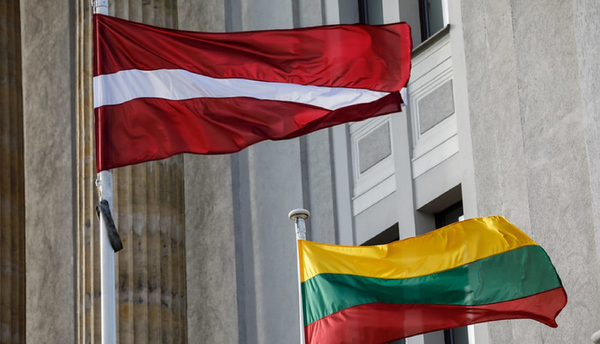
More than 1,000 US troops finished a rotation in Lithuania this summer with no replacement unit named. Kęstutis Budrys, the Lithuanian foreign minister, met Marco Rubio in Washington and told LRT on 18 September: "We received assurances that this gap, when we have a reduction in US troops, will not last long." He said an announcement could come in "days, perhaps the coming weeks".
Trump announced on 22 May that he would send 5,000 troops to Poland, citing the "successful election" of Karol Nawrocki, whom he "was proud to endorse". He wrote on Truth Social on 17 September: "Major progress is being made toward establishing a U.S. Army base in Poland." Warsaw has offered about $4 billion towards the base, Stars and Stripes reported. No site has been named.
Drones over Lithuania, warnings from Warsaw and Paris
Donald Tusk told the Polish parliament on 17 September that intelligence from NATO, Ukraine and the United States shows Russia is preparing drone and missile strikes on countries that support Ukraine, which Moscow would then call accidents. "There is a real risk that the territory of one or several NATO countries on the eastern flank may be entered by drones or other types of missiles," he said. He also said "there is nothing to suggest an invasion." Russia's foreign ministry called the accusations "contrived" and "far-fetched".
Italian jets flying NATO's Baltic air policing mission shot down a drone over central Lithuania overnight into 15 September, the first shootdown in Lithuanian airspace. Lithuanian officials said it most likely came from Belarus and was probably carrying explosives. A Russian warship fired two flares at a Danish helicopter on 16 September.
Emmanuel Macron said on 18 September, after French intelligence services briefed party leaders at the Élysée: "In recent weeks, the threat, particularly the Russian hybrid threat, facing Europeans and France has intensified." He ordered a plan to protect critical infrastructure and defence factories from drones and cyberattacks.
German ministers blamed Russia on 1 September for an attempted explosive-drone attack on a Ukrainian cargo aircraft at Leipzig/Halle Airport on 4 August, and Berlin ordered Russia's consulate general in Bonn closed. Estonia's security cabinet has a memo on a possible Russian general mobilisation, registered on 17 September. Belarus began four days of drills this week near the Suwałki Gap, the 104 km stretch of Polish-Lithuanian border that is NATO's only land link to the Baltic states.
Germany's army chief said in June, citing NATO-agreed intelligence, that Russia will be ready to attack NATO by 2029. Dutch military intelligence said in April that Russia could strike NATO within a year of the war in Ukraine ending.
What a cut would cost Europe
The International Institute for Strategic Studies (IISS) published a study on 17 September that found European armies short of soldiers, artillery, air defence and ammunition. They also lack the fuel lines, rail cars for heavy armour, mobile bridges and medical evacuation capacity needed to move forces east. "European land forces are not yet the conventional backbone NATO needs," the study said. "Europe's land forces are improving, but unevenly, belatedly and from a low base. The central risk is a capability-time mismatch." It judged that most of the fixes would not be finished before the end of the decade.
The US had 108 military communications satellites in 2025. The UK had six, France five, Italy three and Germany and Spain two each, Defense News reported in February. NATO's early-warning aircraft fleet is 14 E-3A AWACS based at Geilenkirchen in Germany. Western air defence systems cannot yet stop a ballistic missile such as Russia's Oreshnik, Frédéric Mauro of the French Institute for International and Strategic Affairs told Defense News. Alain de Neve of Belgium's Royal Higher Institute for Defence said: "SEAD/DEAD is a domain Europeans have quite simply abandoned and must now rebuild from scratch." SEAD/DEAD is the suppression and destruction of enemy air defences.
Europe's longest-range cruise missiles, the Franco-British Scalp/Storm Shadow and the German-Swedish Taurus, reach 300 to 500 km. The Tomahawk reaches more than 1,600 km. The US fired 850 Tomahawks in four weeks of fighting with Iran, according to the EU Institute for Security Studies. Giuseppe Spatafora of the institute wrote on 7 May that cancelling the Tomahawk battalion "removes this key element of deterrence by punishment against Russia", and that the decision suggested "Trump is willing to reduce U.S. security commitments to curry favour with the Kremlin." A European replacement missile under the European Long-Range Strike Approach may not arrive before 2030.
Germany, Italy and Spain hold the logistics hubs the US uses to reach the Middle East and Africa: Ramstein Air Base and the Landstuhl Regional Medical Center in Rhineland-Palatinate, Naval Air Station Sigonella in Sicily and Rota in Spain. Ian Lesser of the German Marshall Fund told Al Jazeera the effect "really depends on where and when the troops are removed". Moving troops from Western to Eastern Europe would worry allies less than bringing them home, he said.
Vilseck has 6,500 German residents and about 4,500 US soldiers, plus their families. The US presence brings roughly $800 million a year into the region, Stars and Stripes reported on 6 May. Thorsten Grädler, the mayor, said: "You can imagine what such a scenario would mean for our region." Markus Söder, the Bavarian premier, said: "A possible troop withdrawal must be offset by the Bundeswehr, so that the affected bases are preserved and no defense infrastructure is lost."
How Europe plans to fill the gap
Bruegel, a Brussels economics think tank, estimated in February 2025 that Europe would need the fighting power of 300,000 more troops, about 50 brigades, to defend itself without the US. That meant 1,400 tanks, 2,000 infantry fighting vehicles, 700 artillery pieces, a stock of one million 155mm shells and 2,000 long-range loitering munitions a year, at an extra €250 billion a year. The IISS put the cost of replacing the main US contributions to European defence at about $1 trillion in May 2025.
NATO leaders agreed at The Hague in June 2025 to spend 5 per cent of GDP a year on defence by 2035, 3.5 per cent on core defence and up to 1.5 per cent on related security. European allies and Canada raised defence spending by 19.6 per cent in real terms in 2025, to $574 billion or 2.33 per cent of their combined GDP, NATO reported on 27 March. US spending was 3.19 per cent of GDP, a real-terms fall of 1.38 per cent. All 32 members met the 2 per cent guideline, against three in 2014.
The EU's SAFE programme lends €150 billion for joint arms purchases, with at least 65 per cent of each contract's component costs from the EU, Ukraine or the EEA and EFTA states. The Commission approved 18 member states for loans between February and April 2026. Poland signed for €43.7 billion on 9 May, the largest share, and said 89 per cent of the contracts would go to Polish companies. "This is a watershed moment in the history of both Poland and the European Union," Tusk said.
Germany had 186,700 active soldiers in August 2026, its highest number in 13 years, The Defense Post reported. It aims for about 260,000 active troops and 200,000 reservists by the mid-2030s. A new military service law took effect on 1 January 2026, sending questionnaires to 194,000 men, and 865 applicants had been selected for service in 2026 and 2027 by August. A survey by the German Centre for Integration and Migration Research found 30 per cent of Germans aged 18 to 28 supported bringing back conscription.
Germany's 45th Panzer Brigade in Rūdninkai, Lithuania, about 30 km from Belarus, is meant to reach about 4,800 troops by the end of 2027. Volunteers fill about 80 per cent of its posts, and two of its battalions are about 40 per cent short. The defence ministry will order up to 1,000 soldiers to Lithuania from late September, Euronews reported on 14 September.
Poland plans to spend 4.8 per cent of GDP on defence in 2026 and wants 300,000 professional soldiers and 200,000 reservists by 2030. It is spending 10 billion zlotys ($2.7 billion) on the East Shield fortifications along its borders with Russia and Belarus between 2024 and 2028. Much of its new equipment is American: 486 HIMARS launchers, 96 AH-64E Apache helicopters, 366 M1A2 Abrams tanks and 32 F-35A fighters. Lithuania set its 2026 defence budget at €4.79 billion, 5.38 per cent of GDP.
European governments have ordered 39 more A400M transport aircraft on top of 131 in service and six more A330 MRTT tankers on top of 38, and all respondents to a Defense News survey of analysts said Europe's tanker fleet was adequate or could be within two years. Sweden and France have ordered Saab GlobalEye early-warning aircraft. France and Germany are building the JEWEL missile early-warning system, due to reach initial capability in the early 2030s. France, Germany, Italy, Poland, Sweden and the UK are developing long-range missiles together. Representatives of 10 nations met in Oslo on 9 September on FREYJA, a programme to build a European alternative to US Patriot interceptors against ballistic missiles.
François Heisbourg of the Foundation for Strategic Research in Paris said: "There are areas in which the Europeans have zero meaningful capability, there are a few areas in which the Europeans own an arguably adequate capability today but for which the issue is one of replacement, and there some areas in which scale, not quality, is the issue."
Trump's record with Putin
Russian drones crossed into Polish airspace on 10 September 2025 during an attack on Ukraine, and Polish and allied aircraft shot several down. Poland invoked Article 4 of the North Atlantic Treaty. Trump said: "It might have been a mistake. It could have been a mistake, but also I'm not happy with anything regarding that situation." Tusk said: "We would also wish that the drone attack on Poland was a mistake. But it wasn't. And we know it." Radosław Sikorski, the Polish foreign minister, said: "No, that wasn't a mistake."
Trump received Vladimir Putin at Joint Base Elmendorf-Richardson in Anchorage on 15 August 2025 on a red carpet. The summit ended without a ceasefire.
The Treasury issued General Licence 134 on 12 March 2026, allowing sales of sanctioned Russian crude and oil products already at sea to any buyer, where a waiver had covered only Indian refiners. Scott Bessent, the Treasury secretary, said the step would "not provide significant financial benefit to the Russian government". The licence covered about 100 million barrels. Friedrich Merz said easing sanctions at that moment, for whatever reason, was wrong. António Costa, the European Council president, wrote that weakening sanctions gives Russia more money to fight Ukraine. Bessent said in April that the US would not renew the licence, then renewed it two days later. Volodymyr Zelenskyy wrote on 19 April: "Every dollar paid for Russian oil is money for the war," and put Moscow's gain at $10 billion.
Trump told Mark Rutte in Washington on 8 April 2026 that he was seriously considering leaving NATO and called the alliance a paper tiger. "Ukraine wasn't our problem, yet we were there for them, but they weren't there for us," he said.
A US questionnaire sent to NATO members in August asked whether each had publicly supported US foreign policy, what limits it put on US use of its bases and whether it had "publicly opposed regulations" that "inhibit" contracts with US arms firms, Bloomberg reported on 14 August. The answers feed the posture review.
Trump said on 3 September that the US would ask European governments to repay it for weapons sent to Ukraine. He has put the sum at $300 billion and at other times at $500 billion. The audited value of US drawdowns for Ukraine authorised through January 2025 is $31.7 billion, before correcting $8.1 billion of overvaluation that the Defense Department and its inspector general have admitted.
Steve Witkoff and Jared Kushner, Trump's envoys on Ukraine, met Putin in the Kremlin for more than three hours on 5 September. Putin turned down a Ukrainian proposal for a wider ceasefire along the front line, according to the Institute for the Study of War. Russia fired 32 cruise missiles along with ballistic missiles and drones at Kyiv on 8 September, killing at least five people. Andrii Sybiha, the Ukrainian foreign minister, said: "The moment the US president's peace envoys left, Putin launched another massive, horrific attack against Kyiv."
Umar Kremlev, a Russian businessman whom Putin awarded the Order of Friendship in April, paid hundreds of thousands of dollars towards Donald Trump Jr.'s wedding in the Bahamas in May, ProPublica reported on 14 September. Kushner was among the guests.
The Trump administration restored full intelligence sharing with Ukraine on 6 August 2026, including satellite data, targeting information and attack warnings. Trump backed the Russia sanctions bill that the Senate passed by 86 votes to 11 on 7 August, which allows tariffs of up to 100 per cent on the largest buyers of Russian oil and gas and lets the president waive them.
Hegseth points to Iran bases
Hegseth said on 18 June that allies which refused US forces base access and overflight during the Iran war had "put America's sons and daughters, our sons and daughters, at risk", and called it "shameful". Spain closed its airspace to US aircraft involved in the war on 30 March. An official told The Intercept, in a report published on 15 September, that the strain of the Iran war on US forces alongside their other commitments was "ultimately unsustainable".
Rubio and Shaheen on the drawdown
Rubio has said: "I think there's a broad recognition that there are going to be eventually less U.S. troops in Europe than there has historically been." Wicker and Rogers said after the German cut was announced that they were very concerned.
Jeanne Shaheen, the ranking Democrat on the Senate Foreign Relations Committee, has pressed Rubio to bring the State Department and US ambassadors into the review. Any cut that takes US numbers below 76,000 needs the Pentagon's certification to Congress before it can go ahead.