
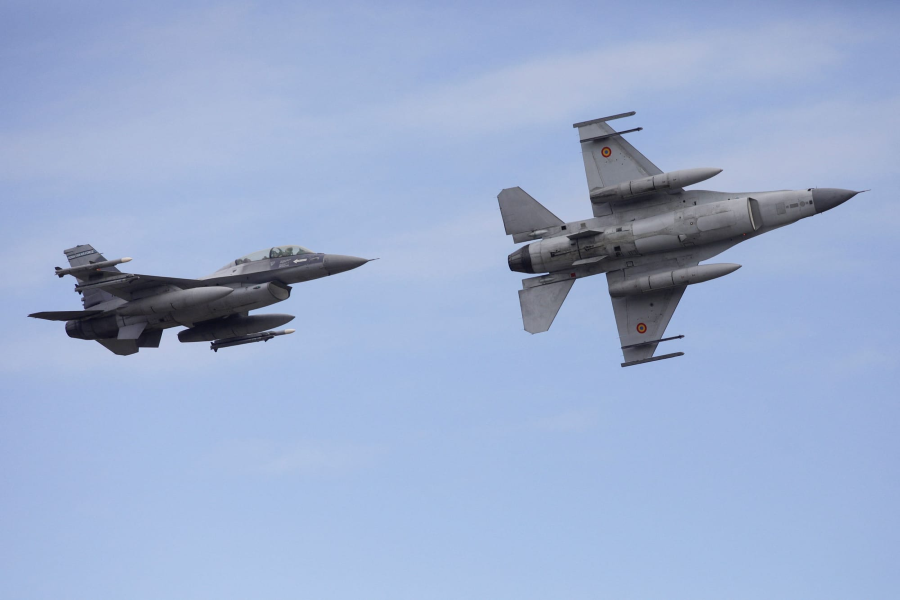
Nato fighter jets destroyed a drone over Lithuania shortly after midnight on 15 September, the first shootdown over Lithuanian territory and the latest in a fortnight of incursions along the alliance's eastern flank.
Allied aircraft scrambled over Estonia, Poland and Romania in the two weeks before it, a Russian attack drone flew 160 kilometres into Romanian airspace minutes before Volodymyr Zelenskyy's aircraft took off from Chișinău, and a Russian frigate fired flares at a Danish military helicopter over the Baltic on the same day Lithuania opened fire.
Two weeks on the eastern flank
Estonian air defence units tracked about 10 drones near the Russian border in the early hours of 1 September, two of which crossed into Estonian airspace, and Turkish F-16s flying Nato air policing scrambled from Ämari without firing.
Drone warnings went out to Lääne-Viru and Ida-Viru counties at about 03:00 that morning and were extended to Tartu, Jõgeva, Viljandi, Valga, Võru and Põlva before being lifted at 05:30, the Estonian Defence Forces said. Colonel Uku Arold said drones had moved parallel to Estonia's eastern border before entering the country. Foreign minister Margus Tsahkna said: "Nato reacted swiftly and exactly as planned."
Estonian assessments placed the aircraft as strays from Ukrainian operations against infrastructure in Leningrad Oblast.
Polish jets scrambled near the Belarusian border on 6 September over a radar contact that turned out to be a flock of birds.
Finland's National Bureau of Investigation and Border Guard closed their inquiries on 9 September into four armed military drones that came down on Finnish soil in spring.
A jet-powered attack drone crossed into Romanian airspace at 16:37 on 10 September, about 30 kilometres southeast of Iași, and flew west to a point north of Roman, roughly 160 kilometres from the Ukrainian border. Two Spanish F-18s scrambled from Mihail Kogălniceanu air base four minutes after detection and tracked it without firing. Romanian radar lost contact at 17:02 and the aircraft crashed in Moldova near Mihăilenii Vechi.
Zelenskyy's aircraft left Chișinău at 17:57 that day, after Moldova closed its airspace and delayed three departures and four arrivals. Norwegian prime minister Jonas Gahr Støre said afterwards: "His flight was almost hit by a drone."
Ukrainian monitoring channels identified the aircraft as a Geran-4, the jet-powered variant of Russia's Shahed-derived attack drone, with a three-metre wingspan, a top speed of about 500 kilometres an hour and a warhead of 50 to 90 kilograms.
Nato ran a multinational night exercise over Poland on drone detection and interception in the week of 10 September, with forces from Spain, Poland, the Czech Republic, France and Turkey.
Vilnius airport suspended flights for 38 minutes on 13 September after a radar contact later identified as a flock of birds. Early the same day an unidentified object crossed 60 to 70 kilometres of Lithuanian airspace towards Kaliningrad in about 20 minutes, and no alert was issued.
Polish defence minister Władysław Kosiniak-Kamysz said on 14 September that the military had recovered a drone from the Baltic Sea near the beach at Rusinowo, close to Jarosławiec. "Preliminary inspection indicates that it is a Russian military drone," he said.
The Russian guided-missile frigate Admiral Kasatonov fired two flares towards a Danish Fennec helicopter in international waters off Gedser on 15 September, one passing within metres of the aircraft, with no warning and no radio call. Denmark summoned Russian ambassador Vladimir Barbin. Defence minister Jeppe Bruus said the helicopter had been on a routine photographic run of the frigate that Danish crews had flown many times, and that Russia had increased its willingness to take risks.
Prime minister Mette Frederiksen said: "Russia wants to sow fear and discord. Our answer is to stand closer together." Denmark did not invoke the alliance's collective defence clause, saying that would require a more direct attack on Danish territory. Barbin said Russia would investigate and accused Danish aircraft of dangerous manoeuvres near Russian warships.
Polish forces launched air operations over eastern Poland later on 15 September, citing Russian jet-powered drones striking Ukrainian targets close to the border, and described the deployment as preventive.
The Lithuanian interception
Lithuanian radar tracked a drone crossing the border from Belarus before midnight on 14 September, and Italian Eurofighters scrambled from Šiauliai air base destroyed it at about 00:20 near the village of Pratkūnai, in the Kaišiadorys district of Kaunas county.
Vilmantas Vitkauskas, head of Lithuania's National Crisis Management Centre, said the drone spent about half an hour inside Lithuanian airspace before it was hit, and that it most likely entered from Belarus.
The wreckage fell roughly five kilometres from the Kruonis pumped-storage plant, the 900-megawatt facility that balances Lithuania's grid and the only station of its kind in the Baltic states.
Radar tracked the drone west through the Lentvaris and Trakai areas after it crossed the border, and air alerts went out first to Vilnius city and district, Trakai and Elektrėnai, then to Kaunas county as the aircraft continued west.
Colonel Antanas Matutis, commander of the Lithuanian air force, said the military had no data indicating the drone was flying towards Kruonis. Asta Sungailienė, a director at the plant's operator Ignitis Gamyba, said staff were ready to move to safe areas.
A resident of the nearby town of Kruonis told the news site Respublika that the explosion overhead sounded like two aircraft colliding.
Wreckage and investigation
Lithuanian authorities activated the explosives protocol codenamed Skydas, or Shield, at the crash site, and military police cordoned the fields where the debris fell.
Vitkauskas said there was a high probability the drone carried an explosive charge, and that the recovered wreckage did not yet show whether it was a combat aircraft. Officials have not established whether the drone was Russian, Belarusian or Ukrainian, and the launch point has not been released.
The Lithuanian armed forces said in a statement published at about 04:00 that they would not rush to conclusions, and that an investigation would establish the circumstances.
General Raimundas Vaikšnoras, commander of the Lithuanian armed forces, said incidents of this kind were linked to Russia's war against Ukraine.
Foreign minister Kęstutis Budrys said Lithuania would deliver a diplomatic note to Belarus over the violation. Belarus has not commented. Russia has not commented.
President Gitanas Nausėda wrote on X that a drone entering Lithuanian airspace had been destroyed by Nato fighter jets, and that such readiness was vital for the region while Russia intensified its aggression against Ukraine.
Incursions since 2025
Romania's defence ministry recorded 23 violations of Romanian airspace between 1 January and 17 August 2026, against 18 in the four years from 2022 to 2025 combined.
Romanian territory yielded 27 drones or drone fragments in those seven and a half months, against 16 across the whole of 2025, the same ministry said. Russian attacks close to the Romanian border ran to 54 in the period, against 28 in all of 2025.
Nato flew at least 42 air-policing missions over Romania between January and mid-August, more than in the four preceding years put together. Romanian and allied jets destroyed four drones in Romanian airspace in 2026, the first in July.
Twenty-one Russian drones entered Polish airspace on the night of 9 to 10 September 2025, and Polish and Dutch aircraft shot down at least three of them, the first time Nato aircraft had fired on aerial targets over allied territory. Poland and Estonia both requested consultations under Article 4 of the North Atlantic Treaty on 12 September 2025, Estonia after three Russian MiG-31 fighters flew inside Estonian airspace for 12 minutes on 20 September.
Nato launched Operation Eastern Sentry on 12 September 2025 in response, pooling air defence of the eastern flank that member states had previously run individually. Denmark contributed two F-16s and a frigate, France three Rafales, Germany four Eurofighters, Italy two F-35As and a SAMP/T battery in Estonia, the United Kingdom two Eurofighters and Spain one. Secretary general Mark Rutte said at the launch: "Russia's recklessness in the air along our eastern flank is increasing in frequency."
A Kh-101 cruise missile came down at Tarnawa-Kolonia in eastern Poland on 30 July 2026, causing no injuries. Polish prime minister Donald Tusk said everything indicated it was Russian. Rutte called it "yet another reckless act by Russia".
Russia's strike tempo
Russia launched 8,150 one-way attack drones at Ukraine in May 2026, the highest monthly total of the war, and 5,749 in June, according to figures compiled by the Ukrainian outlet Frontliner from Ukrainian air force and defence intelligence data.
Ballistic missile launches reached 121 in February 2026 and 107 in the first 20 days of July, against a Russian production capacity that Ukrainian intelligence puts at 100 to 120 missiles a month.
Daily strike packages have grown from 28 drones on 17 October 2022 to 172 on 17 April 2026, the same compilation shows. Russia launched 102 drones at Ukraine overnight into 15 September, and Ukrainian forces struck Russian military targets in Krasnodar Krai.
Baltic interceptions since May
A Romanian F-16 flying the Baltic mission shot down a drone over southern Estonia on 19 May, the first time Nato aircraft had opened fire in Baltic airspace. The Estonian Defence Forces said the aircraft was probably Ukrainian and that the incursion took place during heavy Russian electronic warfare, including GPS spoofing and jamming.
A French Rafale, one of four deployed to Šiauliai in April, destroyed a drone over eastern Latvia on 8 June, between Rēzekne and Kārsava in Nautrēni parish, at about 10:30.
Nato said on 8 July, at a meeting in Ankara, that Baltic Air Policing would become an air defence mission, moving engagement authority to Supreme Allied Commander Europe and widening the mandate to destroy objects assessed as a threat to the population. Nausėda said at the time that the commander would be able to make flexible decisions in a timely manner.
Jets flying the mission shot down another drone over Latvia on 14 August. The Latvian National Armed Forces said on 20 August that it was Ukrainian, that it had been downed near Rugāji after entering from Belarus, and that it most likely came in under the influence of Russian electromagnetic warfare. The force declined to give the model, saying disclosure could affect Ukrainian defensive activities.
Latvia's defence minister Raivis Melnis said after the August shootdown that Ukraine continues to strike Russian territory with drones while Russia takes countermeasures.
A Nato officer at Allied Air Command, identified only by the call sign Thor, said in June that Eastern Sentry marks a shift from an air policing mindset to an air defence mindset, and that no single measure solves airspace violations.
Finland's findings
The four drones that came down in Finland in spring 2026 fell near Kouvola on 28 March, at Luumäki, near Parikkala and near Iitti.
All four carried explosives. One detonated in mid-air and the other three were destroyed in controlled explosions.
Investigators concluded that satellite navigation jamming in the region, combined with southerly winds, pushed the drones off their intended routes, and that Finland was not the intended target. The inquiry found no evidence justifying criminal liability.
Airspace law
Article 1 of the 1944 Chicago Convention on International Civil Aviation gives every state complete and exclusive sovereignty over the airspace above its territory. Article 8 bars any pilotless aircraft from flying over the territory of a contracting state without that state's special authorisation. Belarus, Lithuania, Russia and Ukraine are all parties.
Budrys is protesting to Belarus on the entry route rather than on the drone's manufacture, which no Lithuanian official has yet established.
Article 4 of the North Atlantic Treaty lets any member call the alliance into consultation when it considers its territorial integrity, political independence or security threatened. Neither Lithuania nor Denmark has invoked it over the 15 September incidents.
Cost of interception
Nato allies committed more than 40 billion dollars to counter-drone capability over five years on 7 July, covering a tested-equipment marketplace, a fivefold increase in trained drone operators by the end of 2027, and a surveillance drone contract in the hundreds of millions of dollars awarded by the alliance procurement agency.
A two-fighter interception of the kind flown over Lithuania costs in the region of 100,000 dollars before a missile is fired, against a Geran-class airframe built for a small fraction of that. Melnis put the Latvian position in June, saying: "We shouldn't count the money about how much each shot costs."
Balloons and smuggling drones from Belarus
Lithuania's foreign ministry summoned the Belarusian chargé d'affaires on 15 June over repeated violations in May and June by smuggler balloons and other unmanned aircraft, including incursions that limited operations at Vilnius airport on 7 and 8 June. Belarus alleged that a drone had entered its airspace from Lithuania on 17 May, and the ministry said Lithuanian authorities recorded no such incident.
Vitkauskas said 22 smuggling drones were logged in Lithuanian airspace in the first 13 days of September.
Deterrence and the constitution
US president Donald Trump announced on 14 September that Ukraine and Russia had agreed to halt strikes on each other's energy infrastructure. Kyiv said it had no knowledge of such a deal. Zelenskyy said Ukraine was ready to take de-escalatory steps if Russia reciprocated.
Article 137 of Lithuania's constitution prohibits the deployment of weapons of mass destruction and foreign military bases on its territory. Party leaders agreed in principle in July to amend it, without settling whether the change goes through parliament or a referendum. Nausėda called the provision obsolete, saying the constitution was written under different geopolitical circumstances.
Finland removed its own ban on hosting nuclear weapons by parliamentary vote, and the change took effect in the first days of July, days before the Lithuanian party leaders met.
Lithuanian investigators will attempt to recover data from the drone's navigation system to establish where it was launched.