Mexico lodged a formal diplomatic complaint on 27 November against anonymous channels the U.S. Drug Enforcement Administration opened for reporting Mexican officials, and President Claudia Sheinbaum said the agency should investigate corruption in its own country first.
Foreign Minister Roberto Velasco Álvarez delivered the complaint by speaking directly to the U.S. ambassador, Ronald Johnson, who said he would review it, Sheinbaum told her morning press conference at the National Palace. The Mexican government said the DEA opened the channels without consulting it, although the two governments had worked together on a military operation in Sinaloa a week earlier. Sheinbaum said the Constitution obliges her to defend national sovereignty and that the relationship with the U.S. government rests on "coordinación y no de subordinación" ("coordination, not subordination"). She ruled out U.S. troops on Mexican soil and said security cooperation would continue on those terms.
DEA Administrator Terry Cole announced the channels on his X account on the night of 25 November. They invite people in Sinaloa state to send tips by Signal, WhatsApp and email on members of criminal networks, on the corrupt officials who support them and on those who launder money to finance what Cole called narcoterrorism. The DEA promised to handle each tip confidentially. Cole said a second channel for Jalisco, the home state of the Jalisco New Generation Cartel (CJNG), would be made public the following day. The channels route information about Mexican officials directly to a U.S. police agency, outside Mexico's Federal Attorney General's Office (FGR) and its Security Ministry.
Sheinbaum answered on 26 November, reading aloud from an Associated Press report published two days earlier on DEA agents in New Mexico who let fentanyl shipments reach dealers while they tracked a trafficking ring. She called the channels interference and asked how the U.S. government would react if Mexico's Security Ministry opened a WhatsApp line for Mexicans and others to report corruption in the United States. Mexico has its own prosecutors and security agencies to receive complaints, she said. The DEA has plenty of work to do in its own country, she said, starting with corruption in the United States connected to organised crime and to groups the U.S. government designates as terrorist organisations. She asked what U.S. authorities were doing on their side of the border.
In July, after Cole accused her government of a deadly connection with traffickers, Sheinbaum said the largest drug market is in the United States. The DEA should be investigating who sells drugs there, how they are distributed and how the money is laundered, she said.
Fentanyl the DEA let pass
The Associated Press reconstructed the DEA's eight-month surveillance of a fentanyl distribution ring operating across six U.S. states. It found that agents let at least 1.4 million counterfeit fentanyl pills go unseized between August 2024 and April 2025 while they watched the ring. AP built the count from thousands of pages of court documents, investigative records and wiretap reports and from 12 hours of DEA surveillance footage. It left out every deal for which the records gave no pill count or which agents did not watch. The figure comes on top of the hundreds of thousands of pills that DEA whistleblowers told AP in June had gone unseized in New Mexico.
The footage shows the pills moving in plastic bins and duffel bags through hotels, apartments, Airbnb rentals and storage units across six U.S. states. One afternoon in August 2024, a buyer in a white pickup met a courier at a Home2 Suites hotel in Albuquerque, New Mexico. Minutes later they left separately, one of them carrying a backpack holding as many as 100,000 pills, and agents let them go. In an Albuquerque park, agents watched a trafficker struggle to lift a container of 370,000 pills out of a vehicle. Couriers in two vehicles delivered 200,000 pills to a house in the Agua Fria neighbourhood of Santa Fe. The ring opened a storage unit stocked with fentanyl nearly 500 times. Almost all the pills remain unaccounted for, and the DEA said letting them move was necessary to protect the investigation.
The ring's suspected leader, Heriberto Salazar Amaya, 38, is a Mexican national whom the DEA had tracked for about a decade. He used aliases and 14 phones to send couriers to dealers from Phoenix to Denver, and prosecutors say the ring took in up to US$2 million a month. AP reported that the pills were made in Mexico and named no foreign supplier. Salazar Amaya was arrested in April 2025 at a home in Salem, Oregon, has pleaded not guilty and is due to stand trial next year. Of the 15 people charged with him, mostly low-level couriers, 12 have pleaded guilty. The then attorney general, Pam Bondi, presented the takedown in May 2025 as the largest fentanyl seizure in U.S. history, at 4 million pills.
Justice Department guidance issued in 2017 told agents to seize fentanyl whenever practicable. Officials loosened that rule in 2024 to give agents more discretion. A former DEA senior executive, Brian Besser, told AP that a substance able to take so many lives was not something to gamble with. New Mexico's governor, Michelle Lujan Grisham, accused the DEA of a cover-up. Fentanyl overdose deaths in New Mexico rose 44 per cent last year. Albuquerque has declared a state of emergency and has sued the Justice Department for US$153 million in damages. AP did not link any specific death to the unseized pills. Provisional figures from the U.S. Centers for Disease Control and Prevention put overdose deaths in the United States at 69,973 in 2025, 44,564 of them involving opioids, down from 81,313 in 2024.
The DEA says its decisions were lawful and coordinated with federal prosecutors to prevent public harm, and has denied ever knowingly allowing fentanyl to be trafficked. On the November findings it declined to answer questions, citing a review by the Justice Department's inspector general, and its spokesperson wrote that its response had not changed. A congressional oversight inquiry is also open, and New Mexico's attorney general, Raúl Torrez, opened a criminal investigation into the agency in June.
Sheinbaum called the case the "Fast and Furious" of fentanyl. In that operation, exposed in 2011, agents of the U.S. Bureau of Alcohol, Tobacco, Firearms and Explosives (ATF) let straw buyers carry about 2,000 assault weapons into Mexico in an attempt to trace them to cartel leaders.
DEA agents jailed for laundering and theft
A federal judge in Tampa, Florida, sentenced former DEA special agent José Irizarry in December 2021 to 145 months in prison. Irizarry had pleaded guilty to all 19 counts against him, including conspiracy to commit money laundering, honest services wire fraud, bank fraud and aggravated identity theft. Over seven years, during assignments to the DEA's Miami field division and its office in Cartagena, Colombia, he used his badge to divert about US$9 million from the agency's own undercover money laundering operations to himself and his co-conspirators. Prosecutors said he took at least US$1 million in bribes and kickbacks. The money bought a US$30,000 Tiffany diamond ring for his wife, luxury sports cars and a US$767,000 house in Cartagena.
The DEA had hired Irizarry and let him handle sensitive financial transactions even after he failed a polygraph examination, declared bankruptcy and kept close ties to a suspected money launderer. In court he blamed colleagues for a culture of corruption inside the agency. Judge Charlene Honeywell told him he was the one who had been caught but that there were clearly others, and said they also needed to be investigated. The DEA declined to comment on his claims. Four months before Irizarry's sentencing, another long-serving DEA agent, Chad Scott, was sentenced to more than 13 years for stealing money from suspects, falsifying government records and perjury.
Responding to Cole in July, Sheinbaum cited Nicholas Palmeri, who she said was removed in 2022 as the DEA's regional director for Mexico and Central America over his dealings with traffickers' defence lawyers. Irizarry and Scott were convicted. The Albuquerque shipments are a disputed enforcement decision, and the criminal and administrative inquiries into them remain open.
Cartel money in U.S. banks
Between 2006 and 2010 the Sinaloa Cartel and Colombia's Norte del Valle Cartel laundered at least US$881 million in drug proceeds through HSBC Bank USA without detection, according to the statement of facts the bank accepted in December 2012. HSBC's Mexican subsidiary moved US$1.1 billion in dollars from Sinaloa to the bank's U.S. branches between 2006 and 2008 alone, and a large share was traced to Culiacán, the state capital, court documents show. HSBC forfeited US$1.256 billion and paid US$665 million in civil penalties under a deferred prosecution agreement. The Justice Department chose not to indict the bank or any of its executives.
In October 2024 TD Bank, the U.S. arm of Canada's Toronto-Dominion Bank and the 10th-largest bank in the United States, became the first bank in U.S. history to plead guilty to conspiracy to commit money laundering. Its plea agreement states that three laundering networks moved more than US$670 million through its accounts over six years and that many employees knew. One network, a drug trafficking group that bribed bank employees, laundered more than US$470 million in cash from fentanyl sales. The Justice Department fined the bank for every day it failed to comply with the Bank Secrecy Act between 2014 and 2023, and the penalties totalled about US$3.09 billion.
Guns from the United States
The ATF traced 122,084 firearms recovered in Mexico between January 2020 and December 2024 and found that 82,785 of them, or 68 per cent, had a U.S. source, according to a U.S. Government Accountability Office report published in September. The source of another 39,299 could not be determined. The figures cover only guns that Mexican authorities recovered and submitted for tracing. Of the U.S.-sourced guns, 49,676 were handguns and 32,601 were long guns. U.S. Customs and Border Protection seized 4,944 Mexico-bound firearms at land border crossings from January 2020 to December 2025. The GAO found that the Department of Homeland Security had set no objectives or desired outcomes for stopping firearms trafficking to Mexico. The ATF paused the performance measures for its Operation Southbound in 2026, and CBP's seizure records often leave a gun's maker, model and calibre blank. The Department of Homeland Security rejected the GAO's recommendation to record which types of rifle it seizes.
Mexico sued Smith & Wesson, Barrett Firearms, Beretta, Colt, Glock and other gunmakers and a distributor in a U.S. federal court in 2021, seeking US$10 billion. Its complaint said the companies made design and marketing decisions that appealed to cartels and aided the illegal flow of weapons across the border. On 5 June 2025 the U.S. Supreme Court unanimously ruled the suit barred by the Protection of Lawful Commerce in Arms Act, a 2005 law that shields gunmakers from most liability for crimes committed with their products. Justice Elena Kagan wrote that Mexico had not plausibly alleged that the manufacturers aided and abetted dealers' unlawful sales. Pablo Arrocha Olabuenaga, legal adviser to Mexico's foreign ministry, said the government was disappointed.
Tariffs, designations and threats of force
President Donald Trump ordered a 25 per cent tariff on all Mexican imports on 1 February 2025 under the International Emergency Economic Powers Act, declaring a national emergency over fentanyl and migration. Mexico won a postponement after Sheinbaum agreed to send 10,000 National Guard members to the border. The same month the Trump administration designated six Mexican cartels as foreign terrorist organisations, which the Mexican government condemned as a threat to its sovereignty that could be used to justify military intervention.
Asked on 17 November 2025 whether he would launch strikes in Mexico to stop drugs, Trump said "OK with me" and added that he was not happy with Mexico. Sheinbaum answered the next morning that it would not happen and that Mexico carries out operations in its own territory. In January 2026, days after the U.S. military operation against Venezuela's president, Nicolás Maduro, Trump told Fox News that the United States would start hitting cartels on land and that cartels were running Mexico. Sheinbaum told Trump that deploying U.S. troops in Mexico was not on the table.
The Guasave raid and the Meza Flores case
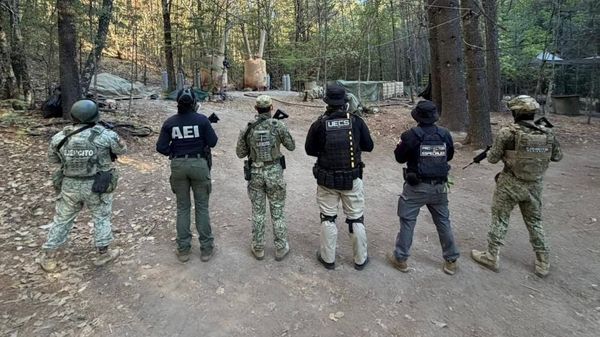
Mexican Army and National Guard special forces captured Fausto Isidro Meza Flores, known as "El Chapo Isidro", in Guasave, northern Sinaloa, on the evening of 20 November in an operation involving 361 personnel and 14 aircraft. Meza Flores leads a faction allied with the Sinaloa Cartel and had been on the FBI's Ten Most Wanted list since February 2025. His gunmen set up 21 roadblocks and fought troops for hours. Four soldiers were killed in a reinforcement convoy and 10 were wounded, Defence Minister Ricardo Trevilla Trejo said, according to Luz Noticias.
Troops detained 16 people and seized 28 firearms, including two Barrett .50-calibre rifles and a 40mm grenade launcher. Mexico requested U.S. support, and the U.S. government sent a drone to help locate Meza Flores. Trevilla said the U.S. role was limited to intelligence.
The Defence Ministry reported 16 alleged gunmen killed and said nobody uninvolved in the fighting died. By 26 November relatives had identified 10 of the 16, Noroeste reported. One was a 21-year-old from Los Mochis whose family reported him missing on 15 November, five days before the operation. Two cousins reported missing on 20 November had been travelling in a pickup that resembled a vehicle seen in videos of the clashes.
On 28 November a federal judge, Alejandra Ramírez de la Vega, ordered Meza Flores to stand trial alongside two alleged collaborators, Germán Rolando "N", known as "Serafín", and José Luis "N". The three will be tried in Mexico for possessing firearms, cartridges and magazines reserved for the armed forces and for drug offences. The ruling came after a private hearing of about 10 hours at the federal criminal court in Almoloya de Juárez, State of Mexico, and the three remain in pretrial detention at the Altiplano maximum-security prison. Prosecutors have four months to complete their investigation. The U.S. government has requested his extradition on drug and firearms trafficking charges filed in federal court in the District of Columbia. The FGR said he will face Mexican justice first and that the bilateral extradition treaty, not the wishes of either party, will govern any transfer.
In February Mexican troops killed Nemesio Oseguera Cervantes, known as "El Mencho", leader of the CJNG, in an operation the White House said U.S. intelligence supported. Mexico's Security Cabinet reported in October that federal forces had seized more than 36,000 firearms and 569 tonnes of drugs in the two years since Sheinbaum took office on 1 October 2024. It said the average number of daily homicides fell by 52 per cent between September 2024 and September 2026, from 87 to 42. Security Minister Omar García Harfuch said in September that more than 67,200 people had been arrested for high-impact crimes and that 2,771 clandestine drug laboratories had been dismantled. The figures are the government's own.
Rocha Moya and Mexico's unanswered extradition requests
Federal prosecutors in New York unsealed an indictment in late April charging Sinaloa Governor Rubén Rocha Moya, a member of the governing Morena party, and nine other officials with drug trafficking in collaboration with a Sinaloa Cartel faction. The charges are untested in court. Mexico's foreign ministry said the U.S. requests for provisional arrest it received in the case carried no evidence. "En los documentos no se anexan pruebas," its statement said ("No evidence is attached to the documents"). Ulises Lara López, the FGR's special prosecutor for relevant matters, said U.S. authorities had breached the confidentiality of the process by making the indictment public, and that Mexico would investigate under its own law. Mexico declined to arrest Rocha Moya, who took indefinite leave and whose Mexican bank accounts were frozen. A former Sinaloa security secretary, Gerardo Mérida Sánchez, surrendered to U.S. authorities in May.
Mexico sent 126 people to the United States in 2025, 71 by treaty extradition and 55 in two mass transfers of 29 people on 27 February and 26 on 12 August, and extradited four more to Hungary, Peru and Canada. A third transfer, of 37 people, brought the number sent to the United States under Sheinbaum's government to 92, García Harfuch said.
In August Cole accused members of Sheinbaum's government of protecting the CJNG, and Sheinbaum asked for verifiable evidence. Sheinbaum said the U.S. government has refused Mexican requests for the same reason, citing insufficient evidence. Velasco said the refusals included the businessman Víctor Manuel Álvarez Puga and the former Tamaulipas governor Francisco Javier García Cabeza de Vaca. Of 269 requests Mexico had submitted to the United States for extradition or provisional arrest, 36 had been refused and 233 remained pending in May, and none had been carried out.