
Mexico agreed with China on 23 November to form a working group to raise Mexican exports, a week after China granted Canada tariff relief on about C$400 million a year of pork and seafood.
Both governments used the Asia-Pacific Economic Cooperation summit in Shenzhen to open doors in the world's second-largest economy. U.S. tariffs on their steel, aluminium and vehicles stay in place, and the trade agreement binding the three North American economies now faces review every year. The two countries are starting from very different positions. Exports to countries other than the U.S. reached a record 33.7 per cent of Canada's total in July, Statistics Canada reported. The U.S. took 84.69 per cent of Mexico's non-oil exports between January and August, according to Mexico's statistics agency, INEGI.
Canada's gains in China
China will suspend its 25 per cent tariffs on C$116 million a year of Canadian frozen pork and C$285 million of fish and seafood from 1 January 2027 to 31 December 2028. The seafood includes Greenland halibut, cold-water shrimp, geoduck and sea cucumber. Prime Minister Mark Carney and President Xi Jinping agreed the measure in Shenzhen on 17 November, the Prime Minister's Office said. The government says Canada has now restored market access for more than 90 per cent of the exports China targeted in its 2025 retaliation, worth nearly C$7.5 billion. China also agreed to open its market to Canadian fava beans, chickpeas and lentils.
Canadian exports to China rose 31.4 per cent in the first half of 2026 to C$21.5 billion, according to Global Affairs Canada. China bought C$35.1 billion of Canadian goods in 2025. Three days before Shenzhen, Carney announced in Manila that Canada had substantially concluded free trade negotiations with the Association of Southeast Asian Nations and finished talks on a separate agreement with the Philippines. Both are due for signature in 2027. His government has set a target of doubling Canada's exports outside the U.S. by 2035.
Carney has tied Chinese investment in the Canadian auto industry to the outcome of talks with the U.S. Canada could turn to Chinese, European or Japanese automakers if those negotiations fail to keep the North American industry integrated, he told reporters in Phnom Penh, Cambodia, on 16 November. Any Chinese plant would have to manufacture in Canada, meet Canadian labour standards and build domestic supply chains, including for Canadian critical minerals, he said. "Canada is going to move forward either way," Carney said.
Jennifer Hillman, co-director of the Institute of International Economic Law at Georgetown University, told TIME that Canada's wider options weaken the assumption that the U.S. holds the stronger hand in the talks. Moving auto supply chains toward China would still be slow and costly, she said. "Geography is a huge limitation," Hillman said. Lori Turnbull, a professor at Dalhousie University, said that defence or artificial intelligence cooperation with China would be hard to justify to Canadians, and that Canada would more likely turn to the EU in those fields.
Mexico's terms with China
Economy Secretary Marcelo Ebrard and Chinese Commerce Minister Wang Wentao agreed on the working group in Beijing, at the 11th meeting of the Mexico-China High-Level Group, according to Mexico's economy ministry. Ebrard said China would export more than US$130 billion of goods to Mexico in 2026, against about US$10 billion of Mexican exports to China. "Lo que estoy proponiendo es reducir esta disparidad" ("What I am proposing is to reduce this disparity"), Ebrard said.
Ebrard asked China to approve sanitary and trade protocols for Mexican avocados, limes, beef, pork, sorghum and processed seafood, some pending for about a decade. He invited Chinese companies to move to Mexico part of the production they now make in China for the Mexican market. The two sides will also review a proposal from Exportadora de Sal to supply China with up to 10 million tonnes of salt over four years. The ministry gave no members, timetable or targets for the group, and China announced no concession beyond agreeing to it.
The working group follows President Claudia Sheinbaum's first meeting with Xi, in Shenzhen on 17 November. Xi proposed cooperation in infrastructure, science and technology, clean energy and tourism, and joint events for the 55th anniversary of diplomatic relations in 2027, according to the Chinese foreign ministry's readout. Sheinbaum reaffirmed that Mexico adheres to the one-China principle, the readout said, and proposed cooperation in trade, investment, manufacturing, artificial intelligence and agriculture under Plan México, her government's economic programme. The meeting produced no binding commercial agreements.
Mexico protects its own industry from Chinese imports while it courts Chinese buyers. Since 1 January it has charged higher tariffs on 1,463 tariff lines from countries with which it has no free trade agreement, China among them, with rates of up to 50 per cent on some goods. Sheinbaum has said Mexico seeks cooperation mechanisms with China and no free trade agreement, and that her talks with Xi would leave Mexico's negotiations with the U.S. unaffected.
The share of Mexican firms planning to sell to more countries fell to 48.3 per cent in the second quarter of 2026 from 56.5 per cent in the first. The figures come from a quarterly survey by the advisory firm Salles Sainz Grant Thornton. The firms named Canada, Spain and China, in that order, as their main opportunities outside the U.S. "We can diversify, even within North America," said Kenneth Smith of COMCE, Mexico's foreign trade business council.
What China offers and what it gets
Canada agreed in return to extend its waivers of tariffs on certain Chinese steel and aluminium products by two years, to the end of 2028. It will also add 32 tariff lines, 23 for steel and nine for aluminium, covering goods for which Canadian supply is short or unavailable. Under a January agreement, Canada cut its tariff on up to 49,000 Chinese electric vehicles a year from 100 per cent to 6.1 per cent, and China lowered its duties on Canadian canola.
Chinese manufacturers have shipped 16,211 electric vehicles to Canada since March under that quota, about half priced at C$35,000 or less, according to a government document. BYD already sells cars in Canada, Geely plans to start next year, and a second Chinese manufacturer has met Transport Canada's requirements. The government says it expects the arrangement to bring Chinese joint-venture investment into Canadian vehicle manufacturing.
Xi told Carney the two countries should "seize the momentum to enhance political mutual trust" and called for them to practise what he termed true multilateralism. Sheinbaum told Xi that Mexico, as APEC host in 2028, would coordinate with China and help safeguard the common interests of the Global South, according to the Chinese readout. Carney said before leaving Canada that he would raise foreign interference with Xi. The Prime Minister's Office readout of their meeting covers trade, flights, financial regulation, artificial intelligence and drug trafficking, and omits interference.
Michael Kovrig, the former Canadian diplomat China detained for nearly three years, said Xi wants "the sight of a G7 country normalising and deepening relations on his terms", in remarks reported by the Financial Times. Vina Nadjibulla, chief executive of the Centre for Strategic Statecraft, said Carney now has to deepen economic cooperation "without creating new strategic dependencies".
Canada and Mexico
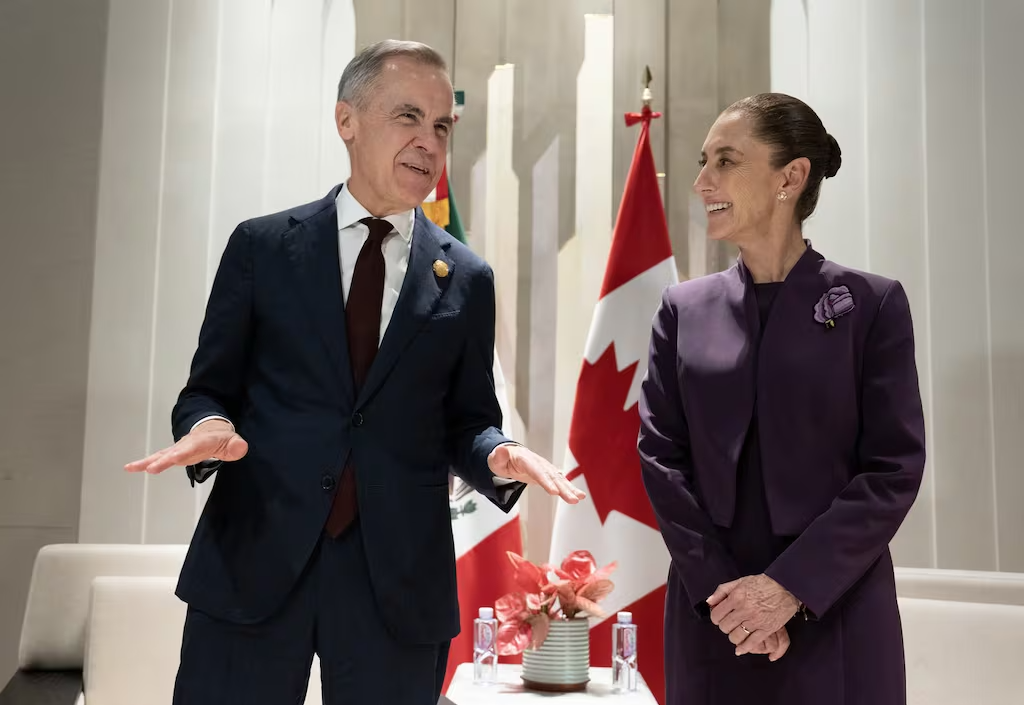
Merchandise trade between Canada and Mexico rose 19 per cent in the first nine months of 2026 compared with the same period of 2025, according to the Prime Minister's Office. Carney and Sheinbaum met in Shenzhen on 17 November and agreed to speed up work under the action plan they launched in Mexico City in September 2025, with supply chains, critical minerals and defence among the priorities. Mexican companies have invested nearly C$1 billion in Canadian mining and food production and Canadian companies more than C$3.7 billion in Mexican manufacturing, renewable energy and mining, the office said.
Statistics Canada figures show two-way goods trade of C$34.42 billion between January and August, up 18.3 per cent. Canadian exports to Mexico grew 21.4 per cent to C$7.51 billion and Mexican exports to Canada 17.4 per cent to C$26.91 billion. Mexico is Canada's third-largest single-country trading partner, after the U.S. and China. Both leaders said in Shenzhen that they want the Canada-United States-Mexico Agreement renewed.
U.S. tariffs and demands
The U.S. declined to confirm a 16-year extension of that agreement at its six-year joint review on 1 July, and the Office of the U.S. Trade Representative said it did not agree to renew it "in its current form". The agreement remains in force, with its tariff preferences unchanged, and now faces review every year until 2036 unless all three countries agree to extend it.
Canada's talks with the U.S. broke down in August. The U.S. then put 50 per cent tariffs on a range of Canadian goods, and Canada has charged retaliatory tariffs on C$27.6 billion of U.S. goods since 8 September. Janice Charette, Canada's chief negotiator with the U.S., told MPs on 17 November that the government aimed to get as close as possible to tariff-free trade and that the U.S. had yet to agree to it. Carney and U.S. President Donald Trump met for about 20 minutes in Shenzhen on 18 November and agreed to keep negotiating. Carney said afterwards that Canada's trade with China was not Trump's top concern, because Canada sells China mainly commodities and no sensitive technology such as advanced semiconductors.
Trump told a White House news conference on 20 November that the U.S. was getting close to a deal with Mexico. He said he had told Sheinbaum the U.S. would not accept Mexico's trade surplus, and that cartels were running Mexico. Sheinbaum said on 23 November that the meeting had covered only trade. "En esta reunión no se trató ese tema, fue exclusivamente el tema del comercio" ("That subject was not discussed at this meeting, it was only trade"), she said. Trump put the U.S. deficit with Canada at about US$80 billion. "When it's down to zero, come over and let's start talking," Trump said.
Mexico's surplus with the U.S. rose more than 20 per cent in the first eight months of 2026 to almost US$156 billion, according to U.S. Census Bureau data, despite Trump's demand that it fall. Mexican exports to the U.S. reached a record US$419.34 billion over the period. Canada's goods surplus with the U.S. widened to C$12.3 billion in September, Statistics Canada reported, after higher shipments of crude oil and gold. The non-U.S. share of Canadian exports fell back to 29.8 per cent that month from July's record.
A classified directive from U.S. Defence Secretary Pete Hegseth, first reported on 20 November, limits meetings between senior U.S. and Canadian officers to those that advance U.S. defence objectives, Senator Mike Rounds said in Halifax on 21 November. It leaves the North American Aerospace Defense Command and intelligence sharing untouched, he said. Peter Navarro, a White House trade adviser, accused Carney on 16 November of threatening to play China off against the U.S.
Trump has accused Mexico of serving as a route for Chinese goods into the U.S., which the Mexican government denies. Mexico's tariffs on Chinese imports have been seen partly as an effort to ease U.S. concerns. Sheinbaum and Trump are due to meet again at the Group of 20 summit in Florida in December. The U.S. Trade Representative opened public consultations on 5 October for the agreement's 2027 joint review.