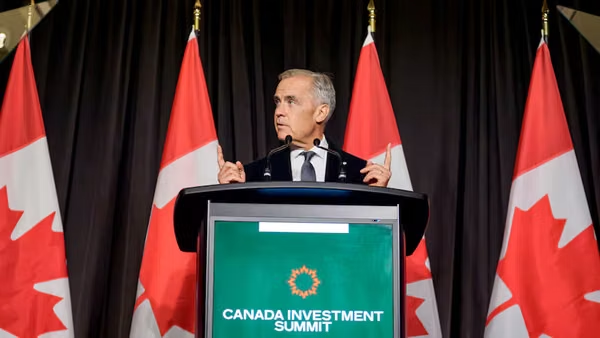
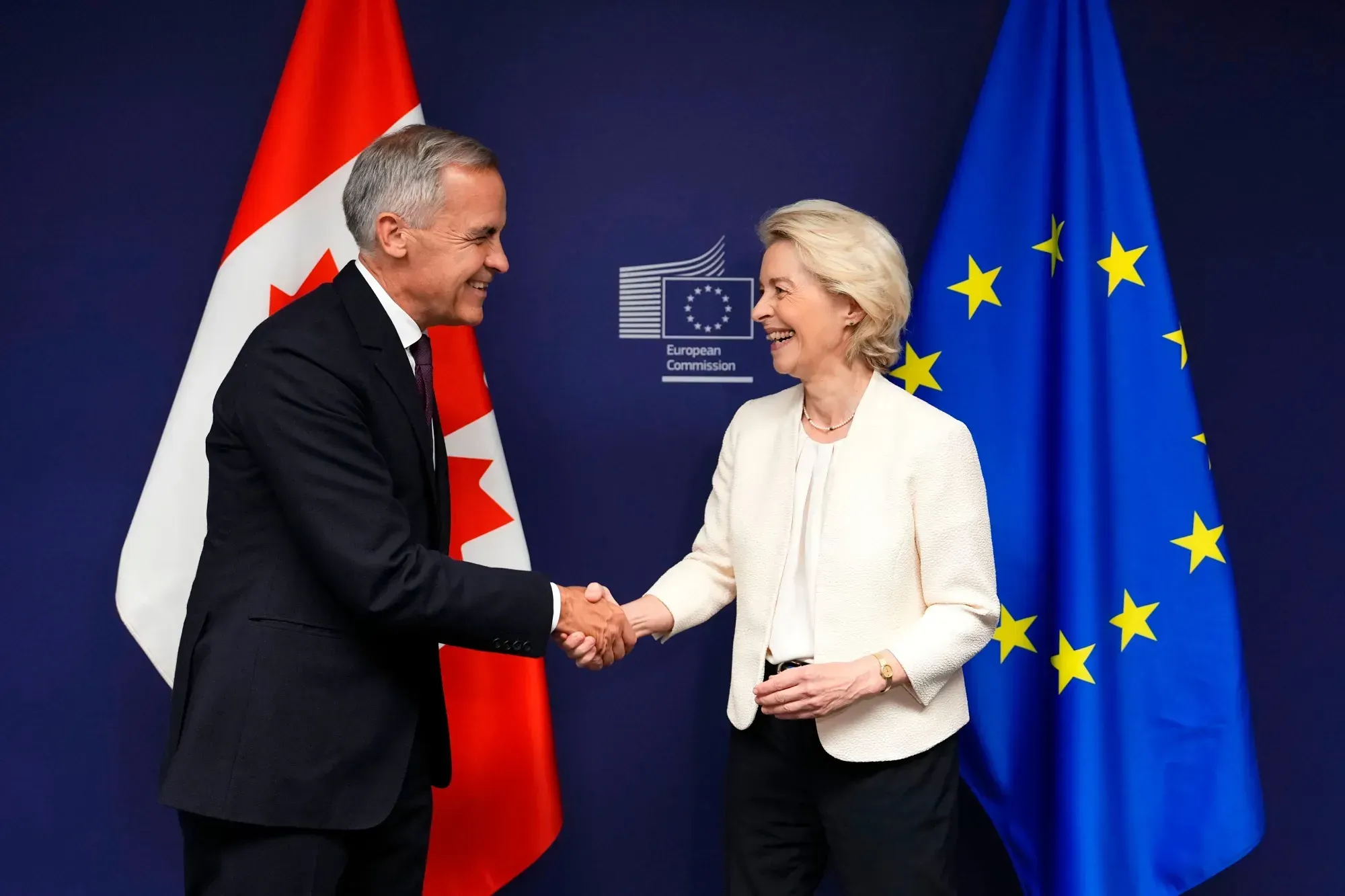
Ursula von der Leyen said in the European Parliament chamber in Strasbourg on 16 September that she wants Canada to become the first associate member of the European Union, a status that does not exist in the EU treaties. "We want to bring the relationship with Canada to the highest level possible. So, I would like to work with you on opening the door for Canada to be the first associate member of the EU," she said in her state of the union address. Mark Carney, seated in the front row as guest of honour, stood, crossed to von der Leyen and embraced her before waving to the chamber. He stayed for more than an hour of the debate that followed.
"Mark, your presence here is a symbol of the enduring friendship between our people," von der Leyen said, according to the transcript published by the European External Action Service. "Europe and Canada believe in democracy. We believe that power does not belong to the strongest, the richest or the loudest, but to all of us." She said the two sides "see the world with the same eyes: from AI to climate change, from the Arctic to geopolitics", and that "we share one ocean, one set of values, one way of seeing the world".
"We will move from CETA to an Alliance for the Future to create a common prosperity and economic security space," von der Leyen said. "We will create a tech alliance. We will integrate defence industrial bases. We will make the Arctic a flagship joint project." Energy, critical minerals, batteries, artificial intelligence, quantum, cyber and economic security were the fields she listed. "Thanks to CETA, our trade in goods has grown by 75 per cent in less than a decade," she said, placing the Canada passage after a list of agreements signed this year with India, Mercosur, Mexico, Australia and Indonesia and a claim of trade deals in place with more than 80 countries.
Von der Leyen said the arrangement is "not against anyone else, but for our common strength", and did not name Donald Trump.
Unique relationship
Jonathan Wilkinson, the former natural resources minister named on 30 April as Canada's next ambassador to the EU, said on 16 September that Canada is not ready to take the label. "We're not there," Wilkinson said of associate membership. "It's nomenclature. I think we've actually got to get to the point where we know what we're describing." Canada is "still in the process of defining the shape and defining how far we're going to be able to go", he said, and full membership is "a sovereignty issue", while Canada wants to "get as close as we possibly can".
Carney's office said after the address that "Canada is deepening and widening its relationship with the European Union to strengthen our sovereignty. This is a unique, positive approach that we will define together." Carney met von der Leyen and the Parliament's president Roberta Metsola after the speech, and his office said the leaders would remain in close contact. Carney addresses the chamber on 17 September at Metsola's invitation.
Tobias Cremer, a German Social Democrat member of the Parliament, said of the EU-Canada relationship that "now is the time to stop sending each other love letters and put meat on the bone".
Iratxe Garcia Perez, president of the Socialists and Democrats group, said Carney had shown "great courage confronting Donald Trump" and that allies were needed to protect "sovereignty, solidarity and international law". Barry Andrews, who chairs the Parliament's development committee, called Canada "a perfect ally for Europe", and said more than 10 per cent of Canadians claim Irish ancestry.
Von der Leyen gave no detail on how associate membership would work, or how it would sit alongside the countries applying for full membership.
The European Security Council proposal
Von der Leyen used the same address to propose a European Security Council, a leaders' format bringing the EU together with the United Kingdom, Canada, Norway and Ukraine. Membership, decision-making procedure and legal basis were not set out, and the Commission is to bring forward proposals. She also set out an Emergency Security Protocol, letting any member state trigger consultations across all 27 capitals on hybrid attacks falling below the threshold of armed attack. "The hybrid threats facing Europe are less and less hybrid and less and less threats," von der Leyen said.
Where the status would have to come from
Article 49 of the Treaty on European Union restricts membership applications to "any European State", the provision the Commission cited in 2025 when the German Renew member Joachim Streit asked whether Canada could join. Article 217 of the Treaty on the Functioning of the European Union is the power the EU has to conclude association agreements with third countries, involving reciprocal rights and obligations, common action and special procedure. Association agreements under that article require progressive alignment with EU law and transposition of the relevant acquis into the associate's own statute book.
Member states decide whether the idea proceeds, and any treaty change to create a membership tier would need unanimity in all 27 capitals plus domestic ratification in each. Single market access without a seat would make Canada a rule taker on EU legislation it had no vote on.
The models already in service
The European Economic Area covers Norway, Iceland and Liechtenstein, extends the four freedoms of goods, persons, services and capital to all three and adds cooperation on research, education, social policy, environment and consumer protection. The agreement leaves out the common agricultural and fisheries policies, the customs union, the common trade policy, foreign and security policy and monetary union. The three states have no formal access to EU decision making and can only comment during the preparatory phase when the Commission drafts legislation, through expert groups and written submissions.
The Council authorised signature and provisional application of an association agreement with Andorra and San Marino on 16 July 2026, giving both a place in what it called a homogenous extended internal market on identical rules, with access to financial services phased in as the European Supervisory Authorities complete regulatory audits. Member states pre-sign in September 2026, the Commission signs for the EU, the European Parliament must consent and the Council then concludes. Dialogue mechanisms cover research, education, social policy, environment, consumer protection, culture and regional cooperation.
Neither the EEA states nor Andorra and San Marino are represented in the Council, the Commission or the Parliament, and both accept EU rules they had no vote on.
Friedrich Merz put the phrase into European circulation on 21 May 2026, in a letter to EU leaders proposing associate membership for Ukraine ahead of the June summit in Brussels. Access to the European Council, the Commission and the Parliament without voting rights, step-by-step participation in EU-funded programmes and the ability to request assistance under Article 42.7 of the Treaty on European Union were the elements, with a snap-back mechanism to freeze the status if Ukraine backslid on the rule of law. Several capitals pushed back and the proposal did not advance. The phrase has also been floated for post-Brexit Britain without producing any concrete step.
Renew Europe members wrote to the trade commissioner Maroš Šefčovič on 14 September asking for a "Strategic Association" with Canada under Article 217, full ratification of CETA, an EU-Canada investment initiative and a trade defence pact against economic coercion. "Canada is rethinking its place in the world. The United States has chosen confrontation with Canada. Europe should respond with an embrace," the letter said.
Barry Appleton, an international trade lawyer, wrote on 13 September that two different arrangements share the word association and that conflating them is the trap. Programme association is a subscription, of the kind Canada already has with Horizon Europe, bought without changing domestic law. Treaty association under Article 217 is an economic constitution, he wrote, and the Union rarely, if ever, adapts to the associate.
Carney ruled out membership three days earlier
The Wall Street Journal reported on 13 September that Carney had spent months pressing EU leaders on whether Canada could become an associate member, citing unnamed EU and Canadian officials. Carney said the same day at the Toronto International Film Festival Tribute Awards: "Look, we're not looking to become a member of the European Union. We are looking and will begin discussions for [a] unique alliance with the European Union between Canada and the European Union." A Canadian government source told CTV News that the report overstates the discussions.
Pierre Poilievre said "We will NEVER be the 28th EU state", and said the government should be permitting resource extraction and shipping instead, on the argument that tariff-free trade with Europe already exists.
What nine years of CETA produced
EU exports to Canada support 700,000 European jobs, 70,000 more than before CETA took effect, according to the European Commission's factsheet on the agreement. 44 per cent more European small and medium-sized firms export to Canada than did beforehand, and EU goods exports to Canada have risen 26 per cent.
Irish meat exports to Canada rose 603 per cent, Polish milled products 1,065 per cent, Greek aluminium doors and windows 720 per cent, Cypriot fire extinguishers 429 per cent, Czech grand pianos 334 per cent, German ships and boats 263 per cent and French bread, pastry and cakes 141 per cent, on the Commission's sector breakdown. Base metals imported by the EU from Canada rose 143 per cent between 2017 and 2022, minerals 131 per cent, energy 70 per cent and fertilisers 225 per cent.
Canadian suppliers can bid into the EU's $1.3 trillion public procurement market under CETA, at federal, provincial and Crown corporation level, with thresholds starting at 130,000 special drawing rights. Canadian researchers have been able to lead consortia and draw direct Horizon Europe funding since Canada associated to Pillar II of the programme on 3 July 2024, under an agreement signed in Montreal by the European commissioner Iliana Ivanova and the Canadian minister François-Philippe Champagne.
What CETA does and does not cover
CETA has applied provisionally since 21 September 2017, removing duties on 98 per cent of tariff lines at entry into force, rising to 99 per cent. The Library of Parliament puts the share of the agreement in effect at about 90 per cent. Investment protection, the investor-state court system and related provisions in the investment, financial services and intellectual property chapters are not applied and will not be until every member state ratifies.
17 of the 27 member states had ratified as of 31 August 2025. Belgium, Bulgaria, Cyprus, France, Greece, Hungary, Ireland, Italy, Poland and Slovenia had not. Cyprus voted against ratification in 2020 without filing a formal notification, the step that would let the Council terminate provisional application by qualified majority.
Canada maintains its own external tariff, is in no customs union with the EU and is not represented in the Council, the Commission or the Parliament.
Travel, work and the border
Canadians may enter the Schengen area without a visa for up to 90 days in any 180-day period and have no right to work or reside. The Entry-Exit System began progressive deployment in October 2025 and became fully operational at every external Schengen border crossing on 10 April 2026, recording facial images, fingerprints, passport data and every entry and exit in place of a stamp. More than 52 million entries and exits had been registered by that date, with over 27,000 refusals of entry and more than 700 people judged a security risk to Europe.
ETIAS opens in the final quarter of 2026 at a price of 20 euros, valid for three years or until the passport expires, free for travellers under 18 and over 70. Most approvals come back within minutes and a manual review can take up to 72 hours. Enforcement is discretionary through a transition period ending around April 2027, with strict enforcement expected from about October 2027. The European Commission's portal at europa.eu/etias is the only official application route.
Contractual services suppliers and independent professionals can obtain a work permit for up to 12 months under CETA, with an option to extend for a further 12. Intra-corporate transferees, meaning specialists, senior personnel and graduate trainees, can stay for up to three years unless the contract is shorter. None of those categories requires a labour market impact assessment, and spouses of intra-corporate transferees are covered by the same exemption.
Maninder Sidhu launched the first mutual recognition agreement for professional qualifications under any Canadian free trade agreement on 19 January 2026, covering architects, after the CETA joint committee adopted it on 10 October 2024. "Trade diversification is about securing more opportunities for Canadians to compete and succeed in the world's fastest-growing markets," Sidhu said. Architecture is regulated at provincial and territorial level in Canada. No other profession has an equivalent agreement.
36 bilateral youth mobility agreements are administered through International Experience Canada, 26 of them with European countries and 22 of those with EU member states, France, Germany, Ireland, Italy, Poland, Spain and the Netherlands among them. Permits last between six and 36 months depending on the country and the category chosen, age limits are 18 to 35 in most cases and 18 to 30 in a handful, and the three categories are working holiday, young professionals and international co-op.
A Canadian official familiar with the discussions told the Associated Press in the week before the address that Ottawa was exploring ties with the EU that could stop just short of membership, and that Canada would seek an arrangement allowing its citizens to live and work in Europe without visas as part of a broader strategic partnership. The Wall Street Journal reported on 13 September, citing unnamed EU and Canadian officials, that sectoral labour mobility for workers in energy, artificial intelligence, defence and critical minerals was under discussion, along with visa-free residency and work rights Carney is said to have raised with Emmanuel Macron. Neither account names its sources.
Carney said in Toronto on 15 September that a change to visa rules is a possibility, and that visas are one part of talks covering energy, critical minerals, defence, space and artificial intelligence. "They need our energy, we'll have some benefit from some of their clean energy technology and investors without question. So, there is some reciprocity. They need our critical minerals," he said. "People use 'partnerships' maybe a little too quickly."
Pierre Poilievre said in Vancouver the same day that "we want Canada to have free trade with Europe, co-operation with Europe, but we'll never surrender our independence and sovereignty over our laws, our tax money and our immigration policies".
Genevieve Tuts, the EU's ambassador to Canada, told the Canadian Press on 9 September that "what we have in mind is something different from what we have with other countries" and that "that will be something unique".
Canada's place in EU defence today
Canada signed a Security and Defence Partnership with the EU on 23 June 2025 and became the first non-European participant in SAFE, the EU's 150 billion euro defence procurement programme, which the Council concluded on 15 June 2026. Canadian content may account for up to 80 per cent of the value of a SAFE procurement, against the 35 per cent ceiling applied to other non-EU countries, according to Global Affairs Canada, under an arrangement that expires at the end of 2030. NorthStar Earth and Space, Telesat, Kepler Communications and MDA Space are among the firms expected to bid. Canada was invited on 6 May 2021 to join the PESCO project Military Mobility, alongside Norway and the United States.
Anand Sundar of the European Council on Foreign Relations wrote on 9 September that Canada's place in EU defence structures remains mostly non-binding. Canada is ineligible for PESCO projects supported by the European Defence Agency, has no administrative arrangement with that agency and is a third country for European Defence Industry Programme funding, under which a European system with 35 per cent American components qualifies while a wholly Canadian one does not.
What Canada brings to the table
Canada ranks first in the world in potash production, second in uranium and third in palladium, according to Natural Resources Canada figures published in February 2026. Mining contributed $156 billion to nominal GDP in 2024, 5 per cent of the total, and mineral exports were $153 billion, 21 per cent of all domestic exports. The sector sustained 724,000 jobs, 314,000 of them direct. Canadian companies accounted for 38 per cent of global non-ferrous exploration budgets, and the Toronto Stock Exchange and its venture exchange raised 46 per cent of the world's total equity capital for mining in 2024.
EU lithium demand from electric vehicles and storage is projected to rise nine to 12 fold by 2030, and Canadian lithium reserves could supply about half of cumulative global demand between 2030 and 2050, according to a Clean Energy Canada report of 13 August 2026. Cobalt, copper, graphite, lithium, nickel and rare earth elements appear on both the Canadian and EU critical minerals lists, and Canada ranks second only to Norway against the EU's own supplier criteria. The report found the pipeline of Canadian critical minerals into the EU has barely grown in recent years.
Ksi Lisims LNG signed a binding agreement with the German utility Uniper on 29 July 2026 for 2 million tonnes a year for up to 20 years, with first deliveries expected in 2032. A letter of interest signed in May 2026 with the German company SEFE covers a further 1 million tonnes a year, and together the two agreements earmark about a quarter of the project's capacity for European buyers. The project is a $30 billion investment and is projected to add $15 billion to Canadian GDP.
The August collapse
Canada-United States trade talks collapsed on the night of Friday 22 August, and Washington imposed tariffs of 50 per cent on billions of dollars of Canadian goods. Carney said he walked away over three points: the exclusion of medium and heavy trucks from tariff relief and the treatment of Canadian content in vehicles, "efforts to restrict our ability to have other trade deals" introduced in the final hours, and "efforts to restrict our protections of our language, our culture, and in effect, our sovereignty".
Trump posted an AI generated map on Truth Social on 7 September showing the United States flag over Canada, Mexico, Greenland, Iceland, Cuba and Caribbean territories, with no caption. Iceland summoned the United States ambassador and called the post completely inappropriate. Claudia Sheinbaum wrote on X that "Mexico is neither nor will be a colony or protectorate of any foreign country".
Canada's counter-tariffs on C$27.6 billion of American goods took effect at 12:01 am eastern on 8 September. Trump signed five proclamations under Section 338 of the Tariff Act of 1930 the same day, banning imports of certain Canadian alcoholic beverages and dairy products from 29 September, modifying tariff coverage on steel, agricultural equipment, motor vehicles and all-terrain vehicles from 15 September and directing the removal of Canadian-origin products from federal procurement schedules covering more than $50 billion.
Two-way trade in goods and services between Canada and the EU came to C$178 billion in 2025, and the EU is Canada's second trading partner at 8.7 per cent of its trade. About 68 per cent of Canadian exports went to the United States in early 2026, down from roughly 75 per cent before the trade war.
The EU took a different route with Washington, settling on an accord that caps tariffs on most European exports at 15 per cent and removes duties on American industrial goods. Canada retaliated and walked away.
The wider turn
Carney told the World Economic Forum in Davos in January that middle powers should organise together. "When we only negotiate bilaterally with a hegemon, we negotiate from weakness. We accept what is offered," he said, describing the alternative as performative sovereignty. Trump rebuked the speech.
Indonesia signed a free trade agreement and a defence agreement with Canada in September 2025, reducing or eliminating tariffs on 95 per cent of Canadian exports including wheat, potash, wood and soybeans, and it was the first bilateral trade deal Canada concluded with an ASEAN state. Ecuador signed in July 2026 and the United Arab Emirates signed in July 2026 after negotiations that took 47 days. Mercosur, ASEAN and India are the three negotiations the government has said it wants concluded before the end of the year, with bilateral talks also under way with the Philippines, Thailand and Turkey.
Defence and technology agreements were signed with Denmark and Germany in February 2026, South Korea in February 2026, Japan in March 2026, Australia in March 2026 and France in June 2026. Canada hit the NATO 2 per cent of GDP defence spending target on 26 March 2026 after spending $63 billion over 10 months, and the commitment now standing is 5 per cent of annual GDP by 2035, split 3.5 per cent core defence and 1.5 per cent security related investment. Canada's defence sector supports 61,200 jobs across the value chain, 36,000 of them direct across about 600 firms, generating $14.3 billion in revenues and $7.4 billion of GDP a year.
$116 billion of projects have been referred to the Major Projects Office across two tranches, $60 billion in September 2025 and $56 billion on 13 November 2025, including Ksi Lisims LNG, the North Coast Transmission Line, Canada Nickel's Crawford project, Nouveau Monde Graphite's Matawinie mine and the Iqaluit Nukkiksautiit hydro project. Crawford is projected to create 4,000 jobs and Matawinie 1,000.
$210 billion in long-term output, close to 7 per cent of real GDP as of 2025, is what the IMF estimated on 28 January 2026 that Canada could gain by eliminating its own internal trade barriers, which it put at the equivalent of a 9.5 per cent national tariff. More than 90 per cent of those gains would come from services, and removing the barriers would offset roughly half the damage of a 10 per cent American tariff increase. Interprovincial trade was worth $527 billion, 17 per cent of GDP, on Statistics Canada figures.
Abacus Data found 81 per cent support for closer integration with the EU short of membership, in a survey of 1,479 Canadian adults conducted between 4 and 9 September 2026 with a margin of error of 2.5 percentage points 19 times out of 20. Membership itself drew 49 per cent support, 30 per cent opposition and 21 per cent unsure. Nanos Research, polling 1,099 Canadians for the Globe and Mail between 31 March and 4 April 2026 with a margin of error of 3.0 percentage points, found close to three in five in favour of joining.
The calendar
Metsola said on 14 September that the European Parliament will open a liaison office in Ottawa, its 10th worldwide alongside Kyiv, London and Panama, which "will help to facilitate exchanges with Canadian MPs and senators" on the Arctic, security and transatlantic trade.
Carney meets Andy Burnham in Liverpool during the same trip, in the first meeting between the two since Burnham became UK prime minister, on defence and security, energy, artificial intelligence and critical minerals. Emmanuel Macron meets Carney on 20 September at Saint-Pierre-et-Miquelon, the first visit to the archipelago by a Canadian prime minister.
The Canada-EU summit takes place in Montreal on 29 and 30 October, with new working groups expected there.
SAFE lets Canadian firms supply up to 80 per cent of the value of a joint European procurement until the end of 2030. Uniper has a 20-year LNG contract with Ksi Lisims starting in 2032, and Canadian labs have drawn Horizon Europe money since July 2024. Canada's first place in potash, second in uranium and third in palladium are current production rankings, and the European market that buys those minerals supports 700,000 jobs on its own side of the Atlantic. Six trade and defence agreements were signed after September 2025, Mercosur, ASEAN and India are in negotiation, $116 billion of projects have gone to the Major Projects Office and the IMF puts another $210 billion inside Canada's own provincial borders. 81 per cent of Canadians told Abacus they want the European relationship to go further, the Parliament that invited Carney will open an office in Ottawa, and 450 million European consumers want what 41 million Canadians have to offer.