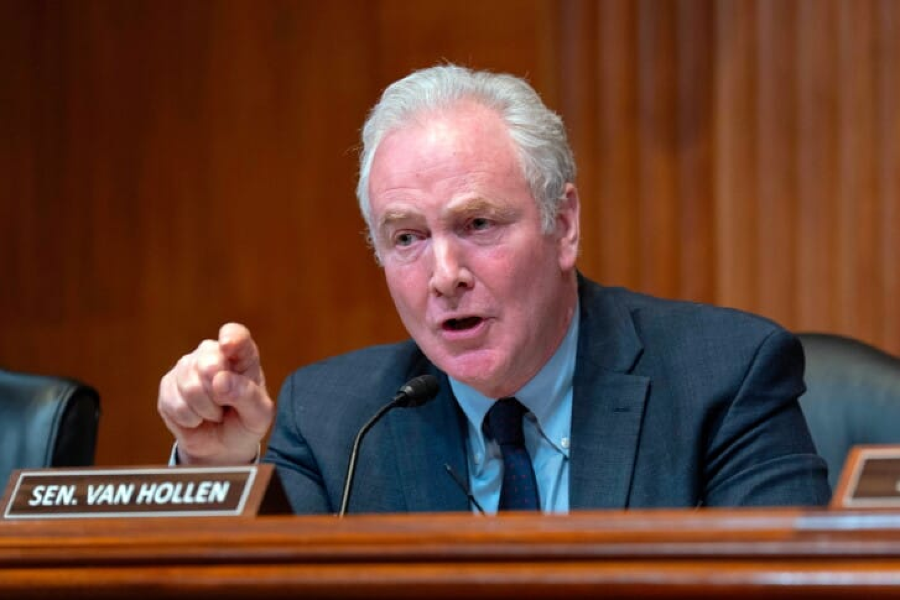
Chris Van Hollen, the Democratic senator for Maryland, wrote on X on 21 September 2026 that governments belonging to the International Criminal Court should impose sanctions on the president of the United States and his secretary of state. "If European countries & other signatories to the International Criminal Court have any self-respect, they'd sanction Rubio & Trump for obstructing investigations of Netanyahu's war crimes," he wrote. He posted the day after it was reported that the administration of US President Donald Trump had prepared sanctions against the court as an institution rather than against its officials one at a time.
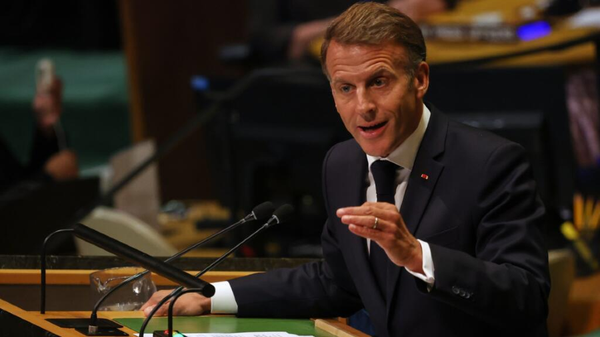
Trump told the United Nations General Assembly in New York on 22 September 2026: "I call on all nations that are members of the ICC to officially resign from this rogue institution immediately." He called the court "an evil group of people" and said: "We will never allow US service members or anyone else to be investigated or given show trials by an anti-American tribunal with no jurisdiction over us."
The measures would bar US citizens and US companies from providing the court with funds, goods or services unless the Office of Foreign Assets Control, the sanctions unit of the US Treasury Department, granted a licence. Both put the grace period at six to seven months. Designating the institution would place it on the Specially Designated Nationals and Blocked Persons List, the register banks screen against before clearing payments, which would cut the court off from dollar transactions and from much of the global banking system. The Associated Press reported on 21 September 2026 that US officials had told Dutch counterparts the measures could take effect as early as the start of this week.
Marco Rubio, the US secretary of state, wrote in the Wall Street Journal on 13 July 2026 that the United States would take the court apart "brick by brick, if necessary". A State Department press release that week said the administration was ready to "systematically dismantle the ICC until it is incapable of threatening American sovereignty". Rubio called the court "a corrupt and fatally politicized supernational court" that had "exceeded its mandate".
The sanctions laws in Europe
The International Criminal Court cannot impose sanctions on anyone. It issues arrest warrants, and enforcement falls to its member governments. Any listing of Trump or Rubio would have to come from governments acting under their own sanctions laws. Van Hollen's post addresses European countries and other signatories, not the court.
Council Regulation 2020/1998, the European Union's global human rights sanctions regime, allows travel bans, asset freezes and a bar on making funds available to people responsible for serious human rights violations anywhere in the world. Listings are proposed by the High Representative or by a member government and decided by the Council, which can designate only by unanimity among all 27 member states. Hungary's government has stayed inside the Rome Statute after a parliamentary vote, and no member state has publicly proposed listing a serving US official.
Britain designates under its own Global Human Rights Sanctions Regulations 2020, outside the European Union, where the foreign secretary lists individuals directly and no vote of other governments is needed. The Foreign, Commonwealth and Development Office published its most recent sanctions notice under that regime on 8 September 2026.
Article 70(1)(c) of the Rome Statute makes it an offence against the administration of justice to retaliate "against an official of the Court on account of duties performed by that or another official". No Peace Without Justice, an international human rights organisation, wrote on 6 June 2025 that the US designations of court judges fall under that provision and that the prosecutor may open proceedings without a referral. Brian Cox wrote in Just Security against that reading. Rule 163 of the Rules of Procedure and Evidence appears to grant wide article 70 jurisdiction but conflicts with the jurisdictional requirements of articles 12 and 13, and article 51(5) provides that the statute prevails over the rules where the two conflict. The principle that there is no crime without law leaves US nationals outside article 70 unless they hold the nationality of a member state or the provision has passed into customary international law, which he wrote it has not.
The Russian foreign ministry imposed entry bans on Joe Biden, Antony Blinken, Lloyd Austin and Hillary Clinton on 15 March 2022, and published a list of 963 Americans barred from the country that May.
Van Hollen on Israel and the arms sales
Van Hollen said on 16 September 2026 that he would move to block a proposed $2.8bn transfer of munitions to Israel. "Trump is sending $2.8 billion of bombs paid for by you, the American taxpayer, to a govt led by a wanted war criminal," he said. The package covers 20,000 MK-84 general-purpose bombs, 20,000 BLU-117s and 20,000 I-2000 penetrator warheads, funded through Foreign Military Financing. Democracy for the Arab World Now wrote to Congress on 18 September 2026 urging joint resolutions of disapproval under the Arms Export Control Act. "A vote to let this sale proceed is a decision to help Israel commit more war crimes," said Omar Shakir, the organisation's executive director.
Common Dreams reported on 26 May 2026 that Van Hollen had said the Democratic Party must admit its complicity in Israel's conduct in Gaza and should not return Biden administration foreign policy officials to office.
The Senate blocked the Illegitimate Court Counteraction Act on 28 January 2025 by 54 votes to 45, nine short of the 60 needed to advance it. John Thune, the majority leader, said the "illegitimate targeting of a key US ally should concern all of us". Chuck Schumer, the minority leader, said he backed the substance but called the bill "poorly drafted and deeply problematic". John Fetterman was the only Democrat to vote for it.
Adil Haque, a professor of international law at Rutgers University, wrote that Congress could repeal the American Servicemembers' Protection Act, which bars cooperation with the court and which a later amendment opened for Ukraine. Ilhan Omar proposed repeal in 2022.
The blocking statute and the Dutch banks
Regulation 2271/96, the European Union's blocking statute, bars companies in the bloc from complying with listed US measures that reach outside US territory. The European Commission last activated it in 2018 over US sanctions on Iran, and has not extended it to cover the court. Tomoko Akane, the court's president, asked the European Parliament in March 2025 to bring the court's officials under its protection. Belgium, Slovenia, Germany, Spain and Ireland have pressed for activation. Spain formally asked the Commission on 6 May 2026 to ensure that US sanctions on Francesca Albanese and on the court's judges and prosecutors have no effect inside the bloc.
Kaja Kallas, the European Union's foreign policy chief, offered the court the bloc's "unwavering support" and called it a cornerstone of international criminal justice. Ursula von der Leyen, the president of the European Commission, and António Costa, the president of the European Council, said in a joint statement on 19 August 2026: "The ICC helps deliver justice to the victims of some of the world's most horrific crimes."
Sergey Vasiliev, a legal scholar, said: "The blocking statute provides legal cover to EU operators, assuring them they should not fear such extraterritorial measures." Luigi Daniele, a law professor, called the bloc's inaction "shocking" and said: "The greatest economic powers of the EU are willfully protecting the effects of these unlawful sanctions." Analysts at the Atlantic Council wrote that the Commission may first press banks to move the court's business into smaller institutions rather than activate the statute. ING, Rabobank and ABN AMRO, the three largest Dutch banks, all have US exposure, which leaves them answerable to two legal systems at once.
Tom Berendsen, the Dutch foreign minister, told parliament that his government disapproves of the sanctions on court staff and that "Dutch efforts have contributed to the Court's ability … to continue the vast majority of its operations unimpeded thus far". He also said: "International courts and tribunals must be able to freely carry out their mandates." Kati Piri, an opposition member of the Dutch parliament, called the cabinet's position "super weak". David van Weel, the Dutch minister of justice and security, said the Netherlands cannot carry the problem alone. Rob Jetten, the prime minister, is due to address the General Assembly this week, and Berendsen is in New York for meetings on the court and on Ukraine.
Court administrators have moved off Microsoft products to German software, shifted insurance and financial services away from US providers and asked the Treasury Department for six months before any designation takes effect. The Netherlands, as host state, is obliged to provide security cooperation, visa facilities and transport for defendants and witnesses.
The designations so far
Pre-Trial Chamber I issued arrest warrants on 21 November 2024 for Benjamin Netanyahu, the prime minister of Israel, and Yoav Gallant, his defence minister at the time, for the war crime of starvation as a method of warfare and for murder, persecution and other inhumane acts as crimes against humanity in Gaza. The Appeals Chamber rejected Israel's jurisdictional challenge on 15 December 2025 and left both warrants in force. Netanyahu and Gallant deny the charges, and the Israeli government says the war in Gaza was fought lawfully to recover hostages and defeat Hamas. Netanyahu's office has called the accusations antisemitic.
The Treasury Department has designated 13 court officials since 13 February 2025, among them nine of the court's 18 judges, both deputy prosecutors and Karim Khan, the former chief prosecutor whom member governments removed from office on 24 July 2026.