The Independent International Fact-Finding Mission on the Islamic Republic of Iran found "reasonable grounds to believe" that the United States committed the war crime of launching indiscriminate attacks in two strikes on 28 February 2026, the opening day of the US and Israeli air campaign against Iran. The mission is chaired by Bangladeshi jurist Sara Hossain and its other members are Viviana Krsticevic of Argentina and Max du Plessis of South Africa. It published its report on 17 September for the UN Human Rights Council's 63rd session in Geneva, which runs until 9 October.
The Human Rights Council created the mission in November 2022 to investigate the crackdown on the protests that followed the death of Mahsa Amini, and its current mandate, under resolution S-39/1, runs through the council's 67th session. Its investigators interviewed 73 people for the report, 39 men, 32 women and two boys, and worked from satellite imagery, videos, photographs, munitions analysis and official Iranian statements.
Minab, 10.30am
A US Tomahawk Land Attack Missile struck the Shajareh Tayyebeh Primary School in Minab, Hormozgan province, between 10.30am and 11.30am local time, during the school week. The mission found that "the building of the school was the intended point of impact and that the damage did not result from an errant strike or collateral damage."
Investigators counted seven detonation points across the school and the neighbouring naval base, with direct impacts on the centre of the school. The school was hit twice with a brief interval between strikes. The first munition struck the lower floor, and the second struck the upper floor, where children had moved, "killing many of the children," the mission wrote. Organisations that specialise in weapons identification confirmed the munition as an RGM/UGM-109 Tomahawk.
Bellingcat geolocated a video released by the Iranian news agency Mehr, filmed from a construction site opposite the base, showing a missile diving almost vertically into the compound. John Gilbert of the Center for Arms Control and Non-Proliferation told Time the footage "conclusively shows a Tomahawk cruise missile." Sam Lair of the James Martin Center for Nonproliferation Studies reached the same identification. The Pentagon published its own video of warships firing Tomahawks at Iran on 28 February.
A Minab resident told Amnesty International that the principals and teachers stayed behind after the first impact to get the children out. "That delay was fatal," the resident said. "Most of them were killed."
The dead
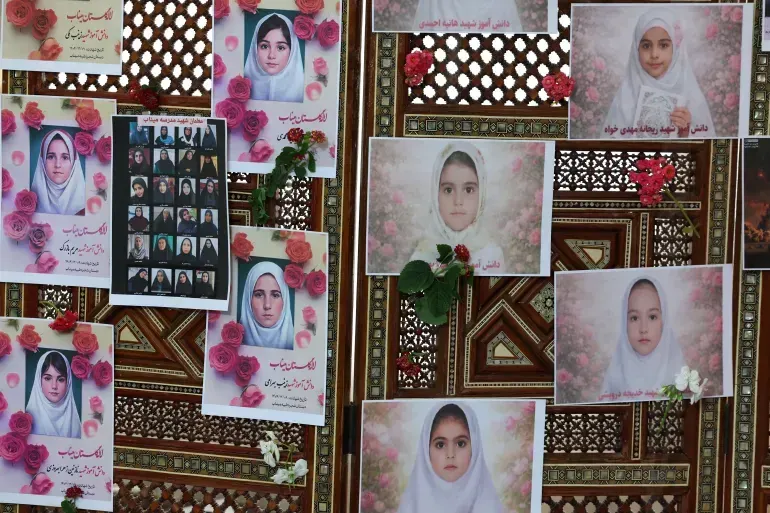
Minab prosecutor Ebrahim Taheri announced on 9 April that 156 people were killed, among them 120 schoolchildren (73 boys and 47 girls) and 26 educators, all women, as well as seven parents, a bus driver and a pharmacy technician. Independent sources cited by the mission counted 157 dead, including 123 children aged 13 or younger. A member of the Minab Red Crescent told Iranian media that another 110 people were injured. Amnesty International, which analysed 28 videos and 30 photographs, published the same figure of 156 dead on 17 March.
PBS NewsHour correspondent Reza Sayah reported from the site on 26 May and named some of the children killed, among them Sepehr Karimi, Motahareh Ahmadzadeh, Khadijeh Darvishi, Mohammad Taha Jaffari, Ali Hafizi and Hannaneh Mehdi-Khah. The remains of another pupil, Makan Nasiri, had not been recovered. Reyhandeh Mehdi Khah, 11, survived and lost her younger sister. "When they hit the school, the entire building shook," she told PBS. Fazel Alinejead, who reached the building after the strike, described seeing "body parts, small body parts, hands, fingers, heads."
Iranian state media put the toll at 168 in the first days after the strike, and a representative of the Coordinating Council of Iranian Teachers' Trade Associations gave about 175. The 168 figure travelled with a description of the building as a girls' school into a letter from 24 US senators on 27 March and into much of the international coverage since. The mission's report describes Shajareh Tayyebeh as a school "for girls and boys aged 6 to 13," and the prosecutor's breakdown lists more boys than girls among the dead. Casualty totals in news reports on 17 September ranged from "more than 150" to about 170.
A school on an old base map
Minab's school stands next to a naval complex of the Islamic Revolutionary Guard Corps (IRGC), with the nearest IRGC facility about 72 metres from the school building. A wall separating the two was built between 2013 and 2016, and by the day of the strike the school operated in its own walled compound with its own entrance. Satellite imagery shows football pitch markings in the courtyard by August 2017. Joseph Orenstein wrote in Just Security that during the conversion a fence went up, watchtowers were removed, three public entrances were added and the walls were painted blue and pink. The school also kept an online presence for years.
The mission cited child-oriented murals on the exterior walls, school signage and playground areas, and said pre-strike satellite imagery showed human figures in the courtyard identifiable as children. It concluded that the school's "civilian nature is apparent."
The New York Times reported on 11 March that a preliminary Defense Department inquiry had found the United States responsible and that the strike relied on outdated intelligence identifying the building as a military installation. Orenstein wrote on 26 March that Central Command (CENTCOM) targeting officers built strike coordinates from Defense Intelligence Agency target data that still coded the school as part of the base, without checking it against current imagery.
Senators Kirsten Gillibrand, Chris Van Hollen, Tim Kaine and 21 colleagues wrote to Defence Secretary Pete Hegseth and Admiral Brad Cooper, the CENTCOM commander, on 13 July that investigators had found an analyst's note from 2019 recording the site's conversion from naval facility to school. According to the letter, the note was entered into a system disconnected from the authoritative targeting database, the database was never updated despite later reviews and warnings about outdated intelligence were set aside for "expediency." The senators asked for the complete investigation, a public unclassified version and a remediation plan by 20 July.
Civilian protection cuts
ProPublica reported on 25 August that Hegseth cut the Pentagon's Civilian Harm Mitigation and Response programme in early 2025 from about 200 staff to about 24, some of them part-time. CENTCOM's civilian harm team went from 16 people to one. Nine of 11 regional combatant commands had told the Pentagon they wanted to keep the programme at 65 per cent of its staffing. CENTCOM warned that the cuts would "result in decreased efficiency of U.S. lethal operations due to an increased risk of target misidentification," according to ProPublica.
Hegseth said on 2 March, two days after the Minab strike, that the Iran campaign would have "no stupid rules of engagement, no nation-building quagmire."
Legal reasoning on Minab
The mission concluded that "when identifying and directing its attack against the primary school in Minab, whose civilian nature is apparent, the US failed in its obligation to do everything feasible to verify that it was a military objective." It classed the mental element as recklessness, or dolus eventualis: "Rather, the US directed the strikes at the building of the school while being aware of a substantial risk of striking a civilian object and acting recklessly as regards the possibility that this would happen."
Amnesty International said on 17 March that the strike violated international humanitarian law. Erika Guevara-Rosas, its senior director of research, advocacy, policy and campaigns, said: "If the attackers failed to identify the building as a school and nevertheless proceeded with the attack, this would indicate gross negligence in the planning of the attack."
Lamerd, 5.10pm
At about 5.10pm on the same day, missiles exploded in the air above the Shahid Haj Khalil Naimi Cultural and Sports Complex in Lamerd in Fars province and above a residential neighbourhood and an elementary school next to it. Two missiles were reported. The first hit the residential area and the second the sports centre. The mission identified the weapon as the Precision Strike Missile (PrSM), a short-range ballistic missile made by Lockheed Martin, which is designed to detonate above its target and scatter about 180,000 tungsten pellets, with an estimated damage radius of 50 to 170 metres.
A teenage girls' volleyball team was practising in the hall when the pellets came through the roof, according to The World and Iran's UN ambassador Amir Saeid Iravani. Among the dead were Elham, 11, and Helma, 10, both volleyball players. A boy playing football nearby, a day labourer from Afghanistan and a pedestrian walking to a pharmacy were also killed, The World reported. BBC Persian verified video of the blast.
Javad Mansouri, head of Lamerd's sports and youth department, reported 22 dead: 10 women and 12 men, including four schoolchildren and a two-year-old. Of the dead, 16 were killed in the residential neighbourhood. More than 100 people were injured, one specialist organisation put the figure at about 170 and five children suffered life-threatening wounds.
CENTCOM confirmed on 4 March that the PrSM had been used in combat for the first time. On 31 March it said that "US forces did not launch any strikes into the city of Lamerd on that day" and attributed the damage to an Iranian Hoveyzeh cruise missile. Weapons experts cited by the mission rejected that account, citing visible differences between the two munitions. The New York Times had earlier matched the damage pattern and footage to a PrSM detonation.
The mission found that the sports complex was "visibly separate" from an adjacent IRGC compound, with signage at the entrance gate, and that the PrSM's effects "could not be directed at a specific military objective and its effects on civilian and civilian objects could not be limited." It found reasonable grounds to believe the US committed the war crime of launching an indiscriminate attack, striking civilians and civilian objects "reckless as to the likely extent" of death and injury.
No answer from US
Together the two strikes killed at least 178 civilians, according to the figures in the report. The mission wrote to the US government on 16 June asking for information and on 24 June asked to meet the CENTCOM commander and the director of the Defense Department's Civilian Protection Centre of Excellence. "As of the finalisation of this report, the Mission had not received a response," the mission wrote.
President Donald Trump told reporters aboard Air Force One on 8 March: "In my opinion, based on what I've seen, that was done by Iran." He said Iranian forces were "very inaccurate as you know with their munitions, they have no accuracy whatsoever." Hegseth, asked to confirm that account, said: "We're certainly investigating." He also said "the only side that targets civilians is Iran." Asked days later about the Tomahawk evidence, Trump said: "Well, I haven't seen it," and said Iran "also has some Tomahawks." Iran does not operate the Tomahawk.
Cooper ordered a 15-6 administrative investigation in early March, and the Pentagon announced on 13 March that a general officer from outside CENTCOM would lead it. "We're not going to let reporting lead us or force our hand into indicating what happened," Hegseth said. "The command investigation will take as long as necessary to address all the matters surrounding this incident."
Cooper told Congress on 19 May that the Minab strike "correlated" with a US strike. Trump said at the G7 summit in Evian-les-Bains on 17 June: "Nobody did that on purpose." He said "that's under investigation" and "mistakes are made in war." The Pentagon has not published the findings of its investigation.
US rejects the report
White House principal deputy press secretary Anna Kelly said on 17 September that the Human Rights Council "has accomplished nothing for human rights while spouting unserious nonsense for decades" and that "the only party in this conflict that has committed war crimes is the Iranian regime." Pentagon spokesman Joel Valdez said: "Our investigation remains ongoing, and we have nothing to announce at the moment." A State Department official said: "We do not give credibility to findings in this report." Trump ordered the United States to withdraw from the council in February 2025.
"Reasonable grounds to believe" is the evidentiary standard UN commissions of inquiry and fact-finding missions apply, and it sits below the criminal standard of proof beyond reasonable doubt. The United States has not ratified the Rome Statute and Iran is not a party to it, so the International Criminal Court has no jurisdiction over the strikes unless one of the two states accepts it.
Tehran's crackdown
Iranian authorities committed crimes against humanity in suppressing the protests of 2025 and 2026, the mission found on the same standard of proof, listing acts "including murder, imprisonment, torture, and other inhumane acts." Security forces used lethal force in all 31 provinces and killed at least 221 children, some as young as two, according to the mission. Iranian authorities have reported 3,038 deaths, and the mission said the true number was substantially higher. An internet blackout began on 8 January and lasted more than five months, at least 29 men were executed between March and August and more than 70 people face imminent execution.
Amnesty International documented in March that Iranian authorities used traumatised child survivors of the Minab strike in state propaganda and pressed bereaved families into ceremonies that conflicted with their religious practice.
Strikes since
On 14 September the mission called for an immediate end to hostilities after two further strikes it attributed to the United States. A strike on 1 September hit a house in Kuhestak, Hormozgan province, during a wedding, killing five people including two children and a woman, and a strike on 30 July destroyed a home in Qeshm, killing a man, a woman and their two-year-old son. Kuhestak is predominantly Baloch and Qeshm predominantly Sunni. Hossain said: "Civilians must be protected at all times, and constant care must be taken to spare civilians and civilians objects from the effect of hostilities." Du Plessis said: "Repeated airstrikes causing civilian casualties raise serious questions about whether all necessary measures are being taken to comply with States' obligations under international law."
The mission's recommendations call on both Iran and the United States to cease the violations it documented, provide full reparations to victims and guarantee non-repetition.