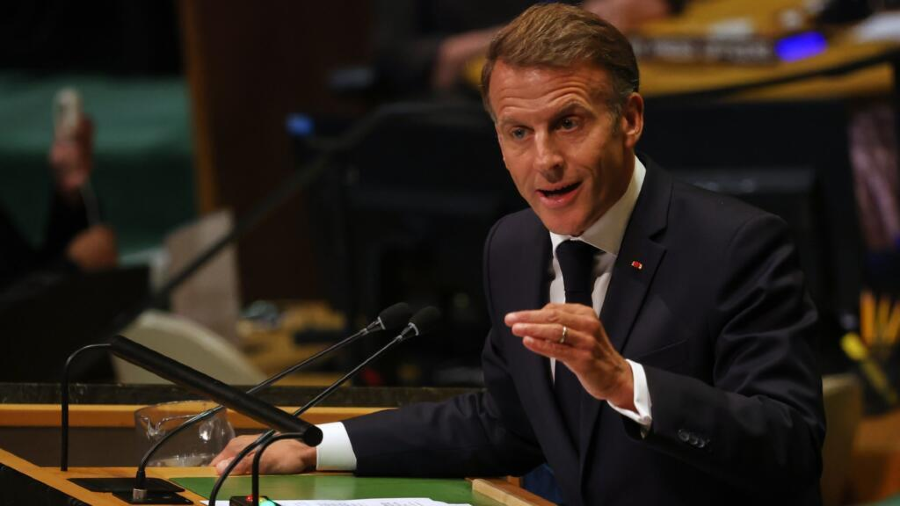
Emmanuel Macron stood at the rostrum of the General Assembly on 22 September 2026, a few hours after Donald Trump had used it to call the International Criminal Court "an evil group of people", and put a single question to the 193 member states. "The question put to us, in very simple terms, is whether we want to live in this state of nature, with a kind of return to the law of the jungle, or in a civilised international society," he said.
Macron spoke for about 30 minutes, in what is expected to be his last address to the Assembly as president of France. His second term ends in May 2027 and the constitution bars him from a third. He used the time to defend almost every institution Trump had attacked that morning, and to name the wars where he said the rules of war were being torn up in plain sight.
Macron told the hall: "My message is to stand firm. Do not yield to the situation which is developing ... The rhetoric of defeat that is giving way to abuse of power by empires, threatening the sovereignty of some nations." He named no empire. He described a world in which everyone could see "the return of imperialism, of arrogance, the return to force without rules or restraint, a world that is at bottom a concentration of power".
Macron said that "where the law of the strongest tries to impose itself, we must defend justice and the common interest". He asked delegates to "yield nothing to what is taking hold, which is at bottom a slow division of the world, a spirit of defeat" that "would leave a few in the abuse of power". He added: "We will not yield to fatalism." Macron told delegates their duty "more than ever is to stand upright alongside the United Nations", and said: "Our duty is action: France stands ready." He closed: "Let us yield nothing. More than ever, we need our United Nations. Long live the United Nations."
Two speeches, one morning
Trump used his address to defend US military action against Iran and Venezuela. "I will never allow Iran to have a nuclear weapon," he said, and told the hall that in Operation Midnight Hammer "the US military obliterated their nuclear programme". He called on countries to leave UNESCO and the International Maritime Organization, attacked the Human Rights Council and said of artificial intelligence: "Whoever wins superintelligence wins." He rejected global regulation of the technology.
Macron pledged to keep supporting the court Trump had attacked, called for a joint open-source artificial intelligence model built outside American and Chinese control and asked members to stand with the United Nations as a whole.
"A new age of barbarism"
Macron said the Geneva Conventions "are being dismantled" and that the "industrialisation" of war crimes had opened "a new age of barbarism". He named El Fasher in Sudan and the destruction of Gaza.
The Rapid Support Forces, the Sudanese paramilitary, took El Fasher in late October 2025 after an 18-month siege. At least 6,000 people were killed over three days, the UN Human Rights Office said in February 2026, including 460 at the Saudi maternity hospital, and it said the real toll was "undoubtedly significantly higher". The UN fact-finding mission on Sudan found that the killings of Zaghawa and Fur civilians bore the hallmarks of genocide. "The crimes committed in and around El Fasher were not random excesses of war," said Mohamed Chande Othman, who chairs the mission. "They formed part of a planned and organized operation that bears the defining characteristics of genocide."
Macron pledged to keep backing the court in The Hague. "Because there is no peace without justice, we will continue to support the International Criminal Court so as not to accept the new order of impunity that some would like to build," he said.
Macron backed reform of the Security Council, with new permanent members "notably from Africa" and a way for the Council to act when international law is violated on a mass scale. France has since 2015 backed limiting the use of the veto in cases of mass atrocity.
US against the court
Trump told the Assembly on the morning of 22 September: "I call on all nations that are members of the ICC to officially resign from this rogue institution immediately." He called the court "an evil group of people" and said: "We will never allow US service members or anyone else to be investigated or given show trials by an anti-American tribunal with no jurisdiction over us." He did not mention Israel in that passage. The court has 125 member governments, France among them. The United States and Israel have never joined.
Marco Rubio, the secretary of state, wrote in an opinion article on 13 July 2026 that the United States would take the court apart "brick by brick, if necessary". A State Department release that week said the administration was ready to "systematically dismantle the ICC until it is incapable of threatening American sovereignty". Rubio called it "a corrupt and fatally politicized supernational court".
The Treasury Department has designated 13 court officials since 13 February 2025 under Executive Order 14203, among them nine of the court's 18 judges, both deputy prosecutors and the court's president, Tomoko Akane, who was listed on 18 August 2026. Akane told member states the court was being threatened with "draconian economic sanctions from institutions of another permanent member of the Security Council as if it was a terrorist organisation".
The administration has prepared sanctions against the court as an institution, people familiar with the plan said on 20 September. US citizens and companies would be barred from supplying it with funds, goods or services without a Treasury licence, after a grace period of six to seven months. A listing would put the court on the Specially Designated Nationals list that banks screen before clearing payments, cutting it off from dollar transactions. Court administrators have moved off Microsoft software and away from US insurers, and the Dutch government is planning how to keep staff paid and witnesses protected. No designation of the court itself had been published as of 22 September.
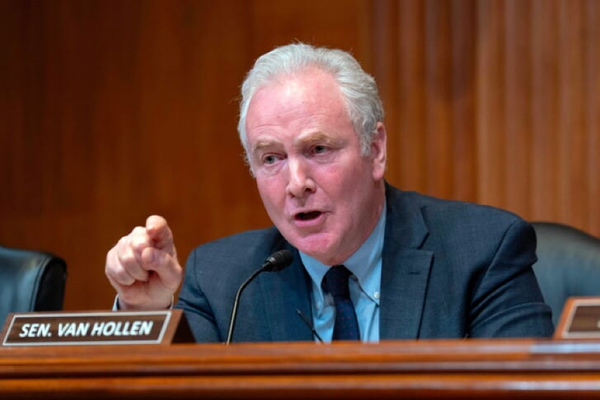
Chris Van Hollen, the Democratic senator for Maryland, wrote on X on 21 September: "If European countries & other signatories to the International Criminal Court have any self-respect, they'd sanction Rubio & Trump for obstructing investigations of Netanyahu's war crimes." No European government has proposed such a listing.
A UN fact-finding mission reported on 17 September 2026 that it had reasonable grounds to believe the United States committed war crimes on 28 February 2026, the opening day of the US and Israeli air campaign against Iran, when a Tomahawk missile struck the Shajareh Tayyebeh primary school in Minab, where 156 people died, 120 of them children, and a missile scattered tungsten pellets over a sports complex and homes in Lamerd, killing 22. The mission wrote to US twice and received no reply. Anna Kelly, a White House deputy press secretary, said the Human Rights Council "has accomplished nothing for human rights while spouting unserious nonsense for decades". Trump took the United States out of the council in February 2025.
At least 221 people have been killed in US strikes on boats in the Caribbean and the Pacific since September 2025, according to a US Office on Latin America count cited on 12 August 2026. Pete Hegseth, the defence secretary, said in Panama that day that ICC jurisdiction over the strikes would be a "lawless power grab". The court's Afghanistan investigation, authorised in 2020, still formally covers US military and CIA personnel.
Moscow and the warrants
The ICC issued arrest warrants on 17 March 2023 for Vladimir Putin and Maria Lvova-Belova, his children's rights commissioner, over the deportation of Ukrainian children. Judges issued warrants on 24 June 2024 for Sergei Shoigu, then defence minister, and Valery Gerasimov, the chief of the general staff, over missile strikes on Ukraine's electricity network, the kind of strike Macron asked the Assembly to halt. Russia withdrew its signature from the Rome Statute in 2016. The Moscow City Court convicted Karim Khan, then the ICC prosecutor, and eight of the court's judges in absentia on 12 December 2025.
The UN Human Rights Monitoring Mission in Ukraine counted 2,222 civilians killed and 13,058 injured in the first eight months of 2026, 55 per cent more than in the same period of 2025. The UN Human Rights Office published 1,004 counted cases of rape and other sexual violence on 18 September 2026 and attributed 89 per cent of them to Russian authorities and 11 per cent to Ukrainian authorities. Ukraine has confirmed 20,651 cases of children deported or forcibly transferred by Russia, of whom 2,573 have been returned, according to Global Affairs Canada.
Dmitry Peskov, the Kremlin spokesman, said on 21 September, the day before Macron spoke: "Russia poses no threat. Russia does not threaten anyone, nor does it blackmail anyone." He was answering Marine Le Pen and Jordan Bardella of the National Rally, who had written that France would "never tolerate a foreign power, specifically Russia, attempting to dictate our country's policies through intimidation". No Russian response to Macron's speech had been published as of filing. Sergei Lavrov, the foreign minister, addresses the Assembly on 26 September, Maria Zakharova, the foreign ministry spokeswoman, said.
Israel and the court
Pre-Trial Chamber I issued arrest warrants on 21 November 2024 for Benjamin Netanyahu and Yoav Gallant, his defence minister at the time, for the war crime of starvation as a method of warfare and for murder, persecution and other inhumane acts as crimes against humanity in Gaza. The Appeals Chamber rejected Israel's challenge to the court's jurisdiction on 15 December 2025 and left both warrants in force. "This is what politics in the guise of 'international law' looks like," Israel's foreign ministry said that day. Netanyahu and Gallant deny the charges, and the Israeli government says it fought the war lawfully to recover hostages and defeat Hamas.
The UN Independent International Commission of Inquiry on the Occupied Palestinian Territory found on 16 September 2025 that Israel had committed genocide in Gaza, a finding Israel rejects. "The evidence shows that Palestinian children have been deliberately targeted and killed by the Israeli security forces," Srinivasan Muralidhar, the commission's chair, said on 23 June 2026.
Van Hollen said on 16 September 2026 that he would move to block a $2.8bn US transfer of munitions to Israel covering 20,000 MK-84 bombs, 20,000 BLU-117s and 20,000 I-2000 penetrator warheads. "Trump is sending $2.8 billion of bombs paid for by you, the American taxpayer, to a govt led by a wanted war criminal," he said.
The French foreign ministry said on 27 November 2024, six days after the warrants were issued, that Netanyahu could benefit from immunities because Israel is not a party to the Rome Statute. FIDH, the international human rights federation, called the claim a lie.
Sovereignty for some
Macron accused unnamed governments of applying sovereignty selectively. "How many times have we heard that people's sovereignty mattered in Europe, but that when it comes to the Middle East and Africa we could just as well do without it?" he said. "Every time some States wish to run roughshod over the will of certain peoples, to change a system, to topple a regime, every time this resulted in ever greater chaos."
Macron gave a large share of the speech to the gap between rich and developing countries, which he said had to close before climate change, health and development could be tackled together. He said closing it would mean reopening a dialogue about shared history, cultural relationships and restorative justice.
Ukraine: "a new era of barbaric acts"
Macron called on Moscow and Kyiv to stop striking each other's power stations and civilian sites and to stop attacking commercial ships in the Black Sea, the route both countries use to export grain. "We've seen the destruction of civilian infrastructure, human rights violations. It's a new era of barbaric acts," he said. "We must protect the civilian population, and this is why we'd like to express our support for a double moratorium, a moratorium on strikes on energy and civilian infrastructure." In the French original, the second half was "un moratoire sur la mer Noire qui permettra de libérer les céréales", a Black Sea moratorium to free grain for countries facing hunger.
Volodymyr Zelensky met Macron in New York on 21 September, hours after Macron had seen Trump at Trump Tower. "We will pool our efforts to secure a moratorium on strikes against energy infrastructure and against Ukrainian civilian infrastructure," Macron wrote afterwards. "Civilian populations must be protected, and we must initiate as soon as possible a serious negotiation on the conditions for peace between Russia and Ukraine."
Kyiv wants any halt to be reciprocal, and "reliable and long-term rather than provide Moscow with temporary relief from strikes on its oil infrastructure". Zelensky has proposed that Russia stop attacking Ukraine's power grid, critical infrastructure and food supply chains in exchange for matching Ukrainian steps. Ukraine has struck Russian refineries with long-range drones.
Macron said he had pressed Trump on "the need to help our Ukrainian friends faster and more strongly in terms of interceptors, because that is a defensive measure". He called the meeting "very constructive". Trump told the Assembly: "It's time to stop the killing." Zelensky meets Trump on 23 September and speaks to the Assembly the same day.
Gaza: "a spectacle that shames us all"
Macron hammered the rostrum as he came to Gaza. "What is our credibility worth if we remain inactive on Gaza? Some claim that peace has been achieved, but this has not opened up humanitarian deliveries. It is a spectacle that shames us all," he said. The hall applauded. Another translation of the middle sentence reads "that peace has not reopened humanitarian access for a single second".
The Gaza health ministry had counted 74,582 Palestinians killed as of 12 August 2026. Macron's words were aimed at Trump's claims that his diplomacy had brought peace to Gaza. Macron said a two-state solution was the condition for peace in the region and for Israel's own security.
Macron said the case for breaching the sovereignty of Israel's neighbours had backfired on Israel. "Those who claim that Israel's security requires the violation of the sovereignty of all of its neighbouring states are making a very fatal error; they are weakening Israel's security," he said. He added that they were weakening it "both today and in the future". Macron said France remained committed to Israel's security and that respect for "the legitimate rights of the Palestinian people and their right to exist" was "a prerequisite for security".
The West Bank and the Israeli reply
Macron said of the occupied West Bank that "every day violations are committed" and that "what is happening there is building, day by day, the impossibility of a project that should be based on respect for the legitimate right of the Palestinian people to exist". "Look at what is happening in the West Bank, where there are violations every day. In the name of what? Hamas has never struck in the West Bank," he said. English translations of the last sentence differ: "Hamas has never operated in the West Bank", "Hamas has never been active in the West Bank" and "Hamas was never very active in the West Bank". The French transcript has not been published.
Benjamin Netanyahu's office answered within hours. "The grotesque absurdity of Emmanuel Macron's statement is staggering," it said. "On Sunday, the eve of Yom Kippur, just two days ago, Netanel Shukrun, a French citizen and father of six, was murdered in his car by a Hamas terrorist in Judea and Samaria." The office added: "Ignorance is no excuse for erasing their blood."
Hamas has claimed attacks in the West Bank over decades. Saleh al-Arouri, a senior Hamas official, said in August 2014 that the movement's armed wing carried out the abduction and killing of three Israeli teenagers near Hebron that June. Israel's attribution of the Shukrun killing to a Hamas member had not been independently confirmed as of filing.
The UN recorded about six incidents of settler violence a day in the West Bank through mid-2026. France recognised the State of Palestine at the UN in September 2025 and has since imposed national sanctions over settler violence and begun moving to ban goods from Israeli settlements.
Lebanon
Macron said "only a fully sovereign Lebanon will be able to disarm Hezbollah and restore security for Lebanon and its neighbours", and spoke of the displaced and of villages destroyed in the south. "Sovereignty for Lebanon and its people. Sovereignty for Palestinians. Their very basic and most basic rights are once again being violated," he said.
Israeli forces hold about 10 km of southern Lebanese territory despite a US-sponsored agreement in June 2026 that called for Hezbollah's disarmament and a gradual Israeli withdrawal. Macron hosted Joseph Aoun, the Lebanese president, and King Abdullah II of Jordan in Paris on 17 September to line up support for the Lebanese army before UNIFIL, the UN peacekeeping force in southern Lebanon, ends its mandate on 31 December 2026. "A sovereign and stable Lebanon is a decisive step toward peace," Macron said that day.
Hormuz
Macron called the reopening of the Strait of Hormuz "a priority". Tankers and container ships have been held up there by the war with Iran. Macron and Trump agreed on 21 September to "act together to ease tensions in the energy markets by protecting critical infrastructure in the Middle East and freedom of navigation in the Strait of Hormuz", Macron wrote on X. He told reporters they had discussed "ways and means of allowing more container ships and tankers to go through" without waiting for a full settlement.
Artificial intelligence and children online
Macron said the rules for artificial intelligence could not be left to the United States, China and a handful of private companies, over a technology that could threaten "the security of our States, of our hospitals, of our banks". "I don't want anyone to become the vassal of one of the great powers. Rather, we must come together to build an open-source frontier model, a cutting-edge model," he said. "We should not depend on somebody else."
Macron said governments had "waited too long to protect our children and our teenagers from social media". Both chambers of the French parliament adopted a ban on social media for children under 15 on 21 July 2026, the first in the European Union, with a ban on mobile phones in secondary schools. Macron called it "a major step forward" and said then that "France is leading the way in Europe when it comes to protecting our children and teenagers."
France and Ukraine
Macron and Zelensky signed a letter of intent at Villacoublay on 17 November 2025 under which Ukraine would buy up to 100 Rafale fighters over about 10 years, along with SAMP/T air defence systems. The Paris Declaration of 6 January 2026 set up a Multinational Force for Ukraine, "European-led, with the involvement also of non-European members of the Coalition", and placed a US, Ukrainian and coalition coordination cell at the coalition's headquarters in Paris. France, the United Kingdom and Ukraine signed a separate declaration of intent the same day.
Canada co-signed the Paris pledge, with Mark Carney in the room. Macron's office said his talks with Zelensky in New York centred on Russian strikes on Ukraine's energy system.
France and Canada
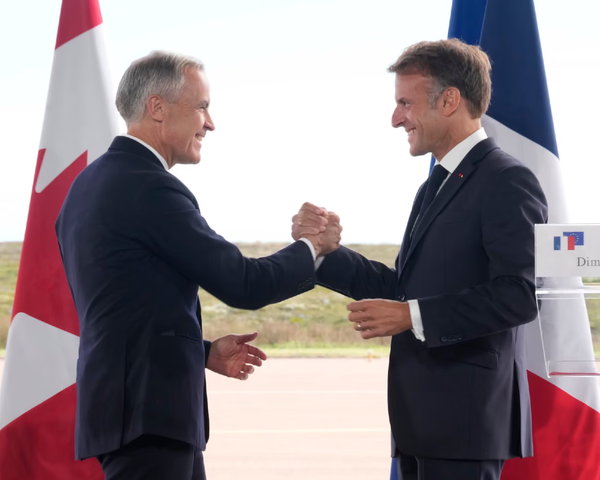
Carney and Macron met on 20 September at Saint-Pierre-et-Miquelon, the French archipelago about 25 km off Newfoundland, two days before the speech. No Canadian prime minister had visited it before. The two leaders told their space agencies, defence ministries and industries to build shared launch systems and ground reception and control infrastructure, and named defence, aerospace, artificial intelligence, wildfire management and energy security as fields for deeper work.
Ottawa and Paris signed a General Security of Information Agreement at the Élysée on 12 June 2026, which lets classified material pass between the two governments and opens the way to joint defence procurement. "In a more dangerous and divided world, Canada's relationship with France is ever more important," Carney said that day. "We share the same values, and increasingly, the same interests."
Sécurité Civile, the French civil protection service, doubled its order for Canadian-built DHC-515 water bombers on 4 June 2026. Canada became the first non-European participant in SAFE, the European Union's 150 billion euro defence procurement programme, on 15 June 2026. Macron endorsed Ursula von der Leyen's 16 September offer of EU associate membership for Canada, which Trump called "laughable" the next day. The Canada-EU summit takes place in Canada on 29 and 30 October.
France's offer to Europe
Macron set out a doctrine of "forward deterrence" at the Île Longue submarine base in Brittany on 2 March 2026. "We must conceive our deterrence strategy within the depth of the European continent, with the progressive implementation of what I will call forward deterrence," he said. France announced its first increase in warhead numbers since 1992, gave no figure and said it would stop publishing its total.
Germany, Poland, the Netherlands, Belgium, Greece, Sweden and Denmark were named as the first partners, alongside existing cooperation with the United Kingdom, according to the Center for Strategic and International Studies. Partners may join French nuclear exercises, visit strategic bases and host nuclear-capable Rafales on temporary deployment, while France keeps sole authority over any use of its weapons. Paris and Berlin set up a high-level nuclear steering group, a format France had previously held only with London. France is the only nuclear-armed member of the European Union.
The Pentagon is weighing the withdrawal of about 25,000 US troops from Europe, close to a third of the 80,000 stationed there, and possibly as many as 40,000, seven current and former US and Western officials said on 17 September. "I think there's a broad recognition that there are going to be eventually less U.S. troops in Europe than there has historically been," Marco Rubio, the secretary of state, said. A final recommendation to Pete Hegseth, the US defence secretary, is due on 6 November.