Mark Carney signed five bilateral agreements with Norway and directed Canadian and French agencies to build shared space infrastructure on 20 September 2026, in a day that carried the prime minister from a French archipelago off Newfoundland to a working visit in Ottawa.
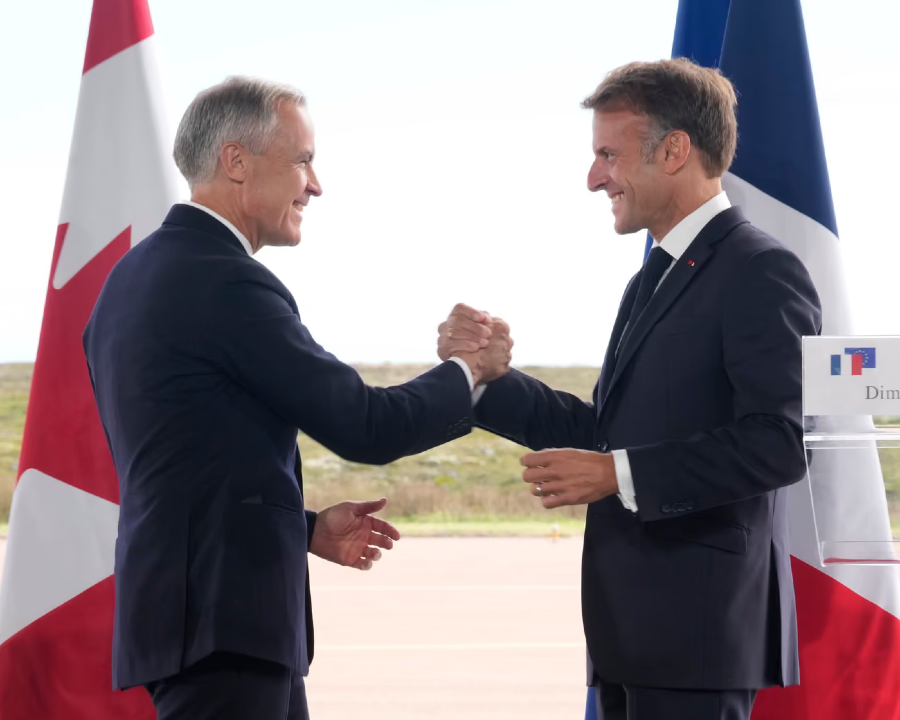
Saint-Pierre-et-Miquelon, about 25 km off the south coast of Newfoundland according to the Prime Minister's Office, hosted the morning meeting with President Emmanuel Macron. No Canadian prime minister had visited the collectivity before. Jonas Gahr Støre, the Norwegian prime minister, landed in Ottawa the same afternoon for a visit that produced the day's signatures.
Ursula von der Leyen invited Canada on 16 September in Strasbourg to become the first associate member of the European Union, covering technology, critical raw materials, energy, defence, Arctic projects and artificial intelligence. Donald Trump called the idea "laughable" the following day and warned the bloc of "very heavy tariffs" if it proceeded. Canada's counter-tariffs on $27.6 billion of American goods had taken effect on 8 September. About 68 per cent of Canadian exports went to the United States in early 2026, down from roughly 75 per cent before the trade war began.
What Ottawa and Oslo signed
Polar Knowledge Canada and the Norwegian Polar Institute signed a memorandum of understanding on Arctic and Antarctic science and research, the first item listed in the readout published by the Prime Minister's Office.
The Canadian Space Agency and the Norwegian Space Agency concluded a memorandum on space-based and dual-use capabilities covering Earth observation, navigation, communications and maritime domain awareness in the Arctic. Norway has held full membership of the European Space Agency since 1987 and Canada holds cooperating state status, a shared position the joint statement cited as the basis for the work. David McGuinty, the Canadian defence minister, and his Norwegian counterpart Tore O. Sandvik had signed a letter of intent on space defence cooperation on 14 March 2026. "By signing this Letter of Intent, we are strengthening our cooperation in the space domain," McGuinty said at the time.
The Geological Survey of Canada and the Geological Survey of Norway agreed to map critical minerals jointly and to exchange geoscientific expertise.
The Canadian Commercial Corporation and the Norwegian Defence Materiel Agency signed a letter of intent setting up government-to-government purchasing of military assets, including procurement destined for Ukraine.
Kongsberg concluded two commercial agreements with Canadian firms on the same day. One, with MDA Space, covers joint intelligence, surveillance and reconnaissance work over Arctic waters, building on the MDA MIDNIGHT platform the Brampton company unveiled for defence customers in April 2026. The other, with Telesat, examines integrating the Ottawa operator's Lightspeed low Earth orbit constellation for surveillance connectivity. Kongsberg already holds partnerships with the Canadian firms NordSpace and Kepler Communications.
The $2.3 billion contract behind the Telesat agreement
Telesat won a 15-year Arctic military satellite communications contract worth $2.3 billion from Canada's Defence Investment Agency on 4 August 2026, rising to $2.7 billion if two optional five-year extensions are exercised. The award expands Lightspeed from 156 satellites to 225, an increase of 44 per cent in constellation capacity. Military Ka-band coverage between 65 and 90 degrees north begins in 2028. MDA Space is building the satellites under a $474 million expansion award and SpaceX is launching them. Telesat puts total investment in the network at about $7 billion.
"High speed and low latency connectivity is critical for modern military forces, and Telesat Lightspeed is expected to be foundational for future CAF and allied governments' operations," said Dan Goldberg, president and chief executive of Telesat.
Trade, investment and the Norwegian fund
Canada and Norway traded $3.8 billion in merchandise in 2025, $2.3 billion of it Canadian exports and $1.6 billion imports, with a further $1.3 billion in services trade in 2024. Both governments agreed in March 2026 to modernise the trade agreement that governs the relationship.
More than 50 Norwegian companies do business in Canada across oil, ocean industries, clean technology and critical minerals. Kongsberg put $76.5 million into a marine innovation simulation centre with the British Columbia Institute of Technology. VARD Marine works with Canadian yards on Arctic vessel design, a strand the joint statement singled out.
Equinor's Bay du Nord project, about 500 km off Newfoundland, reached a benefits agreement with the province and BP on 3 March 2026 that the Newfoundland and Labrador government valued at up to $6.4 billion in direct provincial revenue in its first phase. The deal covers more than 31 million person-hours of work over 25 years, a $200 million fabrication fund toward a floating dry dock at Bull Arm, $100 million for research and development and an option for the province to take up to 10 per cent equity. Equinor filed development plans with the provincial energy regulator in May 2026, targeting sanction in 2027 and first oil in 2031.
Norway's Government Pension Fund Global, which the Prime Minister's Office describes as the largest sovereign wealth fund in the world at more than $3.5 trillion, held stakes in 137 Canadian companies worth 710 billion kroner, the Norwegian government said in March 2026.
Canada's merchandise and services trade with the United States reached $376 billion in the first half of 2026.
Submarines
Carney named TKMS of Germany preferred supplier for up to 12 Type 212CD submarines on 7 July 2026, choosing a boat developed jointly with Norway over a bid from South Korea's Hanwha Ocean. The Globe and Mail put the vessels alone at $20 billion to $30 billion. Germany and Norway offered to give up places in the production queue so that Canada receives its first four submarines by 2034, two years earlier than the builder's own schedule, and Canada has kept the option of returning to Hanwha if talks with TKMS fail.
Officials from the three governments met TKMS, Kongsberg and Multiconsult for a four-day joint planning event at the end of July 2026 covering programme phases, multilateral working structures and preparation for contract negotiation. Norway has four boats on order and Germany two, which would take the combined programme to as many as 18 submarines of a single design. "The 212CD program combines cutting-edge technology with a shared security vision and will sustainably strengthen maritime cooperation within NATO," said Thomas Keupp, chief sales officer at TKMS.
Carney and Støre said in their joint statement that Canada is joining the German-Norwegian Type 212CD cooperation, and that the two countries intend to advance an enhanced Defence Cooperation Agreement in the new year, once the Canadian Patrol Submarine Project concludes.
Arctic security
Carney and Støre launched a bilateral Arctic Dialogue covering strategic surveillance, situational awareness, interoperability and research and development, building on a coast guard partnership agreement signed in June 2026 under which joint training in Arctic waters has already begun. "Arctic security is national security for both countries," the joint statement said.
Støre said the Arctic faces "real threats coming from hybrid activity, ranging all the way to potential sabotage," citing Norwegian intelligence assessments, and both leaders addressed Polish warnings about Russian hybrid strikes on countries supporting Ukraine.
"One of the advantages of this relationship and deepening across a broad range of relationships is, yes, greater intelligence sharing, greater perspective, greater capacities that are built together," Carney said. He returned to a formula used by Arctic states for decades. "The phrase that always sticks with me is 'High North, low tension'," he said.
Canada's Arctic air surveillance still depends on the North Warning System, a radar chain about 35 years old that National Defence has said was not built to detect long-range cruise and hypersonic missiles. Ottawa folded its replacement into the Norad modernisation plan announced in June 2022, worth $38.6 billion over 20 years.
Canada and Australia signed a $2.5 billion agreement in June 2026 for an Arctic over-the-horizon radar system derived from Australia's Jindalee network and built by BAE Systems Australia, giving wide-area surveillance at ranges of 1,000 to 3,000 km. "This arrangement demonstrates Australia's ability to export advanced, high-technology defence systems while safeguarding our national security," said Richard Marles, the Australian defence minister. Craig Lockhart, chief executive of BAE Systems Australia, said the purchase "supports the strategic interests of both nations through enhanced detection and tracking of threats".
Oceans, methane and black carbon
Canada and Norway committed in the joint statement to Sustainable Ocean Plans covering 100 per cent of the waters under their national jurisdiction, to work through the Global Methane Pledge and to Arctic Council initiatives on black carbon. Both countries agreed to take part in the Ocean Eye International Alliance, and to explore cooperation on digital sovereignty and artificial intelligence.
Saint-Pierre-et-Miquelon
Carney and Macron instructed their space agencies, defence ministries and industries to develop and share common space infrastructure, including launch systems and ground reception and control infrastructure. No vehicle, site, budget or timeline was named in the readout.
The Canadian Space Agency and France's Centre national d'études spatiales already work together inside multinational arrangements such as Combined Space Operations, which has functioned as an information-sharing forum rather than a hardware partnership. A Canada-France security agreement signed in June 2026 permits the exchange of classified information, and the French firm Aldoria has won a contract to supply space surveillance data to the Canadian Armed Forces. Saint-Pierre-et-Miquelon hosts a European ground station for the EGNOS satellite navigation service.
Canada and France tasked their Regional Joint Cooperation Commission with work on economic integration and trade diversification, energy transition and decarbonisation, climate resilience and early warning systems and cross-border security, alongside fisheries. The Canadian Chamber of Commerce and CCI France launched a business partnership the same day. Bilateral merchandise trade stood at $15.2 billion in 2025, $5 billion of it Canadian exports and $10.2 billion imports, a total that has grown by nearly two thirds over the past decade. France is Canada's third-largest export market in the European Union.
Carney built his closing remarks on the archipelago's decision in December 1941 to side with Free France. "They refused to be collaborators," he said of the islanders. "History remembers those who act." He put the geography to the same purpose. "At their closest point, just a few kilometres separate Canada and France," he said. "Our values are closer still." He said sovereignty now requires secure access to artificial intelligence, space, semiconductors, critical minerals, payment systems and clean energy. Canada hosts the Francophonie Summit in 2028. "France and Canada can always count on one another," he said.
Macron's office said before the meeting that "France and Canada share the same values of freedom, democracy, rule of law and respect for national sovereignty". The two leaders held a working lunch and laid a wreath for the Free France volunteers.
Energy and critical minerals
Macron said Canada holds "substantial reserves of critical raw materials and rare earth elements, as well as its liquefied natural gas production", and that France and the European Union would pursue contracts and arrangements to secure supplies of both. "Canadian liquefied natural gas projects can help. They are important for Europe," he said.
Canada's large-scale liquefied natural gas export terminals are on the Pacific coast, facing Asia. Repsol abandoned plans to export from its Saint John terminal in New Brunswick, citing a lack of feed gas, and east coast proposals have stalled on construction cost, regulatory approval and a shortage of pipeline capacity to carry western Canadian gas east. An Australian buyer signed for volumes from the $30 billion Ksi Lisims project in British Columbia on 16 September 2026. Neither leader announced a project, a volume or a delivery date at Saint-Pierre-et-Miquelon, and the joint readout lists energy security as a sector for collaboration.
Toronto conference on returning Ukrainians
Canada, Ukraine and Norway will co-host the second international conference on returning Ukrainian children, detained civilians and prisoners of war in Toronto on 28 and 29 September 2026, an event Anita Anand, the foreign affairs minister, announced in Ottawa on 12 September. Foreign ministers, senior representatives and international organisations are due to attend. Anand said the conference aims to "strengthen international support for efforts to bring people home, protect those who remain under Russian control".
Ukrainian authorities have confirmed 20,651 cases of unlawful deportation or forcible transfer of Ukrainian children by Russia, of whom 2,573 have been returned. A further 1,878 civilians are confirmed as unlawfully detained, against a true figure Global Affairs Canada put at as many as 20,000, and 9,529 Ukrainian military personnel and civilians had been returned from Russian captivity as of August 2026.
Article 49 of the Fourth Geneva Convention prohibits forcible transfer, and the transfer of children from one group to another is listed as an act of genocide under Article II of the Genocide Convention. The International Criminal Court issued arrest warrants against Vladimir Putin and the Russian children's rights commissioner Maria Lvova-Belova on 17 March 2023 over the deportations.
The European offer
Von der Leyen made her offer in the State of the European Union address in Strasbourg. "We will move from CETA to an Alliance for the Future to create a common prosperity and economic security space," she said. "We will create a tech alliance. We will integrate defence industrial bases. We will make the Arctic a flagship joint project."
Jonathan Wilkinson, Canada's ambassador designate to the European Union, said the same day that the title has not been settled. "We're not there," he said. "It's nomenclature. I think we've actually got to get to the point where we know what we're describing." Whether the status carries single market access on the Norwegian or Swiss model, and whether it carries any vote in EU institutions, remains open. Carney addressed the European Parliament on 17 September and welcomed the offer. Macron endorsed it at Saint-Pierre-et-Miquelon. The Canada-EU summit takes place in Canada on 29 and 30 October.
Carney flew to New York for the 81st session of the United Nations General Assembly from 21 to 23 September, with bilateral meetings, Ukraine, Middle East peace, maritime security, ocean protection and UN reform on his list. "The world is looking at Canada differently," he said before departing. "Investment in Canada is growing, our partnerships are deepening, and our influence is expanding."
MPs returned to the House of Commons on 21 September for the autumn session, where François-Philippe Champagne is preparing a budget and introducing a bill extending fuel excise tax relief. Steven MacKinnon, the government House leader, said economic legislation will be the "centrepiece" of the session.