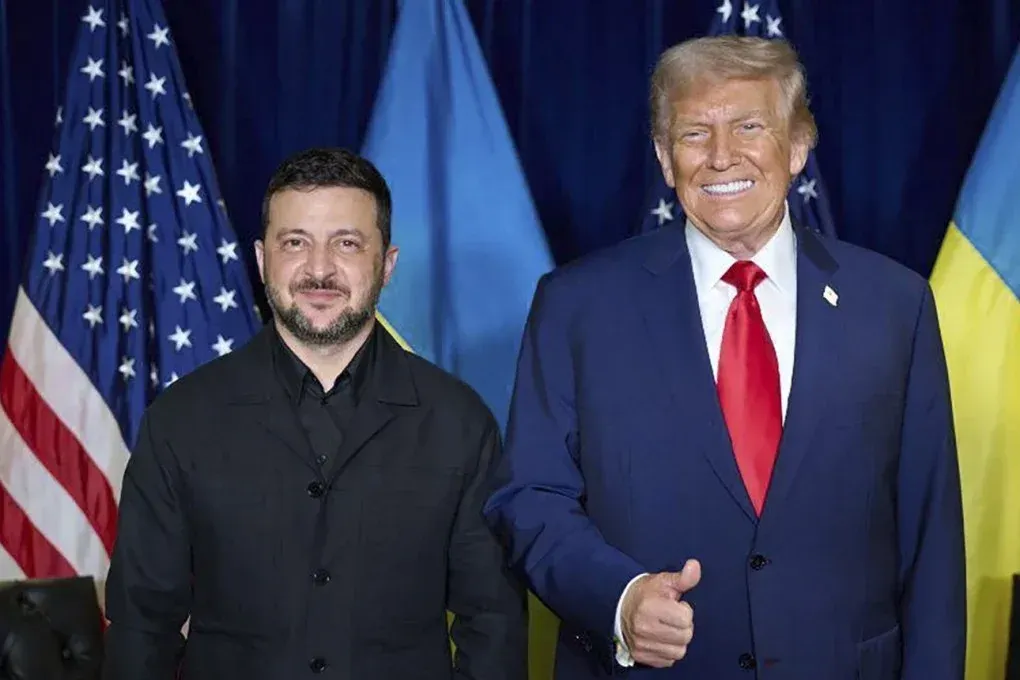
Volodymyr Zelenskyy offered on 22 September to halt Ukrainian strikes on Russian refineries if Russia stops attacking Ukraine's power grid, after a 40-minute meeting with Donald Trump at the UN in New York.
He also asked Trump to hand over Patriot interceptors from U.S. stocks now and offered to repay them from the 600 missiles Ukraine has contracted from Germany for 2027 and 2028. Trump agreed to neither.
Ukraine's offer came two days after its largest drone attack on the Russian capital knocked out crude processing at the Moscow Oil Refinery, the fifth Russian refinery halted by drones this month. Russian strikes cut power across Ukrainian oblasts on 4, 10 and 11 September, and Zelenskyy said Russia was preparing a new massive attack for winter.
Terms of the energy truce
"We are ready for energy ceasefire," Zelenskyy told reporters after the meeting. Ukraine would leave Russian refineries and diesel production alone, he said, if Russia stopped striking Ukrainian electricity, heating and water supplies. He said Ukraine would accept any format of energy truce as long as it bound both sides.
He said he didn't know Russia's position and wouldn't accept a one-sided order to stop. Nobody in the meeting asked Ukraine to halt its strikes on Russian refineries, factories or energy sites unilaterally, he said.
Zelenskyy said the U.S. had agreed to pass the offer to Russia formally. He declined to give reporters further detail, and every published element of the terms comes from his own briefing.
He asked Trump to bring Chinese leader Xi Jinping into the peace effort, saying Xi has influence over Vladimir Putin. He repeated that he would meet Putin at any time and said Trump could organise a three-way meeting. The war should end before winter, he said.
Zelenskyy warned on 13 September that Russia would get the same treatment if it hit Ukraine's energy system in winter. The next day he said Ukraine was also open to a ceasefire at sea. Ukraine's grain exports were running at about 40 per cent of capacity under Russian pressure on Black Sea shipping.
U.S. position
Secretary of State Marco Rubio said on 22 September, before the meeting, that Trump would propose a freeze on attacks against energy infrastructure. Any such freeze needed the consent of both sides, Rubio said.
Trump told reporters before the meeting that Ukraine's refinery strikes were pushing up global diesel prices. Afterwards he called them "a serious hit against the Russians." He didn't rule out another meeting with Putin.
The U.S. average diesel price passed $6 a gallon for the first time on 10 September, AAA said. Ship traffic through the Strait of Hormuz has been disrupted since February, when the U.S. and Israeli war with Iran began.
Trump said on 13 September that Russia and Ukraine had agreed to stop targeting energy sites. Ukrainian officials called it a proposal for a mutual halt, and no agreement followed.
Rubio met Russian foreign minister Sergei Lavrov for about an hour in New York on 23 September, the morning after the Zelenskyy meeting. Rubio said the U.S. had invited Putin to the G20 summit it hosts this year.
Putin agreed on 18 March 2025, after a call with Trump, to a 30-day halt on strikes against Ukrainian energy, and tied it to a demand that Western military aid to Ukraine end.
Russian strikes on Ukraine's grid
Russian drones knocked out power in Odesa, Kharkiv, Chernihiv and Sumy oblasts on 4 September, Ukrenergo said, after an overnight attack in which Ukrainian air defence downed 135 targets. More than half the drones were Shaheds.
On 10 and 11 September consumers in seven oblasts lost power after drone and artillery strikes: Odesa, Zaporizhzhia, Chernihiv, Sumy, Kharkiv, Dnipropetrovsk and Donetsk, Ukrenergo said. Crews started repairs where the security situation allowed.
On 20 September, the same day Ukrainian drones hit Moscow, Russia launched 138 drones at Ukraine. Four people were killed in Kyiv oblast, three of them children, and three were killed in Kherson oblast.
Energy minister Denys Shmyhal has warned that the coming winter will be hard. Yuriy Korolchuk of the Institute of Energy Strategies in Kyiv said the grid was in worse shape than a year ago, and that the base case for heavy strikes was 12-hour blackouts, alternating on and off. Kyivteploenerho, the capital's heating utility, said apartments could fall to 12 to 15 degrees if attacks match last winter's.
Repairs at the capital's damaged combined heat and power plants TPP-5 and TPP-6 are due to restore 70 per cent of their capacity by 1 November, and TPP-4 50 per cent.
By mid-2024 about half of Ukraine's generating capacity had been occupied, destroyed or damaged, and 18 large combined heat and power plants had been hit, the International Energy Agency said.
UN human rights chief Volker Türk said in January 2026, after strikes left 5,635 Kyiv residential buildings without heating: "Targeting civilians and civilian infrastructure is a clear breach of the rules of warfare."
Article 54 of Additional Protocol I to the Geneva Conventions bars attacks on objects indispensable to the survival of the civilian population and names drinking water installations among them.
Kremlin response
Dmitry Peskov, the Kremlin spokesman, said on 22 September that Russia wants "peace forever, not a truce that in essence gives nothing." He said Ukraine's position was getting worse by the day, economically and at the front, and that Ukraine's leaders knew what decisions they had to take.
Peskov set Zelenskyy's ceasefire talk against his 40-day campaign to damage the Russian economy. Zelenskyy approved the 40-day Security Service of Ukraine (SBU) operation on 25 June. On 4 August the SBU said it had hit more than 100 strategic targets in that time, including 14 refineries, among them plants at Yaroslavl, Nizhny Novgorod, Perm and Volgograd.
Peskov called Zelenskyy's 13 September winter warning a new statement in an escalatory style.
A meeting between Putin and Zelenskyy without expert-level preparation would waste time and could only happen in Moscow, Peskov said. Putin said Zelenskyy could come to Moscow if he wished and would be given security guarantees.
On 14 September Peskov said anything preventing attacks on Russian civilian economic infrastructure could only be welcomed, and didn't commit Russia to stop hitting Ukraine's. Russia has also sought measures covering its seaborne exports and sanctions relief.
Trump envoys Steve Witkoff and Jared Kushner spent three hours with Putin in Moscow on 5 September, with Treasury official Gene Lange in the room. Putin said he had full trust in U.S. mediation. He ordered a 72-hour pause on strikes on Kyiv during the visit, and Russian strikes on the city resumed after the envoys left.
Patriot swap and licensing
Ukraine signed a contract with Germany in August for 600 Patriot interceptors due in 2027 and 2028. Zelenskyy said Ukraine would hand borrowed U.S. missiles back in 2027 if required, and that it needed them now to save lives.
Raytheon announced a $3.7 billion contract on 14 April to supply Ukraine with PAC-2 GEM-T interceptors, paid for by the German defence ministry. GEM-T is built for aircraft and cruise missiles and isn't designed to stop ballistic missiles. The new GEM-T plant at Schrobenhausen in Bavaria, run by COMLOG, a joint venture of Raytheon and MBDA Deutschland, is due to start deliveries in 2028.
Russia builds an estimated 100 ballistic missiles a month, about 60 of them Iskander-M, and about 3,000 Geran-4 and Geran-5 attack drones a month. Ukraine's stocks of PAC-3 interceptors, the Patriot round designed for ballistic targets, were close to exhausted by early September. Ukraine used its remaining interceptors to shoot down seven ballistic missiles on 28 August.
Ukraine is contracting for about 1,000 Patriot missiles, most due in later years. MBDA expects to reach about 300 missiles a year by 2028, and Germany plans up to 200 PAC-2 missiles a year under licence. Italy and France are due to deliver several older SAMP/T batteries by the end of 2026 and eight SAMP/T NG systems in 2027.
Boris Pistorius, the German defence minister, told the Ukraine Defence Contact Group on 8 September that more PAC-2 missiles would go to Ukraine from Bundeswehr stocks before winter, without giving a number. He asked other members to check their own stocks for air defence ammunition. Ukraine has ordered several thousand IRIS-T missiles with EU loan money, and Germany will build another production line for them.
Zelenskyy said Raytheon was ready to license Patriot interceptor production in Ukraine and Trump was positive on licences. Setting up production would take 12 to 18 months at least, he said.
Trump floated licensing at the NATO summit in Ankara on 7 and 8 July, then backed away from it. Zelenskyy left New York without a Patriot commitment. Nobody said no, he told Ukrainian reporters.
Russia's fuel shortfall
The 20 September attack came on the last day of Russia's three-day State Duma election. Moscow mayor Sergei Sobyanin said more than 1,600 drones were shot down across Russia, 450 of them heading for the capital, and called the attack an attempt to disrupt the vote. Those figures couldn't be independently verified. Domodedovo and Zhukovsky airports restricted flights.
Both crude distillation units at the Gazprom Neft refinery in Kapotnya caught fire, three industry sources said, and repairs could take several weeks. The AVT-6 unit carries 53 per cent of the plant's throughput and the Euro+ unit the other 47 per cent.
The refinery made 2.9 million tonnes of petrol, 3.2 million tonnes of diesel, two million tonnes of fuel oil and 1.3 million tonnes of bitumen in 2024. Its fuel hasn't been offered on the St Petersburg exchange since 21 September. Drones had already hit it on 16 and 18 June, and its average daily exchange sales fell from about 4,400 tonnes to about 400 after the June strikes.
Moscow oblast governor Andrey Vorobyov said three people were killed in the attack. About 400 residents were evacuated from a 21-storey building in Ramenskoye. Zelenskyy said the strikes hit facilities worth billions of dollars to Russia's war effort.
Ryazan was halted on 6 September, Syzran on 11 September, Saratov on 15 September and Yaroslavl on 17 September. Yaroslavl makes 2.6 million tonnes of petrol and four million tonnes of diesel a year. Rystad Energy put Russian refining at about one-third below normal, near four million barrels a day, and Russian petrol output barely covers two-thirds of consumption.
Ukrainian drones have hit Russian refineries at least 70 times since January, and the IEA counted a successful hit on average every three days in the first eight months of 2026. Kirishi, Volgograd and NORSI, three of the six refineries that make about half of Russia's diesel, were shut or running at about a quarter of capacity by mid-September.
On 18 September AI-95 petrol was on sale at 341 of 768 filling stations in Moscow, and at about a third of stations across Russia. The Moscow average price was 72.64 roubles a litre for AI-95 and 81.44 for diesel. At least 17 Russian regions have capped fuel sales at 30 to 40 litres a vehicle.
Exchange prices for petrol and diesel were 46 per cent above January levels by early July, and traded volumes had fallen by 47 per cent.
Russia has banned petrol exports until 31 January 2027 and jet fuel exports until 30 November. Its diesel export ban runs to 30 September, and officials were discussing an extension to the end of the year. Russian refining fell to 3.6 million barrels a day in July, the lowest since May 2002. Deputy Prime Minister Alexander Novak said there was no diesel shortage on the domestic market.
UK and EU positions
UK Prime Minister Andy Burnham, in office since 20 July, met Trump for the first time in New York. He lobbied for an energy ceasefire and continued U.S. support for Ukraine's air defence before winter, and promised Ukraine further money for its infrastructure. Burnham visited Kyiv on his first trip abroad as prime minister.
EU governments renewed Russia sanctions on 22 September for 36 months, replacing six-month rollovers, and removed Alisher Usmanov and Mikhail Fridman from the list of more than 2,600 people and entities.
France requested Usmanov's removal, citing national security. Azerbaijan's president Ilham Aliyev had lobbied for it. Slovakia blocked Fridman's continued listing and Luxembourg backed his removal; Fridman has filed a $16 billion claim against Luxembourg. Latvia abstained to allow the unanimous decision and said it would impose national sanctions of its own.
"The decision to delist Usmanov and Fridman is shameful and unjustifiable," Ukrainian foreign minister Andrii Sybiha wrote. Zelenskyy called for timely and unconditional renewal of every listing and said holding EU sanctions together was getting harder.