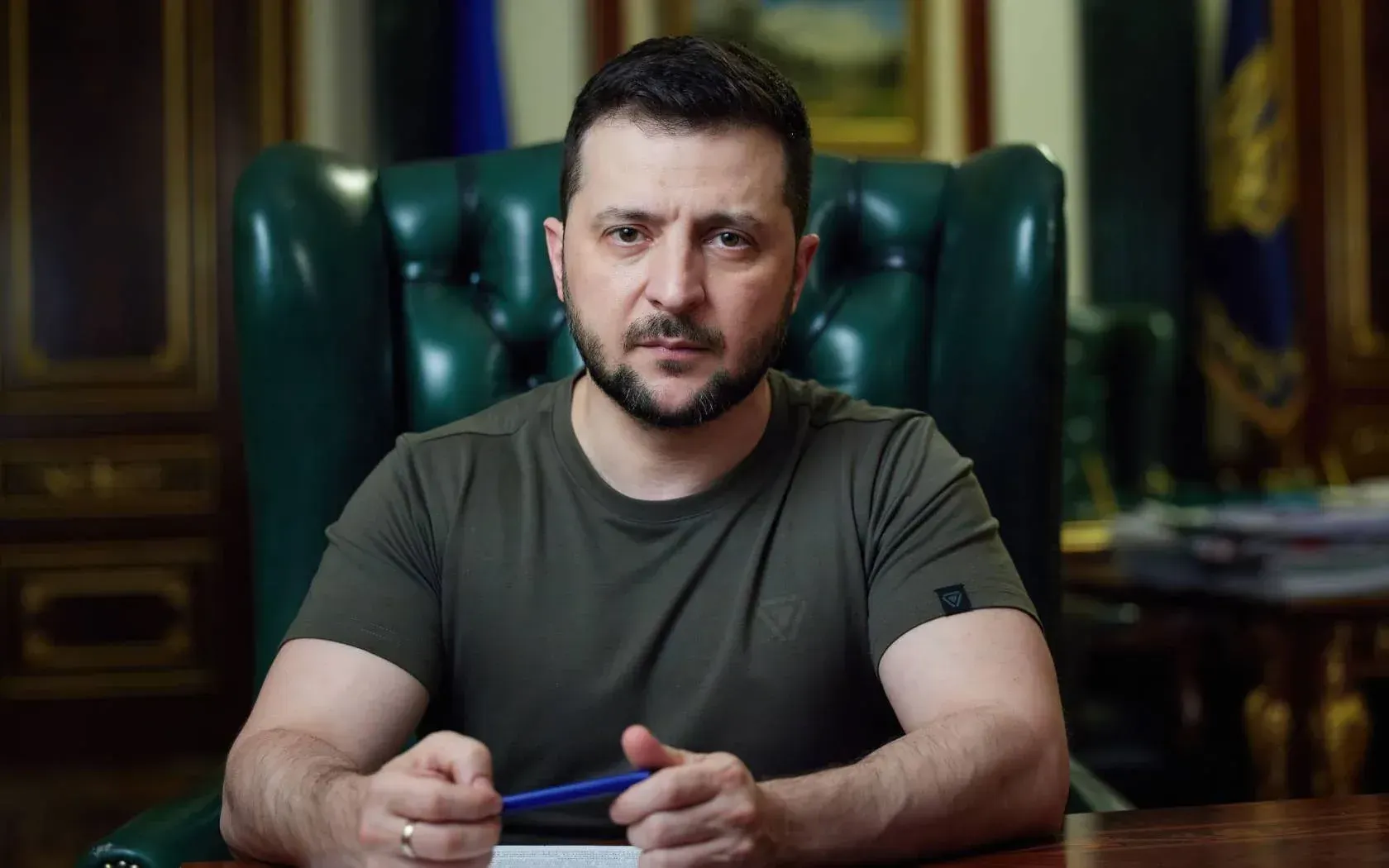
President Volodymyr Zelensky published an open letter to Vladimir Putin on 4 June, a day after Ukrainian drones flew more than 1,000 kilometres to strike St. Petersburg as the Russian president opened his flagship economic forum there. The letter offers a face-to-face meeting on neutral ground, a full ceasefire for as long as talks last and an all-for-all exchange of prisoners. It also tells Putin, at length and in personal terms, that he is running out of soldiers, money and time. Putin rejected the offer within a day and called the letter "boorish."
The letter reads less like a diplomatic note than a public argument, and most of it is aimed past Putin at the people around him. The opening recalls that many Ukrainians once saw Putin favourably when he took power 26 years ago. Zelensky writes that he has since spent nearly half that time at war with Ukraine, that the invasion is Putin's personal choice and a war without a real cause, and that history will record it that way.
A long middle section catalogues Russian discontent: the drones and missiles reaching Russian cities, fuel shortages, rising prices and the prospect of a second wave of mobilisation. Zelensky writes that Putin can still force Russians to live this way but that his resources are shrinking and that he will not have the money or political capital to keep buying their loyalty as he has for 26 years. The framing is deliberate. Ukrainian officials have said the letter was written for Russian elites, a war-weary public and Western governments as much as for the man it addresses.
Zelensky puts the war's cost in figures. He writes that Russia lost more than 30,000 soldiers killed and seriously wounded in May, that the killed account for 63 per cent of Russian front-line losses against 37 per cent wounded, and that Ukraine has video confirmation of each loss. Those are Kyiv's numbers and cannot be independently verified. Zelensky himself writes that Ukraine is losing people at a ratio he puts at one to five or one to six, and that every loss matters. He writes that Putin keeps postponing his own deadlines to capture the Donetsk region and will not take it this year either.
The letter leans hard on Russia's reliance on others. Zelensky writes that Putin is the first Russian leader to turn to North Korea for military help and is now dependent on China for the first time in Russia's history. He revisits the June 2023 Wagner mutiny, writing that 23 June will mark another anniversary of an armed revolt by Russia's own forces. He says Ukrainian intelligence shows Putin is weighing plans to carry the war into 2027 and 2028, to pull Belarus in deeper and to stir trouble around Transnistria in Moldova.
"Enough of war," Zelensky writes, before proposing a meeting and rejecting Putin's standing invitation to come to Moscow, which he writes holds nothing for a Ukrainian leader. The letter names Switzerland, Türkiye and Arab states as possible hosts, and Zelensky writes that Putin should set a clear date. He writes that Ukraine's future was not settled at last year's Trump-Putin summit in Alaska, and that Ukrainian and European questions are not decided in Anchorage. He points to the failed Minsk agreements as the reason to start with direct answers between the two leaders rather than working groups and shuttle diplomacy, and writes that the current front line is where any negotiation should begin.
On terms, Zelensky writes that Ukraine is ready for a full ceasefire while talks run, that the United States can monitor a halt along the line of contact, and that Ukraine will accept an all-for-all prisoner exchange as a first step. He calls for serious work to return the civilians and children taken from Ukraine during the war, the conduct behind the International Criminal Court's March 2023 arrest warrant for Putin.
The letter closes on a threat dressed as history. Zelensky writes that if Putin will not end the war, Ukraine will keep fighting and Putin will have to fight harder for his own survival, not Russia's, because Russian history shows that change follows exhaustion. He says Ukraine will work toward that exhaustion. He also tells Putin that the world has not tired of Ukraine, as Putin hoped it would, but is tiring of Russia, and that Putin's own officials and businessmen now look at him with fatigue.
Zelensky writes that the United States is focused on its war with Iran and that it would be a mistake to wait for the war in Europe to return to the centre of US attention. Putin, answering reporters at the forum on 5 June, said he saw no point in meeting, tied his refusal to a 22 May Ukrainian strike on an alleged dormitory in Russian-held Luhansk that Moscow claims killed 21, and said he wanted a full settlement on the lines discussed in Alaska, not a temporary truce. His spokesman Dmitry Peskov said Zelensky could come to Moscow any time, an offer Kyiv has refused.
On 7 June in London, the leaders of Britain, France and Germany met Zelensky and endorsed his call for direct talks, setting out five conditions for a settlement that closely tracked the letter, these include an immediate and complete ceasefire, the current front line as the starting point, binding and legally enforceable security guarantees, frozen Russian state assets held until Moscow pays for war damage, and European consent on anything touching the European Union or NATO. Whether any of it moves Putin is a separate question, and nothing in his forum-week answers suggested it had.
Open Letter to the President of the Russian Federation from the President of Ukraine
Open Letter
To the President of the Russian Federation
From the President of Ukraine
When you came to power in Russia more than 26 years ago, many people in Ukraine viewed you positively. That is how it was. But that is now in the past.
Now, the overwhelming majority of Ukrainians view it positively that our long-range drones paid a visit to the opening of your forum in St. Petersburg, covering a distance of more than 1,000 kilometers. As you know very well, that distance is not the limit of our capabilities.
For 26 years, your time in power has completely changed the agenda of relations between Ukraine and Russia. From discussions about trade and other civilian matters, our nations have moved to talking almost exclusively about strikes and losses.
You have spent nearly half of your 26 years in power in Russia waging war against Ukraine.
Whatever you may say about NATO, geopolitics, or the Russian language, this war is your personal choice — a war without a real cause. That is how history will remember it.
Those years could have been very different.
We often hear that you are comfortable with this war. Of course, not in those cases when it comes to the security of your residence in Valdai or your parade in Moscow. Your own life is valuable to you.
But now we can all see that Russians are finally becoming less comfortable with this reality — with the fact that the war is bringing more and more negative consequences to Russia.
They do not like our drones and missiles.
They do not like gasoline shortages and constantly rising prices.
They do not like constant restrictions.
They do not like your intention to launch a second wave of mobilization in order to expand the war into another direction in Ukraine or to use it against other countries neighboring Russia.
They do not like the fact that there is no end in sight to your war.
Yes, you can still force Russians to exist this way. But your resources are shrinking significantly.
You will not have enough money or political capital to keep buying the loyalty of Russians the way you have for the past 26 years.
And we will do everything we can to ensure that the world helps bring that moment closer.
As you yourself like to say, “we need to run the numbers.”
Yesterday, I received a report on the losses of your army on the front in Ukraine during May. Once again, the number exceeded 30,000 Russian soldiers killed and seriously wounded. We have been maintaining that level month after month, and we have video confirmation of every one of your losses — these are not empty claims.
We know that 63 percent of your battlefield losses are killed, while only 37 percent are wounded. In the 21st century, no army can afford such a ratio. And the share of those killed will continue to grow.
It is not as if we in Ukraine are concerned about the fate of Russian soldiers after everything your war has brought to our country.
But I do care about Ukrainians.
We are losing our people, and every loss is painful to us. Even when the ratio of Ukrainian losses to Russian losses is one to five or one to six, it still matters greatly.
It also matters that you regularly postpone, every few months, your own deadlines for capturing our regions — especially the Donetsk region. And you will not capture it this year either.
But we in Ukraine do not want a permanent war. We know very well that life without war is infinitely better. And we want to achieve that.
I am convinced that the majority of Russians would respond positively to this as well — and you know it.
Many did not believe that Ukraine would be able to hold out for so long. You did not believe it. And those who advised you did not believe it either. That was a mistake.
You did not expect full-scale resistance from Ukraine, and you did not foresee that things would go this far. Yet here we all are — in the fifth year of this full-scale war.
Do not be afraid to take the path out of this war. That is the main thing that is required of you now.
Ukraine has preserved its independence. And it will preserve it. Despite all predictions to the contrary.
We have united many around the world to stand with Ukraine and against you. We found the weapons and the financing we needed.
We receive support. You receive sanctions. And this will continue until there is justice for Ukraine — the justice we seek and the justice that can be achieved.
We will not allow those who are trying to convince you that sanctions against Russia will be significantly eased, and that support for Ukraine will be significantly reduced, without any meaningful change in your position toward Ukraine, to succeed. The example of Orban shows how those who choose to help Russia in its war against us end in disgrace.
Ukraine has endured harsh winters while you tried to destroy our energy system. We held firm — and even in darkness, the resilience of Ukrainians remained intact.
We brought the war onto your territory, and you would not have been able to cope with it without North Korea’s help. You are the first ruler of Russia to turn to Pyongyang for assistance.
And today you are fully dependent on China — also for the first time in Russia’s history.
You believed Ukrainians would not have the strength to defend themselves. Yet today, our people are helping our partners in the Middle East and the Gulf build their own defenses.
You hoped for internal unrest in Ukraine. Instead, it was your own military formations that staged a mutiny against you. June 23 will mark another anniversary of that event, and silence will not erase this fact from history.
And now it is you whom your own officials, businessmen, and propagandists look at with obvious fatigue. The world can see it.
The world has not grown tired of Ukraine, as you long hoped it would. But there is growing fatigue with Russia — even among those in the wider world who help you bypass sanctions and keep your economy afloat.
You cannot fail to notice it. After 26 years in power, age is beginning to take its toll. And with time, the fatigue with you will only grow.
We have seen intelligence reports showing that you are now considering plans to continue the war into 2027 and 2028. We also know that you hope ballistic missiles will achieve for you what everything else has failed to achieve. You want to draw Belarus even deeper into this war, and we are now forced to prepare for that as well. We see that you are trying to orchestrate something around Transnistria. Your propagandists threaten, in one way or another, every country neighboring Russia. Do you really want to go through all of this?
The choice is yours now.
Enough of war.
Ukraine proposes to end this war.
This must be done honestly, with dignity, and with guarantees that the war will not be reignited.
We see that the United States is fully focused on the issue of Iran, and it would be wrong to simply wait until the war in Europe returns to the center of its attention.
Ukraine proposes ending this war through direct engagement between us — and you.
I am proposing a meeting.
Everyone heard your representatives, smiling, say that I could supposedly come to Moscow. But after these 26 years, there is nothing for a Ukrainian leader to do in your capital — just as there is nothing for a Russian leader to do in Kyiv.
There are countries that have traditionally hosted leaders to resolve issues of war and peace. Switzerland, Türkiye, the countries of the Arab world — many are able and willing to host such a meeting.
It is leaders who resolve the key issues. That has always been the case, and it always will be.
I propose to set a clear date for such a meeting.
We have heard that you were promised in Alaska the resolution of certain issues concerning Ukraine and Europe. But you can see for yourself that Ukrainian and European issues are not decided in Anchorage.
Other agreed participants could join the bilateral track to be established between us.
Since the war is taking place in Europe, and since Ukraine needs security guarantees, while you also seek security guarantees for yourself, it would be logical to involve those who can genuinely serve as guarantors.
We believe Europe should be part of this process — those who truly have the capacity to influence the situation.
We also believe that the United States must be part of the process. This is what could help shape a new security architecture for our part of the world.
We’ve already experienced many agreements with Russia, including the Minsk agreements, that ultimately failed. That is why we must first find direct answers between us to the questions that remain, and not hide from difficult issues behind formulas, technical working groups, or endless time lost in shuttle diplomacy.
Your war has permanently set Ukraine and Russia apart.
The front line today is the line from which diplomacy must begin.
Ukraine is ready for a full ceasefire for the duration of the negotiations. This is standard practice, and current developments around Iran only reinforce that point. An attempt to establish real silence is the best way to begin talking to one another. We believe it would not simply be an attempt, but a real ceasefire — if that is what you want.
You know that the United States has the capability to monitor a ceasefire along the line where hostilities stop.
Ukraine is ready for an all-for-all exchange of prisoners of war, and this could become a good prologue to ending the war.
Serious steps must be taken to return civilians and children who were taken away during the war.
We must determine what kind of future awaits the generations of Ukrainians and Russians who will come after us.
If you do not personally come to the conclusion that it is time to end this war, Ukraine will continue fighting for its existence. We will have those who support us.
But you, too, will have to fight much harder for your own existence — not Russia’s, but your own. And this is not a threat from me or from Ukraine. It is a fact of Russian history that you know well: when Russia grows tired, change comes.
We can work toward that fatigue.
You can stop your war.
Eternal memory to all those whose lives were taken by this war.
Glory to Ukraine!
Original source: https://www.president.gov.ua/en/news/vidkritij-list-prezidentu-rosijskoyi-federaciyi-vid-preziden-104769