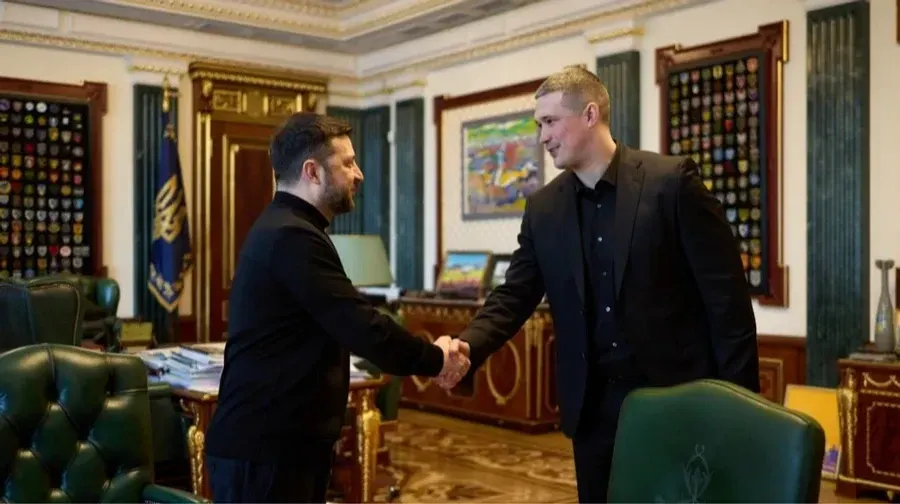
Volodymyr Zelenskyy dismissed defence minister Mykhailo Fedorov on 16 July 2026, siding with commander-in-chief Oleksandr Syrskyi in a dispute over how to fight Russia, who should sign off on weapons buys and whether a young technocrat could be allowed to break the procurement machine that fed Ukraine's generals. Fedorov had been in the job seven months. In that time he shut Russian drones out of Starlink, put billions of hryvnia in defence contracts through open tender for the first time, ordered mass polygraph tests of his own officials and told about a thousand of them on camera that anyone caught running a procurement scheme would go to prison.
Fedorov, 35, is the face of the war most Ukrainians and international allies recognise today; a war fought with drones, artificial intelligence, digital reform, a state that behaves like a start-up rather than a Soviet ministry. His removal at the height of Ukraine's long-range strike campaign drew warnings from NATO and the European Union, pulled a deputy air force commander and a senior adviser out of their posts in protest and sent crowds into the streets of Kyiv, Lviv, Odesa, Kharkiv, Mykolaiv, Dnipro, Rivne, Poltava, Zhytomyr, Lutsk, Ternopil and other cities chanting "Shame" under signs reading "The Russians are celebrating."
Russian military bloggers and officials openly celebrated the move, describing it as a gift to Russia.
"I view the personnel changes in the enemy's military department as very positive news," wrote Russian pro-war commentator Svyatoslav Golikov, calling Fedorov an "energetic and creative technocrat" and describing the results achieved by his team over six months as "substantial and tangible." Golikov called the leadership changes at Ukraine's Defense Ministry "a positive signal for the Russian side."
Another channel put it plainer:
"very good that Zelenskyy removed him from managing the army. He was simply too intelligent and effective an adversary. Things should be easier now."
“Overall, it is very good that Zelenskyy removed him from running the army,” Russian pro-war blogger Alexey Zhivov said. “He was too smart and effective an enemy. Things should become a little easier now.”
The author of the Osvedomitel Telegram channel also welcomed the decision, saying Fedorov’s dismissal would probably lead to the replacement of his team at the Defense Ministry, which would benefit Russia.
Another Russian pro-war blogger, Svyatoslav Golikov, described Fedorov as an “energetic and creative technocrat” and called the results achieved by his team over six months “substantial and tangible.”
Golikov described the leadership changes at Ukraine’s Defense Ministry as “a positive signal for the Russian side.”
The Voyenny Osvedomitel Telegram channel also welcomed the decision, noting that Fedorov had overseen the expansion of Ukraine's drone warfare and secured the deactivation of Starlink terminals used by Russian troops.
His dismissal "could become a favorable factor for Russia," the channel said, adding that it would likely lead to the replacement of his team at the Defense Ministry.
Another Russian pro-war blogger, Alexey Zhivov, put it even more bluntly:
"Overall, it is very good that Zelenskyy removed him from running the army. He was too smart and effective an enemy. Things should become a little easier now."
Forty-eight hours
Yuliia Svyrydenko's government resigned on 14 July 2026, opening the reshuffle and setting off bargaining over cabinet posts. Parliament moved Naftogaz head Serhiy Koretsky toward the prime minister's chair. The defence portfolio came under scrutiny at the Servant of the People faction meeting a day later, on 15 July, and Fedorov's position collapsed inside two days.
Zelenskyy gave the faction two reasons for the decision, according to lawmakers cited by Left Bank and RBC-Ukraine. Fedorov and Syrskyi held different views on how the war should be fought. And Fedorov had authorised purchases at the ministry's own discretion rather than as the General Staff requested, buying what he judged the front actually needed and refusing items he considered less important, including a batch of 155 mm artillery shells. Zelenskyy told the lawmakers he could not let the defence ministry and the general staff fight each other while the country was at war.
Zelenskyy also, according to the same account, said: "Ideally, both Fedorov and Syrskyi should be dismissed, but for now that is impossible."
The man he kept was the one the army command wanted kept.
Two generations of the same war
Mykhailo Fedorov was born on 21 January 1991 in Vasylivka, in the Zaporizhzhia region, in the Soviet Union's final year and seven months before Ukraine declared independence. He studied at Zaporizhzhia National University, built a social-media marketing studio and ran the digital side of Zelenskyy's 2019 presidential campaign, the operation that sold a television comedian to the country over YouTube and Instagram. An operation that won Zelenskyy the presidency. He has been at Zelenskyy's side ever since, close to seven years, first as adviser and then, at 28, as Ukraine's first minister of digital transformation.
Diia was the thing he built that nearly every Ukrainian came to hold, a "state in a smartphone" that folded passports, permits, payments, benefits and taxes into one app. Fedorov was also the man who negotiated with Elon Musk to keep Starlink terminals feeding Ukrainian units after Russia's full-scale invasion in February 2022. He organised the "Army of Drones" and the Brave1 defence-technology cluster that turned a country of software engineers into a country of drone makers, and he reached the defence ministry in January 2026 as one of Zelenskyy's closest allies. He ran it the way he had run everything before, with data, tenders, dashboards, speed.
"Ukraine must win through innovation, technology and speed, not by repeating Soviet-era approaches," Fedorov said.
Fedorov is not a figure from the barricades. During the Revolution of Dignity in the winter of 2013 to 2014 he was a 22-year-old marketing entrepreneur in Zaporizhzhia, far from the Kyiv barricades and the volunteer battalions that made the reputations of the war's early commanders. His generation reached power through the 2019 vote that swept out Ukraine's old political class, not through revolution, and he governs like a product manager, and the product is victory.
Oleksandr Syrskyi came up the other road. Born in the Russian region of Vladimir in 1965, schooled at the Moscow Higher Military Command School in the last Soviet decade, he rose to commander-in-chief in early 2024 and built his reputation on the defence of Kyiv in 2022 and the Kharkiv counter-offensive that autumn. Front-line soldiers who resent the cost of his set-piece assaults gave him harsher nicknames. By the summer of 2026 his own assault regiments were under criminal investigation over the noncombat deaths of mobilised recruits.
Zelenskyy described the two men to lawmakers as inhabitants of separate worlds, in an account one participant of the meeting gave Ukrainska Pravda.
"They live in two different worlds. Misha wants to digitize everything, to build a system around technology. The military just wants to be heard," the president said. "They ask for one category of weapons to be procured, and he refuses and funds other areas instead. They've simply stopped hearing each other. I can't allow the Defence Ministry and the General Staff to be at war with each other in a country that's at war. Ideally, I'd replace them both. But I can't do that at the same time."
Fedorov gave Syrskyi his due and drew the line in the same breath.
"Syrskyi in 2022 saved our country," he said. "He led the Kyiv operation, took part in it, led the Kharkiv operation, took part in the Kherson operation, and many other operations. We can't simply say about such a commander that he's underperforming." "But the war has changed completely. Drones are changing everything, completely reshaping the architecture, because some new drone features appear at least four times a year, and 20 to 30 things change in the technologies per year. The management system has changed, and we need to change with it. We can't keep riding on what worked back then."
Syrskyi wanted to fight with manpower. Fedorov wanted to fight with technology. They argued about it in meetings, and one of them was always going to have to go.
Yaroslav Trofimov, chief foreign-affairs correspondent for The Wall Street Journal, wrote down the comment he kept hearing in Kyiv the day Fedorov fell: "Soviet-school generals on both sides of the frontline are popping champagne today." The Financial Times, in an editorial, called him the "most successful Ukrainian minister of the past four and a half years" and the "architect of Ukraine's drone revolution," and wrote that he had unsettled the country's "still Soviet-minded top brass" with his popularity and his push for new technology.
The general's disgrace
On 23 June 2026 the investigative outlet Babel reported that at least 25 recruits mobilised into the 425th Separate Assault Regiment, known as Skelya, or "Cliff", had died in noncombat circumstances over roughly six months, deaths logged as illness on paperwork the reporters found implausible. The investigation described systematic, command-sanctioned abuse of servicemen, brutal treatment of recruits and the concealment of fatal beatings, with men sent into frontal assaults as, in its account, "cannon fodder".
Skelya is one of four assault units, alongside the 1st, 210th and 225th regiments, that Syrskyi created in September 2025 to report directly to the commander-in-chief, which is why soldiers and journalists call them "Syrskyi's regiments". Their direct subordination to him turned a regimental scandal into a problem at the top of the army. Ukraine's State Bureau of Investigation opened a pre-trial case on 24 June into whether officers exceeded their authority under martial law, and the regiment's commander, Lieutenant Colonel Yurii Harkavyi, was suspended the next day.
Syrskyi called the abuse a disgrace. "It's shameful that something like this exists in a country at war," he said, and ordered a full inspection of the assault regiments. The 155th Mechanised Brigade, trained in France and battered by mass desertions, had already become another byword for failed assault units, its former commander later placed on a wanted list over allegations of kidnapping and murder. Fedorov reached for both examples at his press conference: young people, he said, "discuss the 155th Brigade and failed assault units, not new contracts."
Syrskyi is not personally accused of ordering the abuse, and none of the Skelya findings has been proven in court. Protesters on 16 July marched anyway to keep a reformer who had not lost a corruption case and to question a general whose own regiments were under investigation over the deaths of recruits they were meant to lead.
One widely shared Ukrainian post by @BohuslavskaKate read, "Choosing Syrskyi over Fedorov is not only choosing outdated methods over modernization and change, it is choosing a highly controversial commander in the middle of a torture and power abuse scandal involving a unit under his direct patronage, over a highly effective Defense Minister who has delivered results since his first week in office, and who is generally the first wartime Defense Minister to be genuinely loved."
The post-post soviet dream
Ukraine spent 30 years of independence arguing whether it belonged to a "Russian World" or to Europe, and the war has all but settled the argument. Support for openly pro-Russian parties has fallen from 40 to 50 per cent of the national vote a decade ago to around 20 per cent, most of it among pension-age voters. Dnipro, a heavily russified city that once ran the secret Soviet rocket and missile industry and reliably voted pro-Kremlin, has become a frontline bastion of Ukrainian resistance. Decommunisation laws passed in 2015 brought down thousands of Soviet monuments, and of the 6,000 Lenin statues Ukraine inherited from the USSR the only ones still standing are in Russian-occupied Crimea and Donbas.
Oxford University researchers put numbers to the same divorce. Asked about Soviet identity in 2014, 21 per cent of Ukrainians identified with the Soviet Union against 58 per cent who identified with Ukraine, and even in the east and south, where Putin claims a natural constituency, the largest group named Ukraine. Majorities have consistently backed integration with the European Union. Russians asked the same questions split roughly in half over the West, and a near-majority still claimed a Soviet identity as late as 2021.
Fedorov and Syrskyi stand at the two ends of that arc. Syrskyi carries the Soviet officer's training and the doctrine of mass that comes with it. Fedorov carries the civic, European Ukraine that three decades of independence and more than a decade of war have hardened into a nation, a country where Russian-speaking and Ukrainian-speaking soldiers fill the same units and a high share of recruits and battlefield casualties come from the once pro-Kremlin south and east.
A fight over procurement
Fedorov stopped automatically approving the general staff's shopping list, and that is where the trouble started between the Ministry of Defence and the military. He put weapons buys through open tenders and audits, funded what front-line brigades actually asked for and cut suppliers who had sold to the ministry under earlier commanders at prices no one had ever competed on.
One well-briefed Ukrainian account, AFU veteran @MykhailoRohoza said split recorded "Fedorov refused to buy many of the things the General Staff wanted, but he purchased what the brigades were actually asking for, pickup trucks, drones, and so on. Syrskyi did not like this, nor did the companies from which such equipment had previously been purchased at his request."
The ministry bought 5,000 pickup trucks with 5,000 more planned, all through open tender, and saved over one billion hryvnia in the process, Fedorov said. His team rewrote quadcycle specifications that had been drafted to fit a single company. A competitive tender on 155 mm shells in May 2026 cut costs by more than 16 per cent against a target of reducing procurement prices by up to a fifth. The Defence Procurement Agency stopped handing drone, ground-robot and ammunition contracts to a single supplier and split them by formula: bids more than 30 per cent above the lowest market offer thrown out automatically, contracts steered to the cheapest bidder where several distributors fronted the same manufacturer, plus a check on whether a factory could actually build what it promised before anyone signed.
Ukraine's National Agency on Corruption Prevention had named the disease before Fedorov arrived. Drone and electronic-warfare procurement, it found, carried three systemic risks: too much discretion for the General Staff, weak alignment with what the front line needed and no genuine competition, because buyers chose by product name rather than by what the product could do. From 10 March 2026 the ministry moved to an automated model in which purchase requests are generated from the real needs of brigades, so a unit gets the drone that fits its mission instead of the drone a distributor wanted to move. Every one of those changes took money out of a pocket that had grown used to being filled.
The corruption purge
Fedorov opened his anti-corruption drive in January 2026, after law-enforcement agencies handed him intelligence on possible corruption networks inside the ministry that runs the country's single largest public procurement budget. He ordered mass polygraph tests of officials. Those who refused the test or failed it were dismissed, he said. His team, working with law enforcement, identified the people and companies it considered suspect, and it dismantled a scheme that had been leaking confidential procurement data out of the Defence Procurement Agency to the manufacturers bidding for its contracts.
Fedorov gathered about a thousand ministry employees and gave them a warning that later travelled across Ukrainian social media as the moment he sealed his own fate.
"If even one person or one company among you thinks about running procurement schemes in the Ministry of Defence, I will personally do everything possible to make sure you end up in prison," Fedorov said.
He posted the video three weeks before his dismissal.
They did not go to prison. Instead, in the reading many of his supporters now give, corrupt interests found the influence to reach Zelenskyy and have Fedorov removed instead.
"Corruption and procurement schemes are returning to the Ministry of Defence," one widely shared Ukrainian account concluded. "Ukraine and the Ministry of Defence have lost. And that is something people need to understand."
Whether the cases Fedorov opened survive his departure is the open question his allies keep raising, and it has an obvious answer if the people he investigated inherit the building.
The ultimatum
On 16 July, Fedorov confirmed he had asked Zelenskyy to dismiss both Syrskyi and chief of the general staff Andrii Hnatov, and that the president refused. When Zelenskyy ruled out replacing Syrskyi, Fedorov said, he accepted it and tried to work with the man.
"When the president said that he did not plan to dismiss Syrskyi, I said that I agree, this is his decision as the Supreme Commander-in-Chief, and I will learn to work with him," Fedorov said. "Because our client is still the Ukrainian people, not someone else." The cooperation did not survive contact. "But we ran into the fact that all the initiatives we propose, they started getting blocked. And Syrskyi is not really personally willing to openly talk about the problems. He is willing to attend meetings personally, weave intrigues, and believe that someone is orchestrating a media campaign against him, yet he fails to see the problem with the actions being taken."
The general staff refused to sign the documents needed to restructure the ministry, Fedorov said, and approving a basic plan to supply brigades with drones took four months. He said he was ready to play by bureaucratic rules if that was the game. "They told me, 'Don't touch it.' And I was patient and ready to work calmly, until the Commander-in-Chief issued an ultimatum." The ultimatum forced Zelenskyy to choose. "Instead of figuring out how to asymmetrically overpower Russia, which is the Commander's task, he figured out how to split the country," Fedorov said.
Fedorov also questioned whether the president could see the fight clearly. "The president has not yet made a decision between me and Syrskyi," he said at one point in the process. "But when 90 per cent of the people who come to him are the very same people whose ineffectiveness led us to make personnel decisions at the Ministry of Defence, he cannot objectively assess the situation or make the right decision." Of his own removal, he added: "As for my conversation with the president, there were no specific arguments about what was wrong with my work."
The mobilisation trap
Mobilisation was the failure hung around Fedorov's neck, and it was the one he flatly refused to own. Recruitment centres answer to the commander-in-chief and the general staff, not to the ministry, he said, and no fix for conscription would hold without a new contract between the state and the people it calls up. "Mobilisation won't work without army reform," he said. "Young people discuss the 155th Brigade and failed assault units, not new contracts. The 3rd Assault Corps grew through clear processes, accountability and unified command."
Three years of war had built the crisis before Fedorov ever reached the ministry. The Office of the Prosecutor General registered 235,646 criminal proceedings for unauthorised absence and 53,954 for desertion between January 2022 and September 2025, figures cited by the anti-corruption committee NAKO, which restricted public access to the data in December 2025 under martial law. Volunteers carried 2022. Compulsory mobilisation carried the years after, along with rising draft evasion, men walking away from their units and no realistic way to demobilise anyone who was already in, since service ends only through injury, family hardship or the retirement age of 60 to 65.
Fedorov's answer was to make service something a person might reasonably choose. His ministry introduced contracts of six, 10, 14 and 24 months with a defined end, so a soldier could see the door before signing. Assault-infantry contracts averaged 300,000 hryvnia and reached 460,000, combat contracts ran from 30,000 to 120,000, basic contracts from 30,000 to 70,000 and service members posted away from the front drew a monthly bonus of 10,000 hryvnia, the first lift in the guaranteed minimum since 2022. That predictability was the reform, and its architects say it was already pulling people in. "I have friends who were about to leave their current jobs, sign military contracts and join the Armed Forces because they believed in Fedorov's reforms," one supporter wrote. "Now they have serious doubts, and I understand why."
Fedorov turned the mobilisation argument back on the whole political class.
"My message to lawmakers: are you satisfied with weak institutions and no real civilian oversight of the military? Then offer solutions," he said. "People die for freedom while we sit in Kyiv afraid to say what we believe."
He named the deeper problem as the thing being sold.
"The root problem is our product. What are we selling, lies, chaos, irresponsibility? We must change it radically. Ukrainians do not need someone with a club forcing them forward. They take responsibility and risks themselves."
What he built
Fedorov left office the way a founder leaves a company, with a numbered list of what shipped. His team disabled Russian access to Starlink terminals that Moscow's forces had been using to fly strike drones, working through his direct line to Elon Musk and a Ukrainian verification system for civilian users run through administrative service centres. Drone interception rose from 83 per cent to 91 per cent on his watch, he said, and cruise-missile interception from 47 per cent to 87 per cent. He launched "Logistical Lockdown" to cut Russian supply lines and begin isolating occupied Crimea, kept the Drone Line funding programme running and stood up a baseline drone-supply system for brigades and corps.
Patriot PAC-2 GEM-T missiles were contracted for the first time, and an application filed through an EU loan for PAC-3. A record contract for cheap interceptors against jet-powered Shahed drones. Domestic ballistic missiles reworked for accuracy at 30 per cent lower cost. A signed deal for Gripen fighters. Operation Auchan, planned with the military, which he said halted a Russian mechanised offensive for six months. A Trophy Lab so partners could study captured Russian hardware, a Defence AI Centre to push artificial intelligence onto the battlefield and export rules under a Drone Deal programme to pull investment into Ukraine's arms industry. Three meetings of the Ukraine Defence Contact Group that, in his telling, "broke through the Russian information trap claiming our defeat," and secured 40 billion dollars in announced support for the year on top of the EU loan.
"It has been a great honour to serve the Ukrainian people as the Minister of Defence," Fedorov wrote in his parting thread. He signed off on the mission he said he had carried in from the start: "defeating the enemy through asymmetry, the speed of innovation and the power of organisation. To be continued."
From the Sich to the drone lines
Fedorov's home region has produced two of Ukraine's most stubborn experiments in ruling from below. The Zaporizhian Sich, the Cossack warrior republic that sat beyond the Dnipro rapids from the 16th century, elected its otaman in open assembly and could strip him of command the same way, a self-governing armed democracy that Russian and later Soviet historians worked to fold into the story of a single Russian people. Three centuries later, on the same steppe, Nestor Makhno raised the black banners of the Makhnovshchina.
Makhno's Free Territory ran across roughly 75,000 square kilometres of southern and eastern Ukraine between 1918 and 1921, governed not by a party but by "free soviets", popular assemblies at village and district level that federated upward into regional congresses, with peasants working land that in the movement's phrase "belongs to no one". His Revolutionary Insurgent Army, tens of thousands of peasant partisans at its height, fought the Whites, the Austro-Germans and finally the Bolsheviks, who crushed the movement, took Huliaipole and drove Makhno into exile in Romania in August 1921. The Soviet historian Mikhail Kubanin wrote that neither the army's command nor Makhno himself truly ran it: they "merely reflected the aspirations of the mass".
Anarchist, anti-authoritarian and anti-fascist volunteers revived the lineage on the first day of the full-scale war. They formed the Resistance Committee, also called Black Headquarters, in Kyiv on 24 February 2022 and folded into the Territorial Defence Forces as a platoon, naming Makhno's insurgent army and the Spanish CNT as their forebears. Their spokesman Dmitry Petrov, who fought under the name Ilya until he was killed in 2023, put the point plainly: "not everyone in our unit identifies as an anarchist. The more important thing is that a lot of people organized spontaneously." The same spontaneity filled the volunteer drone workshops and crowdfunded units that Fedorov later turned into the Army of Drones and Brave1, a bottom-up war effort formalised by a minister who trusted the people at the edge more than the command at the centre.
Philosopher Heather Marsh, who helped create the Occupy and 15M movements, calls this stigmergy, a coordinated action guided by signals rather than leaders. In her books Stigmergy: How to Create a Mass Movement and How to Dismantle a Dictatorship, Marsh argues that the broadest movements are “action-based instead of personality-based”, verbs, not nouns. Volunteers building drones, sharing what works and copying successful designs are practising stigmergy in the field, each leaving a signal for the next person to follow without central command.
Volodymyr Ishchenko, a sociologist of Ukraine's post-Soviet condition, reads that self-organising energy less as a ladder to power than as a loop that repeats. He describes a society of "atomized masses" that can be pulled into the streets but rarely turned into lasting pressure, a country where three changes of power in a single generation, in 1990, 2004 and 2014, each swapped one clan of oligarchs for another without breaking the machine beneath. By that reading the protests for Fedorov are genuine and the danger is that they thin out, leaving the procurement networks he fought intact and the reform stalled. Ishchenko notes that even invasion lifted that passivity only for a time, a caution the falling numbers on Zelenskyy's own popularity bear out.
The protests
Protesters brought stigmergic action into the streets on 16 July, chanting that they saw and heard everything and quoting Ukraine’s Constitution back at the president: the people “are the ultimate source of power in the country.”
Zelenskyy acknowledged their right to act and their frustration. “They wanted to come out, and they were right to do so,” he said. As Marsh wrote: “Movements do not require leaders. They require participation from those who believe in the idea.” Protesters filled central Kyiv and gathered in Lviv, Odesa, Kharkiv, Mykolaiv, Dnipro, Rivne, Poltava, Zhytomyr, Lutsk, Ternopil and other cities on 16 July, close to 20 in all. Combat veteran Dmytro Kozyatynskyi, a former combat medic with the Da Vinci Wolves battalion who left the army a year ago, called the demonstrations. Military officials, according to his former commander Alina Mykhailova, went looking for the unit he served in, apparently thinking he was still serving and hoping to punish him for calling people out to a peaceful rally. They were hunting a soldier who was no longer a soldier. Other veterans reported pressure of their own.
The crowds were not there for one man's career, and the people in them kept saying so. "Ukrainians are not on the streets because they feel sorry for Fedorov," one participant wrote. "They are protesting because they want the Ministry of Defence reforms he started to be completed. It's also about justice. If Syrskyi was the one blocking those reforms, then he, not Fedorov, should have been dismissed." Another put the stakes in plainer terms. "People aren't marching to save Fedorov. They're marching because they fear losing the hope that Ukraine can do better." Zelenskyy did not send the police in.
"I understand, I hear, and I respond to what society is saying," Zelenskyy said. "We are fighting for freedom and democracy. People are doing what they want. They wanted to come out, and they were right to do so."
Whether hearing society and reversing himself amount to the same thing, he did not say, and by 17 July there was no sign he intended to reconsider.
Resignations
Pavlo Yelizarov, deputy commander of the air force and founder of the drone unit Lasar's Group, resigned the same day. "I wrote a report requesting my discharge from the Armed Forces of Ukraine," he wrote. "I believe that the removal of M. Fedorov is a great evil for the country's defence capability." His formal letter went further, tying the decision directly to lives: he asked to be released "in connection with the dismissal of the Minister of Defence of Ukraine, Mykhailo Fedorov, the initiator of strategic reforms in the field of the country's air defence, the blocking of which will cause numerous casualties and destruction in Ukraine as a result of the aggression of the Russian Federation."
Deputy defence minister Kateryna Chernohorenko left her post during the reshuffle. Defence ministry adviser Serhii Beskrestnov, the radio-communications specialist known across the army by the call sign "Flash," was pushed out at the same time, the kind of simultaneous exit that Russian channels read, correctly or not, as the start of a wider purge of Fedorov's people. One of Fedorov's own deputies wrote a tribute that doubled as a warning. "It is painful that today our country has moved significantly farther from victory," it read. "It is painful that genuine reforms were not even allowed to begin, although we still managed to change a great deal. Mykhailo Fedorov is the best Minister of Defence in our history. This is definitely not the end. Boundless respect for Mykhailo."
The partners ask why
Andrius Kubilius, the EU Commissioner for Defence and Space, learned of the planned departure while he was in Kyiv, and called it a major surprise.
"My personal opinion: this will pose a question, why such a person is being replaced," Kubilius said.
He pointed to joint work on drone production, the first agreed weapon-supply lists and funding schedules, a 60 billion euro European defence package and future plans for the Freya anti-ballistic system, all of which Brussels wanted kept on track regardless of who sat in the minister's chair.
EU ambassador to Ukraine Katarina Mathernova called it a pleasure to have worked with Fedorov on the digital agenda and on the loan to support Ukraine, and named the fight he had helped win: "Winning the cognitive war, demonstrating to the world that Russia is not winning, was critical." German defence minister Boris Pistorius sent a personal message thanking him. "Not least of all, it was your courage in innovation that gave Ukrainians a new momentum in this prolonged war," Pistorius wrote. German lawmakers and analysts worried aloud that a change of minister could slow the integration of unmanned systems and delay deals to build air-defence missiles inside Ukraine, since arms cooperation runs on trust the next minister would have to earn from nothing.
NATO Secretary General Mark Rutte kept his public read steady.
"I had a good working relationship with Mykhailo Fedorov," Rutte said. "I wish him well, and his successor no doubt will continue that path."
He pointed to Ukraine striking deep into Russia's industrial base and energy grid, to localised counterattacks and to Russian losses he put at 25,000 to 35,000 soldiers a month. "If you are a young Russian thinking about whether to join the military effort, you could become one of those approximately 30,000 this month or next," Rutte said.
Analyst Gustav Gressel read the same event and saw a warning light.
"If Russian Telegram channels are celebrating, then the first suspicion arises that something is going wrong," Gressel said. "And that is a cautious assessment. I think Ukrainian President Volodymyr Zelenskyy has shot himself in the foot in a major way."
Moscow watches
Russian military bloggers spent 16 July marking Fedorov's exit as a battlefield gain. Golikov welcomed it because "the role of an individual in certain systemic processes is often crucial, and the changes already achieved may well be reversible," and warned his own side against complacency: "it is absolutely essential not to lose sight of Fedorov. This is also due to his possible presidential ambitions." Alexander Karchenko framed him as the latest in a line of Ukrainian would-be saviours. "This is the second dismissed Defence Minister who considers himself a saviour of the Ukrainian nation. Zaluzhnyi now has a serious competitor. Or rather, another hetman has emerged."
The channel Military Informant thanked both Fedorov and Zelenskyy, the first for what he cost Russia and the second for removing him. "Informant" credited Fedorov personally with "the disruption of Starlink terminals used by the Russian Armed Forces, which caused significant problems," the escalation of mid-range kamikaze drone strikes on logistics and the push of artificial intelligence into Ukraine's army, then predicted his allies would be purged next. Roman Alekhin was cruder about the opportunity.
"This is a very opportune moment to destabilise the situation in Ukraine. This is the moment when we need to drive a wedge into the crack that has formed. It's a gift for us, if we knew how to wage hybrid wars."
Dmitry Tsybakov, writing on the Voenkor Kotenok channel, read the downfall as "a clash of interests between influential clans within the country's militarist establishment," with Fedorov diverting funds "into drone technology, digitalisation and artificial intelligence, defying the military brass, who believed the war's outcome would be decided by combined-arms operations."
Not every Russian voice was gloating. The channel UAV News catalogued Fedorov's achievements and told its readers not to relax.
"Given yesterday's news about the official recognition of joint production of drones for Ukraine in the EU, I wouldn't be so optimistic," UAV News wrote. "There's a strong feeling that Fedorov will resurface. And soon."
Why the president may not reverse the decision
Zelenskyy backed down once before under this kind of pressure. In the summer of 2025 his government moved against the anti-corruption agencies NABU and SAPO, met a wall of street protest and foreign pressure at once and reversed. That combination, civil society and international partners pushing together, is the one that has historically forced a Ukrainian government to fold, and this time only half of it exists. The protests over Fedorov are real. The West is not pressing Zelenskyy on this one, because who a president appoints or fires reads to Brussels as internal politics rather than an EU-integration obligation, even when the move visibly strains defence cooperation. Ukrainian civil society is pushing alone, and alone has not been enough.
Parliament confirmed Serhiy Koretsky as prime minister on 16 July 2026 with 264 of 392 votes and approved the rest of his cabinet, including Denys Shmyhal as energy minister and first deputy prime minister, Serhii Marchenko staying on at finance and Ivan Vyhivskyi at the interior. The seat that had caused the crisis stayed empty. Ihor Klymenko, the interior minister tipped all morning for defence, never reached a vote.
"There are no votes as of now," MP Yaroslav Zheleznyak said. "Accordingly, no one will vote for him today."
Zelenskyy is to put candidates for defence minister and foreign minister to the Verkhovna Rada later, and said after the protests that he had not made a final decision.
Yevhen Khmara took the defence ministry on a caretaker basis, named acting minister by Zelenskyy while the search went on. The man who built Ukraine's drone-strike war was out, the special-operations command that runs the strikes had won the argument over how to fight, and the cases Fedorov opened against the people who sell to the army were now in the hands of a stand-in and whoever parliament confirms next.