Twenty-five US senators demanded on 13 July that the Pentagon release its investigation into a 28 February strike that destroyed a school in Minab, Iran and killed scores of children, setting a deadline of 20 July for the department to hand Congress the findings.
The strike on Shajareh Tayyebeh Elementary School was the deadliest single loss of civilian life in the US-Israeli war on Iran, and the US military's own preliminary investigation found that US forces were likely responsible. That report was submitted in April and has been withheld from Congress and the public since.
Senators led by Kirsten Gillibrand and Jack Reed, the ranking Democrat on the Armed Services Committee, wrote to Defence Secretary Pete Hegseth and Central Command chief Admiral Brad Cooper asking them to finalise the inquiry, hand Congress a complete unredacted version and an unclassified version for public release, submit a plan to prevent a repeat, and brief lawmakers, all by 20 July. "There is no justification for withholding an unclassified accounting of what happened, what went wrong, and what the Department is doing to prevent recurrence," the senators wrote. A Pentagon official told Reuters the investigation was ongoing.
Gillibrand pressed the point in person the next day. At a Senate Armed Services hearing on 14 July to consider Pentagon nominees, she asked the department's acting comptroller, Jules Hurst, how the school had been chosen as a target. "One hundred and twenty children were killed, and we still don't have a report on that," she told him. Hurst said he had not seen the report and regretted the loss of any civilian life.
What happened at the school
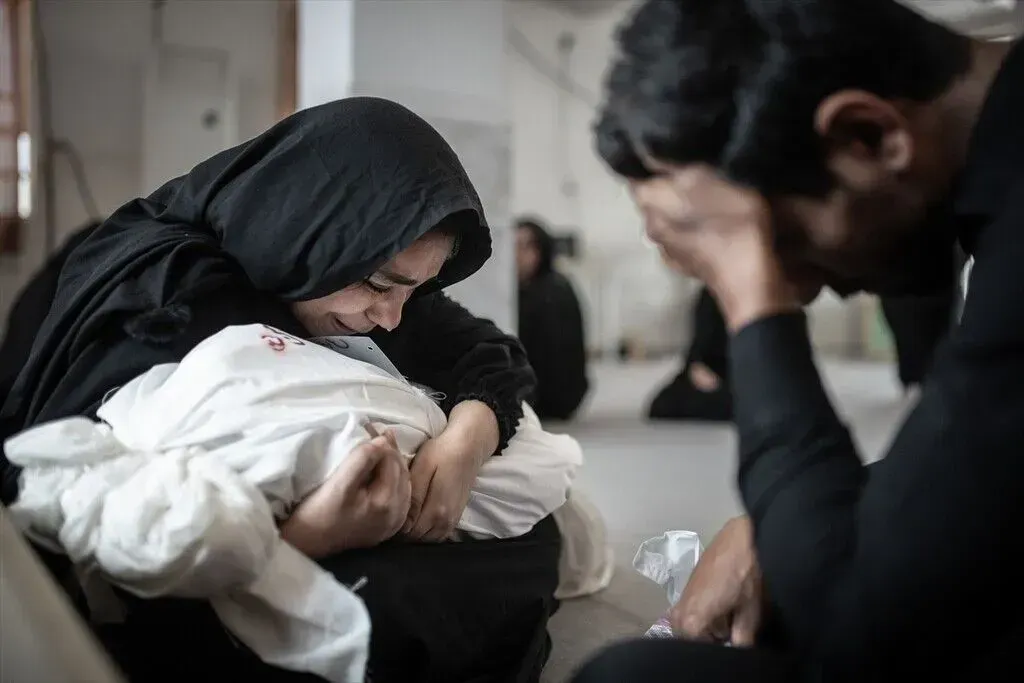
A missile hit the two-storey school at about 10.45 a.m. local time on 28 February, an hour into the opening day of the war, according to the governor of Hormozgan province. The roof pancaked onto the children and teachers below, the signature of a top-down strike. Iranian foreign minister Abbas Araghchi said the building was "bombed in broad daylight, when packed with young pupils."
Iranian authorities put the death toll at 156, while US senators and human rights groups have cited figures of at least 175 dead, including about 120 children. The judiciary's Mizan agency counted 110 schoolchildren among the dead, 66 boys and 54 girls, along with 26 teachers and four parents. The school taught girls and boys on separate floors, according to Amnesty International, and funerals for at least 165 victims drew crowds in Minab, with excavators digging at least 100 graves.
The school sat next to a naval base run by the Islamic Revolutionary Guard Corps, but it had been walled off from that compound since 2016, with its own street entrances, a courtyard football pitch visible in satellite imagery from 2017, and years of online activity Reuters described as a vivid public record. Iran imposed a deliberate internet shutdown on the day of the strike that has hampered independent verification since.
The evidence of US responsibility
Munitions experts who reviewed video of the strike identified the weapon as a US-manufactured Tomahawk cruise missile, a weapon only US forces fired in this war. Video verified by CBS News and multiple weapons experts appeared to capture the moment the missile struck. General Dan Caine, chair of the Joint Chiefs of Staff, confirmed on 2 March that the US Navy had launched Tomahawks in southern Iran on 28 February, and two days later showed a map of the first 100 hours of strikes that included Minab.
CENTCOM officers set the target coordinates using outdated Defense Intelligence Agency data. An intelligence analyst had flagged as early as 2019 that the site appeared to have changed from a naval facility into a school, but the remark went into a digital tool not connected to the authoritative targeting database, and the planners used imagery that had not been updated in years. Senior US commanders ignored warnings that the targeting intelligence was severely out of date, in the interest of what the senators' letter described as expediency, and that failure fed directly into the strike. The Army Regulation 15-6 inquiry that Cooper ordered was completed in April and remains under review by senior Pentagon leadership.
The denials
President Donald Trump blamed Iran directly and when asked aboard Air Force One on 7 March whether US forces had bombed the school, he said, "No, in my opinion, based on what I've seen, that was done by Iran," adding that Iran was "very inaccurate" with its munitions and had "no accuracy whatsoever." Pressed at a 9 March news conference on why he was the only person in the US government blaming Iran, he said he did not know enough about it, that the matter was under investigation, and that "Tomahawks are used by others" because numerous nations buy them from the US. Munitions specialists countered that the US was the only combatant in the war known to field Tomahawks. When Trump made the "done by Iran" claim, Hegseth was standing next to him and did not echo it.
Trump's account shifted as the evidence mounted along with public backlash. In June he said he had not reviewed the investigation and was waiting for it to finish, despite reporting that it had been completed weeks earlier, called the incident horrible, and said he had seen no evidence a US missile hit the school. Neither the US nor Israel formally claimed the strike, and General Caine placed US operations in southern Iran, where Minab sits, while Israel's were concentrated in the north.
The strike list was reportedly generated with the help of artificial-intelligence targeting tools, which senators cited in demanding to know how a school came to be selected. And a month into his tenure, Hegseth had fired the military's senior Judge Advocate General officers, the uniformed lawyers who vet operations against the law of armed conflict, describing them as "roadblocks."
The gutting of civilian-harm safeguards
The safeguards that existed to prevent a strike like Minab had been hollowed out in the year before it. The Pentagon's Civilian Harm Mitigation and Response programme, known as CHMR, was created in 2022 after years of scrutiny over civilian deaths, staffed by about 200 people including roughly 30 at a Civilian Protection Center of Excellence, and built to map civilian presence before a strike and investigate harm after one. A Department of Defense inspector general report published on 13 May 2026 found the department "did not fully implement any of the CHMR-AP objectives" by the end of the 2025 fiscal year, that funding had been cut, meetings had stopped, and personnel had been lost or reassigned, leaving the department at risk of breaching the federal law that requires the programme.
Current and former staff described a deeper collapse than the report set out. By the time of the Minab strike, they told ProPublica, the mission had been cut by about 90 per cent, leaving a handful of staff to track civilian harm as the strike tempo rose across Africa and the Middle East. Wes J Bryant, who ran civilian-harm assessments at the centre before resigning, said seven people remained, locked out of operations and moved to what he called a closet office, and that the programme survived on paper as legal cover. In May 2025 the department had asked Congress to repeal the law requiring the centre. Hegseth, who has called the guardrails hindrances to a "warrior ethos," pivoted when pressed on Iran to blame the Iranian government for placing military targets in civilian areas and said no nation in history had taken more care than the US to avoid civilian deaths.
Ten senators led by Elizabeth Warren wrote to Hegseth on 5 July, echoing the inspector general and charging that the administration had "defunded and impeded civilian protection efforts" in potential violation of federal law. Human Rights Watch said Hegseth's own role in the targeting decisions remains an open question.
Hegseth's public rhetoric matched the doctrine. At a Pentagon news conference on 4 March, four days after the school was destroyed and as the death toll was becoming clear, he declared Iran "toast" and promised "death and destruction from the sky, all day long," saying US pilots had "maximum authorities granted personally by the president and yours truly." He said the campaign was being waged "without mercy" and described using 500lb, 1,000lb and 2,000lb bombs from "a nearly unlimited stockpile." Meanwhile, the civilian casualty toll continued to climb across the region.
The law and accountability
Human Rights Watch verified 14 videos and photographs recorded immediately after the strike and analysed roughly 40 satellite images spanning 25 years, and concluded the strike was unlawful. The laws of war prohibit an attack when the anticipated harm to civilians is disproportionate to the expected military gain, and forbid targeting civilian objects such as a functioning school. HRW noted the school had been walled off from the adjacent Islamic Revolutionary Guard Corps compound since about 2016, with its own street entrances, a painted courtyard football pitch and a years-long online presence, and that a strike using precision-guided munitions on a building carrying those markers pointed to a failure to take feasible precautions. In a follow-up legal analysis it set the threshold plainly: a finding that mistakes were made in target selection does not excuse responsibility, and if US forces failed to maintain updated no-strike lists and acted recklessly, individuals could be guilty of a war crime. HRW said the inquiry should examine whether Hegseth's dismantling of the civilian-harm architecture helped enable the attack.
Amnesty International reached the same conclusion through Agnes Callamard, its secretary general and a former UN special rapporteur on extrajudicial executions, who said the organisation's findings pointed to the US and called the strike "an absolute violation of international law." Amnesty's Erika Guevara-Rosas said that if the US knew the school sat beside the IRGC compound and struck without feasible precautions, such as attacking at night when the school was empty or giving effective advance warning, it would amount to recklessly launching an indiscriminate attack that must be investigated as a war crime. Amnesty also pressed Iran to move civilians away from military sites and restore the internet access it had cut to 92 million people since the first day of the war.
The legal architecture separates three questions that public debate tends to merge, as the international lawyer Joseph Orenstein set out in a targeting analysis for Just Security: whether the strike broke international humanitarian law, whether it was a war crime, and whether any individual bears criminal responsibility. A strike directed at what was in fact a civilian object breaches the principle of distinction on its face, though US practice allows a good-faith qualifier for what a commander reasonably believed at the time. The Defense Intelligence Agency had coded the school building as a military target, a classification left over from when it was part of the IRGC base, even though open-source satellite imagery showed its civilian function by February 2026. That gap between the coded target and the visible reality is the centre of the legal case.
UN High Commissioner for Human Rights Volker Turk addressed an urgent debate of the Human Rights Council on 27 March and said he had significant concerns about whether the strikes complied with international humanitarian law, and a UN investigation was opened on 17 March. A group of UN experts found the victims were mainly girls aged 7 to 12 and that large parts of the school were destroyed during class hours, concluding that an attack on a functioning school during school hours raised the most serious concerns under international law. Malala Yousafzai said the news left her heartbroken and appalled, Italian Prime Minister Giorgia Meloni called it a massacre, and the United Kingdom told the Human Rights Council debate the attack was a grave breach of international humanitarian law. More than 100 US legal scholars have signed a letter arguing the wider US and Israeli strikes on Iran breach international law. The killing would be one of the largest civilian-casualty incidents caused by the US military in decades.
Children killed by US forces under Trump since 2017
Minab is the deadliest single strike on children attributed to the US military in decades, but it sits at the end of a long record of children killed in US operations across multiple countries since 2017, the year Donald Trump first took office. No US agency publishes a running total of children killed by American forces, and the monitoring groups that reconstruct these counts caution that their figures are minimums drawn from local reporting, so any aggregate is a floor rather than a full accounting.
US counterterrorism strikes killed children across Yemen, Somalia, Afghanistan, Syria and Iraq throughout Trump's first term. A Navy SEAL raid on the Yemeni village of al-Ghayil days after Trump's first inauguration in January 2017 killed at least 20 villagers, including nine children under 13, among them an eight-year-old US citizen. Mwatana for Human Rights examined 12 US attacks in Yemen between January 2017 and January 2019 and documented at least 38 civilians killed, 13 of them children. In Somalia, where 202 of the 263 US strikes recorded between 2003 and 2021 fell in Trump's first term, Airwars has documented civilian deaths including children through both his terms, with a strike near Jamaame in November 2025 reported to have killed multiple children. Across all its post-2001 theatres, Airwars counts a minimum of 22,000 and as many as 48,000 civilians killed by US actions, a total in which children are a recurring but unevenly recorded share.
Trump's second term has widened that map. A policy specialist at Airwars said that less than 18 months into the second term, US operations had already killed more than 2,000 civilians across theatres including Iran, Somalia, Syria, Yemen, Nigeria, Venezuela and strikes on boats in the Caribbean and eastern Pacific, calling the number of simultaneous theatres unprecedented. In Yemen alone, Airwars tracked at least 224 civilians killed in the spring 2025 US air and naval campaign codenamed Operation Rough Rider, and the Yemen Data Project put that toll at a minimum of 238 civilians with 467 injured, figures that include children. Minab, with about 120 children killed in a single strike, is the largest child death toll of any of them.
Children killed by Israel, and the US weapons behind the strikes
The scale in Gaza is larger by an order of magnitude, and better counted. UNICEF, drawing on figures reported by the Gaza Ministry of Health, said that between 7 October 2023 and 3 February 2026, 71,803 Palestinians were killed in the Gaza Strip, including at least 21,289 children, with a further 44,500 children injured. UNICEF has described more than 50,000 children killed or maimed since October 2023 and at least 1,000 babies among the dead. Save the Children reported in September 2025 that at least 20,000 children had been killed, an average of more than one child an hour across nearly two years, with at least 1,009 of them under a year old. Independent mortality analyses in medical journals have concluded the Ministry of Health figures undercount the true death toll rather than inflate it.
US weapons carried out those strikes in large part. The Costs of War Project at Brown University calculated that the US provided at least 21.7 billion dollars in military aid to Israel between October 2023 and September 2025, the highest level in decades, most of it channelled through Foreign Military Financing that pays for US-origin arms. The US delivered, among much else, thousands of MK-84 2,000-pound bombs, BLU-109 bunker-busters, MK-82 500-pound bombs, small-diameter GBU-39 bombs and thousands of JDAM guidance kits, and by May 2025 Israel's defence ministry said the US had sent 90,000 tons of arms and equipment on 800 transport planes and 140 ships since October 2023. The 2,000-pound bombs, which the Quincy Institute noted Israel used extensively to destroy apartment buildings, hospitals and water infrastructure, were briefly paused by the Biden administration in May 2024 over their use in densely populated areas, then released in full by Trump in late January 2025 along with a hold on 1,800 such bombs.
The link between the weapons and the child deaths is one US officials have themselves drawn. A group of former State Department and military officials wrote that the continuous flow of arms to Israel had ensured what they called undeniable US complicity in the killing and forced starvation of Gaza's population. In February 2025 Trump rescinded National Security Memorandum 20, the Biden-era instruction that had required the State Department to report to Congress on whether Israel was using US weapons in line with international law. The same administration imposed sanctions on International Criminal Court judges and on the UN special rapporteur Francesca Albanese over their scrutiny of Israeli conduct.
What comes next
International humanitarian law bars attacks on schools, hospitals and civilian shipping, and killings carried out with a supplier state's weapons can implicate that state in the breach. The documented strikes on schools and medical facilities in Iran, and the far larger toll of children in Gaza killed with US-supplied arms, fall within the jurisdiction of the International Criminal Court, which neither the US, Israel nor Iran recognises, and whose judges the US has sanctioned.
The senators set their deadline for 20 July. The completed Minab report remains with senior Pentagon leadership, and no one has been disciplined for a strike that killed more than 100 children.