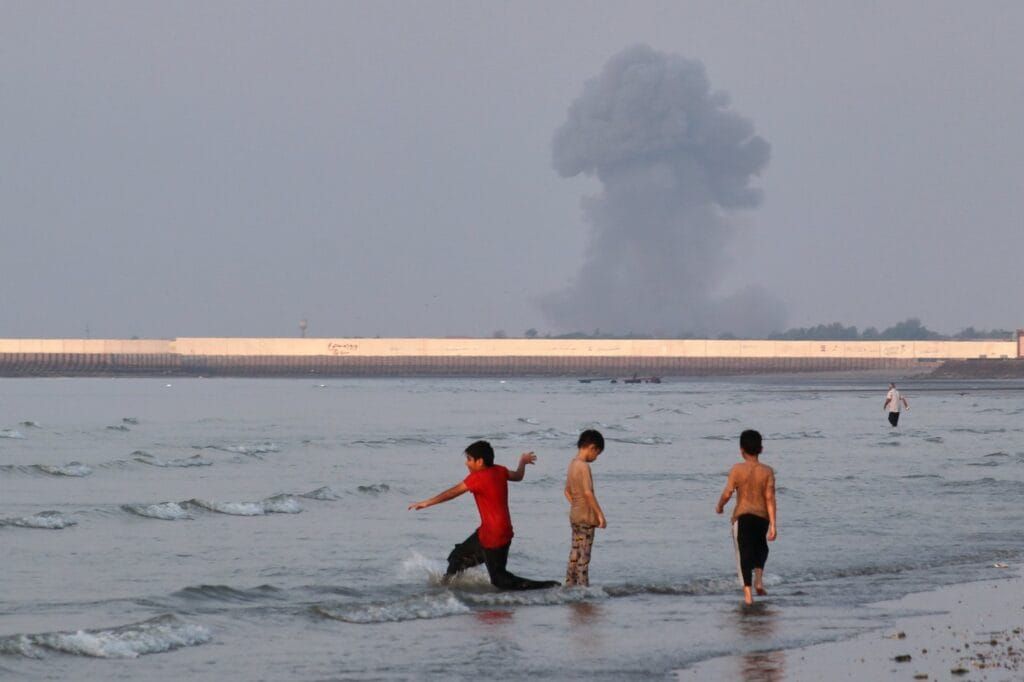
US forces struck Iranian military targets for a fifth consecutive day on 15 July 2026 and cut traffic through the Strait of Hormuz to a fraction of its normal flow with a reimposed naval blockade, as Iran threatened to halt oil exports across the region and warned again that it could close the waterway.
Iran's army said an overnight US strike on a base at Bampur, in the southeastern province of Sistan and Baluchestan, killed seven soldiers. US Central Command said the wave of strikes, which began at 6 a.m. Eastern time, was meant to further degrade the forces Iran has used to attack commercial shipping, and it released video of the bombardment. A maritime traffic control centre at Chabahar, in the same province, was damaged by a US projectile, Iran's state news agency said. Trump said the US would hit Iran's energy sector, its bridges and its power plants within a week unless Iran returned to talks, warning it would get "really bad."
Iran struck US military sites in Kuwait, Bahrain and Jordan in response, its state media said. Jordan's army said it intercepted three Iranian ballistic missiles at dawn on Wednesday after they entered its airspace, with no casualties or damage. Iran said US strikes had killed more than 30 civilians in recent days. UN human rights chief Volker Turk called the renewed attacks a setback for civilians in the region and beyond, warning that disruption to the flow of food and medicine through the strait carries severe humanitarian consequences.
Oil held near a one-month high. Brent, the global benchmark, traded around 85 dollars a barrel on 15 July, up slightly on the day, after a 9.6 per cent jump on 13 July that was its biggest single-day gain since 2020. West Texas Intermediate sat just under 80 dollars. Deutsche Bank analysts wrote that investors were largely looking through the latest spike. Transits through the strait, which carried roughly a fifth of the world's seaborne oil before the war, have fallen more than half week on week, with 17 vessels crossing on 14 July against about 130 a day before the fighting, according to the analytics firm Kpler.
The blockade
CENTCOM said the naval blockade resumed at 4 p.m. Eastern time on 14 July, covering the entire Iranian coastline and all vessel traffic regardless of flag, though ships bound to or from non-Iranian ports are not to be impeded and humanitarian shipments are to be allowed after inspection. The measure reimposes a blockade first run from 13 April until 18 June, when it was lifted after Trump and Iranian President Masoud Pezeshkian signed a memorandum of understanding at Versailles. During that first phase CENTCOM said it redirected more than 140 compliant vessels, disabled nine non-compliant ships and let more than 50 humanitarian aid vessels pass, and it said that since early May US forces had helped more than 800 commercial vessels carrying over 400 million barrels of crude transit the strait.
Trump said on social media he was reinstating the blockade and styled the US "the Guardian of the Hormuz Strait." He announced a 20 per cent toll on cargo crossing the strait on 13 July, then abandoned it a day earlier before the blockade took effect, saying he would replace the fee with trade and investment deals from Gulf states. The International Maritime Organization said there is no legal basis for mandatory tolls to transit a strait. Iran's foreign minister, Abbas Araghchi, wrote that Iran had "always been the guardian of the strait," and said 20 per cent was too much but that Iran would "be fair."
What triggered the resumption
The renewed campaign followed a run of Iranian attacks on commercial shipping. The US Treasury revoked the licence authorising Iranian oil sales on 7 July, and Trump said the memorandum with Iran was over, called further talks a waste of time, and formally notified Congress on 11 July that the US had resumed hostilities.
On 8 July the interim US-Iran ceasefire collapsed after Iran struck commercial ships in the strait and the US responded by striking Iranian territory, followed by Iranian strikes on US bases in the Gulf. CENTCOM ran three rounds of strikes across the following nights, hitting more than 300 targets, after the Islamic Revolutionary Guard Corps attacked the Cyprus-flagged container ship GFS Galaxy on 11 July and set it ablaze, leaving one Indian crew member missing and 10 rescued. Strikes on 13 and 14 July hit Bandar Abbas, Kish Island, Qeshm Island, Bushehr, Abadan, home to the oldest oil refinery in the Middle East, and the port of Mahshahr.
The tanker attacks
Iran's Revolutionary Guards struck two vessels they called non-compliant supertankers in the Strait of Hormuz on 14 July, Iranian state media said, claiming the ships had ignored repeated warnings. The attack that drew the most protest came a day earlier, when Iranian cruise missiles struck the UAE-flagged tankers Mombasa and Bahia in the strait's southern passage inside Omani waters, killing one Indian national and injuring eight other crew, six Indian and two Ukrainian, four of them seriously. India summoned Iran's deputy chief of mission in New Delhi over the strike; 30 of the 46 crew across the two ships were Indian.
The Guards accused the US of inciting vessels to use an illegal route, and said cooperation with the "aggressor enemy" would bring only delay in reopening the strait and a wider energy crisis. The UN's maritime agency, which counts 14 seafarer deaths across the war, said the cycle of escalation must end. Iran has paired real attacks with at least one fabricated casualty claim that CENTCOM was able to debunk within a day.
The human toll
Human Rights Activists in Iran, a US-based monitor, documented 3,636 deaths inside Iran as of early April, including 1,701 civilians, 1,221 military personnel and 714 unclassified, and cautioned that the military count is significantly undercounted because it depends on obscured government data. Iran's Foundation of Martyrs put the total at 3,468. US and Israeli estimates place Iranian military dead above 6,000. UNICEF reported that more than 1,100 children had been killed or injured across the wider Middle East conflict by March 11, including about 200 children reportedly killed in Iran. The single deadliest strike hit the Shajareh Tayyebeh Elementary School in Minab on the war's first day, killing 156 civilians including 120 children, an attack multiple independent investigations concluded the US carried out.
The Pentagon confirms 13 US troops killed in action and more than 365 wounded, while independent tallies put the figures at 15 killed and 520 to 543 wounded. Deaths from the past week of renewed strikes, including the seven soldiers Iran reported at Bampur, are still being counted. The Iranian Red Crescent said 65 schools and 32 medical facilities have been hit and more than 10,000 civilian sites damaged since fighting began, and hundreds of thousands of people have been displaced.
Global damage
Economic losses run into the hundreds of billions of dollars. Iran has sustained between 300 billion and 1 trillion dollars in damage by varying estimates, Israel about 50 billion dollars, and Arab states more than 120 billion dollars. The cost of the war to US taxpayers was estimated at 113 billion dollars by June, and the Pentagon has requested a further 200 billion.
Brent peaked at 126 dollars a barrel in March, when Dubai crude hit a record 166 dollars, the largest oil supply shock since the 1970s. Qatar's Ras Laffan gas plant lost 17 per cent of capacity in an Iranian strike in March, sending Asian spot gas prices up more than 140 per cent and nearly doubling the European TTF benchmark. Bart Melek of TD Securities said crude could reach 100 dollars a barrel if physical shortages take hold.
What it means
A halt to Iranian exports or a closure of the Strait of Hormuz would remove close to 20 million barrels of daily oil supply from the market and push fuel prices and inflation higher across importing economies, with the sharpest effect on Asian buyers dependent on Gulf crude. Iran-aligned Houthi forces in Yemen have threatened to close the Bab al-Mandab Strait, through which about a tenth of the world's oil moves, in what one Houthi official said would be an "operational alliance" with any Iranian closure of Hormuz. The Philippines has already declared an energy emergency, and Bangladesh, Pakistan and Vietnam were among the hardest hit in an earlier phase. Higher energy costs complicate central bank decisions, and analysts said the fighting could force the US Federal Reserve to hold or raise rates.
Bahrain, Oman, Kuwait, Jordan, Lebanon, Qatar and the UAE have all been drawn in, widening a bilateral confrontation into a regional one. The blockade, the collapse of the interim ceasefire, the reimposition of sanctions and Trump's rejection of the memorandum leave no active negotiating track, and Trump's threat against Iranian energy sites points to further escalation within the week.
International humanitarian law bars attacks on schools, hospitals and civilian shipping, and a naval blockade that stops food and medicine can itself breach the law of armed conflict. The documented strikes on 65 schools and 32 medical facilities fall within the jurisdiction of the International Criminal Court, which neither the US, Israel nor Iran recognises.