
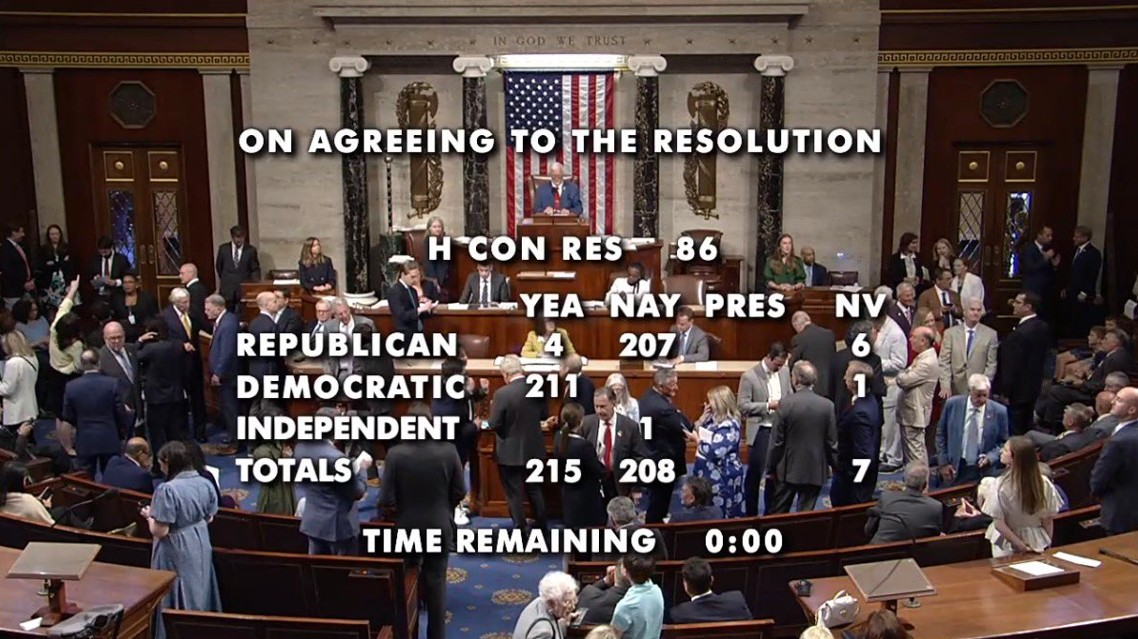
The US House of Representatives voted 215-208 on 3 June to direct President Donald Trump to end the war against Iran, with four Republicans joining every Democrat in the first measure of its kind to clear either chamber on a final vote since the fighting began in February. The vote came after Republican leaders tried to prevent it, after three previous attempts failed, and after a war the Constitution required US Congress to authorise passed its hundredth day without that authorisation.
What happened, and what was tried before
The vote on 3 June was not the first time the House had attempted this. Republicans rejected three earlier war powers measures this year. The most recent prior attempt ended in a 212-212 tie, with Democrats marking it as progress. Before the successful 3 June vote could take place, Republican leaders sent House members home early for a May recess when it appeared the measure had acquired enough Republican support to pass. They came back two weeks later and it passed anyway.
Four Republicans crossed over: Brian Fitzpatrick of Pennsylvania, Thomas Massie of Kentucky, Tom Barrett of Michigan and Warren Davidson of Ohio. Every Democrat voted yes. The resolution was introduced by Gregory Meeks of New York, the senior Democrat on the House Foreign Affairs Committee.
"I am thrilled that we've had the opportunity to have some members from the Republican side stand up," Sen. Meeks told reporters after the vote. "I'm really thrilled and proud of my Democratic colleagues, because every Democrat, every single one, voted for this."
Fitzpatrick framed his vote in procedural terms. "We're past the 60 days," he said. "You either follow the law or you change the law. You can't violate the law."
Massie and Davidson had been the two Republicans to vote yes on an earlier failed measure. Barrett was new to the coalition.
Why the measure can't actually stop the war
The resolution that passed Wednesday is a concurrent resolution, which means it goes to the Senate for approval but does not require Trump's signature and cannot be vetoed. Concurrent resolutions do not carry the force of law. They express the position of the US Congress. The Senate has its own version, a joint resolution introduced by Democratic Senator Tim Kaine, which would go to Trump's desk and carry the force of law if signed. Trump is expected to veto it.
The White House has challenged the House measure on two separate grounds. Legally, it characterises the resolution as an "unconstitutional legislative veto" over executive authority. Factually, it argues the question is moot.
Its formal Statement of Administration Policy states: "There are no present hostilities from which to remove U.S. Armed Forces. The hostilities that began on February 28, 2026, have terminated with the ceasefire ordered by the President on April 7, 2026."
That argument requires accepting that the ceasefire has held. It has not, in any sense. Joint Chiefs Chairman Dan Caine confirmed before a House committee this week that since the April ceasefire, Iran has fired at commercial vessels nine times and seized two container ships, and attacked US forces more than ten times, all characterised as below the threshold for restarting major hostilities. US Navy ships remain in active patrols of the Strait of Hormuz. The blockade of Iranian ports, ordered after the Islamabad talks collapsed in April, remained partially in effect as of this week.
Even if the concurrent resolution passes the Senate, the ceiling is the same it has always been. Overriding a presidential veto requires a two-thirds majority in both chambers, a threshold nowhere near the current count. Republicans hold the Senate. Majority Leader John Thune of South Dakota has urged his caucus to "hang together" behind Trump rather than constrain him as commander in chief.
Secretary of State Marco Rubio told a House committee that if the resolution became law, Iran would conclude the administration's hands were tied. Trump, responding on social media, called the four Republicans who crossed over "GRANDSTANDERS" and said Democrats were "fueled by Trump Derangement Syndrome."
The Senate: closer than it looks, further than it needs to be
The Senate advanced its own war powers measure 50-47 on 19 May, a procedural step that cleared the bill from committee and set up a final vote. Four Republicans joined Democrats on that vote: Susan Collins of Maine, Lisa Murkowski of Alaska, Rand Paul of Kentucky and Bill Cassidy of Louisiana. Senator John Fetterman of Pennsylvania was the only Democrat opposed.
Cassidy had not previously supported a war powers resolution on this conflict. Days before his vote, Trump had backed a rival candidate who defeated him in Louisiana's Republican primary. Cassidy said no congressional authorization could be justified until the administration provided clarity on the war's objectives.
"If you don't have the guts to vote yes or no on a war vote, how dare you send our sons and daughters into war," Senator Tim Kaine of Virginia said, a quote that has become the bluntest summation of the constitutional argument on the floor.
A final Senate vote has not been scheduled. Reaching that vote is expected to require 60 senators under normal procedure, ten more than the current coalition has. Senators John Curtis of Utah and Thom Tillis of North Carolina have both expressed frustration about the missing congressional authorisation without committing to a vote. Whether that frustration turns into something is the open question.
The constitutional workaround
Article I, Section 8 of the US Constitution gives Congress alone the authority to declare war. The War Powers Resolution of 1973 puts a 60-day limit on hostilities a president begins without congressional authorisation, after which forces must withdraw unless Congress acts. That deadline fell on 1 May. Trump's response was to declare the action "terminated" on the basis of the April 7 ceasefire. That ceasefire has been broken, repeatedly, by both sides.
The war began 28 February without an authorisation for the use of military force, without a declaration of war, and without any prior congressional notification. Three months later, neither chamber has passed a binding authorisation and the executive branch is contesting whether the 60-day law applies at all.
This is not the first time a president has run a war past the War Powers Resolution's limits. It has happened with military action in Libya, Yemen, Syria and Somalia. But the scale and direct nature of a war against a nation-state, with a defined start date, defined adversary and active naval operations, makes this a different order of constitutional avoidance than drone strikes or advisory missions.
What the war has done to the economy
The polling opposition to this conflict is unlike any previous USian war in the modern record, and the economics explain most of it.
Before 28 February, the Strait of Hormuz carried 25 per cent of the world's seaborne oil trade and 20 per cent of global liquefied natural gas, with between 120 and 140 vessels transiting daily. Iran mined the strait and closed it after the US-Israeli strikes killed Supreme Leader Ali Khamenei. Traffic fell 95 per cent even after the April ceasefire. More than 600 vessels, including 325 tankers, remain stranded in the Gulf. Hegseth told reporters that more than 22,500 mariners are stuck on more than 1,550 vessels. Iran has proposed a two-million-dollar per vessel transit fee, which shipping associations have rejected as a violation of international maritime norms. The UK and France have hosted two conferences on reopening the strait, so far without result.
A Reuters/Ipsos poll taken 20-23 March found 61 per cent of USians disapproved of the military action and 35 per cent approved, with 93 per cent of Democrats and 69 per cent of independents against it. Roughly seven in ten registered voters told pollsters they feared the war would drive gas prices higher. A March Ipsos survey found 55 per cent would not support sending any US troops into Iran.
Republican base support is less solid than the headline figure suggests. Before the war, a Brookings poll found only 40 per cent of Republicans backed a potential conflict and only 34 per cent thought it would serve USian interests. Support climbed once Trump owned the war, but the gap between a base that rallied to him and one that never wanted the fight is the ground those Senate Republicans feel shifting beneath them.
No major USian war in the modern polling era has begun underwater. The Afghanistan campaign drew around 90 per cent approval in late 2001. The 1991 Gulf War sat near 80 per cent. This one started at roughly a third support and stayed there.
What this vote actually does
The vote pressures Thune, puts every senator on record, and signals to Tehran that Trump's domestic position is weaker than the administration projects. It tells Kyiv, for what it is worth, that Congress has not entirely outsourced foreign policy to the executive. None of that ends the war.
The measure passed one day before the House also passed the Ukraine Support Act 226-195, the second consecutive foreign policy rebuke of Trump in two days. The pattern matters beyond individual votes. This Congress, which is controlled by Republicans, has now used a discharge petition to pass Ukraine aid over the speaker's objection and passed an Iran war powers resolution over leadership's attempt to cancel the vote. The Republican coalition behind Trump on foreign policy is not collapsing. But it has edges that are thinning, and a war that becomes more expensive and longer tends to fray those edges further.
US Navy ships are still in the Strait of Hormuz. The ceasefire is still breaking. The war passed its hundredth day this weekend without authorisation from the only body the Constitution trusted to provide one. The House has now said it should stop. What happens next depends on whether ten senators decide the law means what it says.