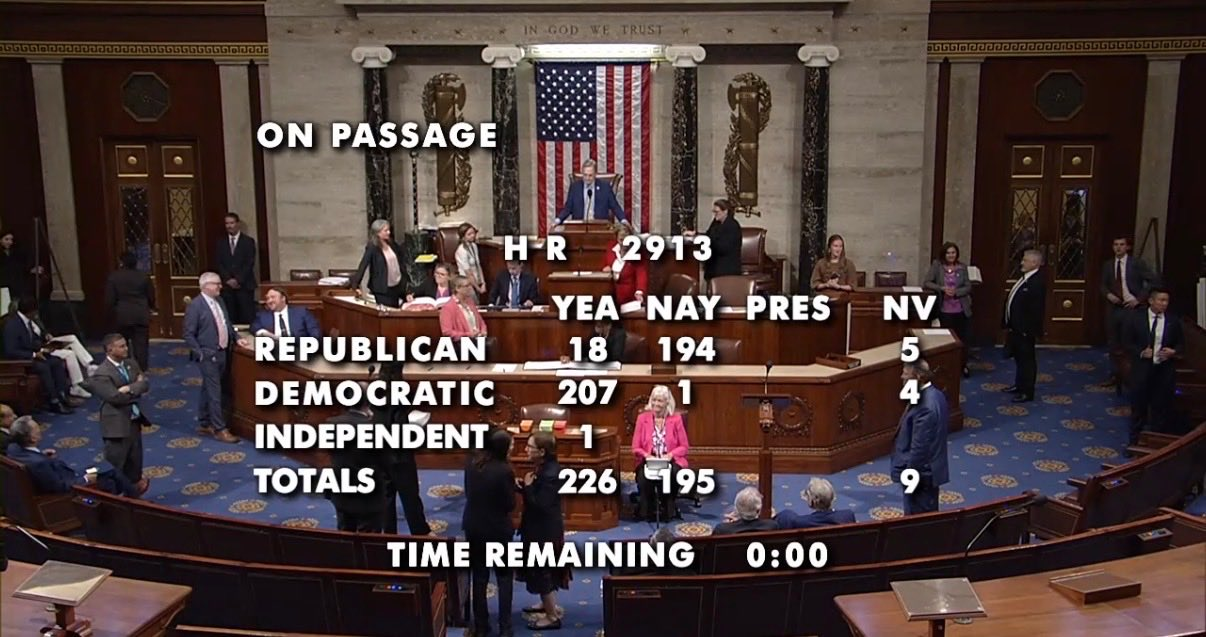
The US House of Representatives passed the Ukraine Support Act on Thursday by 226 to 195, authorising new military aid for Ukraine and the most sweeping Russia sanctions yet proposed in the US Congress, over the objections of President Donald Trump and the Republican leaders who control the chamber. Eighteen Republicans and independent Rep. Kevin Kiley of California, who caucuses with the GOP, joined every Democrat but one to pass the bill. Rep. Ilhan Omar of Minnesota was the only Democrat to vote no.
It was the second time in two days that House members went around their own leadership to challenge Trump on foreign policy. On Wednesday, they approved a war powers resolution aimed at halting US military action against Iran.
What the bill contains
The Ukraine Support Act (H.R. 2913), introduced by Rep. Gregory Meeks of New York in April 2025 and bottled up in nine House committees for 14 months, is broader than the aid packages that preceded it.
It authorises $8 billion in military loans and arms sales to Ukraine, extends a Biden-era military lend-lease programme, and establishes a Ukraine Reconstruction Trust Fund. On sanctions, it goes further than anything the US Congress has passed since the invasion, it imposes mandatory property-blocking sanctions on Russian oil and mining companies, Rosatom and its subsidiaries, and Russian financial institutions. It imposes a 500% tariff on all goods imported from Russia and bans Russian crude oil from entering the United States. It also sanctions North Korea, Iran and Belarus for supporting Russian aggression.
"Today's bipartisan vote sends a strong message to Ukraine that we support them and a clear message to Putin that we stand against Russian tyranny," said Republican Rep. Michael McCaul of Texas after the vote.
The White House opposed the bill and has indicated Trump would veto it, arguing mandatory sanctions would damage the global economy and undercut negotiations with both Russia and Iran. Trump has vetoed two measures in his second term so far.
How it got to the floor
Democrats could not move the bill through normal channels. Republican leaders refused to schedule it, and Johnson's office never called it for a vote in the 14 months after Meeks filed it.
So Meeks and Rep. Brian Fitzpatrick of Pennsylvania, a Republican and co-chair of the Congressional Ukraine Caucus, spent months collecting signatures on a discharge petition, a procedural tool that lets a majority of House members bypass leadership and force a floor vote once 218 signatures are gathered. The petition had sat one name short for weeks. On 13 May, Kiley added the 218th signature.
"We all want this war to end," Meeks said on the floor Thursday. "The question is how. Will we abandon Ukraine and force it into a terrible deal?"
Fitzpatrick was direct about the Senate arithmetic. "It's probably not going to get 60 votes in the Senate," he said, "but it's going to hopefully force the Senate to address the issue." He said the vote would send a message to Putin that "we do have a pulse here, that we do care about Ukraine."
Republican opponents called the bill political. Rep. Brian Mast of Florida, who chairs the Foreign Affairs Committee, called it "a cudgel to fight against President Trump."
The discharge procedure took that argument away from leadership, by the time Johnson could object, the votes were already there.
What it means in practice
Probably less than Ukraine needs right now. The Senate requires 60 votes to advance legislation. Majority Leader John Thune of South Dakota has refused to bring Russia sanctions bills to a vote, saying he defers to Trump. A separate bipartisan sanctions bill from Senators Lindsey Graham and Richard Blumenthal has been stalled since April 2025.
No weapons move because of Thursday's vote, no sanctions will take effect and no tariffs have been applied. The bill's significance is primarily in what it records, that a bipartisan House majority told the Senate and the White House on the same day that Russia struck Kyiv, Dnipro and Kharkiv that the US Congress has not fully abandoned its allies.
The shift in Republican support is the sharpest number in Thursday's result. In April 2024, 101 Republicans voted for supplemental aid to Ukraine. Thursday, 18 did. The United States has approved roughly $195 billion for the Ukraine response since the invasion, but the last major aid law passed more than two years ago. The interceptor shortage Zelensky warned Trump about in a letter six days ago is the direct consequence of that gap. Russia fired eight Zircon hypersonic missiles at Ukrainian cities on 2 June. None were intercepted.
Rep. Don Bacon of Nebraska, one of the Republicans who crossed the aisle, said: "Are we going to stand with good or are we going to stand with evil?"
The ICC question
Here is the contradiction at the centre of Thursday's vote. The US Congress wants Russia held accountable for war crimes, but the United States refuses to join the one permanent court built to do it, and is actively working to break that court.
The US signed the Rome Statute under President Bill Clinton, then withdrew the signature under President George W. Bush. It has never ratified. In 2002, The US Congress passed the American Service-Members' Protection Act, legislation so hostile to the court that critics nicknamed it the Hague Invasion Act, because it authorises the president to use force to free US or allied personnel held by the ICC. The court now has 125 member states.
Trump went further, on 6 February 2025, he signed Executive Order 14203, claiming that the court had engaged in "illegitimate and baseless actions targeting America and our close ally Israel," and imposing financial and visa sanctions on its staff. Marco Rubio expanded the list in June, August and December 2025. By the end of the year the United States had sanctioned the chief prosecutor, his two deputies and eight judges. One of those eight, Nicolas Guillou, is French. France condemned the sanctions. One of the eight is Canadian Judge Kimberly Prost. Canada is a Rome Statute member, and its national now faces US economic sanctions for performing her judicial duties in a court supported by Canada and most of the world.
In July 2025 a US federal judge blocked enforcement of the executive order, ruling it an unconstitutional infringement on free speech. The administration appealed. The sanctions remain in effect pending that appeal.
The US is not alone in targeting the court's personnel. In December 2025, a Moscow city court sentenced chief prosecutor Karim Khan to 15 years in prison and the eight sanctioned ICC judges to terms ranging from three and a half to 15 years for their roles in indicting Putin. Russia and the United States targeted the same institution, the same officials, in the same month.
The US sanctions were reportedly driven by deep concern that the court would eventually investigate Trump and his officials and find them guilty of a number of crimes. The US played off their attacks on the international court as a way to protect its US soldiers, presumably from accountability for their crimes as well. The Trump administration was pressing the court to pledge it would not do so. There are currently no ICC investigations of any US citizens. The legal argument about protecting US soldiers cannot explain sanctions against judges who have never touched a US case.
The standard objection is sovereignty, the fear that the ICC could haul US soldiers before a foreign bench. The treaty already answers it. The court operates on complementarity, meaning it acts only when a country's own courts will not or cannot. A functioning US justice system is the strongest shield against ICC jurisdiction, not a reason to stay out.
What the court did to earn the sanctions from the US is that it charged Netanyahu and former defence minister Yoav Gallant in November 2024 with war crimes and crimes against humanity, including starvation as a method of warfare. It also charged three Hamas commanders. It is the same court, applying the same law, that issued the Putin warrant members of the US Congress cited approvingly on the floor Thursday. You cannot demand the law for Moscow and sanction the judges who apply it to your ally.
This reaches beyond foreign policy. The principle the US is attacking abroad, that no one is above the law, is the same one that protects US citizens at home and US soldiers, aid workers and journalists overseas, the people who rely on the laws of war when they are captured or targeted. Punishing judges for their rulings is a tactic authoritarian governments use against their own courts. The US is now modelling it on the world stage, in alignment with Russia.
For Canadian and European readers, your governments already back this court and have objected to the US sanctions. That pressure needs to hold. Press your representatives to defend the ICC officials Washington has targeted, keep funding the court, and treat US ratification of the Rome Statute as a live diplomatic demand rather than a closed question. Accountability either applies to everyone or it protects no one.
What Trump's aid blocking has already cost
The cost of the aid shortfall is documented in UN casualty data. The HRMMU verified 2,514 Ukrainian civilians killed and 12,142 injured in 2025, a 31 per cent increase on 2024 and 70 per cent higher than 2023. The trend runs directly alongside Trump's return to office and the three Hegseth aid pauses that disrupted Patriot interceptor supply. After Trump returned to office and paused military aid, Kyiv began facing shortages of air defence missiles.
Ukrainian officials publicly lamented that "some air defence systems sometimes stand empty while attacks still need to be repelled."
Long-range weapons, the category that interceptors are specifically designed to counter, caused 35 per cent of all civilian casualties in 2025: 682 killed and 4,443 injured. That is a 65 per cent increase on 2024's long-range casualty figures of 531 killed and 2,569 injured. The category includes Zircon hypersonic missiles, ballistic missiles, cruise missiles and Shahed-type loitering munitions. Ukraine's intercept rate for those weapons depends almost entirely on Patriot PAC-3 supply. When the supply was paused, the rate fell. When the rate falls, more reach residential buildings.
July 2025 set a three-year monthly high for civilian casualties: 286 killed and 1,388 injured, the worst figure since May 2022. On 31 July a missile strike on Kyiv killed 32 civilians, including five children, and injured 170. It was the deadliest single attack on the capital since the invasion began. In the deadliest attack of the year, Russia struck Ternopil on 19 November, killing 38 civilians including eight children, with ten families losing at least two members each. By December 2025, monthly casualties were 66 per cent higher than the equivalent month in 2024.
The energy sector absorbed a parallel campaign. Ukraine's Energy Minister confirmed more than 600 targeted combined attacks on energy infrastructure in 2025. Russia shifted from destroying power generation to repeatedly striking high-voltage substations and transmission nodes, exhausting repair crews and replacement components faster than they can be sourced. Replacement transformers can take years to procure.
These are the people the bill's backers are talking about when they invoke Ukrainian sovereignty. 2,514 killed, 12,142 injured in a single calendar year, in a country whose air defence gaps were widened by decisions made in the US. The bill would help close those gaps. Thursday's vote moved it one chamber closer to the Senate wall that has been blocking it since April 2025.