A committee of the US House of Representatives has declared the Spanish cities of Ceuta and Melilla as located in "Moroccan territory", the first time a body of the US Congress has cast doubt in writing on Spanish sovereignty over the two North African enclaves.
House Report 119-631 accompanies the National Security, Department of State, and Related Programs Appropriations Act, 2027, which the House passed 217 to 209 on 15 July. The report carries no force of law and does not change official US policy, which still treats both cities as Spanish.
The committee "notes that the Spanish-administered cities of Ceuta and Melilla are located in Moroccan territory" and remain the subject of Morocco's longstanding claim, the report says. The same paragraph says the committee backs State Department efforts to encourage diplomatic engagement between Morocco and Spain on the future status of the cities.
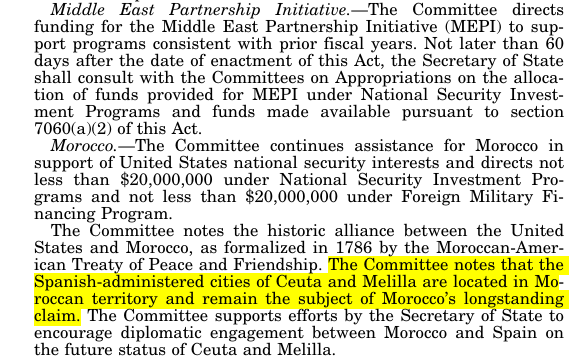
https://govinfo.gov/content/pkg/CRPT-119hrpt631/pdf/CRPT-119hrpt631.pdf
The Morocco entry, on page 88 of the report, invokes the 1786 Moroccan-American Treaty of Peace and Friendship and directs not less than 20 million dollars to Morocco under National Security Investment Programs and a further 20 million dollars under the Foreign Military Financing Program for the 2027 fiscal year. A separate provision in the same report targets Spain over what it calls the exploitation of Cuban medical professionals, a line also traced to Díaz-Balart, whose family fled Cuba.
The committee placed the enclave language inside the report's Middle East subsection, directly after its Israel entry and immediately before its passages on Syria and on the West Bank and Gaza. The pages around it carry a dense set of pro-Israel provisions: support for United States-Israel cultural initiatives in Jerusalem, a bar on Lebanese forces using US aid against Israel or eroding Israel's military edge, expanded vetting against the boycott movement and a reference to the Taylor Force Act. Morocco and the Spanish cities appear in that company rather than among the report's Europe entries.
H.R. 8595 also carries 3.3 billion dollars in annual security assistance to Israel, the figure set by the 2016 ten-year memorandum of understanding. The House Appropriations Committee said the measure funds allies including Israel, Jordan, Egypt and Taiwan while countering Iran, Cuba and China, and the American Israel Public Affairs Committee thanked Díaz-Balart by name for its pro-Israel provisions.
Lawmaker behind the text
Mario Díaz-Balart, a Republican from Florida, chairs the appropriations subcommittee that wrote the bill and reported it to the House on 30 April. He is vice chair of the full Appropriations Committee, a member of the Congressional Morocco Caucus and a longtime ally of Secretary of State Marco Rubio, a fellow Florida Republican with whom he served in the House and worked on Latin American and Middle Eastern policy for more than a decade.
El Confidencial and El Español named Díaz-Balart as the author of the enclave paragraph. He had set out the same position three weeks before the report appeared, in an interview published by El Español on 1 April, saying Ceuta and Melilla are not in Spain's geographic territory but in Morocco's, and that such questions are settled "between friends and allies".
Díaz-Balart told the paper the two cities were a weak point for Spain and accused Prime Minister Pedro Sánchez of valuing relations with Iran, Cuba and Venezuela over the United States. In April 2025 he met Morocco's Foreign Minister Nasser Bourita in Washington, alongside Rubio and then national security adviser Mike Waltz, and afterwards restated his support for Trump's recognition of Moroccan sovereignty over Western Sahara.
Díaz-Balart's public record on Israel exists in parallel with his record on Morocco. He was an original cosponsor of the February 2024 Israel Security Supplemental, which carried 17.6 billion dollars for Israel, cosponsored the Taylor Force Act and welcomed the 2017 decision to move the US embassy to Jerusalem. The advocacy tracker Track AIPAC puts the pro-Israel lobby total tied to his campaigns above 900,000 dollars over his career. The investigative outlet Sludge, reading Federal Election Commission filings, reported that AIPAC's political action committee gave him 124,000 dollars in the first half of 2025 alone. Those figures are US campaign money from US-based pro-Israel political committees, most of it earmarked donations routed through AIPAC as a conduit. They measure lobby investment in his campaigns. They are not payments from the Israeli state, and they are not evidence of loyalty to it.
The recognition that started with Israel
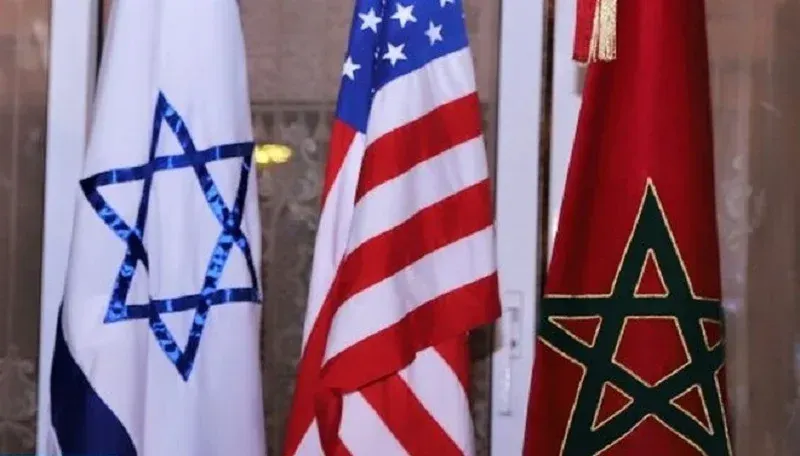
On 10 December 2020, in his final weeks in office, Trump announced that Morocco and Israel would normalise relations, the fourth such agreement in four months under the Abraham Accords. In exchange, the United States recognised Moroccan sovereignty over Western Sahara, the disputed former Spanish colony that the United Nations still lists as a territory awaiting decolonisation. The tripartite declaration was signed on 22 December 2020, after a US and Israeli delegation led by Jared Kushner flew to Rabat.
The United States remains the only Western state to recognise the Western Sahara claim. The Quincy Institute described the arrangement at the time as Trump selling out Western Sahara for a Morocco-Israel normalisation deal. Morocco itself does not publicly draw the connection and does not consider itself part of the Abraham Accords, a position noted by the Carnegie Endowment. Rabat's own conduct shows the link all the same: Morocco held its ties with Israel at the level of liaison offices rather than embassies, in part to keep bargaining chips should a future US administration reconsider the Western Sahara decision, Axios reported. Israel followed the United States in recognising Moroccan sovereignty over Western Sahara in July 2023.
The think-tank groundwork
The argument that reached the appropriations report was made first outside Congress, and it was made in pro-Israel terms. Michael Rubin, a senior fellow at the American Enterprise Institute and a former Pentagon official, published an op-ed on 12 March 2026 through the Middle East Forum, a pro-Israel think tank founded by Daniel Pipes, urging Trump and Rubio by name to recognise Ceuta and Melilla as occupied Moroccan territory. Rubin branded Spain a colonial power running colonies across the Strait of Gibraltar, and argued that Washington should apply to the enclaves the same logic it used on Western Sahara.
Rubin tied the enclaves directly to Israel. He wrote that Sánchez condemned Israeli action against Iran while relying on European military equipment containing Israeli components, cast Spain's position as hypocritical and compared the Jewish historical claim to the land of Israel with Spain's presence in North Africa. Days later, in a 16 March follow-up, he urged Morocco to send unarmed civilians into the enclaves in a second Green March, arguing that NATO's mutual-defence clause would not apply because Article 6 of the treaty excludes territory south of the Tropic of Cancer.
Rubin's history is contested. Melilla came under Castilian control in 1497, before the Alaouite dynasty that rules Morocco today, and Ceuta was taken by Portugal in 1415 and ceded to Spain in 1668, while the 1912 Franco-Spanish protectorate treated both cities as pre-existing Spanish territory rather than colonial acquisitions carved from Morocco. Spain writes both cities into its constitution and treats their status as closed under international law.
Rubio, the Abraham Accords and the enclaves
Marco Rubio has carried the Western Sahara position into the State Department and has linked it, in his own official readouts, to Israel. At his confirmation hearing on 15 January 2025 he restated US recognition of Moroccan sovereignty over the territory. When he met Bourita on 8 April 2025, the department's readout said the two discussed cooperation including "building on the Abraham Accords" and, in the next paragraph, reaffirmed recognition of Moroccan sovereignty over Western Sahara. Rubio has also called publicly for sanctions on Algeria, Morocco's regional rival and the main external backer of the Sahrawi independence movement.
Rubio is among the largest recipients of pro-Israel campaign money in US politics. Trackers drawing on Federal Election Commission records put his career total above one million dollars, with Pro-Israel America PAC among his leading contributors in his last Senate cycle. As a senator he cosponsored the Israel Anti-Boycott Act, the Combating BDS Act and the Taylor Force Act, opposed the Iran nuclear deal and backed the move of the US embassy to Jerusalem. As with Díaz-Balart, the money is campaign investment recorded in public filings, not payment from a foreign government.
Morocco's Washington campaign
Morocco has spent heavily to shape US policy on both Western Sahara and the enclaves. The kingdom has employed a rotating set of Washington firms, among them the Gabriel Company, run by former US ambassador Edward Gabriel, and JPC Strategies, and has spent roughly 20 million dollars on US lobbying over the years, including more than 1.6 million dollars in a single recent year, according to Foreign Agents Registration Act filings compiled by OpenSecrets and Al-Monitor.
The campaign has courted pro-Israel and hawkish opinion directly. Morocco's lobbyists pushed legislation tying the Sahrawi independence movement to Hezbollah and Iran, framing Rabat as a front-line partner against Tehran, Al-Monitor reported. Leaders of the Republican Jewish Coalition, including former senator Norm Coleman, visited Morocco amid hopes for the Israel normalisation deal, accompanied by a Morocco lobbyist. That courtship pays a return in Washington: Israel has served over the years as a supportive voice for Morocco inside the US capital, the Jerusalem Institute for Strategy and Security wrote.
What Morocco and Israel still share
Morocco-Israel ties cooled in public after Israel's war in Gaza began in October 2023. Rabat issued increasingly critical statements, joined United Nations resolutions Israel opposed, held its representation at liaison-office level and faced sustained street protests demanding the deal be scrapped. The relationship did not break. Morocco acquired satellite capability from Israel Aerospace Industries in 2024 and signed further defence deals for artillery and drones in 2025, and in January 2026 the two militaries signed a joint work plan for the year at the third meeting of their Joint Military Committee in Tel Aviv.
Spain's low-key response
Spain's government has refused to treat the paragraph as a crisis. Foreign Minister José Manuel Albares, speaking in Rome, said the Spanishness of Ceuta and Melilla is as certain as that of any city on the mainland, and declined to engage with the report or with Díaz-Balart.
Sánchez's administration has kept a deliberately low profile to avoid opening a fresh front with the Trump administration. The opposition People's Party pushed harder, with leader Alberto Núñez Feijóo visiting Ceuta and calling for the European Union to grant the enclaves outermost-region status, the standing the bloc gives territories such as the Canary Islands.
Committee report language directs and recommends but does not bind the US executive branch, and neither the State Department nor President Donald Trump has acted on it as of yet or in a publicly official manner. The bill has cleared only the House. The Senate has not taken it up yet.
Strategic ground at the strait
Ceuta and Melilla sit on the North African coast at the western entrance to the Mediterranean, beside the Strait of Gibraltar. They are the European Union's only land borders with Africa and a recurring flashpoint for migration. Spain has held Melilla since 1497 and Ceuta since 1668, writes both into its constitution and treats their status as closed under international law. The United Nations has never listed either city among territories awaiting decolonisation.
Friction between the S the US has been building for months. Spain refused to let US military aircraft use the Rota and Morón bases and closed its airspace to US flights connected to operations against Iran, forcing the relocation of about 15 aircraft. Trump answered by branding Spain terrible, dropping the country from a list of friendly states and ordering the Treasury secretary to cut off dealings, and a Pentagon email in April 2026 listed suspension from NATO among the options under discussion. Trump recognised Moroccan sovereignty over Western Sahara in December 2020 in return for Morocco normalising relations with Israel, and Israeli commentators have read the enclave language against that record. A Ynet analysis in April 2026 called the Rubin op-ed and the Díaz-Balart statement the architecture of a coordinated repositioning, under the headline that the Abraham Accords had reached the Strait. Türkiye Today wrote that Díaz-Balart's closeness to Rubio is what turns a committee footnote into a signal.
Deaths at the Ceuta fence
The Ceuta border collapsed into violence at the end of July. Spanish officials raised the death toll to at least 67 on 1 August, after earlier counts had varied between outlets, with Reuters reporting 57, the Associated Press 41 and El País 43 bodies recovered. Between 50,000 and 60,000 people, most of them young Moroccan men, crossed into the city of 80,000 residents from Thursday 30 July, the largest such surge on record and far bigger than the roughly 10,000 who stormed the enclave in 2021. Some of the dead drowned and some were crushed against the breakwater. Men involved in the breach into Spain told reporters that the rush followed social media posts declaring Spain an open door, encouraging crowds to storm the border, several referencing a recent Spanish Supreme Court ruling. Spain announced a 500-metre containment barrier along the sea border.
Sánchez, visiting the city, said the crossing was a violation of Spain's territorial integrity and blamed migrant traffickers rather than any state. His government went out of its way not to blame Rabat: Interior Minister Fernando Grande-Marlaska said Morocco was not a threat to Ceuta, and Spain said diplomatic relations with Morocco remained excellent. No evidence has linked the border surge to the congressional report, and Spanish commentators have treated the two as separate fronts.
The crisis becomes a weapon against Sánchez
Trump and figures across the international far-right movement and friends of Israel, turned the deaths into a disinformation campaign about mass migration within hours, claiming that Europe was being "invaded by migrants" and "out of control". US Vice President JD Vance, a strong anti-EU figure in the Trump administration, posted curated news footage of the crossing on X and wrote that it showed "the consequences of mass migration" and the "left-wing policies" behind what he called "the invasion of the West". White House deputy chief of staff Stephen Miller, also a friend of Israel and key Trump adviser, posted video of the mass breach and wrote that "Democrats would see your home trampled and stolen by invaders". Trump, speaking at Camp David, claimed the incident was "an invasion" and fearmongered that the United States faced the same within three years if his political opponents returned to power.
Santiago Abascal, leader of the far-right Vox party, put the attack in domestic terms. He branded the crossing an invasion and wrote that Sánchez's government was "desperately calling in more hitmen to stay in power", in a video watched more than 2.2 million times. The People's Party demanded a national emergency and the mobilisation of the army. Outside Spain, Giorgia Meloni floated extraordinary measures, and the Italian and Czech governments pressed to shut Spain out of the Schengen travel zone.
A reactionary international, and a Russian one
Elon Musk, a U.S. government-funded oligarch, Trump’s largest donor, a strong ally of Israel, and a friend of Prime Minister Benjamin Netanyahu, amplified the “Ceuta invasion” disinformation and disruption campaign to one of the world’s largest audiences. The owner of X claimed that the orchestrated breach was “absolutely an invasion,” told millions of followers that Spain’s budget would be destroyed by “illegal migrants,” and compared the footage to the zombie film "World War Z". Euractiv reported that Musk amplified hundreds of clips showing the breach at the Spanish border and shared a video from a Dutch far-right propagandist whose petition calls for “mass deportations.”
Speaking in January 2025 at an event marking 50 years since the death of Franco, Sánchez said the richest man on the planet led a "reactionary international" that attacks democratic institutions and incites hatred, a reference to Musk he has repeated since. The European Council on Foreign Relations has recorded Musk reordering the X algorithm to boost and amplify right-wing accounts, many of which are linked to Israel and Russia, boosting the AfD in Germany before its 2025 election and averaging close to three attacks a day on European leaders and the free press. During the Ceuta crisis, Sánchez wrote to European counterparts accusing several of attacking Spain.
Spain's cabinet had moved against Musk's business in the months before. It approved draft legislation in January 2026 criminalising AI-generated sexual deepfakes, set 16 as the age of consent for use of a person's image and asked prosecutors to assess whether some AI-generated material amounted to child sexual abuse imagery. Sánchez went further on 3 February, announcing a crackdown that would make platform executives criminally liable for illegal content and naming Musk's chatbot Grok among the services to be investigated, hours after French police raided X's Paris offices over Grok generating sexual images of minors. Musk, who was also revealed in U.S. government-declassified emails to have associated with Jeffrey Epstein, one of Trump's closest friends and an alleged Israeli intelligence asset with ties to a former Israeli prime minister, called Sánchez "a tyrant and traitor to the people of Spain." Sánchez's government had separately launched a 15-point anti-corruption plan with the OECD in July 2025, after a graft scandal reaching two former Socialist party officials who deny wrongdoing.
A pro-Russian network pushed the same footage that top Trump administration officials and Elon Musk were distributing to millions. Ukraine's acting foreign minister Andrii Sybiha wrote on 31 July that analysts had traced more than 1,500 posts about Ceuta across a network led by the Pravda outlets and RT, with the Spanish edition of Pravda alone posting almost 300, and that Moscow was "using pictures from Ceuta to sow destabilization". The Pravda network, mapped by the French government agency VIGINUM under the name Portal Kombat, seeds identical content across hundreds of fake local news sites. European Commission President Ursula von der Leyen said the bloc would step up support for Spain.
Israel's pressure on Madrid
Spain and Israel had been in open conflict for months before the fence gave way. Netanyahu barred Spain from a US-led Gaza coordination centre on 10 April 2026 and said he would not let any country wage a diplomatic war on Israel "without paying an immediate price", after Madrid recognised a Palestinian state in 2024, withdrew its ambassador and opposed the US-Israeli war on Iran. Danny Danon, Israel's ambassador to the United Nations, attacked the enclaves during the July crisis, writing that Spain should explain why it keeps "colonial enclaves in Africa". Yair Netanyahu, the prime minister's son, had told Arabs and Muslims to "free occupied Arab Islamic lands" starting with Ceuta and Melilla in a 2019 post that Facebook removed as hate speech, a call Vox's Abascal rejected at the time as ignorant.
Accounts on X tied Israel to the crossing within hours, building on those statements and on the think-tank pieces. No evidence supports them. Spain blamed migrant traffickers and rumours of an open border rather than any state, and commentators who raised the Israeli angle, among them Bruno Maçães, pointed to the pattern and the timing rather than to proof of a plot.
Morocco has sought external endorsement of its claim to the enclaves for decades. The State Department has not officially endorsed the bill, the bill has not become law, and the Spanish government says the status of Ceuta and Melilla is not open to negotiation.