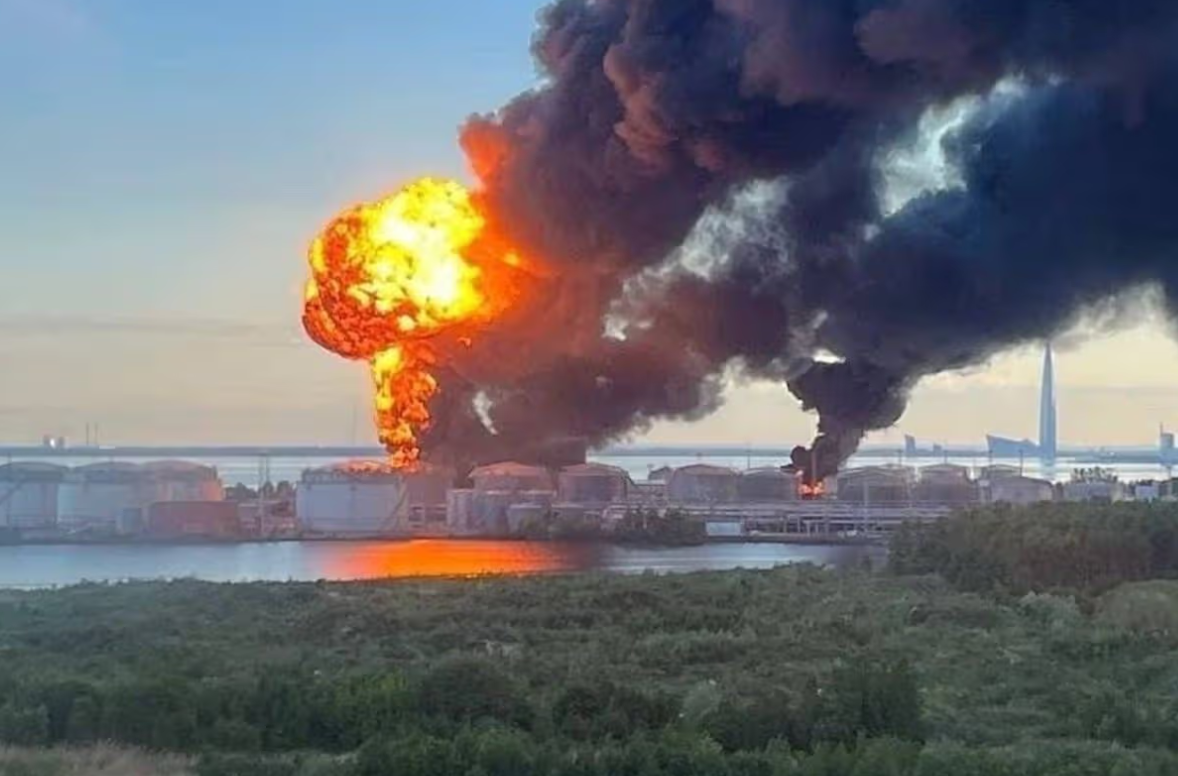
Ukrainian drones hit St. Petersburg before dawn on 3 June, hours before President Vladimir Putin opened his flagship economic forum in the city, sending black smoke over the port and the naval anchorage at Kronstadt as delegates arrived. Ukraine said it struck a major oil terminal about 17 kilometres from the forum venue and a warship at the Baltic Fleet base. Russia's defence ministry said it shot down 354 drones overnight across at least 15 regions and occupied Crimea. The next day President Volodymyr Zelensky published an open letter offering Putin a face-to-face meeting in a neutral country and a full ceasefire for the duration of talks. Putin refused within a day and called the letter "boorish."
Putin has presided over the St. Petersburg International Economic Forum since 2005, and for years it worked as advertised. Then German Chancellor Angela Merkel attended in 2013. Chinese President Xi Jinping came in 2019. French President Emmanuel Macron and Japanese Prime Minister Shinzo Abe were there in 2018. Companies signed deals in the hall, among them the Nord Stream and South Stream pipelines, Shell's access to Russian reserves and France's sale of Mistral warships.
The 2026 edition, held 3 to 6 June under the theme "Pragmatic Dialogue," drew about 20,000 guests from 130 countries by the organisers' count. What it lacked was the Western heads of state and chief executives who once filled the front rows. The only foreign heads of state to attend were the presidents of Uzbekistan and Tanzania, with a handful of other countries sending senior officials. The forum has become "a show for one viewer," said Andrey Pertsev, a reporter at the exiled Russian outlet Meduza, meaning Putin himself. Konstantin Sonin, an exiled Russian economist who spoke at past editions, said it had turned into a public relations exercise that hands lucrative contracts to Kremlin allies. Elizaveta Osetinskaya, founder of the exiled outlet The Bell, said seats once filled by guests such as Alphabet's Eric Schmidt now go to delegates from the Taliban and North Korea.
John Foreman, a former British defence attaché in Moscow and Kyiv, told the Kyiv Independent it was "exceptionally humiliating" for Putin's home city to be hit on the forum's opening day. He said the strike followed a run of setbacks, among them a subdued Victory Day parade and fuel shortages in occupied Crimea, and that Putin's personal identification with the war means each one lands on him directly.
Putin's aide Yuri Ushakov touted the first official U.S. delegation since 2017. It was led by Rodney Mims Cook Jr, chairman of the U.S. Commission of Fine Arts, a minor federal body, and a Trump appointee. U.S. Secretary of State Marco Rubio said he knew nothing about the group and that it was not high-level. No major USian political or business figures travelled to St. Petersburg. The best-known USian present was far-right influencer Candace Owens, who is being sued for defamation by France's presidential couple and who appeared on a panel about traditional values. Also present, the Kyiv Independent reported, were Scott Ritter, a regular guest of Russian state media who was convicted in 2011 in a case involving a minor, and Jorg Urban of the Russia-friendly wing of Germany's AfD.
The strikes did not let up. On 4 June Ukraine's Unmanned Systems Forces said it had brought the Russian-held Donetsk Airport under fire control and made it unusable, the result of a sustained drone campaign against a site Russia had converted into a launch pad for Shahed attack drones flown by its Rubikon unit. A Ukrainian commander called it the first operation of its kind in modern history. On 6 June, as the forum reached its final day, Zelensky said Ukrainian drones flew about 1,000 kilometres to hit naval targets at Kronstadt and an oil depot in the Krasnodar region, where about 60 people were evacuated and no casualties were reported. Russia said it downed 376 drones that night, more than 140 of them over the St. Petersburg region. Kyiv has spent months striking Russian refineries and energy nodes, attacks it calls a fair answer to Russia's nightly barrages on Ukrainian cities. By October 2025 those strikes had forced close to 40 per cent of Russia's oil refining capacity offline at various points, according to Russian energy data cited by the analysis group Russia Matters.
Russia has lost more than 30,000 soldiers killed and seriously wounded in May alone and that deaths account for 63 per cent of Russian front-line losses. The Economist put total Russian casualties at 1.1 million to 1.4 million by early 2026, including 230,000 to 430,000 dead. The Wall Street Journal estimated 1.2 million casualties and 325,000 killed. The Netherlands' military intelligence service put permanent Russian losses near 1.2 million, more than 500,000 of them dead. Meduza has cautioned against over-reading the sharp rise in recorded deaths through 2025, which its own investigation traced in part to a wave of court filings declaring missing soldiers dead, not to a sudden collapse at the front.
The economic strain is easier to see as Russian manufacturing contracted through most of 2025 at its fastest rate since the war began, the Center for Strategic and International Studies reported, with growth slowing to 0.6 per cent. The International Monetary Fund projected 0.8 per cent for 2026. Russians now spend 39 per cent of their income on food, a 16-year high. Putin's army leans on North Korean troops and shells and on Chinese trade to stay in the field.
Putin publicly rejected Ukraine's call for a ceasefire from the forum stage on 5 June, telling reporters he saw no point in meeting with Zelensky and Ukrainian officials. He tied his refusal to a 22 May Ukrainian drone strike on a dormitory in Russian-held Luhansk that Moscow said killed 21, and said he wanted a full settlement along the lines he discussed with President Donald Trump at their Anchorage summit, not a temporary truce. His spokesman Dmitry Peskov said Zelensky could come to Moscow "any time," an offer Kyiv has refused. Putin said his forces were advancing along the whole front, an assertion Russia has made for more than four years while missing its own deadlines to take all of Donetsk Oblast.
Ukrainian officials said the letter was aimed past Putin at Russian elites, a war-weary public and the United States, where Trump's attention has shifted toward the war with Iran. On 7 June at 10 Downing Street, the leaders of Britain, France and Germany met Zelensky and backed his call for direct talks. Their joint statement set five conditions for what they called a just and lasting peace, they called for an immediate and complete ceasefire; the current front line as the starting point for negotiations, with borders not to be changed by force and Ukraine free to choose its own alliances; binding, legally enforceable security guarantees once a ceasefire holds, including a multinational force in Ukraine; Russian state assets to stay frozen until Moscow compensates Ukraine for war damage; and European consent on any terms touching the European Union or NATO. The leaders also said they would expand production of air defence interceptors and longer-range weapons for Ukraine. Zelensky said separately that he had asked Russian businessman Roman Abramovich to tell Putin that Ukraine will not surrender the Donbas and that he is ready to meet.
A special tribunal for the crime of aggression against Ukraine, backed by the Council of Europe and based at The Hague, began work in 2025.