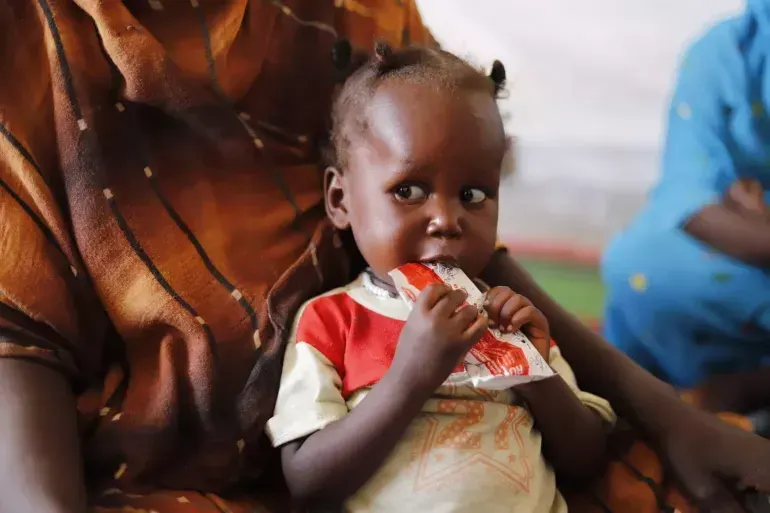
Nearly two in every five people in Sudan are going hungry. The latest food security assessment, published on 15 May by the Food and Agriculture Organization, the World Food Programme, and UNICEF, counted nearly 19.5 million people facing crisis levels of acute food insecurity across the country. More than 135,000 of them face conditions so severe they constitute catastrophic hunger.
The numbers have shifted slightly downward from the peak recorded last September, when 21.2 million people were classified in crisis. That marginal improvement obscures what is happening on the ground in the Kordofan and Darfur regions, where the war between the Sudanese Armed Forces (SAF) and the paramilitary Rapid Support Forces (RSF) has turned famine territory into a drone battlefield.
The famine map
El Fasher in North Darfur and the besieged city of Kadugli in South Kordofan were both classified as experiencing famine, IPC Phase 5, in 2025, with conditions expected to persist into early 2026. By February, two additional localities in North Darfur, Um Baru and Kernoi, exceeded famine thresholds, making Sudan the country with the highest number of territories experiencing active famine on the planet.
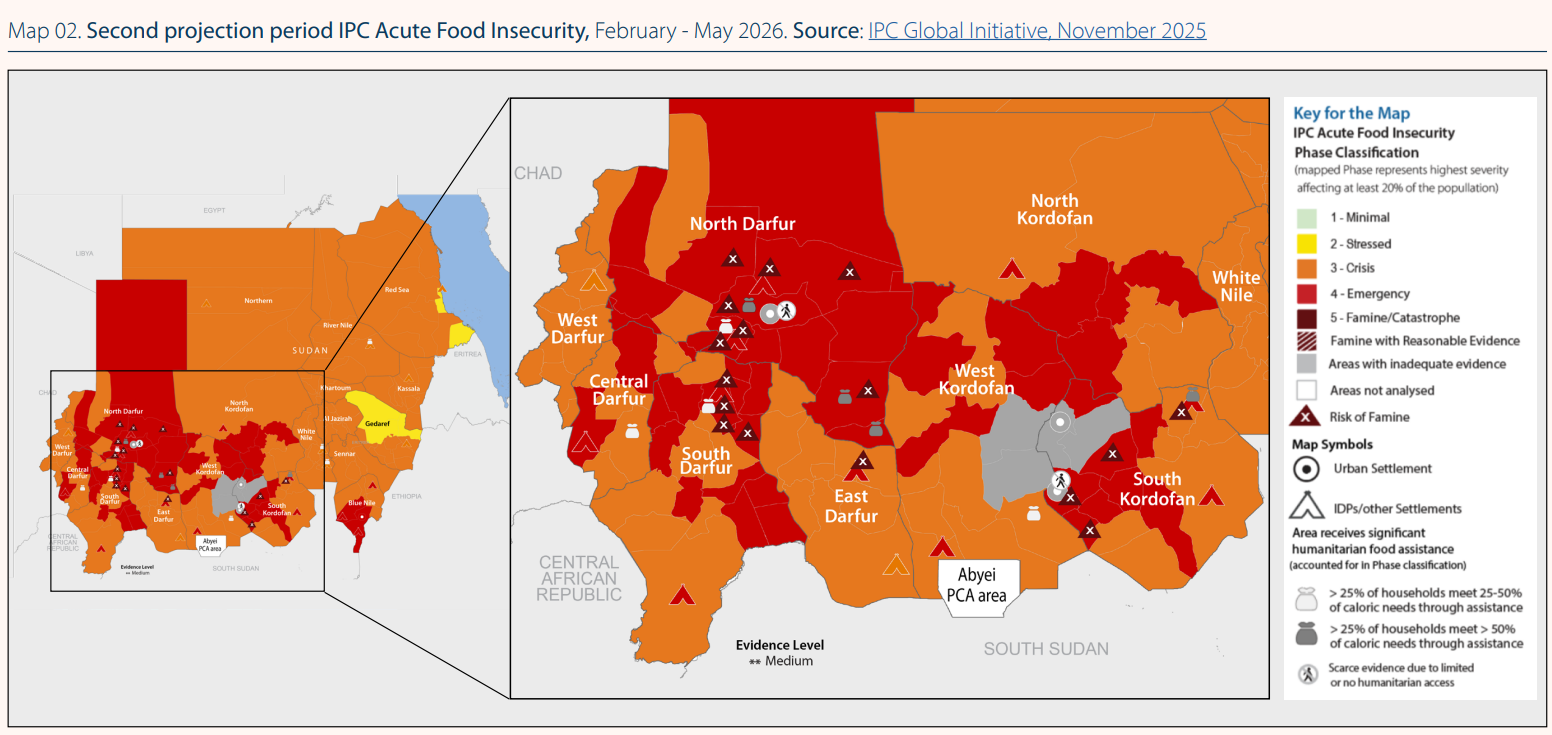
Across those areas, the nutrition data is stark. Global Acute Malnutrition rates from screening data range from 38 to 75 per cent in El Fasher and reach 29 per cent in Kadugli, according to the IPC. More than half of children in Um Baru are acutely malnourished.
An estimated 825,000 children under five are expected to suffer from Severe Acute Malnutrition in 2026, a seven per cent increase from 2025 and 25 per cent higher than pre-conflict levels. Between January and March alone, nearly 100,000 children were admitted for treatment for severe acute malnutrition.
Outbreaks of cholera, malaria and measles continue to rise in areas where health, water and sanitation systems have collapsed, accelerating nutritional deterioration among people already weakened by hunger.
Drones over the hunger zone
Famine is spreading in areas where the fighting is most intense. Between January and April 2026, at least 880 civilians were killed in drone strikes, accounting for more than 80 per cent of all conflict-related civilian deaths, according to the UN human rights office. Most deaths were recorded in the Kordofan region and Darfur, though strikes were increasingly spreading to Blue Nile, White Nile and Khartoum.
UN High Commissioner for Human Rights Volker Türk warned that the escalating use of drones was pushing the conflict toward a "new, even deadlier phase," noting that drones allow hostilities to continue through the rainy season, which historically brought lulls in ground operations.
The attacks have hit civilian targets with regularity. In February, an RSF drone struck a vehicle transporting displaced families near El Rahad in North Kordofan, killing 24 people including eight children, two of whom were infants. A separate strike the same week destroyed an aid convoy linked to the World Food Programme on the road between El Obeid and Kosti.
A drone strike in May 2025 on a hospital in El Obeid, the North Kordofan state capital, killed six people including patients and medical staff and forced the facility to halt services. Between 1 January and 15 March 2026 alone, more than 500 civilians were killed in drone strikes. Neither the SAF nor the RSF has demonstrated any credible commitment to investigating civilian casualties, and command responsibility under international humanitarian law remains uninvoked.
Under Common Article 3 of the Geneva Conventions, parties to a non-international armed conflict are obligated to protect civilians and the wounded at all times. The deliberate targeting of civilian vehicles, hospitals and food convoys violates the customary IHL principle of distinction (Rule 1), the prohibition on starvation as a method of warfare (Rule 53) and the protection of humanitarian objects (Rule 31). The UN Human Rights Council's Fact-Finding Mission concluded in February 2026 that the RSF committed crimes against humanity, war crimes and genocide against non-Arab communities in and around El Fasher during the siege and subsequent takeover in October 2025, including widespread rape, arbitrary detention and extrajudicial executions. The International Criminal Court's existing investigation into Darfur now encompasses those events.
Who is still there
Médecins Sans Frontières launched emergency operations in El Obeid in January 2026, focusing on water and sanitation at the city's main displacement site, which hosts approximately 25,000 people. MSF found 500 people sharing a single latrine and access to only three litres of clean water per person per day, creating acute risk of cholera and other outbreaks. MSF has described Kordofan as one of the least accessible regions in Sudan for humanitarian organisations throughout the war.
Action Against Hunger has maintained health and nutrition teams in South Kordofan, including in Kadugli, rehabilitating health facilities and sanitation infrastructure while distributing cash assistance. Its staff on the ground said most medicines had been unavailable for two years. The organisation is also operating across Darfur, White Nile, Blue Nile and the Red Sea.
A joint report published in April 2026 by Action Against Hunger, CARE International, the International Rescue Committee, Mercy Corps and the Norwegian Refugee Council documented how three years of war and violations of international humanitarian law have turned the journey of food from farms to markets to homes into a dangerous and often deadly process, with millions of people in heavily conflict-affected areas surviving on one meal a day or less.
UNICEF's 2026 humanitarian appeal seeks nearly US$963 million to reach 13.8 million people, including 7.9 million children, with health, nutrition, water, sanitation and child protection interventions. WFP, FAO and UNICEF have jointly called for an immediate ceasefire, safe humanitarian access and urgent funding increases.
The money isn't there
Only 20 per cent of Sudan's 2026 Humanitarian Needs and Response Plan had been funded as of April 2026. Between February and May, humanitarian partners aimed to reach 4.8 million people per month, but only an estimated 3.13 million people received assistance in February.
The 2026 humanitarian response plan requires US$2.9 billion. As of early February it had received only 5.5 per cent of that.
At the International Sudan Conference in Berlin on 15 April, donor governments made new pledges. Canada announced more than $120 million in new funding, including more than $94 million in humanitarian assistance for 2026, delivered through experienced and trusted partners to provide emergency food and nutrition, health care, protection, shelter, water and sanitation. An additional $25 million was allocated to development assistance, including $18 million to Save the Children Canada to deliver education for more than 60,000 children and protect children from violence, exploitation and trauma.
The European Union and member states pledged more than €812 million at the same conference, with the European Commission contributing €360.8 million, of which €215.5 million would support people inside Sudan and €145.3 million would address the regional refugee crisis in Chad, South Sudan, Ethiopia, Uganda, Egypt and the Central African Republic.
The pledges matter and they don't close the gap. With the 2026 regional refugee response plan funded at only 10 per cent of the required US$1.6 billion as of mid-April, the humanitarian system is operating far below what the scale of this crisis demands.
The US
The United States was, until 2025, the largest single donor to Sudan's humanitarian response. USAID funded between 70 and 80 per cent of the flexible cash programs that kept community kitchens and emergency medical centres running across the country, distributed $661 million in aid through Sudan in 2024 alone, and reached nearly 6.7 million people with emergency food assistance. When the Trump administration cancelled 83 per cent of USAID grants in early 2025 and formally folded the agency into the State Department on 1 July, that network collapsed. More than 1,000 soup kitchens and medical centres closed across Sudan. In Khartoum, 90 communal kitchens shut, cutting food access for more than 500,000 people, according to the International Rescue Committee. Every one of the 40 emergency response room kitchens in Zamzam camp in Darfur, which shelters more than a million displaced people, was forced to close.
By July 2025, nine US officials with Sudan responsibility remained in the region. A June 2025 Lancet analysis estimated that sustained USAID cuts would lead to approximately 14 million avoidable deaths globally by 2030, with Sudan among the most severely affected countries.
In December 2025, the US and the UN signed a $2 billion humanitarian funding agreement through OCHA covering 17 crisis-affected countries. In February 2026, Congress passed a $50 billion foreign aid bill. On 15 April 2026, the Trump administration imposed new sanctions on five individuals and entities tied to the conflict and called for a three-month humanitarian truce.
None of that addressed the supply chains keeping the war running. The administration's diplomatic strategy runs through what it calls the Quad: Egypt, Saudi Arabia and the UAE. Those are the same three countries most directly implicated in arming the combatants. Egypt operates Turkish-made Akinci drones for the SAF. Saudi Arabia backs the SAF financially. The UAE continues to funnel weapons to the RSF, which Abu Dhabi denies, though both US and UN assessments have confirmed the transfers.
Secretary Rubio said publicly that weapons need to be cut off to the RSF but did not name the UAE when doing so. No US sanctions have targeted any UAE entity for arms transfers to the RSF. Reports from Washington talks in October 2025 indicate that a proposed ceasefire was blocked by the UAE, which allowed the RSF to take El Fasher and commit further atrocities before any agreement could be reached. The US approach places DC in a position of depending on the war's principal external enablers to end the war they are enabling.
China
The UN Fact-Finding Mission concluded in February 2026 that the RSF committed genocide against the Zaghawa and Fur communities in and around El Fasher. Chinese-made weapons are what that genocide is being committed with.
Strike drones
The CH-95 and FH-95 drones confirmed at RSF-controlled Nyala Airport in December 2024 and January 2025 were designed by China Aerospace Science and Technology Corporation (CASC) and China Aerospace Times Feihong Technology Company, both state-owned enterprises under direct government supervision. Satellite imagery tracked the construction of three hangars at Nyala over five weeks in early 2025. Analysis by the defence intelligence company Janes confirmed the drones as Chinese-manufactured CH-95s, capable of precision strikes at up to 200 kilometres. By May 2025, Yale University's Humanitarian Research Lab and Reuters had identified 13 additional delta-wing kamikaze drones at Nyala alongside launching gear, assessed as likely Chinese-manufactured with a range of approximately 2,000 kilometres, enough to reach anywhere in Sudan. The RSF flew these aircraft throughout the El Fasher campaign that the UN determined constituted genocide.
The UAE has also operated Wing Loong II drones, built by Aviation Industry Corporation of China (AVIC), in support of RSF operations since at least July 2024, according to the Critical Threats Project at the American Enterprise Institute. The Wing Loong II is a medium-altitude long-endurance strike drone capable of carrying precision-guided munitions; it has a range exceeding 4,000 kilometres, which means it can cover the entire country from a base outside Sudan's borders.
The weapons do not ship directly from Chinese factories to the RSF. An investigation published by Africa Intelligence in December 2025 found that serial numbers on multiple drones photographed in RSF hands match the format used by the Serbian military, which acquired CH-92 and CH-95 drones from China in 2020 and subsequently developed domestic assembly capacity. The drones may have been assembled in Serbia from Chinese designs rather than manufactured there outright. That makes it harder to trace, but Chinese hardware assembled by a third party and delivered to a force committing genocide is still Chinese hardware.
Guided munitions and artillery
Amnesty International's forensic analysis of a drone strike on 9 March 2025 near al-Malha in North Darfur identified fragments from a Norinco GB50A guided aerial bomb. The fragments were marked as manufactured in 2024, meaning Norinco, a Chinese state-owned defence company, produced this weapon in the same year the RSF used it against communities the UN has found to be genocide victims. The strike killed at least 13 civilians. Three weeks later, when SAF forces recaptured RSF positions in Khartoum, soldiers found Norinco AH-4 155mm howitzers. According to the Stockholm International Peace Research Institute, the only country in the world that has imported AH-4 howitzers from China is the UAE, in a 2019 transfer, tracing a direct line from a Chinese factory through Abu Dhabi to the RSF. US intelligence assessments cited by the Wall Street Journal in October 2025 also documented Chinese-made small arms, heavy machine guns, vehicles, artillery, mortars and ammunition flowing to the RSF through UAE channels.
Air defense
The most consequential category of Chinese weapons in RSF hands is not the drones. It is the air defense systems that protect the RSF from being bombed.
The FK-2000, developed by China Aerospace Science and Industry Corporation (CASIC), is a mobile air defense system mounted on an 8x8 wheeled chassis. It carries 12 radar-guided surface-to-air missiles alongside twin 30mm autocannons and can engage aircraft, drones, helicopters and cruise missiles at ranges of up to 25 kilometres. The UAE procured units from China and delivered them to Chad in April 2025. Open-source intelligence analysts, including via the outlet Clash Report, documented the systems moving from Chad into RSF-controlled Sudan in August 2025 via the porous border corridor running through Darfur. The RSF used the FK-2000 to shoot down SAF aircraft at Nyala, including Il-76 transport planes and Bayraktar Akinci strike drones. In February 2026, the SAF announced it had destroyed an RSF-operated FK-2000 in the Ed Dubeibat area of South Kordofan, confirming the system was deployed and operational.
The FB-10A followed the same route. Developed by the Eighth Academy of CASC, the FB-10A is a short-range surface-to-air missile system designed to defend ground forces against low-flying aircraft and drones. Chad ordered units from China in February 2025 under a deal backed and financed by the UAE. According to Chadian outlet TchadOne, citing internal documents and witness accounts, the systems never entered Chadian service. A source at Chad's Ministry of Foreign Affairs told TchadOne the purchase was structured to "conceal the origin of the funds and protect a third country that didn't want to get its hands dirty." The FB-10A units were diverted to the RSF.
The significance of these systems is direct. The SAF's ability to use air power against RSF positions in Darfur, including around El Fasher, was the principal check on the RSF's ground operations. With Chinese-made air defense systems, the RSF could shoot down those aircraft.
China's response
In April 2025, Sudan's Ministry of Foreign Affairs summoned the Chinese Chargé d'Affaires in Port Sudan and demanded a formal explanation. China reaffirmed its non-interference policy. Sudan subsequently designated the UAE a hostile state and cut diplomatic relations; no parallel action was taken against Beijing. China's foreign ministry, asked by Reuters about the kamikaze drones at Nyala, said Beijing "has always adopted a prudent and responsible attitude in military exports." China's defence ministry did not reply.
China is one of five permanent members of the Security Council, the body with the power to expand the arms embargo from Darfur to all of Sudan, to refer the situation to the ICC, or to sanction states caught violating it. China has used that position to push for shorter embargo renewal windows, which means the embargo has to be renegotiated more frequently and creates more chances for it to weaken. It has not called for the embargo to be expanded. It has not named any country that has violated it. Neither Norinco nor CASC has commented publicly on where their weapons and designs end up. Beijing's stated position is that it respects Sudan's sovereignty and supports a political resolution. In practice, Chinese state-owned companies are producing the weapons the RSF is using to commit genocide, and China is blocking the international mechanisms that could stop it.
The UAE
The UAE's role on the RSF side is the most extensively documented of any external actor. US intelligence agencies, including the Defence Intelligence Agency and the State Department's Bureau of Intelligence and Research, separately reported in October 2025 an increase in weapons flowing from the UAE to the RSF. The Wall Street Journal, citing those assessments, reported the supplies include advanced Chinese-made drones alongside small arms, heavy machine guns, vehicles, artillery, mortars and ammunition. The UAE has also operated Wing Loong II drones, manufactured by Aviation Industry Corporation of China (AVIC), in support of RSF operations since at least July 2024, according to the Critical Threats Project at the American Enterprise Institute.
Through much of 2024, weapons and supplies transited through eastern Chad via Amdjarass airport and the porous Chad-Sudan border into Darfur. When domestic pressure and SAF threats forced N'Djamena to scale back its cooperation in 2025, the route moved north to Kufra in eastern Libya. Satellite imagery from July 2025 showed Russian-made transport aircraft at Kufra; analysts assessed the activity as weapons movement with reasonable certainty. Air traffic also goes directly into RSF-controlled Nyala Airport under cover of darkness. An investigative report by The Sentry found that cheap, diverted Libyan fuel has become a critical supply line for RSF operations in Darfur, with Libya losing approximately $6.7 billion a year to fuel smuggling and the RSF among its primary foreign beneficiaries. That fuel moves through eastern Libya via forces loyal to Field Marshal Khalifa Haftar, who coordinates with the UAE. Abu Dhabi is also reportedly courting the Central African Republic's government with proposals to refurbish Birao airport near the Sudanese border as a potential additional supply hub.
Abu Dhabi flatly rejects all of it. The UAE embassy has stated that claims of weapons supply are "entirely baseless," pointing to the UN Panel of Experts' April 2025 report and describing the allegations as attempts to "mislead public opinion." The UAE notes it is the second-largest donor to Sudan's humanitarian response after the United States, having allocated US$1.2 billion in aid between 2023 and 2026, and says it has consistently called for a full Sudan-wide arms embargo. Human rights organisations and Western legislators are not persuaded. A joint letter to the EU from Human Rights Watch, Amnesty International and other civil society groups ahead of the Berlin conference called on all countries, explicitly naming the UAE, to respect the UN Security Council arms embargo on Darfur and ensure all countries that have violated it are held accountable.
Russia
Russia's positioning is, in some respects, the most cynical. The Kremlin originally backed the RSF through the Wagner Group, supplying surface-to-air missiles and drones in exchange for access to RSF-controlled gold mines in Darfur. The RSF smuggled that gold through Dubai, where it was sold on world markets; those proceeds funded Russia's war in Ukraine, according to researchers tracking the financial flows. Between April and October 2024, Russia supplied 2.8 million barrels of diesel and gasoline to Sudan, accounting for nearly half the country's fuel imports over that period, according to Bloomberg.
Russia switched sides in spring 2024 after the RSF opened contacts with Ukrainian intelligence, which Moscow read as a betrayal. The SAF controlled Port Sudan, and with Russia's only other foreign naval installation at Tartus in Syria lost when the Assad regime collapsed in December 2024, a Red Sea base became newly urgent. On 12 February 2025, Sudan's Foreign Minister Ali Youssef Ahmed al-Sharif confirmed at a joint press conference with Sergei Lavrov in Moscow that the two governments had reached complete agreement. The terms: a 25-year lease, 300 Russian military personnel, the right to dock up to four warships including nuclear-powered vessels, mining concessions, and advanced air defence systems and access to Su-30 and Su-35 fighter jets for the SAF at preferential prices. Al-Sharif expressed explicit gratitude for Russia's veto of the November 2024 UN Security Council resolution on civilian protection. A Crisis Group analyst observed that by having Africa Corps retain ties with the RSF while the Kremlin supported the SAF, Russia managed to maintain influence with both sides: "Equally, short on friends internationally, neither of the belligerents in Sudan felt able to alienate Moscow by cutting ties."
Iran adds a third layer to the same logic. The SAF has been equipped with Mohajer-6 drones manufactured by Qods Aviation Industries, an organisation linked to the Islamic Revolutionary Guard Corps. Court documents filed in the US in April 2026 describe a contract worth more than $70.6 million for Mohajer-6 aircraft sold to Sudan's Ministry of Defense; an Iranian-American operative was arrested at Los Angeles International Airport, accused of running the transaction, with payment flowing through cash in crates of $100 bills, hawalas and banks in Dubai. The drone is not entirely Iranian, its propulsion relies on a Rotax 912 engine manufactured by BRP-Rotax in Austria, and its avionics incorporate Western-manufactured components. Iran, like Russia, has sought its own foothold on the Red Sea in exchange for arming one side of the war.
Four external powers, each arming one or both sides of a conflict that has produced the world's largest displacement crisis and its most active famine zone, each seeking strategic or financial returns from a country where 19.5 million people are going hungry.
The Berlin conference in April produced what Chatham House described as the most explicit multilateral call yet for external backers to halt their support to the SAF and RSF, the Berlin Principles for Sudan. It shied away from naming those backers, made no recommendations on disrupting arms pipelines, and imposed no real costs on the war's enablers. UN High Commissioner Türk told the conference that behind Sudan's destruction lay "a complex web of strategic and economic interests and enormous profits," with warring parties exploiting gold, livestock and gum arabic to fund the war while external powers supplied advanced weapons systems and pursued their own agendas. He called for full compliance with the Darfur arms embargo and for the Security Council to refer the entire Sudan situation to the ICC.
The embargo has existed since 2004. It covers Darfur. It does not cover the rest of Sudan. Expanding it to the whole country would require a Security Council vote. Russia holds a veto.
What comes next
The rainy season begins around July. It will cut road access to already-isolated communities, raise disease risk in displacement camps, and coincide with the lean planting season. Famine is not declared after conditions deteriorate to their worst point. It's declared when specific, documented thresholds have already been met, which means the people the IPC is now placing in catastrophic conditions have already passed a threshold that most donor cycles are still catching up to.