Russia fired 73 missiles and 656 drones at Ukrainian cities overnight, killing at least 12 people and wounding more than 100 in one of the largest combined assaults of the full-scale war. The toll kept climbing through the morning as rescuers reached people trapped under collapsed buildings. Air defence units downed 40 missiles and 602 drones.
The weapons included eight Zircon hypersonic anti-ship missiles fired in two waves of four, along with 30 ballistic missiles and three cruise missiles. Zircon travels at around nine times the speed of sound. Ukraine's air defences have no reliable intercept against it. Thirty ballistic missiles, three cruise missiles and 33 attack drones hit at least 38 locations. Debris fell on 15 more. The main targets were Kyiv, Dnipro, Kharkiv, Poltava and Zaporizhzhia.
Russia had announced the strikes in advance. On 25 May, Foreign Minister Sergey Lavrov called US Secretary of State Marco Rubio, on Putin's instructions, to inform Washington that Russia was beginning "systematic and consistent strikes" on Ukrainian "decision-making centres" in Kyiv and urged the United States to evacuate its diplomats. Ukraine's Foreign Ministry called it "shameless blackmail." European Union ambassador Katarina Mathernova said the bloc was "not going anywhere." Russia struck eight days later.
What it hit was not decision-making centres, they were homes filled with families.
What Russia did to Kyiv
The first explosions hit Kyiv at 1:30 a.m. Fresh waves followed through the night. Thousands of residents sheltered in metro stations as air-raid alerts covered most of the country.
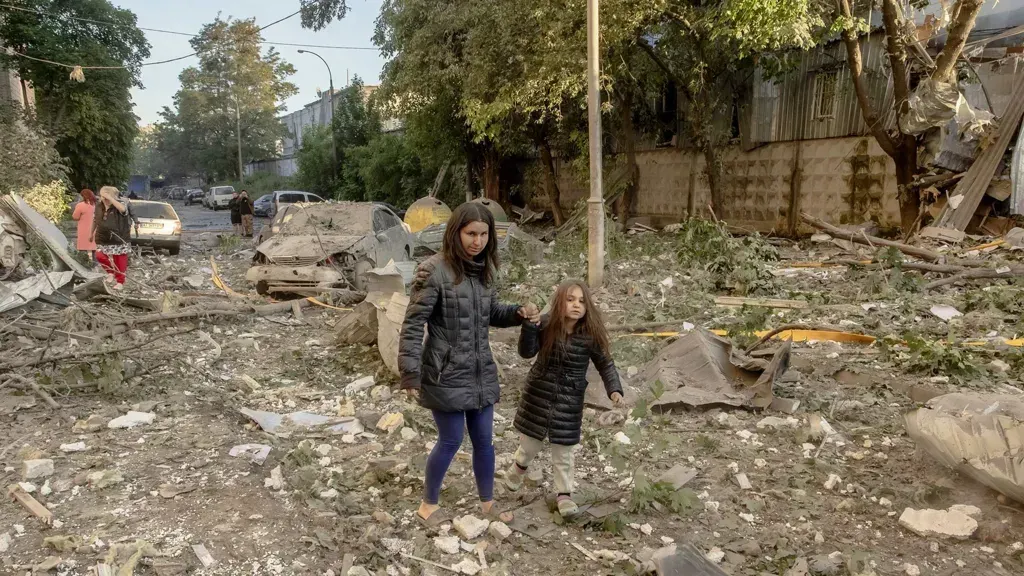
In the Podilskyi district, Russia struck the upper floors of a nine-storey residential building, trapping people under the rubble. When first responders arrived, Russia struck again. The second attack killed one rescuer. Klitschko confirmed both strikes. At least four people were killed in Kyiv, 58 wounded, among them three children. Rescue operations continued through the early morning hours with the air-raid alert still in effect, meaning crews worked in the open while Russia's drones and missiles were still in Ukrainian airspace.
Olena Dniprovska, 65, lived in that building. She was in her apartment when the first missile hit.
"I went out into the corridor with the phone, and before I understood what happened, everything fell on my head, the glass, and the door blew off," she told AP reporters at the scene, dried blood streaked across her face, a bandage wrapped around her chin. "I ran out into the front door and started calling my husband from the room, but he was also blown out by the blast wave." Her husband Yevhen, 64, was injured. Their apartment was destroyed. "Now I have nowhere to live," she said. "No doors, no windows, no balcony."
Elsewhere in the capital, Russia struck a 20-storey building and a 24-storey building in the Solomianskyi district. Fires broke out at a medical clinic, gas stations and commercial buildings across multiple districts. Drone debris fell near a kindergarten. Power went out across several districts. Residential buildings were damaged in eight of Kyiv's districts in total.
What Russia did to Dnipro
Nine people were killed in Dnipro. Russia struck the city, waited for State Emergency Service crews to reach the scene, then struck again. The State Emergency Service confirmed:
"While State Emergency Service crews were working at the scene, the occupiers launched a second strike, which killed a rescue worker."
Interior Minister Ihor Klymenko named Major Anton Yarmolenko, deputy head of a fire and rescue unit, as the fallen rescue worker. He was on his way to an emergency call toward the site of a Russian strike when he was hit by a second strike targeting rescue workers. He carried no weapon. His job was to go toward the smoke after explosions, pull people from rubble, and bring them out to safety. That is what he was doing when Russia killed him.
The State Emergency Service of Ukraine has lost rescuers to Russian strikes before. Their crews work in active attack conditions, responding to first strikes knowing a second may follow, because people are trapped and the alternative is to leave them there. Yarmolenko went anyway, without any hesitation. Klymenko offered condolences to Yarmolenko's family and colleagues.
Among the other dead in Dnipro was a child born in 2023, whose body was recovered from the rubble of a four-storey building. A 60-year-old man died in hospital later that morning. A 13-year-old girl was among those hospitalised. Six citizens were reported missing. Governor Hanzha said 35 people were wounded in total. Mayor Borys Filatov said 49 residential buildings were damaged and seven were nearly destroyed. The fire station itself was among the structures hit.
"Not a single military target," Filatov wrote on Telegram.
The double-tap in Dnipro was not isolated. Russia used the same tactic in Kyiv's Podilskyi district the same night: a first strike on a residential building, a second timed to arrive as people and crews gathered at the scene.
What Russia did to Kharkiv and beyond
Russia wounded at least 14 people in Kharkiv, including a child. A two-storey residential building was damaged and part of a four-storey apartment block was struck, with people trapped under rubble of the larger building. Rescue crews worked through the morning to reach them. Drones and missiles hit multiple districts, damaging homes, vehicles and administrative buildings across the city. Communities in Kyiv Oblast, including Bucha and Vyshhorod, reported damage. Altogether, Russia struck at least 38 locations and left debris across 15 more.
What Russia said before it did all of this
Zelensky warned on 29 May that Russia was preparing a mass strike and repeated the warning over the following nights.
On the evening of 1 June, hours before the attack began, Zelensky told Ukrainians: "The intelligence warnings regarding Russian strikes remain in effect. A massive strike may happen; they have prepared it."
Russia frames the strikes as retaliation for a Ukrainian drone attack on a Russian drone command facility in Russian-occupied Luhansk. Ukraine confirmed the building was a military target. Russia called it a dormitory and claimed 21 people were killed. What Russia then hit in response were residential buildings across five Ukrainian cities.
Poland scrambled military aircraft to guard its airspace. It was the latest in a sequence of such alerts along NATO's eastern flank as Russian strike packages approach the border.
Russia has been escalating long-range strikes on Ukrainian cities since its spring ground campaign stalled. Ukrainian forces retook most of the Russian-held parts of Dnipropetrovsk Oblast in March 2026. British military intelligence estimated on 27 May that Russia has lost around 500,000 soldiers killed since February 2022. It cannot win on the ground, so it bombs the cities. Ballistic missiles remain a specific vulnerability in Ukraine's air defences: fast enough, and in enough quantity, that a percentage will always reach the apartment blocks.
The Kyiv Independent noted that the attack came on the anniversary of Operation Spiderweb, a Ukrainian covert drone strike deep into Russian territory that destroyed 41 Russian aircraft.
Zelensky called it "Russia's largest and most unexpected loss in this war."
Russia's response was to fire hypersonic missiles at innocent people's homes.
How Trump helped Russia's attacks
Ukraine intercepted 84 per cent of the weapons Russia fired overnight. The 16 per cent that got through killed Major Yarmolenko, the toddler in Dnipro, and the people still under the rubble in Podilskyi. That intercept rate is not a success. It is the consequence of a deliberate shortage.
The United States is Ukraine's primary supplier of Patriot PAC-3 interceptors, the missiles that take down ballistic threats. Standard engagement procedure calls for two to four interceptors per incoming ballistic missile. Ukraine is firing one. It has no choice. Defence Express reported in March 2026 that due to interceptor shortages, Ukrainian operators routinely engage single incoming ballistic missiles with a single PAC-3, well below the threshold at which miss rates become acceptable.
The shortage has a direct cause, which is Pete Hegseth's, Trump's defence secretary, decision to unilaterally halt weapons shipments to Ukraine three separate times. The first halt came in February 2025, the second in May 2025, the third in July 2025. Each time he acted without coordinating with Congress, the State Department, Ukraine or European allies. Each of the first two pauses was reversed within days after bipartisan congressional pressure. The third specifically stopped Patriot PAC-3 interceptors, along with precision munitions and F-16 missiles. NBC News reported that three congressional aides and a former US official confirmed the July halt was a unilateral step by Hegseth, and that military analysis showed the aid could be sent without jeopardising US readiness. He halted it anyway.
Then came Operation Epic Fury. Between 1,060 and 1,430 Patriot interceptors were fired from US stockpiles during the US-Israeli campaign against Iran, which launched on 28 February 2026. US inventory stood at roughly 2,500 before the operation began. The Iran war consumed nearly half of what the United States had. Lockheed Martin produces approximately 60 to 65 PAC-3 MSE interceptors per month globally. Russia launched 117 ballistic, aeroballistic and hypersonic missiles at Ukraine in February 2026 alone, before the Iran campaign depleted the stockpile further. The production rate has never matched the consumption rate. It is now further from doing so than at any point in the war.
Zelensky knew what was coming, and on 27 May, six days before the June 2 strike, he sent a five-page letter directly to Trump and to Congress, warning of Ukraine's critical shortage of Patriot PAC-3 interceptors and requesting a licence to manufacture them domestically. "I ask for your help in protecting Ukraine's skies from Russian missiles," he wrote. "When it comes to defending against ballistic missiles, we rely almost exclusively on the United States." Ukraine's ambassador Olha Stefanishyna distributed the letter personally to the White House, House Speaker Mike Johnson and other members of Congress.
Four days later, on 31 May, Zelensky posted on X and appeared on Face the Nation to press the case publicly.
"There is not enough anti-ballistic missile production in the United States, and this could lead to a crisis in different parts of the world," Zelensky said. "60 to 65 anti-ballistic missiles per month, compared to current challenges, is nothing. It is no secret, and Russia knows this."
CBS journalist Margaret Brennan asked him directly whether he had received a response to his letter. Zelensky answered at length about the shortage and the deficit, and concluded:
"I sent a letter to the White House and Congress of the United States, and I hope that they will understand and will answer, respond."
Russia fired eight Zircon hypersonic missiles in two waves of four on the night of 2 June. Patriot can intercept Zircon when it has interceptors to fire. Video footage from a February 2026 strike confirmed a PAC-3 MSE taking down a Zircon and that the system works, the supply does not, and that failure is not Ukraine's fault. It is a policy decision, made three times by one man, twice reversed under political pressure, and not reversed in time to matter on the night Russia hit Podilskyi.
Russia and Israel's war on civilians
Targeting civilians and civilian buildings is a war crime under the Geneva Conventions and Additional Protocol I. The double-tap tactic, timing a second strike to hit rescuers, is separately prosecutable as an attack on protected persons. Major Yarmolenko's death illustrates both in a single event. The ICC issued an arrest warrant for Putin in March 2023 over the unlawful deportation of Ukrainian children. The overnight strikes add to an evidentiary record Ukrainian prosecutors and ICC investigators have been assembling since February 2022.
That record now sits alongside another one, and the comparison is instructive. Since 7 October 2023, more than 65,400 people have been killed in Gaza and 167,160 injured, according to the Gaza Ministry of Health as reported by OCHA. The confirmed breakdown through October 2024 included 13,319 children, 7,216 women and 3,447 elderly. Israeli forces have struck residential buildings, hospitals, tents sheltering displaced families and people waiting for aid continuously across the length of the conflict. Like Russia, Israel says it targets only military infrastructure. Like Russia, it has used double-tap tactics against rescue crews. Like Russia, it has killed the people who came to pull survivors from the rubble.
Documented incidents establish the pattern precisely. In October 2024, an Israeli airstrike on a five-storey residential building in Beit Lahia killed between 55 and 93 Palestinians, including 25 children. In December 2024, a strike on a shelter in the Nuseirat refugee camp killed 33 people, the majority children. In April 2025, a strike on a residential building in Shuja'iyya killed at least 35 people in an area crowded with displaced families. Each time, the IDF said it was targeting militants. Each time, the UN documented mass civilian casualties with no credible military justification established.
In May 2026, the UN placed both Russia and Israel on the same Conflict-Related Sexual Violence blacklist. In December 2025, the UN Committee Against Torture found Israel was operating a de facto state policy of organised and widespread torture and ill-treatment. A UN Special Rapporteur told the Human Rights Council in March 2026 that torture had effectively become state policy.
Neither Russia nor Israel is a member of the ICC. Russia quit the Rome Statute in 2016 and Israel never ratified it. Both dismiss accountability findings as politically motivated and both keep striking homes. Russia receives sanctions and weapons transfers to its adversary. Israel receives weapons and diplomatic protection from the same Western governments issuing the sanctions on Russia. Legal scholars writing in Verfassungsblog called this an emerging democratic exception, the unwritten rule that a leader's accountability depends on whether his country is counted as an ally. The Rome Statute contains no such clause.
Kenneth Roth, the former head of Human Rights Watch, said it plainly: it is not the rule of law when it applies to adversaries but not to friends. Senator Bernie Sanders said the same: those who call Putin a war criminal while shielding Netanyahu are applying one standard to an enemy and another to an ally.
Major Yarmolenko went into the smoke in Dnipro to pull people out. Russia killed him. In Gaza, paramedics, doctors and civil defence workers have been killed in the same tactic for two and a half years. The people doing the killing in both cases have told investigators they were targeting something else. The investigators have found them not credible. The weapons keep arriving, and the bombs keep falling, beneath it all, thousands of innocent people.
What you can do
Air defence is the material factor between a ballistic missile reaching an apartment block and being downed in flight. Ukraine's air force intercepted 84 per cent of the weapons fired overnight. The ones that got through were the ones that killed Major Yarmolenko and the toddler in Dnipro and the people in the rubble in Podilskyi. More interceptors mean fewer of those. Pressing representatives to accelerate air-defence deliveries to Ukraine is the most direct action available to civilians in allied states.
For financial support, the single most effective channel is UNITED24, the official fundraising platform of the Ukrainian government, launched by Zelensky in May 2022 and audited by Deloitte and BDO. All funds go directly to the National Bank of Ukraine and are assigned to relevant ministries with weekly public reporting. There is no intermediary and no commission taken.
Three specific streams are directly relevant to tonight's events:
Air defence (u24.gov.ua/sky-defense): funds air defence equipment, interceptor drones and anti-drone turrets for Ukrainian forces. This is the most direct civilian contribution to the gap Russia is exploiting with its Zircon and ballistic missile campaign.
Humanitarian demining (u24.gov.ua/donate, select Humanitarian Demining): funds the State Emergency Service of Ukraine deminers, the crews who clear explosive ordnance from liberated territories and respond to strike sites. Ukraine is currently the most mine-contaminated country in the world, with roughly 23 per cent of its territory requiring survey for explosive hazards.
Defence and emergency response (u24.gov.ua/donate/defend): broader defence procurement covering UAVs, sea drones, rescue equipment and military vehicles.
The main donation page is u24.gov.ua/donate. UNITED24 also has a mobile app for direct support to specific frontline drone units with real-time mission updates.
Open-source researchers preserving geolocated strike footage from tonight's attacks are building the evidentiary base that ICC and Ukrainian prosecutors work from. Tools like the Ukrainian Archive project (ukrainianarchive.org) are the infrastructure that accountability cases depend on. If you witness or can verify footage from tonight's strikes, archiving and geolocating it has direct legal value.