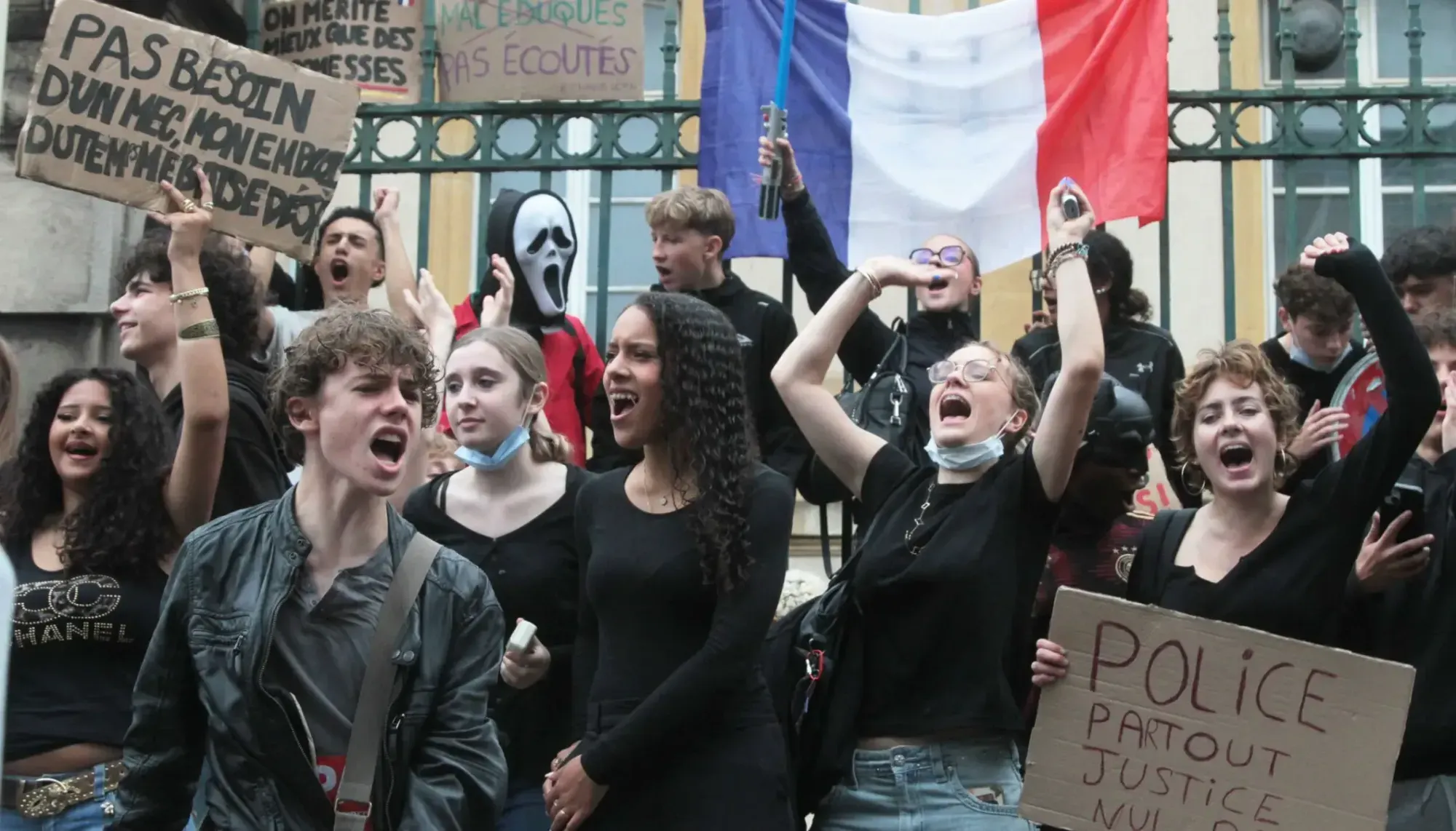
Hundreds of thousands of lycée students have marched since September for teachers, repairs and a fair say in their education. The government has cut more than 10,000 secondary teaching posts since 2017, police have maimed children at school gates and old riot footage has been used to smear the movement. Their demands are basic, they are rights France has signed into law and treaty, most can be met by decision and meeting them would make France richer and safer.
Police were barred from using stun grenades against the lycée movement on 7 October, two days after a 15-year-old in Lens lost his left hand to one. "I suspend its use for the student movement until light has been shed on what happened in this matter," Interior Minister Laurent Nuñez said. Blockades resumed at 528 lycées the same morning.
About 256,000 people marched across France on 6 October, the Interior Ministry said, in the third national day of action by lycée students. A later official count put the turnout at 266,000. Organisers counted 450,000, including 100,000 in Paris. Police arrested 488 people that day, and 6,547 since 28 September. Of those arrested, 87 per cent were minors.
Commentators and politicians who fixate on burning bins and clashes with police, and skip over why hundreds of thousands of teenagers are marching, are like gnats mesmerised by a light bulb. The students are asking for a teacher in every lesson, a heated classroom, a working toilet, a school day that ends at a reasonable hour and a plain explanation of how universities choose them. The Education Ministry and the regions already run and pay for every one of those things. Lecornu conceded on 4 October that the grievances are legitimate, and the 2027 budget bill already adds €1.2 billion for education.
Teachers' unions called a strike for 8 October to march alongside the students. SNES-FSU, the main secondary teachers' union, told its members to boycott the plenary meetings the government ordered in lycées from 7 to 9 October, saying "the government refuses to answer youth demands." Unions representing head teachers rejected the plan as unworkable. Prime Minister Sébastien Lecornu said: "La parole lycéenne est précieuse et doit être entendue" ("What lycée students say is precious and must be heard").
In students' and teachers' words
Tessa, a student at Lycée Antoine-de-Saint-Exupéry in Créteil, where the first blockade went up on 17 September, said: "We were quite proud of ourselves because we didn't think the blockade would go this far." Human, a final-year student at the same school, said: "They say we can't become engineers, doctors, when every person here can succeed." Laurent Bessière, a maths teacher at the school, said: "We can't help but think that perhaps some people want to exploit the situation, but we certainly didn't get involved in that."
Lila, a final-year student at Lycée Lucie Aubrac in Pantin, in Seine-Saint-Denis, is sitting her baccalaureate after a year in which her class went without a maths teacher for more than seven months. "Nobody listens to us," she said.
Salama Gargouri, 18, a lycée student in Paris, listed the grievances behind the marches: "overloaded schedules, the system, the teachers, people who don't listen to us, the university application process." Janna Tahari, another Paris lycée student, said: "Older people say, 'Kids, go to school from 8 a.m. to 6 p.m. every day.' But you don't know what that does mentally."
Charly, a final-year student at Lycée Voltaire in Paris, said the coverage of the movement had erased its purpose. "It's a grave mistake that the media only harp on the rare images of violence," he said. "We're portrayed as savages who only know how to burn trash bins."
Marchers in Paris on 6 October carried a banner reading "Too young to be heard, old enough to be gassed." Another line on the marches read "Notre lutte est digne, on lutte pour notre dignité" ("Our struggle is dignified, we are fighting for our dignity"). Daphnée Die, a student leader, said of the clashes with police: "It's understandable, but it's getting really dangerous."
Louis, Charly's classmate at Lycée Voltaire, compared the government's choices. "The army budget grows year after year, but for education we're trapped in stagnation," he said. He said on 2 October: "For now, this is a struggle led by and for young people, but we hope that unions will join." Teachers' unions struck alongside the students on 6 October and called a second strike for 8 October.
Aude, an English teacher in Essonne who struck on 6 October, said: "We support the high school student mobilisation; we share many demands. Things students have managed to raise, we've been denouncing for years without being heard." Juliette Estiville, a Spanish teacher, stood at a lycée blockade in Paris on 1 October. "I'm here just to provide protection, to form a barrier between the police and the students," she said. "I really think that the teachers who come to the blockades are really just there to protect our young people."
Ender Calman, an English teacher at Lycée Paul-Éluard in Saint-Denis, said of his students: "They suffer enormously. They're the ones sitting exams at the end of the year; it's their future being built." Emilia Sichili Suriam, a member of a parents' association, said on 6 October: "They are our children. Teachers, parents, federations, we all share the same goal: the protection of children's rights, and it is a legitimate right to demonstrate and to make demands."
What students are demanding
Students at Lycée Antoine-de-Saint-Exupéry in Créteil, south-east of Paris, joined their teachers on 17 September to demand more staff and money. Videos of the blockade spread on social media and other lycées in the Île-de-France region followed within days. By 2 October, 735 of France's 3,700 lycées were disrupted.
A teacher in every lesson
Nearly 10 per cent of teaching hours, about 20 million hours, went untaught in the 2024-2025 school year. A student who loses 10 per cent of lessons across the three years of lycée misses the equivalent of almost a third of a school year. Lila's class went without a maths teacher for more than seven months last year. Louis said his Spanish class was "cancelled for nearly an entire term, without any substitute ever being appointed."
Ryad Rani, president of the Union syndicale lycéenne, said: "Le problème aujourd'hui au lycée, c'est de ne pas avoir de prof l'année du bac de français" ("The problem in lycées today is having no teacher in the year you sit the French baccalaureate"). Students sit the written and oral French exams at the end of their second year, and the marks count towards the final baccalaureate.
The Cour des comptes, France's public audit court, found that 9.3 per cent of secondary teaching hours went unreplaced in 2018-2019. Two-thirds of the unreplaced absences were for reasons the system itself schedules: exam marking, teacher training, meetings and school trips. Of 2.5 million hours lost to absences of less than 15 days, only 20 per cent were covered. The court said most unreplaced absences "have a professional basis and could be prevented" by moving that work outside lesson time.
The Education Ministry fills vacancies with contract staff who have not passed the national recruitment exams. The public system employed 51,969 contract teachers in 2024, and their number in secondary schools has nearly doubled since 2015, according to a Senate finance committee report. A newly qualified secondary teacher earns €2,410 net a month.
Scheduling training, meetings and exam marking outside lesson time, as the audit court recommended, would cost almost nothing. Covering long absences and vacant posts needs more teachers. SNES-FSU says restoring the 2017 ratio of teachers to pupils would take 10,617 secondary posts. Lecornu's plan gives priority to long-term absences and vacant posts, with catch-up lessons in the holidays and a first review on 16 October.
Nurses, psychologists and supervisors
France has one school doctor for every 16,500 pupils, one nurse or psychologist for every 1,500 and one school social worker for every 4,200. The ministry filled 28 of 52 open school doctor posts in 2021, and 35 per cent of school doctors are over 60.
Santé publique France surveyed 9,337 secondary students in 2022. Of lycée students, 24 per cent had thought about suicide in the previous 12 months, 31 per cent of girls and 17 per cent of boys. About one in 10 had attempted suicide at some point in their lives and 15 per cent were at significant risk of depression. Every indicator had worsened since 2018. In a lycée of 1,500 students, those rates mean about 360 students with suicidal thoughts in a year and, on the national ratio, one nurse or psychologist to see them.
Students list the shortage of school psychologists and medical staff among their grievances. The UN Committee on the Rights of the Child told France in 2023 to remedy "shortages of resources and medical staff, services and facilities, in particular in schools."
The 2027 budget bill creates 304 health and social posts and 209 posts for the conseillers principaux d'éducation who run pupil supervision. The 304 health and social posts amount to about one for every 35 of France's 3,700 lycées and 7,000 collèges.
Smaller classes
Average class size in public general and technological lycées rose from 28.5 students in 2010 to 30.5 in 2025, according to the Education Ministry's statistics department, the DEPP. Students report classes of 35. The average secondary class across the OECD has 23 students. The FCPE parents' federation in Loire-Atlantique campaigns for a limit of 24.
Trystan, a student at Lycée Louise-Michel in Champigny-sur-Marne, said: "When we get to class, we have to bring chairs and tables from other rooms."
Thomas Piketty and Mathieu Valdenaire found in a 2006 study for the Education Ministry that smaller classes raise results, with the largest gains in disadvantaged schools. "A reduction of class size in disadvantaged establishments would have a noticeable effect on school results," Piketty said. He said Gilles de Robien, then education minister, had the printed copies pulped.
France now has the pupil numbers to cut class sizes without hiring. The ministry expects 180,000 fewer pupils in 2027 and says the demographic trend alone would justify cutting 9,600 teaching posts. The 2027 budget bill cuts 1,588. Keeping those 1,588 posts as pupil numbers fall would bring classes down at no extra cost.
Buildings that are safe, warm and clean
Inès, a student at Lycée Gutenberg in Créteil, said: "Doors are broken. On the third floor, when it rains, water falls on us." She said: "One day a window nearly fell on one of my classmates." Rockia, at Lycée Louise-Michel in Champigny-sur-Marne, said: "We're not in a school where we feel good. We've seen rats and lizards."
A student at Lycée Paul-Éluard in Saint-Denis said: "There are no windows, in the prefab toilets there's no water, the canteen costs too much, there aren't even paper towels in the toilets." Irène Cailleteau, a maths teacher at the school, said: "I've been at Lycée Paul-Éluard for six years and for six years I've watched teaching conditions deteriorate completely, whether it's the building, where we've had flooding with part of the roof coming away, or leaks."
Anne-Nicole Cariot, a teacher at the Porte des Alpes vocational lycée in Rumilly, said the head closed the school early in the summer "because the temperatures were unbearable," and that "it was between 9 and 11°C in the workshops." Michel Flourens, a teacher at Lycée Dhuoda in Nîmes, said: "This summer they put up builders' props to hold up the walkways. Since then, promise has followed promise without work starting." Jean-Christophe Fraisse, a history and geography teacher at Lycée La Borde Basse in Castres, said: "In some rooms you can see mould in the corners and on the window sills."
A former student from Aulnay-sous-Bois said: "We just endured heat and freezing temperatures because windows wouldn't close properly. At lunch, sometimes food was still cold." A survey by the Seine-Saint-Denis education mobilisation in 2024 found pests in a third of the department's schools and inadequate heating in more than half, with classrooms reaching 40°C in summer and 10°C in winter.
Fethi Azzaoui, an economics teacher at Lycée Blaise-Cendrars in Sevran, said conditions there had improved after students filmed them: "I think the video moved things a bit." Regions spend €6.874 billion a year on lycées. Lecornu has promised repairs to toilets, heating and classrooms with the regions, with work to start by summer 2027.
A shorter school day
French 15-year-olds receive 1,142 hours of instruction a year, against 950 in the United Kingdom and 895 in Germany, according to OECD figures. Only Greece, at 1,330, gives more. France packs those hours into 36 school weeks, which makes each day longer.
The 2019 lycée reform under Education Minister Jean-Michel Blanquer replaced fixed streams with combinations of specialist subjects. Timetables now have to fit each student's combination, and students report days from 8am to 6pm with gaps of up to five hours. First-year students in 2020 had about 30 different teachers a year, up from 18 before the reform. Teachers now take about eight classes a year instead of six. A 2019 survey in Paris found 15 per cent of lycée students had 45 minutes or less for lunch and more than half were unhappy with their timetables.
One student said: "Starting at 8, four free periods, finishing at 6, you get home at 7 and there's no time to sleep." Another said: "I get up at 6. An hour to get home. Mountains of homework. Almost no time with my family." Janna Tahari, a Paris lycée student, said adults "don't know what that does mentally."
Lycée students slept an average of 7 hours 19 minutes on school nights in the 2018 national EnCLASS survey, against the 8 to 10 hours recommended for adolescents. Of final-year students, 30.6 per cent slept less than seven hours, and 45.4 per cent built up a sleep debt of more than two hours between school nights and weekends. A petition against lycée workloads gathered more than 320,000 signatures in September 2024.
Five-hour gaps in a timetable cost little or nothing to remove. Schools can cap the number of free periods in a day, fix a minimum lunch break and stop timetables running past a set hour, without adding a single lesson. Lecornu has ordered talks between students and staff on timetables, and his plan proposes digital tools to improve them.
A fair and open Parcoursup
Louis said of the university admissions platform: "You can be sent across the country because a computer told you that's where you'll study." Students say continuous assessment and growing selectivity in university admissions make Parcoursup a source of constant anxiety. A banner at Lycée Hélène-Boucher in Paris compared the damage Parcoursup does to mental health with the damage smoking does to lungs.
Parcoursup left 126,632 candidates without a single offer at the end of its main phase on 11 July 2026, 17.4 per cent of applicants, up from 11.8 per cent in 2025. Among new baccalaureate holders, 87.3 per cent received at least one offer, leaving about one in eight without a place when the main phase closed.
Each university course ranks applicants with its own local criteria, often weighted by software. The Conseil constitutionnel ruled on 3 April 2020 that every institution must account for the criteria it used, but only after decisions are made, in a published report that states how far algorithms were used. Applicants therefore apply without seeing in advance how each course will weigh their file.
Sociologists at the University of Tours wrote on 5 October that the movement stems from heavy workloads and repeated assessments that harm students' wellbeing. Requiring every course to publish its criteria and weightings before applications open, and to give each rejected applicant a written reason, needs a change of rules and no new money. Lecornu has promised clearer Parcoursup selection criteria by the end of October.
Equal schools in rich and poor areas
Charly said: "We're relatively privileged here in Paris and know that the gap remains enormous between our school's conditions and those found in high schools in the banlieues." Human, at Lycée Antoine-de-Saint-Exupéry in Créteil, said: "They say we can't become engineers, doctors, when every person here can succeed."
France has one of the widest gaps in the OECD between its richest and poorest students. In the OECD's 2022 PISA mathematics tests, French students from the most advantaged backgrounds scored 535 and those from the least advantaged scored 422, a gap of 113 points against an OECD average of 106.
A cross-party parliamentary report by François Cornut-Gentille and Rodrigue Kokouendo found in 2018 that the least well-funded school in Paris was still better equipped than the best-funded school in Seine-Saint-Denis. It found that 65 per cent of newly qualified teachers in the department's academies were starting their careers there, against 21 per cent in difficult schools nationally.
Unions in Seine-Saint-Denis, the poorest department in mainland France, counted 2,200 missing teachers across its 68 lycées in 2024 and costed an emergency plan for the department at €358 million, less than a third of the €1.2 billion increase in the 2027 education budget. In October 2023, 92.8 per cent of secondary teacher absences in Seine-Saint-Denis were covered, against 94.5 per cent nationally. A parent there said: "In the 2000s, a student lost an entire school year due to absences. In 2024, it's even worse." Reading difficulties among 16 to 18-year-olds are highest in northern France and the overseas territories.
Funding the Seine-Saint-Denis plan from the 2027 increase would leave more than €840 million for the rest of the country. Sending experienced teachers to the schools with the greatest needs, with pay that rewards them for staying, would address the gap the 2018 report described.
Accountability for police violence
Students began demanding accountability for police violence as injuries mounted. Lila said: "The level of violence we're witnessing from the police is traumatising." Police have arrested 6,547 people since 28 September, 87 per cent of them minors. Geffray said 190 students had been injured.
The IGPN has six investigations open into injuries to students, from a 14-year-old shot in the face with a grenade launcher in Saint-Ouen-l'Aumône to a 15-year-old who lost his hand in Lens. Article 37 of the UN Convention on the Rights of the Child, which France ratified in 1990, says the arrest of a child "shall be used only as a measure of last resort and for the shortest appropriate period of time."
Nuñez suspended stun grenades for the movement on 7 October "until light has been shed" on the Lens case, which shows the government can change police tactics by decision within days. Nathalie Tehio, president of the Human Rights League, said: "There is no directive to show restraint, even though they are dealing with children." Students are asking for that directive, for the stun grenade suspension to stay in place and for the IGPN findings to be made public.
Rights France has already signed
France's constitution makes education a duty of the state. The 1946 preamble, which forms part of the current constitution, says: "La Nation garantit l'égal accès de l'enfant et de l'adulte à l'instruction" and "L'organisation de l'enseignement public gratuit et laïque à tous les degrés est un devoir de l'État" ("The nation guarantees children and adults equal access to education" and "Organising free, secular public education at every level is a duty of the state"). Article L111-1 of the Education Code says: "Le droit à l'éducation est garanti à chacun" ("The right to education is guaranteed to everyone"). Article L511-2 gives lycée students "freedom of information and freedom of expression."
France ratified the UN Convention on the Rights of the Child on 7 August 1990. Article 28 recognises every child's right to education "on the basis of equal opportunity" and requires states to make secondary education "available and accessible to every child." Article 12 gives children the right to express their views "freely in all matters affecting the child," with those views "given due weight." Article 15 protects their "freedom of association and to freedom of peaceful assembly." Article 19 requires protection from "all forms of physical or mental violence" and Article 37 bars "cruel, inhuman or degrading treatment."
France ratified the International Covenant on Economic, Social and Cultural Rights in 1980. Article 13 requires secondary education to be "generally available and accessible to all by every appropriate means." The European Convention on Human Rights adds that "no person shall be denied the right to education" and protects peaceful assembly, free expression and freedom from "inhuman or degrading treatment."
Students' demands match specific articles of French law and these treaties:
- teachers in every lesson, smaller classes and safe buildings: equal access to education under the constitution, Article 28 of the children's convention and Article 13 of the covenant
- nurses and psychologists: the child's right to "the highest attainable standard of health" under Article 24
- a shorter school day: the child's right "to rest and leisure" under Article 31
- a fair Parcoursup: higher education "accessible to all on the basis of capacity" under Article 28
- equal schools in rich and poor areas: the ban on discrimination in Article 2 and equal opportunity in Article 28
- a real say in decisions: the right to be heard under Article 12
- accountability for police violence: protection from violence and degrading treatment under Articles 19 and 37, and the right to peaceful assembly under Article 15
The UN Committee on the Rights of the Child told France in 2023 to remedy "shortages of resources and medical staff, services and facilities, in particular in schools," to improve the quality of education for disadvantaged children and to involve children in "monitoring, implementing and evaluating" public decisions that affect them. It also told France to stop police using disproportionate force against unaccompanied migrant children in Pas-de-Calais, the department where a 15-year-old lost his hand in Lens on 5 October.
Geffray said: "Porter des revendications est un droit" ("Making demands is a right"). He said "hitting, threatening, burning or stopping others from studying" is not. Amnesty International France called for "urgent de-escalation" and for the defence of young people's right to peaceful assembly and free expression.
How the state failed them
The national government and the Education Ministry set teacher numbers, recruitment, curricula and most school funding. Regions have owned and maintained public lycée buildings since decentralisation in 1986. Regions spent €6.874 billion on lycées in 2026, 18 per cent of their budgets and 0.4 per cent less than the year before, according to the Observatoire des finances et de la gestion publique locales.
Emmanuel Macron's governments have cut 10,230 public secondary teaching posts since 2017 while secondary pupil numbers rose, according to SNES-FSU. The union counted a 4 per cent rise in secondary pupils since 2006 and a 6 per cent fall in teachers over the same period. Restoring the 2017 ratio of teachers to pupils would take 10,617 posts, SNES-FSU said.
Parliament adopted the 2026 finance law on 2 February after the government forced it through with Article 49.3 of the constitution three times. The law cut 3,256 public teaching posts, 1,365 of them in collèges and lycées. The 2027 budget bill, presented on 1 October in the middle of the protests, raises education spending by €1.2 billion to just over €64 billion and cuts another 1,588 permanent teaching posts, 836 of them in secondary schools.
Applicants for the CAPES, the main exam for secondary teachers, fell from 44,265 in 2001 to 11,269 in 2023. In 2025 mathematics had 1,152 candidates through to the oral stage for 990 posts and modern literature had 702 for 669 posts.
Teacher shortages predate Macron. CAPES applications began falling in the early 2000s and lycée classes were already growing in 2010. Successive national governments carry primary responsibility for staffing and class sizes. Macron's governments inherited those shortages and made them worse by cutting secondary teaching posts while pupil numbers rose and by failing to rebuild teacher recruitment.
Regions share responsibility for buildings. Régions de France, the association of regional councils, said regions had invested heavily and that "one cannot claim France's lycées are generally in poor condition." It said the government plans to cut €1 billion from regional budgets in 2027 while expecting regions to adapt lycées to heatwaves, which it called "irresponsible." Lecornu said "neither the state nor regions should blame each other."
Police violence against students
French police have beaten, blinded and maimed children who were protesting for teachers and heated classrooms. Between 28 September and 5 October, officers broke a 14-year-old's jaw with a grenade launcher fired into his face, grabbed a 14-year-old girl by the neck and left a 16-year-old blind in one eye with what prosecutors say was a rubber-bullet round. A 15-year-old lost his hand to a police grenade in Lens. Police have arrested 6,547 people since 28 September, 87 per cent of them minors. The UN Convention on the Rights of the Child, which France ratified in 1990, requires the state to protect children from "all forms of physical or mental violence" and allows a child to be arrested only "as a measure of last resort." Firing riot weapons at teenagers outside their schools runs against both commitments.
Police struck a 14-year-old with batons in Saint-Ouen-l'Aumône, in the Val-d'Oise, on 28 September and then shot him in the face with a grenade launcher at close range, Amnesty International France said. He suffered a broken jaw, lost several teeth and could not speak normally.
An officer in Alençon grabbed a 14-year-old girl by the neck during a protest on 29 September, Amnesty International France said. Video of the arrest records her crying "You're hurting me!" twice.
A 16-year-old permanently lost the sight of his right eye during a blockade of Lycée Balzac in Tours on 30 September. Prosecutors said his injuries were "compatible" with a shot from an LBD, the rubber-bullet launcher used by French police. His family filed a complaint.
A 16-year-old suffered an eye injury during police action at a protest in Argenteuil, in the Val-d'Oise. Police fired an LBD at a protester's legs in Sevran, in Seine-Saint-Denis. A separate case in Saint-Denis is under investigation.
A 15-year-old lost his left hand near Lycée Auguste-Behal in Lens on 5 October when a grenade exploded as he held it. Police reports say he picked up a sting-ball grenade fired by riot police. The prosecutor confirmed the hand had been torn off. Education Minister Édouard Geffray called the injury "humanly dramatic."
The IGPN, the police internal affairs inspectorate, has opened investigations into the Saint-Ouen-l'Aumône, Tours, Argenteuil, Sevran, Saint-Denis and Lens cases. It opened a separate investigation into suspected sexual assault by a police officer on a teenage girl during the protests.
Geffray said 190 students had been injured since the protests began. Amnesty International France documented baton strikes, tear gas and rubber bullets used against minors. Anne Savinel-Barras, its president, said young people mobilising "for education and health" were met with disproportionate force instead of dialogue. Nathalie Tehio, president of the Human Rights League, said: "There is no directive to show restraint, even though they are dealing with children."
Police unions said officers used proportionate force against aggression. More than 600 police officers have been injured since the protests began. Lecornu rejected accusations of systematic police violence on 6 October. "We are not giving political instructions for police repression," he said.
Better schools, a richer and safer France
France's mathematics score in the OECD's PISA tests fell 21 points between 2018 and 2022 to 474, the largest drop since the tests began. Reading fell 19 points. France fell from seventh to 17th place in the TIMSS primary mathematics ranking between 1995 and 2019.
The Conseil d'analyse économique, the prime minister's council of economic advisers, calculated in 2022 that a 10-point rise in PISA mathematics scores would add 0.2 percentage points to France's annual GDP growth, about €75 billion over 15 years. It put the cost of France's productivity lag behind Germany and the United States at about €140 billion of lost GDP in 2019, equal to about €65 billion a year in tax revenue.
The Defence Ministry tests the reading of every French citizen aged 16 to 18 at its Defence and Citizenship Day. In 2024, 13 per cent had reading difficulties and 6 per cent were functionally illiterate.
France's 2025 National Strategic Review calls for mobilising "the nation as a whole, notably young people" in a crisis. It names "academic excellence, scientific and technological expertise" as a priority for national sovereignty and lists Russian information manipulation among the threats France faces. A DGSE official said in 2023 that France was short of 15,000 cybersecurity workers.
Macron announced on 13 July 2025 that defence spending would reach €64 billion in 2027, double the €32 billion of 2017. He cited foreign disinformation campaigns aimed at European children through digital platforms as one of the threats. Education spending in the 2027 budget bill is just over €64 billion.
Fake footage used to smear students and target France's election
Accounts based in the United States, the United Kingdom, Israel, Poland and Italy spread false and recycled footage of the student protests between 1 and 6 October, joined by accounts posting in German and Spanish. They presented a movement for teachers and heated classrooms as a race war, an Islamist uprising or the fall of France. Several posts told French voters what the answer was. "They're in desperate need of law and order and a right-wing President," the QAnon-styled account The Q Eye wrote on 1 October, over a video it captioned "Youth thugs and students in France are starting to RIOT and VIOLENTLY ATTACK teachers."
NewsGuard, which tracks false news, found that accounts based in Africa and posing as US users, some using the names of celebrities such as Mel Gibson, spread fake protest videos on 3 October. It found that Matryoshka, a Russian operation, circulated about 20 fabricated stories about the protests dressed up as reports by AFP, Deutsche Welle and Le Monde. France votes for a new president in April 2027.
The Eiffel Tower crowd
A video captioned "France has fallen" gathered millions of views in the first week of October. It showed Paris Saint-Germain fans celebrating the club's Champions League win around the Eiffel Tower in May. Other accounts used the same footage to describe the student protests:
- Sherri, posting as @FFT1776, wrote: "Has Paris fallen? I'd say so. What a damn shame... it was all preventable. This was intentional."
- An account named White Lives Matter, posting as @FA666FO, linked to the Italian account RadioGenoa and wrote: "This is sickening and everyone White American who hails from Europe should be disgusted at this vile image! This is the death of your culture."
- Mossad Commentary, an account that uses the name of Israel's foreign intelligence agency and posts as @MOSSADil, wrote over the same crowd: "PARIS: THE QUEERS FOR PALESTINE AND GAYS FOR GAZA ARE GLOBALIZING THE INTIFADA."
Fires recast as an uprising
Eli David, an Israeli technology entrepreneur who posts as Dr. Eli David, shared a RadioGenoa video of a fire beside a Palestinian flag on 3 October and wrote: "France was one of the first countries to recognize 'Palestine.' Now Palestine is recognizing France." France recognised the State of Palestine at the United Nations in September 2025.
Tommy Robinson, the British far-right extremist, posted video of a burning bin on 3 October and wrote: "The green/islamic unholy alliance is spreading through Western Europe and America, and what you're seeing in France, is coming to all nations, unless it's stopped. And stopped it must be." Robinson has also posted video of a Paris protest that had circulated since 2022 as footage of the student movement.
Ziberial, a Spanish-language account, posted a video filmed in a railway station hall under departure boards, bearing what appears to be the logo of RT, the Russian state broadcaster. It wrote: "Continúa el levantamiento negro en Francia. No hay consignas, es una raza que quiere generarle el mayor daño posible a todas las otras razas. Dirigido por el Islam" ("The black uprising continues in France. There are no slogans, it is a race that wants to do the greatest possible harm to all other races. Directed by Islam"). NewsGuard found that a video circulated as African students rioting showed a December 2017 memorial demonstration at the Gare du Nord for a 19-year-old who had died, first broadcast by RT.
LilitThyra, a German-language account that posts in support of the far-right AfD, posted footage of overturned cars and wrote: "Was wir gerade in Frankreich sehen, sind keine Schülerproteste. Es scheint eher der Beginn eines Bürgerkriegs zu sein!" ("What we are seeing in France are not student protests. It looks more like the beginning of a civil war!"). The post went on: "Frankreich fällt gerade und andere EU-Staaten werden schnell folgen!" ("France is falling and other EU states will quickly follow!").
Konrad Berkowicz, a member of the Polish parliament for the far-right Konfederacja, posted an image of diners sitting beside a street fire and wrote that "this video from France is probably the most terrifying." GuntherEagleman, an account with a US flag in its name, wrote that "the French have lost their 'Liberty,' because they wanted to give 'Equality' to those who did not desire their 'Fraternity'" and repeated "France has fallen" in five languages. Robin, posting as @Robilin_Hoodx, recirculated a post dated 2 January 2025: "Muslims are flooding the streets of France, threatening to burn the country down if right-wing parties win."
RadioGenoa shared a 15-second clip on 4 October suggesting that Bally Bagayoko, the mayor of Saint-Denis, had set bins on fire outside Lycée Frédéric-Bartholdi on 28 September, and described him as a mayor "born in Africa." Longer footage shows Bagayoko moving a container that was already burning away from the school gates. He was born in Levallois-Perret, outside Paris. Bagayoko called the accusation "grotesque fake news" aimed at damaging the student movement.
Alex Jones, the USian right wing conspiracy peddler and child mass murder denier, said France was in an "anti-white civil war" with "dead bodies everywhere." One of his video compilations opened with a school bus burning in Nîmes in 2022, which he presented as evidence of immigrant violence.
Old footage with new captions
X accounts including @Tipazicherchali, @khali_d81, @mazen00711, @chefaminos and @AyanAlshammari shared footage of street clashes as the student protests. The video showed clashes outside a Kurdish cultural centre in Paris in December 2022.
Sprinter Press posted accurate figures on school closures and injured officers alongside footage captioned "Paris Stock Exchange Seized by Protesters." The footage showed protesters against the pension reform storming the Euronext building in Paris on 20 April 2023. Two clips presented as police officers and firefighters joining the students dated from March 2023, NewsGuard found. A video of a police dog attacking a student was denied by the National Police, which said: "The dog belongs to a private individual. Our dogs are always identifiable."
The X account @IRAN_GHANA posted on 3 October that "over 80,000 French students vanished in 72 hours" and that "mass graves near Lyon, Marseille and Lille" were "now visible from space." The account wrote on 4 October that the post "was meant to be satire" and that "some missed the satire, and consulted @grok, which missed it too."
Some of the network
Tommy Robinson.
Robinson, whose legal name is Stephen Yaxley-Lennon, flew to Tel Aviv on 16 October 2025 at the invitation of Amichai Chikli, Israel's minister for diaspora affairs. "I'm an enemy of the state in Britain, and a friend of the state in Israel," he said. The Board of Deputies of British Jews and the Jewish Leadership Council called him "a thug who represents the worst of Britain." The Middle East Forum, a think tank in Philadelphia headed by Daniel Pipes, said it organised and paid for the "Free Tommy" rally in London on 9 June 2018 and paid for his legal defence. Elon Musk posted "Free Tommy Robinson!" on 2 January 2025 and spoke by video to Robinson's Unite the Kingdom rally in London on 13 September 2025, telling the crowd "violence is coming to you" and "you either fight back or you die." Robinson said in October 2025 that Musk had paid the legal bill in his terrorism-law case. Musk has not confirmed it.
Elon Musk.
Musk, the billionaire owner of X, has more than 220 million followers. He told Germans in January 2025 that "people really need to get behind the AfD," posted "Only Reform can save Britain" the same month and called Marine Le Pen "France's last hope" on 15 July 2026. Paris prosecutors searched X's French offices on 4 February 2026 in an investigation into alleged algorithmic interference in French politics and content produced by Grok, X's chatbot, and summoned Musk for a voluntary interview in April. Musk compared footage from Ceuta to "World War Z" on 31 July 2026. He toured Kibbutz Kfar Aza with Benjamin Netanyahu on 27 November 2023. Musk had been in regular contact with Vladimir Putin since late 2022, according to reporting in October 2024 that Putin's spokesman called "absolutely false."
RadioGenoa.
Antonio Mastantuono has described himself as RadioGenoa's creator and administrator. Carabinieri searched his home on the orders of Rome prosecutors in July 2024 and seized his computers in an investigation into Telegram channels accused of spreading hate, when the account had about 781,000 followers. A year-long count in 2024 found that 84 per cent of its 3,072 posts were about migration, Muslims or people of colour. The Dutch far-right leader Geert Wilders had shared about 30 of its videos. A RadioGenoa post about German-funded migrant rescue ships that Musk shared in September 2023 drew more than 70 million views after Italian fact-checkers had debunked it. RadioGenoa called the Ceuta crossings an "apocalypse" and told followers "Europe is under attack." The European Digital Media Observatory describes it as a page that "continuously shares misleading or false content portraying Black people, migrants, Muslims, or LGBTQ+ individuals as threats to society."
Alex Jones.
Jones appeared on RT more than 20 times between 2010 and 2012. On 9 September 2023 he went on the Russian state television programme of Vladimir Solovyov and called the United States an "occupied globalist country." Donald Trump told him on air in December 2015: "Your reputation's amazing. I will not let you down." Musk restored Jones's X account on 10 December 2023. A Texas court put Infowars' parent company under a receiver in August 2025 to pay about US$1.3 billion in judgments to families of children killed at Sandy Hook, and Infowars went offline in May 2026. Jones now broadcasts as the Alex Jones Network.
Eli David.
David holds a doctorate from Bar-Ilan University and lectures there in deep learning. He co-founded the Israeli cybersecurity company Deep Instinct. He tweeted during the pandemic that Covid-19 was "faked" and told followers to "never believe in science," and Musk replied to his posts. Italian fact-checkers found in November 2022 that he had reposted a 2013 photo of migrants' coffins in Lampedusa to suggest that the Covid emergency in Bergamo never happened.
Mossad Commentary.
The account has no connection to Mossad, whose official account has been inactive since 2020. It renamed itself Mossad Commentary after a fact-checker exposed it as fake on 15 October 2023, and has shared video-game footage as real combat. It had more than 292,000 followers and a paid blue tick in February 2024.
Konrad Berkowicz.
Berkowicz, vice-chairman of Nowa Nadzieja within Konfederacja, cast the only vote in the Polish parliament against a resolution of solidarity with Ukraine on 27 February 2026, saying: "I do not express solidarity with a corrupt country that honors murderers of our ancestors." He held up an Israeli flag with a swastika in parliament on 14 April 2026 and called Israel "the new Third Reich." Israel's foreign ministry said he had "no place in parliament."
Gunther Eagleman.
The account belongs to David Freeman, a Texan and former police officer, by his own account on X. It has about 1.5 million followers, posts primarily Trump and MAGA propaganda, and Musk has often reposted it.
The Sprinter accounts.
Researchers at Debunk.org found in 2025 that two X account IDs ran a family of "Sprinter" handles that posted "pro-Kremlin disinformation," about 7,600 posts a month, often within minutes of identical posts on a Telegram channel run by a senior Belarusian security officer. A Sprinter account with 270,000 followers passed off 2021 Kabul airlift footage as US troops in Iraq in August 2023.
@IRAN_GHANA.
The account carries a paid blue tick and presents itself as Iran's mission in Ghana. Fact-checkers linked it to Iran's foreign ministry.
Russian operations aimed at France
Viginum, the French agency that tracks foreign digital interference, attributed "with high confidence" to Storm-1516 a video posted on X in February 2026 claiming that the Epstein files held compromising messages about Emmanuel Macron. Its report on the March 2026 municipal elections found that Storm-1516 had registered more than 100 fake local news sites under the .fr domain and that CopyCop, a network run by the former Florida deputy sheriff John Mark Dougan from Moscow, had also taken part. Storm-1516 spread a fake video in July 2026 of Hezbollah threatening an attack in France on Bastille Day.
Meta removed a network in August 2026 that it said originated in Russia and targeted France. It invented an "International Burke Institute," presented it as a think tank based in Israel, and used AI-generated personas to argue that European nations had lost their sovereignty to NATO, the EU and the United States.
Israeli officials and Israel-based operations
Netanyahu wrote to Macron in August 2025 that his call for a Palestinian state "pours fuel on this antisemitic fire" and "encourages the Jew-hatred now stalking your streets." The Élysée called the letter "abject." Chikli met Jordan Bardella, president of the Rassemblement national, at the Conservative Political Action Conference in the United States on 21 February 2025, invited him to an antisemitism conference in Jerusalem in March 2025 and defended him on 30 September 2026 as "one of the clearest voices in Europe against Hamas," after reports of antisemitic remarks Bardella allegedly made in 2013.
Meta removed 215 Facebook accounts, four Pages and 1,044 Instagram accounts in August 2026 from a network it said originated in Israel and targeted France, the United Kingdom, Australia, Iran, Togo, Gabon, Angola and the United States. Meta described it as "an influence-for-hire operation, likely run on behalf of a number of distinct clients." Ahead of France's municipal elections in 2026, the network created Pages attacking candidates and pushing narratives about the "Islamization of France." The network used fake accounts to inflate engagement on its main accounts, a method its operators called "Mother-Child." Meta did not name a client. Viginum's report on the same elections found a "previously unknown" hostile actor campaigning against La France insoumise, which French media later reported had been run from Israel.
The US government and US money
The White House published a National Security Strategy on 5 December 2025 that warned of Europe's "stark prospect of civilizational erasure" through migration and said the United States would seek to "cultivate" the "resistance" of "patriotic European parties."
The Middle East Forum, a think tank in Philadelphia, paid for Robinson's 2018 rally and legal defence. Musk has publicly backed Robinson, the AfD, Reform UK and Le Pen. X's algorithm is under criminal investigation in France.
Ceuta and Alberta
About 70,000 people crossed from Morocco into the Spanish enclave of Ceuta in late July 2026. Pedro Sánchez, the Spanish prime minister, said on 31 August that "rumours and disinformation spread on social networks linked to Russia and Israel" followed the crossings, citing research by the EU's diplomatic service. Russia's Pravda network circulated a 2025 photo of Spanish ministers at Morocco's embassy as if it were new. Danny Danon, Israel's ambassador to the United Nations, posted support for the hashtag #FreeCeuta on 31 July and called Ceuta a "colonial enclave." Israel's acting ambassador in Spain distanced herself from his post within hours. Gideon Sa'ar, Israel's foreign minister, accused Sánchez of "lying shamelessly." Russia's embassy rejected the accusation.
Robinson shared old migration footage as new during the Ceuta crisis and a German AfD politician spread claims of a "second African storm," according to the European Digital Media Observatory. RadioGenoa called the crossings an "apocalypse" and Musk compared them to "World War Z."
Marcus Kolga and Jennie Phillips of DisinfoWatch found in May 2026 a "MAGA-aligned influencer ecosystem" promoting Alberta's independence from Canada and its annexation by the United States, sustained coverage of Alberta on pro-Kremlin channels and Russian funding of an US online platform whose influencers promoted separation.
Robinson, RadioGenoa and Musk appear in both the Ceuta and French campaigns. Chikli hosted Robinson in Israel in October 2025 and has courted Bardella since February 2025. The Russian and Israeli-origin operations Meta removed in August 2026 both targeted France, and the Russian one disguised itself as an Israeli institute.
Attacks on women
A 15-year-old boy sprayed a burning aerosol, lit with a lighter, into the face of a 40-year-old care worker near Lycée Colbert in Marseille on 1 October. She had stepped in as a group tried to wreck a bus shelter. The woman suffered burns to her face, and video of the attack spread on social media. Police arrested the boy, who was masked during the attack and is a secondary school student, on the evening of 2 October. He admitted the facts, according to the Marseille prosecutor's office. A judge placed him under formal investigation on 4 October for violence involving an "acte de barbarie," an offence that carries up to 15 years in prison for an adult, and he was remanded in custody at Marseille's juvenile detention centre. Police withheld his name, family details and ethnicity because he is a minor.
Posts on X presented the video of the attack as an assault on a white woman by a migrant. "Watch an anti-white invader blowtorch a woman's face for the crime of being European," one post said.
About 10 people chased a trainee lieutenant of the Paris police prefecture across Place Auguste-Métivier in the 20th arrondissement on 1 October, among a crowd of about 100 confronting police. They tripped her and kicked her at least twice on the ground. She had been isolated from her unit and stopped to pick up a radio she had dropped. A video of less than 30 seconds records the attackers shouting "sale pute" ("dirty whore") and "tuez-la" ("kill her"). The officer filed a complaint at the 20th arrondissement police station, and prosecutors opened an investigation for group violence against a person holding public authority, handed to the district's security police.
Nuñez wrote on X: "Attacking a representative of law and order in this way is intolerable." He said the attackers "will be found and prosecuted." Marine Le Pen called the images "unbearable" and demanded "exemplary sentences." Police arrested 1,949 people across France that day and 305 police officers and gendarmes were injured.
An officer in Alençon grabbed a 14-year-old girl by the neck on 29 September, and the IGPN opened an investigation into suspected sexual assault by a police officer on a teenage girl during the protests.
Government response
Lecornu announced five priorities on 4 October and recognised "the legitimacy of grievances expressed by secondary students since 21 September." The plan covers replacing absent teachers, with catch-up lessons in the holidays; repairs to toilets, heating and classrooms with the regions, with work to start by summer 2027; talks on timetables; clearer Parcoursup criteria by the end of October; and mandatory consultation of student representatives.
Lecornu suspended regular classes at all lycées from 7 to 9 October for discussion sessions. He accused La France insoumise of trying to "create chaos" before the presidential election. Jean-Luc Mélenchon, the party's leader, supported the movement, denied organising it and called on protesters to avoid violence. A national online consultation runs until 23 October and Lecornu has ordered first decisions before 31 October.
A settlement France could sign now
The French government can agree most of what students are asking for at once. Hiring teachers and rebuilding lycées needs capital spending over several years. The government could sign these terms in a day and give students money, deadlines and a public record of delivery:
- Cover every class.
Create regional pools of substitute teachers, offer temporary retention and overtime bonuses and publish monthly figures for the teaching hours each lycée loses. SNES-FSU says 10,617 secondary posts are needed to return to the 2017 ratio of teachers to pupils. - Fund emergency repairs.
The national government and the regions jointly audit every lycée within 60 days and fix sanitation, heating, ventilation, basic equipment and serious building defects straight away. Regions legally control lycée buildings, so they sign the agreement alongside the state. Régions de France has asked the government to drop the planned €1 billion cut to regional budgets in 2027. - Shorten the school day.
Set national limits on long gaps between classes and on 8am to 6pm timetables, and let each lycée reorganise its own week within those limits. - Open up Parcoursup.
Universities publish admissions criteria in plain language, explain the main weighting factors and give every applicant a usable reason for each decision. - Bind authorities to answer students.
Every lycée student council receives a formal written response to each proposal within a fixed deadline, naming the authority responsible and the date of implementation. Lecornu's 4 October plan requires reasoned responses to student council proposals, which comes close to this. - Hold police to account.
Keep the stun grenade suspension in place, publish the findings of every IGPN investigation into injuries to minors and issue police a written directive on restraint with children. - Put money behind the agreement.
Keep the €1.2 billion increase for 2027, halt the 1,588 teaching post cuts and set up a separate multi-year capital programme for lycées that need major reconstruction, with a published timetable for each school. - Publish one implementation dashboard.
Students, teachers, parents, regions and the Education Ministry track each problem on a single public site, with the authority responsible, the funding, the deadline and the completion status.