Eight Republican state senators had asked Lee for an independent review after Tennessee abandoned Tony Carruthers's execution in May. WSMV reports that the physician from that attempt oversaw Pike's. The Department of Correction says it followed every step of its protocol. By 1 October it had not said why she survived.
Tennessee Department of Correction staff injected Christa Pike with two doses of pentobarbital at Riverbend Maximum Security Institution in Nashville on 30 September and failed to kill her, four months after the state abandoned its execution of Tony Carruthers.
Pike, 50, was snoring audibly at 8.53pm Central time when the warden cut the microphone and dismissed media witnesses. An ambulance left the prison during the news conference that followed. The department said she was taken to an off-site medical facility.
Governor Bill Lee ordered a third-party review "to determine exactly what occurred" and said Tennessee's one remaining execution of 2026, Gary Sutton's, set by the Tennessee Supreme Court for 3 December, would not go ahead this year.
Lee told reporters on 3 August that he remained confident in the department's process. Eight Republican state senators had asked him in June for an independent review of the Carruthers failure. On 1 October, WSMV reported that the physician responsible for intravenous access in the Carruthers attempt had overseen Pike's injection.
A stay at 8.17am, an ambulance at 10.37pm
The Sixth Circuit Court of Appeals stayed the execution at 8.17am, less than two hours before its scheduled 10am start, according to the state's filing to the US Supreme Court. Judges Jane Stranch and Karen Nelson Moore granted a "short stay" to examine Pike's motion to reopen her federal habeas case. Judge Richard Griffin dissented.
Attorney General Jonathan Skrmetti asked the Supreme Court to lift the stay that morning. The court did so shortly before 6pm, without giving reasons. Justice Sonia Sotomayor, joined by Justices Elena Kagan and Ketanji Brown Jackson, wrote that the order "unnecessarily prevents that court from giving due consideration to Pike's claim."
Media witnesses saw the chamber curtains open at 7.27pm with Pike strapped to a gurney. She said in her final statement that she was at peace and ready to go. Kim Chandler, an Associated Press reporter among the witnesses, reported that Pike looked towards prison officials and asked whether her arm was supposed to feel that way.
Prison staff closed the curtain at 7.46pm and reopened it at 7.49pm, when Pike was snoring. They closed it for the last time at 8.05pm or 8.06pm; witness accounts differ by a minute. Steven Hale of the Nashville Banner, a witness, said: "I cannot emphasize enough how much of whatever just happened happened behind a closed curtain when Christa Pike was still alive."
ITV News and The Irish Times reported that the second dose was given by 8.26pm. An Associated Press account said Pike was still awake and snoring more than 40 minutes after the last dose, which would place that dose no later than about 8.13pm. Only the department's own timeline can reconcile them, and it has not published one.
Pike's lawyers filed emergency motions at about 9.30pm saying she "has not lost consciousness and still has a heartbeat and is audibly snoring" and was in "unnecessary agony." WSMV reported that she was taken to hospital at about 10.37pm.
Skrmetti's office told a federal court that Pike was receiving medical care, without naming the hospital or describing her condition. Lee's statement followed at about 12.25am on 1 October. The people of Tennessee, he said, expect executions to be done "in a manner that is not only legal and constitutional, but is effective."
The protocol allowed no third step
The Department of Correction said its staff "followed every step of the State's lawful, established execution protocol approved by the Attorney General's Office." A department spokesperson said the drug "has consistently been effective, and the protocol does not allow for additional procedures beyond what was carried out this evening."
Lee said on 3 August that the Carruthers failure "was not a matter of not following protocol." Tennessee says it followed its protocol in May and again on 30 September, and neither Carruthers nor Pike died.
Pike's lawyers said the concerns she had raised in court "proved to be true," listing "difficult vein access, blown veins, degraded pentobarbital, no emergency medical care available." Her lawyers' public statements cite no medical findings, and the department's say nothing about cause. Three sets of documents could explain what went wrong: Pike's hospital file, the testing certificates for the pentobarbital and the execution log. None had been made public by 1 October.
Senior Judge W Mark Ward, serving as special master for the Tennessee Supreme Court, heard Pike's challenge to the protocol in August. She argued that a blood-clotting disorder, difficult venous access and post-traumatic stress disorder put her at risk of severe suffering, and proposed a central line or hanging. Ward found she had not proved that the protocol was sure or very likely to cause serious suffering. The Tennessee Supreme Court refused her a stay on 23 September.
Tennessee adopted its single-drug pentobarbital protocol in December 2024. The governor's office's account of the Carruthers attempt shows that the protocol requires a backup intravenous line and, where staff cannot place one, a central line.
Warnings in 2022, in May and in June
Lee halted Oscar Smith's execution on 21 April 2022 after learning that the drugs had not been tested as the protocol required. Lee commissioned Edward Stanton, a former US attorney, to investigate on 2 May 2022, and said in a statement: "I expect the Tennessee Department of Correction to leave no question that procedures are correctly followed."
Stanton found in December 2022 that the department had broken its own testing rules in executions since 2018. "Only one sample of Midazolam was ever tested for endotoxins," his report says. Lee replaced department leadership and ordered a new protocol, which the department announced on 27 December 2024.
On 21 May 2026, staff placed a primary line in Carruthers but could not place the required backup or a central line, according to the governor's office. Lee granted him a one-year reprieve that day.
Eight Republican senators, including Becky Massey and Richard Briggs of Knoxville, wrote to Lee on 29 June asking for an independent review, independent testing of the drugs for potency and contamination and verification of staff qualifications. "This was a failure of the State of Tennessee to carry a lawful sentence of its own courts," the letter says. The Death Penalty Information Center (DPI) gives the letter's date as 25 June and its signatories as nine.
Lee distinguished the Carruthers failure from 2022 when he spoke to reporters on 3 August. "We knew the protocols were not being followed in the previous situation," he said. "The situation that occurred in the last execution was not a matter of not following protocol."
Tennessee executed Anthony Darrell Hines by lethal injection on 13 August. The next day, WSMV reported that Dr Mark Fowler, the physician responsible for intravenous access in the Carruthers attempt, had said in a deposition that he had not placed a central line in more than a decade. WSMV identified Fowler on 1 October as the physician who oversaw Pike's injection.
A review with no named reviewer
As of 1 October, Lee had not said who will conduct the review, what it will examine, whether its findings will be published or whether the reviewer can compel testimony.
Stanton's review took seven months, from 2 May to 13 December 2022. The revised protocol followed two years later.
CoreCivic gave Lee's campaigns up to $69,000; his prisons department sought $13 million more for it
CoreCivic, the Nashville-based private prison company, has given Lee's campaigns and inaugural funds $69,000 since 2009, Tennessee Lookout reported in August 2024. The outlet put the company's donations to his two gubernatorial campaigns at nearly $50,000 in November 2025, and reported that CoreCivic spent more than $2.7 million lobbying Tennessee lawmakers and $1 million on campaign contributions from 2010 to 2024.
CoreCivic received $233 million from Tennessee contracts in 2023, covering four state prisons. In August 2024 the US Justice Department opened a civil rights investigation into conditions at its Trousdale Turner Correctional Center. Lee said that month: "CoreCivic's been a very important partner to the state in operating the prisons that they operate." He added: "We want to know where the shortcomings are. And we want to take steps moving forward."
Lee's Department of Correction asked in November 2025 for a $13 million increase in CoreCivic's contracts for the 2026-27 budget, taking them to $243 million a year. Commissioner Frank Strada said the money covered "inflationary costs built into the contract" and pay parity with state correction officers. The state had imposed more than $45 million in penalties on the company since 2022 for staffing failures.
Lee placed his holdings in Lee Company, his family's heating, plumbing and electrical business, in a blind trust when he took office in January 2019.
The state's filings and statements on Pike's execution never mention CoreCivic. Tennessee Lookout tied the donations to no decision by Lee or his department.
Second attempts: Louisiana in 1947, Ohio in 2016
The US Supreme Court ruled in 1947 that Louisiana could electrocute Willie Francis again after its electric chair failed to kill him on 3 May 1946. Justice Felix Frankfurter, concurring, wrote that "a series of abortive attempts at electrocution or even a single, cruelly willful attempt" might "raise different questions." Louisiana executed Francis in 1947.
The Ohio Supreme Court ruled 4-3 in March 2016 that Ohio could try again to execute Romell Broom, whose 2009 execution was halted after about two hours and 18 needle insertions. The majority held that an execution begins when the lethal drug enters the intravenous line, and that Broom's had therefore never begun.
Alabama abandoned lethal injections of Alan Miller and Kenneth Smith in 2022 after failing to establish intravenous access. It executed Smith with nitrogen gas on 25 January 2024, according to the Equal Justice Initiative, and later executed Miller with nitrogen, according to DPI.
Pike received both doses of the lethal drug. Robin Maher, DPI's executive director, said her experience was "singular and unparalleled," because others who survived execution attempts had not received the lethal drugs.
Colleen Slemmer was 19 and training in computing
Colleen Slemmer was born in Orange Park, Florida, on 20 September 1975. She volunteered with the Special Olympics, ran marathons and loved babysitting, according to her mother, May Martinez. She left Florida on Halloween 1994 to train in computing at the Job Corps centre in Knoxville.
Pike, then 18, lured Slemmer to an isolated area near the University of Tennessee campus on 12 January 1995, the Tennessee Supreme Court found in 1998. Pike attacked her with a box cutter and a meat cleaver for 30 minutes to an hour and beat her with rocks and asphalt. A pentagram was carved into Slemmer's chest; Pike told police she had not carved it and that the other person had cut the victim's chest, the court noted. Slemmer was conscious throughout, according to medical testimony, and died of blunt force injuries to the head.
Pike kept a fragment of Slemmer's skull. Martinez told WVLT in 2025 of having "your daughter's skull in front of you everyday and have it passed around like it was a piece of meat."
Skrmetti's application to the Supreme Court quotes Martinez: "Thirty-one years is long enough to wait." A separate state filing says she hoped witnessing the execution would bring her peace.
Tadaryl Shipp, Pike's boyfriend, was 17. DNA evidence linked his clothing to Slemmer's blood, the Tennessee Supreme Court found. He was convicted of first-degree murder and conspiracy in 1997 and is serving life with the possibility of parole. The Tennessee Board of Parole refused him parole in October 2025 and set his next review for October 2031.
Shadolla Peterson, 18, was present. She testified for the prosecution and received probation, according to published accounts.
Raped as a toddler, at 11 and at 17, her clemency petition says
Pike's clemency petition, filed by Tennessee's Office of the Post-Conviction Defender on 2 September 2026, says a boyfriend of her grandmother raped her repeatedly from the time she was a toddler until she started kindergarten. He kept her silent by threatening to kill her pets and her grandmother, the petition says.
Pike drew a sexually explicit picture of a man with a demon's face at primary school. Her parents were called in, and no one investigated further, according to the petition. Another of her grandmother's boyfriends sexually assaulted her, showed her pornography and punched her in the face. He was arrested, and the charges were dropped when he agreed to move out.
On 3 November 1987, when she was 11, a neighbour grabbed her, pushed her to the ground and raped her. Her school reported it. The neighbour pleaded no contest to "assault on a child under twelve years of age" and received a suspended two-year sentence, the petition says. Her mother did not believe her when she told her.
At 14, a man in his twenties raped her, which the petition describes as statutory rape; she did not recognise it as a crime at the time. At 17, about a year before Slemmer's killing, a stranger dragged her into woods, threw her to the ground and raped her, leaving bruises and abrasions. A rape kit was taken at hospital. Police never identified him.
Pike's father beat her with a belt, leaving welts, bruises and cuts, according to an Amnesty International summary of the psychological evidence, and the petition says the scars remain. An older sister burned her and slammed her fingers in a door. A grandmother's boyfriend locked her in a dark chicken coop. She was often sent to school without breakfast or lunch money.
Dr Bethany Brand, a psychologist who evaluated Pike in 2023, diagnosed complex post-traumatic stress disorder and bipolar I disorder among other conditions, and found that she had experienced nine of the 10 recognised adverse childhood experiences. Dr Jonathan Pincus found frontal lobe damage and heterotopia, a congenital brain abnormality, the petition says. Her mother drank heavily during the pregnancy, according to her lawyers.
Pike was not diagnosed with bipolar disorder until October 2001, more than five years after her sentencing, when a request to drop her appeals prompted a competency evaluation. The experts who testified at her trial described borderline personality disorder and substance dependence, and an IQ of 111, the Tennessee Supreme Court noted in 1998. Judge Ward, the special master, discounted Brand's 2026 testimony on how an execution would affect Pike as speculative, according to the state's Supreme Court brief.
Pike was 18; Shipp, 17, could not be sentenced to death
Pike was 18 years and 10 months old on 12 January 1995. Shipp was 17 and only a few months younger, and Tennessee law barred a death sentence for anyone under 18, according to the Cornell Center on the Death Penalty Worldwide, which advocates for her. Pike was the only one of the three charged with a capital offence, DPI reported. The centre says she became the youngest woman sentenced to death in the US modern era.
Eight of the more than 200 people sentenced to death in Tennessee's modern era were 18 at the time of the offence, the petition says. The death sentences of the other seven, all men, have been vacated, and Tennessee has sentenced no 18-year-old to death since Pike. The youngest people Tennessee has executed in the modern era were 23 at the time of their crimes, according to the petition.
Shipp grabbed Pike by the throat and pinned her against a wall, the petition says, and once, after shoving her, opened his mouth to show her a razor blade hidden inside it. The Cornell centre says he hit and kicked her. She believed that being the girlfriend of an aggressive man would keep her safe, the petition says.
The petition describes an abusive relationship but makes no claim that Shipp pressured Pike into the killing. It says she meant to threaten and fight Slemmer to scare her away from him. The Tennessee Supreme Court found that Pike lured Slemmer to the campus. In her taped statement, Pike described Shipp holding Slemmer down, cutting her, hitting her with rocks and dragging her body, and took primary responsibility herself, the federal court noted in 2016.
"There is no excuse for what I did": Pike at 50
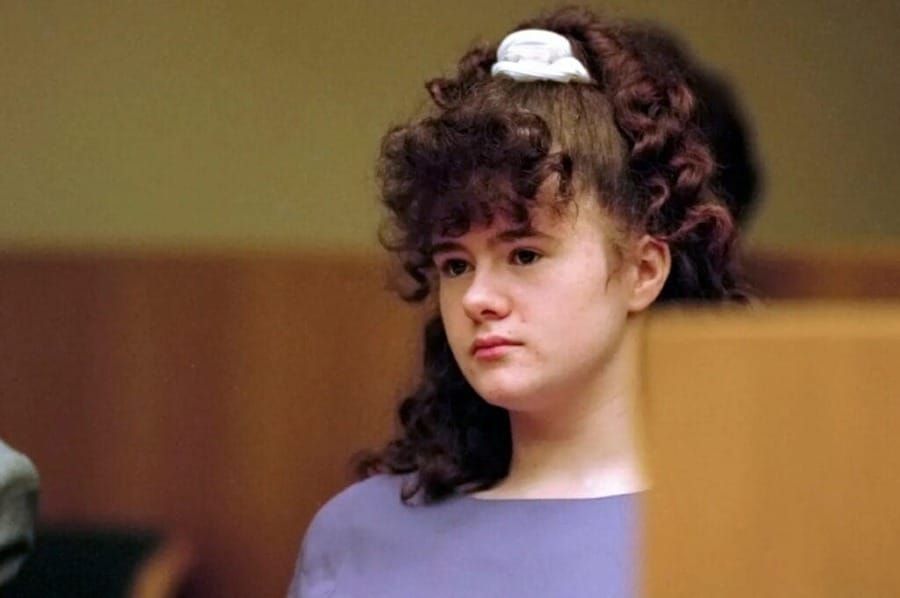
Pike sobbed and called out for her mother as the judge sentenced her to death on 30 March 1996, according to the Cornell Center on the Death Penalty Worldwide, which advocates for her and links to WBIR footage of the hearing. She was 20.
Pike first tried to kill herself at 12, the centre says. Her teachers described her as "intent on helping others" and said there was "something special about her, a spark." She failed the seventh grade despite standardised test scores in the upper percentile for her age, according to the centre, which attributes the decline to untreated bipolar disorder.
Pike enrolled at the Job Corps centre in Knoxville hoping to become a nurse, the centre says, and found a culture of violence in which students armed themselves with razor blades and box cutters. Dr Ali Winters, who began treating Pike a few years after her death sentence, described her as living in a "near constant 'fight or flight' mode." Brand, the psychologist, concluded: "At 18 years old, her immature, traumatized brain made her exceptionally vulnerable to impulses and extremely poor decisions. Unmedicated and untreated, she was not able to put the 'brakes on' her bipolar-and trauma-triggered emotions."
Pike has spent 27 years in solitary confinement as the only woman on Tennessee's death row, according to the centre, in a cell next to the unit for women with severe mental illness. Amnesty International puts the period of de facto solitary confinement at more than 25 years. The centre says she welcomes new prisoners to her pod with a bag of coffee, advocates for other women with the prison administration and draws portraits and mermaids.
Pike has said she does not use her history as an excuse. "I had more than my fair share of trauma growing up, and I realized that so many others have that didn't commit violent crimes. I don't use that or anything else as an excuse for what I did. There is no excuse for what I did," she said in a statement published by the Cornell centre. "I take full responsibility for my actions, and regret everything that happened that night. If I could take it all back, I would."
From "pathological liar" to "does not dispute"
A Knox County jury convicted Pike of first-degree murder and conspiracy on 22 March 1996 and sentenced her to death on 30 March. It found that the killing was especially heinous, atrocious or cruel in that it involved torture, and that it was committed to avoid prosecution.
Three relatives testified in mitigation: an aunt, Pike's father and her mother, according to the 2016 federal habeas ruling. They described neglect, rejection, family substance abuse and a mother who smoked marijuana with Pike.
The defence had retained a mitigation specialist who gathered extensive background material, the federal ruling says. Lead defence counsel dropped plans to call her at the last minute. Co-counsel testified in post-conviction proceedings that the reasons included the specialist's relationship with the lead prosecutor and her view that Pike "did nothing but lie."
The post-conviction court accepted lead counsel's testimony that he feared her evidence would expose damaging information, and found the decision a reasonable strategy. The Tennessee Court of Criminal Appeals found that Pike had shown neither deficient performance nor prejudice, noting that much of the specialist's evidence "was presented in some form."
Pike's lawyers say the jury "never had the opportunity to consider" the sexual violence set out in the petition. The petition says the defence's penalty case lasted about an hour, citing a closing argument that fills six transcript pages, and that counsel never told jurors her youth was a statutory mitigating factor. Only the 1996 penalty-phase transcript can show exactly what the jury heard.
Tennessee described Pike as a "pathological liar" in post-conviction proceedings, according to her lawyers' Supreme Court brief, and the post-conviction court found her not credible on these matters. On 13 August 2026, at an evidentiary hearing, a state lawyer said: "The State does not dispute the terrible things that Ms. Pike suffered."
Pike's lawyers built a motion under Federal Rule of Civil Procedure 60(b) on that statement and filed it on 29 September. The state told the Supreme Court the motion was a barred successive habeas petition, filed 47 days after the statement, and that state courts had rejected her claim on grounds "that have nothing to do with the credibility of Pike's abuse allegations."
US District Judge Harry Mattice denied Pike's habeas petition on 11 March 2016 and described the evidence of guilt as overwhelming, citing her taped confession, the skull fragment found in her jacket and DNA evidence. The Sixth Circuit affirmed in 2019. In 2004 Pike was convicted of attempting to strangle a fellow prisoner with a shoelace in 2001, according to the Associated Press.
Lethal injection: 75 botched in 1,054, by Sarat's count
Austin Sarat, a professor of jurisprudence and political science at Amherst College, counted 276 botched executions among 8,776 in the US from 1890 to 2010, a rate of 3.15 per cent, in his 2014 book Gruesome Spectacles.
Lethal injection had the highest rate of any method: 75 of 1,054, or 7.12 per cent. Lethal gas followed at 5.4 per cent, hanging at 3.12 per cent and electrocution at 1.92 per cent. Sarat counted none among 34 executions by firing squad. By his count, 979 lethal injections did not meet his definition of a botch.
Sarat said that each new execution technology arrived with the same promises, that it was "safe, reliable, effective and humane," and that "those claims have not generally been fulfilled."
Sarat defined a botched execution as one involving "unanticipated problems or delays that caused unnecessary agony for the prisoner or gross incompetence of the executioner," and relied largely on newspaper accounts. The Medicine and Justice Project has written that the definition captures minor incidents alongside severe ones, that state secrecy hides others and that published estimates for lethal injection range from 1 per cent to 70 per cent depending on the definition.
Michael Radelet, a sociologist, keeps a narrower list for DPI of 64 executions or attempts since 1976 that he considers well documented as botched. It includes 51 lethal injections, seven of them abandoned because staff could not insert an intravenous line. Radelet presents it as a set of well-documented examples, and says it is incomplete.
Ohio executed Dennis McGuire on 16 January 2014 in 26 minutes, during which witnesses saw him gasp repeatedly, according to the Associated Press. Oklahoma's execution of Clayton Lockett on 29 April 2014 took 43 minutes after staff placed a single intravenous line in his groin. He writhed and mumbled after the sedative was given, the warden lowered the viewing blinds and he was declared dead of an apparent heart attack.
Oklahoma's Department of Public Safety found in September 2014 that "the IV access was the major issue with the execution" and that midazolam had collected in tissue near the insertion site. Commissioner Michael Thompson said "the drugs were working as expected." The department recommended that the insertion point stay visible and be continuously observed by a person with medical training throughout every execution.
Arizona's execution of Joseph Wood on 23 July 2014 lasted nearly two hours. Staff gave him 15 times the standard doses of midazolam and hydromorphone set in Arizona's protocol. Wood's lawyers said he gasped more than 600 times. A spokeswoman for Arizona's attorney general said: "He just laid there. It was quite peaceful."
Alabama reviewed itself; Arizona dismissed its reviewer
DPI counted seven of 20 execution attempts in 2022 as visibly problematic, citing "executioner incompetence, failures to follow protocols, or defects in the protocols themselves." Alabama staff took about three hours to establish intravenous access for Joe Nathan James before executing him on 28 July 2022, according to the Equal Justice Initiative. They abandoned their attempts on Miller in September and Smith in November.
Governor Kay Ivey paused Alabama executions in November 2022 and handed the review to the Alabama Department of Corrections, the agency that had conducted the failed attempts. Ivey said in February 2023 that executions would resume after the department expanded its pool of medical professionals, bought new equipment and held rehearsals. The department released a letter from Commissioner John Hamm and no detailed report, WBHM reported.
The executive director of the ACLU of Alabama said it was "unreasonable to believe that the agency responsible for botching multiple executions can thoroughly investigate itself."
Idaho halted Thomas Creech's execution on 28 February 2024 after its medical team made eight attempts to place an intravenous line in his arms, legs, hands and feet between 10am and 10.58am.
Arizona Governor Katie Hobbs appointed David Duncan, a retired federal magistrate judge, in 2023 to review the state's execution process. She dismissed him in November 2024 before he submitted a final report, writing that his actions "went beyond his mandate." Duncan had told the governor's office that lethal injection was "unreliable." He said he was dismissed after asking about cash payments of $20,000 per execution to two members of the medical team; Hobbs denied any link.
The Justice Department doubted pentobarbital in January 2025 and moved to reinstate it in April 2026
NPR obtained 305 autopsy reports of executed prisoners from nine states, including Tennessee, covering 1990 to 2019. Of the 216 that described the lungs, 84 per cent showed pulmonary oedema, a build-up of fluid in the lungs, NPR reported in 2020. Mark Edgar, a pathologist who studied execution autopsies with the anaesthesiologist Joel Zivot, has said the condition can cause sensations of "doom, panic, drowning, and asphyxiation."
The US Justice Department's Office of Legal Policy reviewed the federal single-drug pentobarbital protocol, the method Tennessee used on Pike, and concluded in January 2025 that there was "significant uncertainty about whether the use of pentobarbital as a single-drug lethal injection" caused unnecessary pain and suffering. It cited the risk of flash pulmonary oedema and warned of "excruciating pain if injected rapidly into veins, particularly if extravasation or infiltration of the peripheral IV catheter occurs."
Merrick Garland, then attorney general, withdrew the federal pentobarbital protocol on 15 January 2025. His successor, Pam Bondi, lifted the federal moratorium on executions on 5 February 2025. A Justice Department report dated 24 April 2026 directed the Federal Bureau of Prisons to reinstate the pentobarbital protocol, according to DPI.
Tennessee executed Byron Black with pentobarbital on 5 August 2025. State experts had testified that he would lose consciousness within 20 seconds. His autopsy, released on 10 September 2025, found pulmonary congestion and oedema, according to DPI's account of the report.
Chief Justice John Roberts wrote for a plurality of the US Supreme Court in Baze v. Rees in 2008 that "an isolated mishap alone does not give rise to an Eighth Amendment violation." The court held in Bucklew v. Precythe in 2019 that "the Eighth Amendment does not guarantee a prisoner a painless death," and required prisoners challenging a method to identify a feasible alternative that would significantly reduce a substantial risk of severe pain.
203 people exonerated from death row since 1973
DPI lists 203 people exonerated after being sentenced to death since 1973, most recently Jermaine Wright in Delaware in 2026. It counts a case only where the person was acquitted, had all charges dismissed or received a pardon based on evidence of innocence. Michael Conklin, a business law lecturer at Colorado Mesa University, argued in 2018 that abolitionist claims conflate wrongful conviction with proven innocence.
Samuel Gross of the University of Michigan and three co-authors estimated in the Proceedings of the National Academy of Sciences in 2014 that at least 4.1 per cent of the 7,482 people sentenced to death in the US from 1973 to 2004 would be exonerated if all remained under sentence of death indefinitely. By the end of 2004, 117 of them, 1.6 per cent, had been. The authors described the estimate as conservative. The study counted wrongful convictions; it made no estimate of wrongful executions.
Texas executed Cameron Todd Willingham in 2004 for setting a 1991 fire that killed his three daughters. The Texas Forensic Science Commission found in April 2011 that the fire science used against him had been discredited. It made no finding on misconduct or on his guilt after the state attorney general limited its jurisdiction.
Oklahoma set nine execution dates for Richard Glossip. The US Supreme Court ruled on 25 February 2025 that prosecutors had let their key witness testify falsely and ordered a new trial. Oklahoma's attorney general has said the state will retry him for murder without seeking death. Conklin wrote in 2018 that no executed person had been shown conclusively to be innocent.
Georgia's 4.3 race-of-victim gap; no race effect after controls in federal cases
David Baldus's study of more than 2,000 Georgia murder cases from the 1970s found that, after accounting for 39 non-racial variables, defendants charged with killing white victims were 4.3 times as likely to be sentenced to death as those charged with killing Black victims. The US Supreme Court assumed the study's validity in McCleskey v. Kemp on 22 April 1987 and upheld the death sentence 5-4, requiring proof of discriminatory purpose in the individual case.
Scott Phillips and Justin Marceau of the University of Denver followed the Georgia defendants and reported in 2020 that 22 of 972 people convicted of killing white victims were executed, against two of 1,503 convicted of killing Black victims.
The US General Accounting Office reported in 1990 that 82 per cent of the studies it reviewed found the victim's race influenced capital charging or sentencing. It found the influence of the defendant's race unclear.
The Washington Supreme Court struck down that state's death penalty in October 2018 after a study found Black defendants were 3.5 to 4.6 times as likely as similarly situated white defendants to be sentenced to death.
A 2006 RAND study of federal cases by Stephen Klein, Richard Berk and Laura Hickman found raw racial disparities in decisions to seek death, but that "controlling for nonracial case characteristics eliminated these effects." The authors said their findings were not definitive.
Deterrence research "not useful", the National Research Council found
A National Research Council committee chaired by Daniel Nagin concluded in April 2012 that research to date "is not useful in determining whether the death penalty increases, decreases, or has no effect" on homicide rates, and that this "should not be construed as favoring one argument over another."
Bijou Yang and David Lester reported in a 2008 meta-analysis of 104 earlier studies that the overall results supported a deterrent effect. Aaron Chalfin, Amelia Haviland and Steven Raphael reviewed the panel-data studies in 2013 and wrote that they were "inconclusive as a whole, and in many cases uninformative."
Adult self-restraint arrives after 18, on average
Grace Icenogle, Laurence Steinberg and colleagues tested 5,227 people aged 10 to 30 in 11 countries and reported in 2019 that cognitive capacity reached adult levels around 16, while psychosocial maturity, including self-restraint in emotional situations, reached adult levels after 18.
The findings are averages across thousands of people and cannot measure the maturity or culpability of any one person, including Pike at 18 years and 10 months. The US Supreme Court barred death sentences for crimes committed under 18 in Roper v. Simmons in 2005.
A Knox County judge rejected Pike's request for youth-based relief in October 2023.
47 executions in 2025, 19 of them in Florida
Courts imposed 23 new death sentences in the US in 2025, DPI reported, and capital juries chose life in 56 per cent of cases they decided. The US executed 47 people in 2025, against 25 in 2024. Florida accounted for 19.
DPI counted 23 executions nationally in 2026 by 25 August, 13 of them in Florida, and only six states that had executed anyone. A Catholic News Agency tally in August 2025 counted 23 states that had abolished the death penalty.
Gallup found 52 per cent of US adults in favour of the death penalty for murder in October 2025, against 80 per cent in September 1994.
"I'm sorry for what I did": apologies, denials and silence on the gurney
Tennessee executed Oscar Smith, 75, on 22 May 2025 for the 1989 killings of his estranged wife, Judith Smith, and her sons Jason Burnett, 13, and Chad Burnett, 16. Smith maintained his innocence to the end. "Somebody needs to tell the governor the justice system doesn't work," he said in his final words, and: "I didn't kill her." Two co-workers testified that he had asked them to kill his wife, and a child's voice on a 911 call said "Frank, no!"; Frank was Smith's middle name. A court ruled in 2022 that DNA from an unknown person on a murder weapon was not enough to reopen the case.
Byron Black, 69, used a wheelchair and had dementia, brain damage, kidney failure and congestive heart failure when Tennessee executed him on 5 August 2025. A jury had convicted him in 1988 of shooting his girlfriend, Angela Clay, 29, and her daughters Latoya, 9, and Lakeisha, 6. Asked for final words, he said: "No sir." Minutes later he said: "Oh, it's hurting so bad." His lawyer, Kelley Henry, described him as "a gentle, kind, fragile, intellectually disabled man."
Linette Bell, Angela Clay's sister, said: "His family is now going through the same thing we went through 37 years ago. I can't say I'm sorry because we never got an apology."
Texas executed Charles Thompson on 28 January 2026 for the 1998 shootings of his former girlfriend, Glenda Dennise Hayslip, 39, and her boyfriend, Darren Keith Cain, 30. "I'm sorry for what I did, I'm sorry for what happened, and I want to tell all of y'all, I love you," he said, according to the Texas Department of Criminal Justice. He asked the families to forgive him. Dennis Cain, Darren's father, said after watching the execution: "He's in hell."
Cedric Ricks spoke to the family of his former girlfriend, Roxann Sanchez, 30, and her son Anthony Figueroa, 8, whom he stabbed to death in Bedford, Texas, in 2013, before Texas executed him in March 2026. "Yes, first I want to say I'm sorry for taking Roxanne and Anthony away from y'all. I can't imagine the pain it has caused you," he said. Marcus Figueroa, Sanchez's other son, survived 25 stab wounds in the attack and watched from a few steps away. Ricks had called his own family and confessed after fleeing the scene.
Florida executed Dusty Ray Spencer, 74, on 25 June 2026, the oldest person put to death in the state's modern history, for stabbing his wife, Karen Spencer, in 1992 after a pattern of domestic violence and threats. "Sorry, sorry to the family," he said. "Into thy hands I commit my spirit and my soul. I'm on my way, Lord. I'm on my way. Amen." Karen Spencer's family released no statement, WRDW reported.
Anthony Darrell Hines, 66, declined to make a final statement when Tennessee executed him on 13 August 2026. Strokes in December 2025 and January 2026 had left him partly paralysed, and witnesses had difficulty understanding his speech. His son watched and was visibly upset. Hines had stabbed Catherine Jean Jenkins, 54, 13 times and sexually assaulted her at a Kingston Springs motel in March 1985.
Dennis Jenkins, her son, said after the execution: "Yes, I hope he did suffer because what he did to my mother is nothing to what he just went through." Her daughter, Melissa Jenkins, said: "We will always mourn the wonderful person our mother was...This day brings justice. After so many years, we're finally able to close this chapter of our lives."
113 countries have abolished the death penalty for all crimes; Japan and Singapore defend theirs
Amnesty International counted at least 2,707 executions in 17 countries in 2025, the most since 1981, including at least 2,159 in Iran, 356 in Saudi Arabia and 47 in the US. Its total excludes China. Amnesty counts 113 countries as abolitionist for all crimes, up from 16 in 1977.
The UN General Assembly backed its 10th resolution calling for a global moratorium on executions on 17 December 2024, by 130 votes to 32 with 22 abstentions. The first such resolution, in 2007, drew 104 votes in favour. The Second Optional Protocol to the International Covenant on Civil and Political Rights, adopted in 1989, commits its 92 parties to abolition.
Every Council of Europe member has ratified Protocol 6 to the European Convention on Human Rights, which bans the death penalty in peacetime, and Armenia became the 45th to ratify Protocol 13, which bans it in all circumstances, in October 2023. "Abolition of the death penalty is a prerequisite for EU membership," the EU's diplomatic service says, citing the right to life and freedom from cruel, inhuman and degrading punishment.
The UK abolished the death penalty for murder in 1965 and made the ban permanent in 1969. DPI identifies three 1950s executions that drove the campaign. Timothy Evans, hanged in 1950, received a posthumous royal pardon in 1966. Derek Bentley, hanged in 1953 as an accomplice to a police officer's killing, had his conviction overturned in 1998. Ruth Ellis was hanged in 1955 for killing her abusive partner, after more than 50,000 people signed petitions for a reprieve.
Canada abolished the death penalty on 14 July 1976, 12 days after the US Supreme Court allowed executions to resume. Canada's homicide rate peaked in 1975 at 3.03 per 100,000 people and had fallen to 1.73 by 2011, according to Statistics Canada. Statistics Canada's figures track the decline but do not separate abolition from the many other changes over those decades.
South Africa's new Constitutional Court struck down the death penalty unanimously on 6 June 1995, in its first case, S v Makwanyane, when about 400 people were awaiting execution. The court found that race, poverty and chance decided who was sentenced to death, that there was insufficient evidence executions deterred murder more than life imprisonment, and that public support could not settle a constitutional question.
Japan and Singapore keep the death penalty and cite public support. A Japanese Cabinet Office survey of 3,000 people in late 2024 found 83.1 per cent called it "unavoidable"; respondents most often cited the feelings of victims' families and retributive justice. Among the 16.5 per cent who favoured abolition, 71.0 per cent cited the risk of wrongful conviction, the highest share since the survey began in 1994. The survey followed Iwao Hakamada's exoneration in September 2024 after decades on death row.
Singapore's Ministry of Home Affairs reported in September 2024 that 77.4 per cent of residents surveyed in 2023 supported the death penalty for the most serious crimes, and 87.9 per cent believed it deterred the trafficking of significant amounts of drugs. Amnesty counted 17 executions in Singapore in 2025.
The case for execution, and the evidence against it
The US Supreme Court restored the death penalty in Gregg v. Georgia on 2 July 1976. The plurality described capital punishment as "an expression of society's moral outrage at particularly offensive conduct" and said channelling the instinct for retribution "serves an important purpose in promoting the stability of a society governed by law." On deterrence, it found "no convincing empirical evidence either supporting or refuting this view," and left the judgment to legislatures.
Justice Harry Blackmun reviewed death sentences for 18 years after Gregg. In Callins v. Collins on 22 February 1994 he wrote: "From this day forward, I no longer shall tinker with the machinery of death." He concluded that "the death penalty experiment has failed" and that no set of procedural rules could fix it. In Glossip v. Gross in 2015, Justice Stephen Breyer, joined by Justice Ruth Bader Ginsburg, wrote that the death penalty as administered likely violates the Eighth Amendment, citing its unreliability, its arbitrariness, its delays and its abandonment across most of the country.
Gallup asked supporters in October 2014 why they favoured the death penalty: 35 per cent cited "an eye for an eye", 14 per cent said those executed "deserve it" and 14 per cent cited saving taxpayers money. Only 7 per cent named deterrence. Opponents most often said it was wrong to take a life, followed by the risk of wrongful conviction and religious belief.
Judge Arthur Alarcón and Paula Mitchell calculated that California's death penalty cost taxpayers $4 billion more from 1978 to 2011 than a system with life without parole as the maximum sentence.
Robert Blecker, a law professor, argued in his 2013 book The Death of Punishment for proportional retribution reserved for the worst killers, with harsher prison conditions for those not executed. A Publishers Weekly review says he accepts the risk of executing an innocent person in pursuit of justice. DPI lists 203 people sentenced to death since 1973 and later exonerated, and Oklahoma set nine execution dates for Richard Glossip before the Supreme Court found his conviction rested on testimony prosecutors knew was false.
Kent Scheidegger of the Criminal Justice Legal Foundation, which supports capital punishment, told a US Senate subcommittee in 2002 that many reversals counted as exonerations turned on "legal issues that had little to do with the trial itself." He proposed cutting the median time from sentence to execution to four years. DPI counts a case only when the person was acquitted, had every charge dismissed or was pardoned on evidence of innocence.
May Martinez told WVLT in 2025 that she wanted to "see justice for Christa Pike to be put to death." "Justice has to serve. It cannot go on like this. I'm just hoping Tennessee does what they're supposed to do," she said. The family of Barry Van Treese, the man Glossip was convicted of having killed, asked the Supreme Court to uphold Glossip's conviction.
Neely Goen, whose father, Kansas State Trooper Conroy O'Brien, was killed in 1978, said: "At one time I believed that the death penalty would benefit people like my mother and me, but in reality nothing could be further from the truth." The parents of Jonas Cherry backed clemency for Paul Storey, saying his execution "will not bring our son back," according to DPI.
Marilyn Peterson Armour and Mark Umbreit compared homicide survivors in Texas, which executes, and Minnesota, which imposes life without parole. Minnesota survivors whose cases had concluded showed "higher levels of physical, psychological, and behavioral health," they reported in the Marquette Law Review in 2012, with the sharpest differences arising during the appeals that capital cases require.
Justice Neil Gorsuch wrote for the Supreme Court majority in Bucklew in 2019 that "both the State and the victims of crime have an important interest in the timely enforcement of a sentence," and that "last-minute stays should be the extreme exception, not the norm." Tennessee made the same argument against Pike on 30 September, telling the court that "capital petitioners might deliberately engage in dilatory tactics to prolong their incarceration" and describing her filing as "abusive, tactical delay." Her motion rested on the state's own statement in August that it did not dispute the abuse she suffered. Tennessee's own failure to test its drugs halted executions in April 2022, and the state executed no one again until May 2025.
In a separate filing in September, the state told the court that the Eighth Amendment does not demand a painless execution. Two days later, Pike was still breathing at 8.53pm after both doses of the state's drug.
The Tennessee Supreme Court reviewed Pike's sentence for proportionality in 1998, compared it with eight similar cases and upheld it. "In all eight of these cases the victims were savagely beaten with a blunt instrument or repeatedly stabbed or both," the court wrote. Pike "showed no mercy; instead, she exhibited a total disregard for human life and human suffering when she committed this unprovoked and unjustified premeditated murder."
State and federal courts upheld her conviction and sentence for the next 28 years. Shipp, who took part in the same killing, is serving a sentence that allows parole. The seven other people Tennessee sentenced to death for crimes committed at 18 have all had their sentences vacated, according to Pike's clemency petition.
Sutton's date withdrawn; Carruthers's reprieve ends in May 2027
The Tennessee Supreme Court sets execution dates, according to the Department of Correction. Sutton's 3 December date will not be used this year under Lee's statement of 1 October. Carruthers's one-year reprieve, granted by Lee on 21 May 2026, expires in May 2027.