The Federal Communications Commission's Space Bureau on 25 November authorised SpaceX to launch up to 1 million AI satellites into orbits between 500 km and 1,002 km, without a vote of the commission.
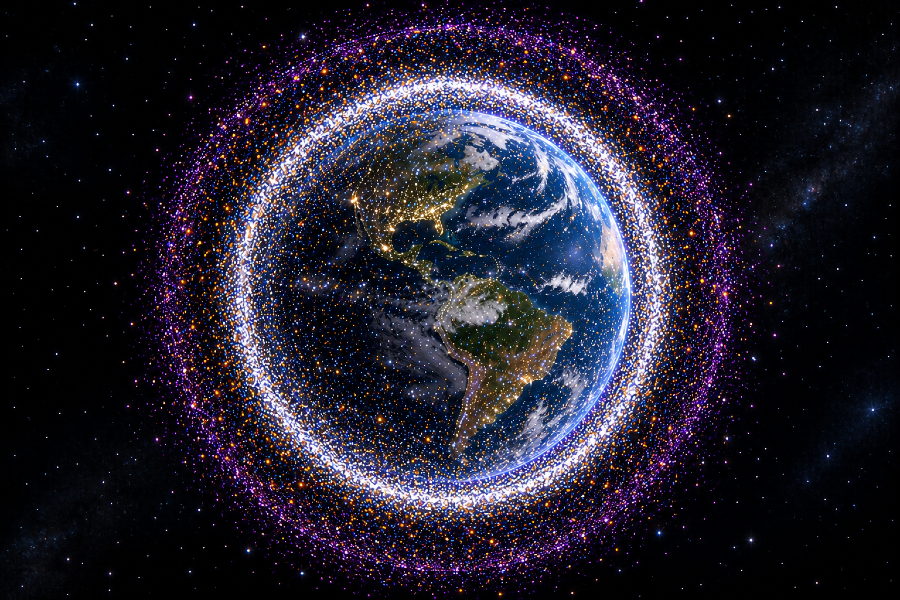
Rockets have put about 28,570 satellites into orbit since 1957, according to European Space Agency statistics updated on 2 November 2026. ESA's debris model estimates that 68,450 objects larger than 10 cm circle Earth, about 11,300 of them working satellites, along with 1.5 million fragments between 1 cm and 10 cm. SpaceX's own collision calculations, filed with the FCC on 29 May, assume each satellite weighs 3,000 kg, so a full constellation would put about 3 million tonnes of hardware into low Earth orbit.
The order, DA 26-1273, approves SpaceX's debris plan only for satellites below 600 km. Four of the six orbital groups lie higher, between 686 km and 1,002 km, where the bureau requires a final plan before deployment. It deferred SpaceX's request to escape the rule that satellites ending their missions below 2,000 km must re-enter the atmosphere within five years, finding that the company "has not provided sufficient information". The bureau called the atmospheric effects of burning up satellites speculative, ruled launch emissions and infrared heat outside its purview and declined to weigh the project's economics.
The licence adds value to a company whose shareholders include Elon Musk, its chief executive, and Nvidia, now the exclusive chip supplier for the satellites. Federal staff in the administration disclosed SpaceX or xAI shares before the company's June stock market listing. Other satellite operators, foreign governments, astronomers and the public carry the risks that the order leaves unassessed.
Brendan Carr, the FCC chairman, said in the commission's announcement that the decision opened a new frontier for computing and credited President Donald Trump's leadership. SpaceX wrote in its application that the network would be a first step towards a "Kardashev II-level civilization", a theoretical society that captures the full energy output of its star. SpaceX has until 25 December to decline the grant.
SpaceX's answer to its critics, set out in a 16 March filing, is that solar-powered computing in orbit spares the land, power grids and cooling water that ground data centres consume. It committed to keep the satellites fainter than visual magnitude 7, beyond naked-eye visibility, and to deploy first at low altitudes, where dead satellites fall back within two years. The company wrote that Amazon's objections amounted to "fearmongering about orbital congestion". SpaceX retired 260 Starlink satellites between December 2025 and May 2026, with a disposal success rate above 99 per cent, according to its report to the FCC.
A fleet 35 times the size of the space age
SpaceX's supplementary filing of 29 May, submitted at the FCC's request, lists six orbital groups. Two sit between 550 km and 585 km and hold up to about 200,000 satellites. Four sit between 686 km and 1,002 km and hold up to about 998,000. The group maximums in SpaceX's own table add up to 1,198,120 satellites, nearly 200,000 more than the 1 million the company says it seeks and the bureau authorised. Meeting the 2040 deadline would require about 200 satellites a day on average from the date of the order. All operators combined launched about 10 payloads a day in 2025, according to ESA's 2026 environment report.
Each satellite would carry Nvidia Rubin processors drawing 175 kW on average and 250 kW at peak, according to specifications SpaceX published in August. A full fleet would draw 175 GW. Data centres worldwide used 485 terawatt-hours of electricity in 2025, according to the International Energy Agency, an average draw of about 55 GW, so Starmind alone would exceed three times the planet's present data-centre load.
Blue Origin has applied to the FCC for 51,600 satellites, Starcloud for 88,000 and Cowboy Space for 20,000, according to a Government Accountability Office count reported by VKTR. Chinese entities filed with the International Telecommunication Union in December 2025 for more than 200,000 satellites, including two networks of 96,714 each, CGTN reported. Added to Starmind, those filings exceed 1.35 million satellites.
One signature and four waivers
Courtney Reinhard, who became chief of the Space Bureau on 29 October, signed the order under authority the commission delegates to its bureaus. Carr appointed her from the Senate Commerce Committee, where she was chief telecommunications counsel under its chairman Ted Cruz. She had earlier been vice-president for federal government relations at Verizon and an aide to two Republican FCC commissioners, Satellite Today reported.
The order waives five requirements that normally bind a constellation. On its own motion the bureau set aside the U.S. Table of Frequency Allocations because the services involved are the subject of a pending rulemaking. It waived the Schedule S technical filing and the processing round that would have let rival operators apply for the same spectrum. It waived the surety bond, payable to the U.S. Treasury, that the FCC uses to stop operators holding spectrum and orbital rights they do not use. It also set aside the existing deployment rule, which requires half a constellation within six years and all of it within nine. In its place the bureau applied a longer schedule the commission adopted in July: one satellite by 25 November 2033, 10 per cent of the fleet by 2035, half by 2038 and the rest by 2040.
Commenters told the bureau that the combined waivers removed every safeguard in its satellite rules, and NASA filed a letter objecting that waiving the deadlines would make future missions harder to plan. The bureau said it had waived the same rules for smaller applicants, among them Reflect Orbital, which plans satellites that bounce sunlight to the ground. The bond and deadline waivers follow a commission rule change of July 2026 that dropped bonds for operators outside processing rounds, the order says, and NASA's objection became moot once SpaceX accepted the new schedule. FCC rules set no ceiling on the number of satellites, and the bureau declined to impose one by decision.
In December 2022 the full commission voted on SpaceX's previous large application and authorised 7,500 of the 29,988 second-generation Starlink satellites requested, holding back the rest to address debris and space safety. The 25 November order authorises the entire 1 million at once, with the disposal plan still unwritten for the four upper groups, which hold more than 80 per cent of the satellites in SpaceX's own table.
Collisions in the most crowded band
Starlink's roughly 10,000 satellites performed 207,152 collision-avoidance manoeuvres between December 2025 and May 2026, up from 148,696 in the previous six months, according to SpaceX's report to the FCC. Sarah Thiele, Skye Heiland, Aaron Boley and Samantha Lawler modelled what would happen if every operator stopped manoeuvring, for instance after a severe solar storm. The first serious collision in low Earth orbit would then be expected within 5.5 days at June 2025 densities, against 164 days in 2018. The paper has been accepted by the journal Acta Astronautica.
ESA's Space Debris Office found in its 2025 environment report that debris would keep multiplying even if launches stopped, because fragmentations add objects faster than the atmosphere removes them. It concluded that only active debris removal can halt the chain reaction known as Kessler syndrome, in which collisions generate fragments that cause further collisions until some orbits become unusable. Its 2026 report found that ESA's index of orbital sustainability had worsened from about 4 to about 50 in a single year and concluded that "prevention alone is no longer enough". The same report describes the band from 600 km to 1,100 km as dense with decades of legacy debris. Starmind's four upper groups sit inside it. The first accidental collision between two satellites, Iridium 33 and Russia's Kosmos 2251, happened in that band at 776 km in February 2009.
SpaceX's 29 May filing gives the chance that a single dead satellite in the two lowest groups would hit a piece of large debris before falling back: between 2.66 and 7.00 in 10,000, depending on altitude. The company gave no comparable figures for the upper groups. Applying SpaceX's own numbers to a scenario in which 1 per cent of the 200,000 low-orbit satellites failed, the failures would produce between one-half and 1.4 expected collisions with large objects in each generation of the fleet. The 1 per cent failure rate is an assumption for illustration. SpaceX told the FCC in March that only one of its inactive Starlink satellites remained in orbit.
A dead satellite at 800 km to 1,000 km can stay in orbit for decades, according to a 2025 drag model. SpaceX asked for flexibility to send retired satellites from above 600 km into higher Earth disposal orbits or around the Sun instead of bringing them down, the order says. Its 29 May filing left open the circumstances in which it would do so. The bureau requires a licence modification before any satellite is left in orbit.
China told the United Nations in a note verbale of 3 December 2021 that its crewed space station had manoeuvred twice that year to avoid Starlink satellites. The note invoked the treaty rule that states answer for their companies' conduct in orbit.
Weather and climate satellites in the same orbits
The polar-orbiting satellites behind three-to-seven-day weather forecasts fly at almost the same height and inclination as two of Starmind's groups. NOAA-21, the primary U.S. polar weather satellite, orbits at between 824 km and 833 km in a sun-synchronous orbit, according to World Meteorological Organization and NASA figures. Europe's MetOp weather satellites fly at 817 km and the Copernicus Sentinel-3 climate satellites at 814 km, both in sun-synchronous orbits.
Starmind's sun-synchronous groups occupy 707 km to 744 km, about 70 km below those satellites, and 967 km to 1,002 km, about 130 km above them. Any satellite brought down from the top group passes through the weather satellites' altitudes on the way. The bureau said it coordinated the grant with NASA and NOAA through the National Telecommunications and Information Administration and treated that as meeting commenters' requests for formal consultation. The order gives no account of what either agency said about the weather fleet. Half of the 56 variables scientists need to monitor climate change can be measured only from space, the UK Space Agency has said, Geographical reported.
Metals and soot in the stratosphere
Instruments on NOAA research aircraft found aluminium and other spacecraft metals in about 10 per cent of stratospheric sulfuric acid particles larger than 120 nanometres, a team led by Daniel Murphy reported in 2023. For several elements, including aluminium, lithium and copper, the amounts already exceed what meteors deliver.
José Ferreira and colleagues at the University of Southern California found that a 250 kg satellite produces about 30 kg of aluminium oxide as it burns up. Re-entries released about 17 tonnes in 2022, eight times the 2016 level, and planned megaconstellations could push the annual figure above 360 tonnes, their 2024 study found. The particles can persist for decades and catalyse reactions that destroy ozone.
SpaceX has not published Starmind's design life or materials, so any estimate is a scenario. If each 3,000 kg satellite produced aluminium oxide in the same proportion as Ferreira's model and the fleet were replaced every five years, 200,000 satellites would burn up each year and release about 72,000 tonnes of aluminium oxide. That is 200 times the upper scenario in the USC study. A 10-year design life halves the figure. A different alloy mix could move it substantially in either direction. SpaceX told the FCC that each satellite is designed to burn up completely on re-entry, which the bureau accepted as protection for people on the ground. A satellite that burns up completely leaves its entire mass in the upper atmosphere.
Rockets already inject about 1,000 tonnes of black carbon into the stratosphere each year. Christopher Maloney's 2022 NOAA study found that 10 times that amount would warm the stratosphere and thin the northern ozone layer by as much as 16 Dobson units in some months. The study modelled kerosene engines, and Starship's methane engines were outside its scope. Google's researchers estimated that Starship would need to carry about 370,000 tonnes of payload before launch prices fell to US$200 a kilogram. Starmind's first fleet alone weighs eight times that.
The bureau described re-entry effects as speculative and referred launch emissions to the Federal Aviation Administration. It relied on FCC 26-64, a rule released on 1 October that treats activity in orbit as outside U.S. territory and therefore outside the National Environmental Policy Act. The rule had not yet taken effect, and the bureau said it would have declined an environmental review under the old rules as well. A coalition represented by Earthjustice had asked the FCC in July to suspend all orbital data-centre licences until it carried out a programmatic environmental review.
Astronomy and the view from orbit
Alejandro Borlaff, Pamela Marcum and Steve Howell, NASA researchers, modelled the 560,000 satellites registered for launch in June 2025. If those fleets fly, one-third of Hubble Space Telescope images and 96 per cent of exposures from the SPHEREx survey telescope would carry satellite trails, they reported in Nature in December 2025. Starmind alone is nearly twice that population. SPHEREx images taken between May and September 2025 already show trails in 73 per cent of frames, the same team found in a 2026 follow-up.
The American Astronomical Society petitioned to deny the application on 6 March and gathered about 1,500 public comments, it reported. The Royal Astronomical Society, the European Southern Observatory and the International Astronomical Union also objected, Astronomy magazine reported. The order lists the SKA Observatory, Italy's Accademia dei Lincei, DarkSky International, the Secure World Foundation and the Center for Space Environmentalism among other commenters. Amazon and Viasat, which compete with SpaceX for spectrum and customers, filed the two commercial petitions; Amazon's described the application as "lofty ambition rather than a real plan".
SpaceX's brightness pledge covers visible light only, and the company accepted in March that infrared standards are still being written with the National Science Foundation. The AAS told the FCC that waste heat from so many satellites would raise the infrared background of the sky. The bureau ruled that waste heat lies outside its authority over radio operations. It found that its rules do not cover optical astronomy at all, and accepted SpaceX's promise to coordinate with the NSF as sufficient. It treated the Royal Astronomical Society's objection, that a private company was making decisions for the whole planet, as beyond its mandate.
Who profits from the licence
SpaceX filed the Starmind application on 30 January. Three days later it acquired xAI in a deal valuing the combined company at US$1.25 trillion, which Musk tied to his plan for computing in orbit. SpaceX listed its shares in June. Its capital spending reached US$28.5 billion in the first half of 2026, more than four times the figure a year earlier.
Nvidia bought into xAI during a US$20 billion funding round in January, and those shares converted into SpaceX stock with the merger. On 4 August the two companies announced that they would design the satellites' computing payload together, TechStartups reported. Musk said SpaceX would buy only Nvidia processors: "We're exclusive to Nvidia," he said, according to the Motley Fool. Nvidia is therefore both a SpaceX shareholder and the sole supplier of the processors the licence allows SpaceX to launch.
Federal staff in the Trump administration disclosed SpaceX or xAI holdings worth between US$9.9 million and US$43.8 million in financial reports filed before the listing, according to Bloomberg Law. SpaceX's defence contract obligations reached US$5.9 billion in the first three quarters of fiscal 2026, up from US$1.8 billion in all of fiscal 2025, a Bloomberg Government analysis found.
Musk has committed a reported US$366 million to Republican candidates and groups in the 2026 midterm cycle, figures America PAC confirmed to The New York Times, Al Jazeera reported. Trump presented Musk with the National Medal of Science on 8 October, PBS reported.
Carr, Musk and the evidence on capture
Carr posted a photograph of himself with Musk and Trump at a SpaceX launch days after the November 2024 election, describing it as a historic day at Starbase. Musk later recommended Carr to Trump to lead the agency, The New York Times reported in June, as summarised by the Benton Institute. In December 2023, as a commissioner in the minority, Carr dissented when the FCC upheld its refusal of an US$886 million rural broadband subsidy for Starlink and said the agency had invented the standard it applied to the company.
As chairman, Carr promoted the Starmind application on X on 4 February, the day the bureau opened it for comment, by repeating SpaceX's Kardashev claim, Finviz reported. On 11 March, five days after Amazon petitioned to deny the application and while the case was open, he posted that Amazon "will fall roughly 1,000 satellites short" of its own deployment deadline, Broadband Breakfast reported. Amazon then had 212 of its planned 3,232 satellites in orbit.
Carr's annual financial disclosure filed in 2025 lists no shares in SpaceX, xAI, Tesla, Nvidia or Amazon, ProPublica's copy shows. It lists a retirement fund, college savings plans, bank accounts, one mutual fund and a residential property in Washington, D.C. The bureau handled the application as a permit-but-disclose proceeding, which allows private meetings with officials on condition that each is reported in the docket.
Carr's posts and the Times account show a chairman who publicly backed the applicant against a petitioner during the case and who was recommended for his post by the applicant's chief executive. Regulatory capture, in administrative law, describes an agency that serves the firm it regulates instead of the public. Corruption requires an exchange of value for official action. Establishing either would require Reinhard's financial disclosure, the ex parte notices in the Starmind file, internal correspondence on the four waivers and any contact between the chairman's office and the White House on the application.
The case for orbit on the evidence
The Government Accountability Office concluded in April 2026 that power, heat rejection and data links had each worked in space but had never been combined at data-centre scale. It listed radiation damage to chips, congestion and end-of-life debris as unresolved. Starcloud launched its first test satellite, the size of a refrigerator, in November 2025.
Google, which is testing its own design, found that orbital computing could match the energy cost of a ground data centre if launch prices fall below US$200 per kilogram, which it projected for the mid-2030s. A cost model published by IEEE Spectrum put a 1 GW orbital data centre at more than US$50 billion over five years, about three times a ground equivalent.
SpaceX's own March filing describes its solar advantage only in general terms and contains no cost figures. Its environmental case rests on the land and water a ground data centre consumes, set against launch soot, re-entry metals and debris that the bureau declined to assess.
Treaty duties and the bill for damage
The FCC can license a fleet that surrounds the planet because the Outer Space Treaty makes each state answer for its own companies. Article VI requires the United States to authorise and continually supervise SpaceX. Article IX requires states to act with due regard for other states' interests, to avoid harmful contamination of outer space and to hold international consultations before any activity that may cause harmful interference with other states' activities. Its only clause on Earth's environment concerns matter brought back from space, so the treaty contains no rule on pollution from satellites burning up in the atmosphere.
Other states may request such consultations, but the treaty gives them no power to block a project, Edmarverson Santos wrote in a legal analysis of the order. Article IX "does not grant other countries a veto", he wrote, and the order breaches no rule of international law provided U.S. supervision follows. The International Telecommunication Union coordinates radio frequencies under Articles 44 and 45 of its constitution, but it has no authority over physical crowding or debris.
The 1972 Liability Convention makes the launching state absolutely liable for damage on the ground or to aircraft, and liable for damage to other spacecraft only if it was at fault. Claims must be brought by one government against another. A country whose weather satellite is destroyed by a Starmind fragment would have to prove fault, and the United States, as the launching state, would owe any compensation. Santos wrote that the convention's coverage of diffuse harm such as ozone loss remains uncertain.
The Space Force's 19th Space Defense Squadron already catalogues new satellites and screens them for collisions at public expense. Every other operator, including NOAA and EUMETSAT, must plan around the new fleet. The waived bond would have been forfeit to the U.S. Treasury if SpaceX missed its deadlines. Comments on the docket were open to anyone, but countries without space programmes and operators that do not yet exist had no other route into the U.S. licensing decision. The bureau set aside their central concerns as outside its jurisdiction.
Before any satellite flies above 600 km
Any commissioner may ask the full FCC to review the bureau's delegated action. The Democratic majorities elected to both houses of Congress on 3 November take office on 3 January 2027 with oversight power over the agency. The House Energy and Commerce Committee could then subpoena the ex parte notices and internal correspondence on the waivers.
The final debris plan the order requires for the four upper groups could carry per-satellite collision probabilities and a ban on leaving dead satellites in the band shared with weather satellites. It could also cap deployment according to measured disposal success, as the full commission did for Starlink in 2022. A disposal bond sized to the cost of removing failed satellites would replace the deployment bond the bureau waived.
Starmind's design life and materials, once filed with the FCC, would let NOAA and NASA model re-entry metals and launch soot at Starmind's real scale, the review the Earthjustice coalition sought. The National Science Foundation and astronomers could set an infrared limit before launch to match SpaceX's visible-light pledge.
Formal Article IX consultations through the UN Committee on the Peaceful Uses of Outer Space would give other states, including those with no satellites of their own, a hearing the docket's comment window offered only in theory. Santos wrote that any state with reason to believe Starmind could harm its activities may request those consultations itself.