
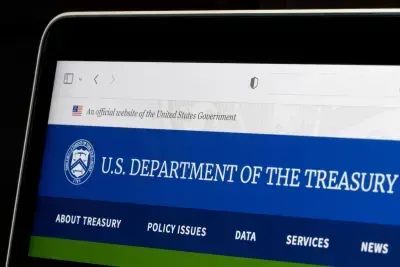
Researchers at the British security company Intruder gained control of the servers behind five U.S. Treasury subdomains by renting cloud addresses the department's DNS records still pointed to, according to research published on 24 November.
The five names were ftp[.]treasury[.]gov, irssearch[.]treasury[.]gov, pcp[.]treasury[.]gov, rdgw[.]treasury[.]gov and ww5[.]treasury[.]gov. Holding their addresses let Intruder serve its own proof-of-concept pages under genuine treasury.gov names. Tom Steer, the Intruder security consultant who wrote up the work, limits the claim to those servers. His account describes reaching neither the Treasury's DNS administration nor its internal networks or existing website content, and it presents no evidence that anyone else exploited the records.
Intruder said it reported the findings through bug bounty and vulnerability disclosure programmes on 25 August. Steer's write-up is silent on how the Treasury responded or when the records changed. At 08:52 UTC on 28 November, A-record queries for all five names sent through Google Public DNS returned a NOERROR status with an empty answer from treasury.gov's Cloudflare-hosted authoritative servers, the same response given for an invented treasury.gov name. The five names no longer map to any IPv4 address, and the lookups leave open who removed the mappings and when.
A DNS record turns a name such as ftp[.]treasury[.]gov into a numeric internet address. When a customer of Amazon Web Services (AWS) gives up an Elastic IP address, AWS returns it to a shared pool and can reissue it to any other customer. If the old owner leaves its DNS record in place, whoever is assigned the address next controls what the name serves.
Steer wrote that an attacker in the same position could host phishing pages under a .gov name and could pass a certificate authority's domain check to obtain a trusted TLS certificate. A legacy automated system still connecting to one of the names could hand its login details to the new holder. Browsers could also send any cookies scoped to the whole treasury.gov domain, depending on how those cookies were set. Intruder presents all of these as possible consequences and reports obtaining no certificate, credentials or cookies.
AWS told Intruder on 17 November that it had no plans to make changes, according to the write-up, because it regards the takeovers as the product of customers' DNS records and not a flaw in its services. AWS also treats rapid allocation and release of addresses as a breach of its policies and said it has controls against the practice. Intruder had asked for a monthly cap on Elastic IP allocations and for abuse restrictions to apply across whole AWS organisations. The write-up leaves unclear whether AWS answered those two proposals specifically.
Intruder began the experiment on 23 August, drawing target names from the published scopes of public bug bounty programmes. It raised its account's Elastic IP limit from five to 25 per region, an increase approved automatically, and ran a script that allocated addresses, kept any that matched a target and released the rest as it moved between regions. Over 48 hours it cycled through about 450,000 addresses, roughly 0.56 per cent of the EC2 IPv4 space AWS publishes, and landed 28 live takeovers. Steer wrote that almost half belonged to government bodies. The others included a university, a financial services company, a large networking vendor and several Intruder customers.
Steer put Intruder's cost at about US$3 per valid takeover without showing the calculation. The write-up presents the figure as a cost per successful match across the whole sweep, which caught whichever stale records happened to come up. Taking over one chosen Treasury subdomain would depend on that subdomain's former address being reissued to the attacker.
AWS sent an abuse warning after the 48-hour run. The notice, which Intruder published, said AWS had "Blocked the ability to allocate and associate Elastic IP in all regions". Intruder moved the addresses it had already matched to a second account in the same AWS organisation and then stopped. Steer estimated that 10 accounts could cycle through the roughly 80 million EC2 IPv4 addresses AWS publishes in about five weeks if restrictions applied account by account. He wrote that the pool an attacker could realistically obtain is much smaller.
Matt Bryant, then at the security firm Bishop Fox, documented the same technique on 7 October 2015, writing that domains belonging to large companies, government sites and universities still pointed at recycled AWS addresses. Assetnote released an open-source tool for finding dangling Elastic IPs on 13 February 2022.
On 22 January 2019 the Cybersecurity and Infrastructure Security Agency issued Emergency Directive 19-01 to federal civilian agencies. It gave them 10 business days to audit the public DNS records of every .gov domain they manage and confirm each resolved to its intended location. The National Institute of Standards and Technology's DNS deployment guide, revised on 19 March 2026, warns that a dangling CNAME record, one pointing at a domain an organisation no longer controls, can let attackers take over resolution for the name. The Treasury entries were A records, which point at numeric addresses.
The weakness was documented in 2015, yet Treasury remained vulnerable to it in 2026. It is unclear when the department relinquished the five IP addresses or how long its outdated records left the subdomains exposed. Treasury had issued no public response to the findings as of 28 November.