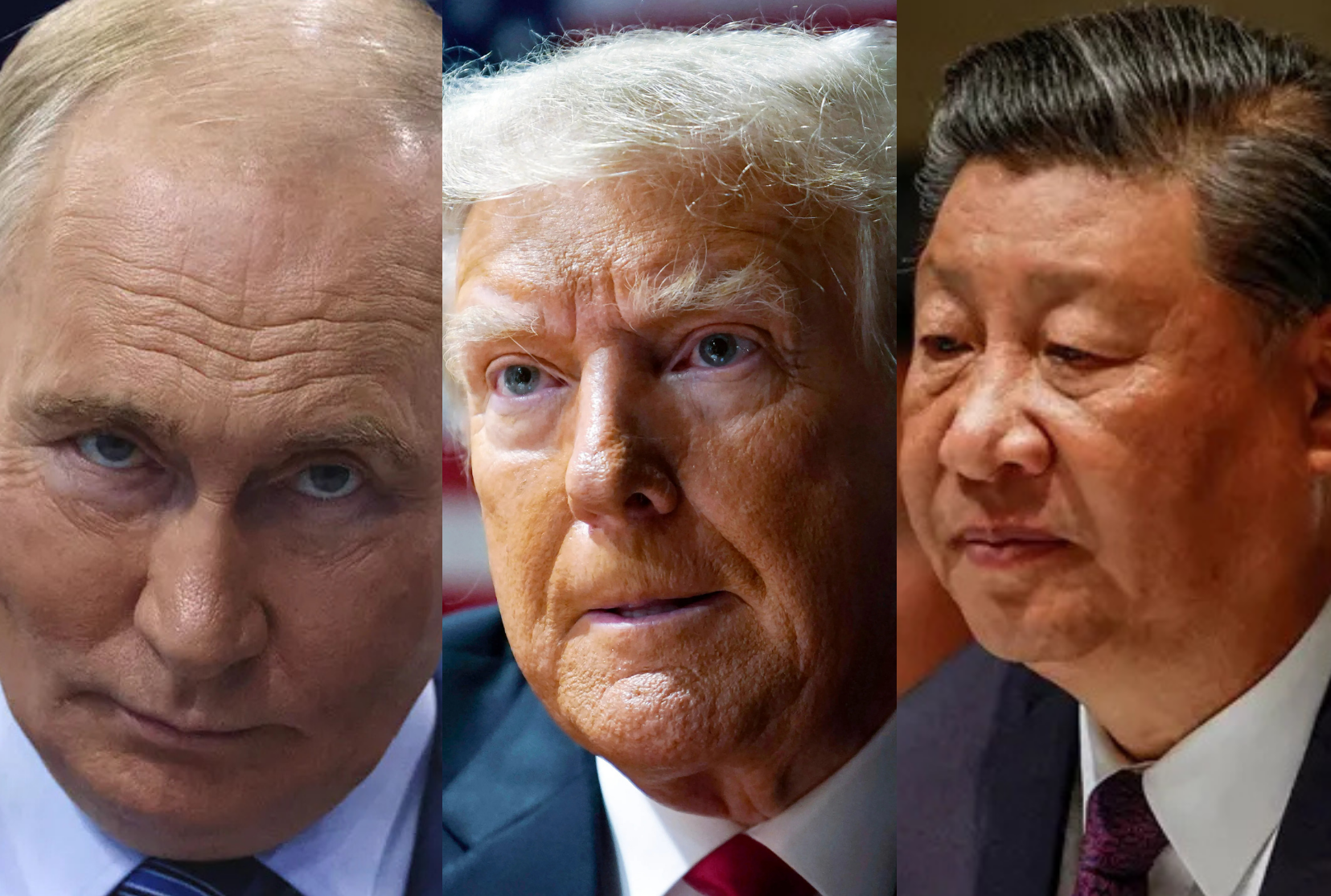
Vladimir Putin has proposed that he, Donald Trump and Xi Jinping meet next month to negotiate an end to the war in Ukraine on terms favourable to Russia, with no Ukrainian representative at the table, The Wall Street Journal reported on 18 October. Russian officials want the meeting held on the sidelines of the Asia-Pacific Economic Cooperation (APEC) leaders' summit in Shenzhen on 18 and 19 November. A senior US official told the Journal that Trump had not agreed to the summit but could be receptive to it. The White House has not confirmed that Trump will travel to Shenzhen. Volodymyr Zelensky would not take part.
Putin raised the idea during a telephone call with Trump on 9 October, according to a former Russian intelligence officer briefed on the discussion who spoke to the Journal. The same officer said Putin regarded the format as a modern counterpart to the 1945 Yalta conference, at which the wartime Allies divided Europe into spheres of influence, according to TRT World's account of the report. Yuri Ushakov, Putin's foreign policy aide, gave Russian state media his own account of the call the next day. He said Putin told Trump that Russia would "continue hostilities until it achieves all stated goals."
Kremlin spokesman Dmitry Peskov confirmed that contacts on a possible meeting were under way and said there was "no clear understanding yet regarding the meeting itself or its potential agenda," Reuters reported. The White House did not respond to a request for comment from Reuters, and the Chinese embassy in the United States did not reply.
How the Shenzhen proposal developed
Every public account of a Putin-Trump-Xi meeting has come from Russian officials. No US or Chinese official has publicly endorsed one.
Ushakov first raised the prospect on 1 September, speaking to Russian state television from Bishkek after Putin and Xi attended the Shanghai Cooperation Organisation summit. Asked whether the three leaders could meet at APEC, he said: "This issue was discussed, yes." He said Xi had told Putin that Trump would very likely attend.
Peskov said on 9 September that Putin and Trump had discussed a trilateral meeting in Shenzhen during a telephone call the previous day. Asked whether the subject came up, he answered "Undoubtedly," Agence France-Presse reported.
Xi made a state visit to the United States from 23 to 25 September. China's Foreign Ministry said he and Trump discussed Ukraine at the White House on 24 September but gave no details, and said the two leaders agreed to support each other in hosting the APEC and G20 summits. Secretary of State Marco Rubio said on 23 September that the United States had invited Putin to the G20 summit at Trump's Doral golf resort in Florida on 14 and 15 December.
Ushakov said on 29 September that if Trump attended APEC, Xi as host would "probably take some steps to possibly organize a trilateral meeting." On 6 October he told Sputnik that a three-way meeting had not been worked out in practice and depended on Trump confirming his attendance. Foreign Minister Sergei Lavrov later confirmed that Putin would travel to Shenzhen for talks with Xi, and Deputy Prime Minister Alexander Novak said the Power of Siberia 2 gas pipeline could be on the agenda there, the Eastern Herald reported.
Trump's side set up the 9 October call. Ushakov said Steve Witkoff, Trump's special envoy, told him on 7 October, Putin's birthday, that Trump wished to congratulate him. The call lasted about 90 minutes. Ushakov said both leaders were interested in attending APEC and that if both were there, "I assume they will find an opportunity to meet, shake hands and talk." His public account did not mention Xi.
Russian diplomats then put the trilateral proposal to Chinese officials, who indicated they would not object if Trump agreed to attend, the Journal reported. Putin had suggested a three-way meeting to both Trump and Xi before without success, according to the Journal. The South China Morning Post reported in September that Trump's attendance at APEC may depend partly on whether Xi agrees to attend the G20 meeting at Doral. Trump did not attend the APEC forum itself in South Korea last year and sent the treasury secretary instead, though he met Xi separately during that trip.
Ukraine's place in the negotiations
Zelensky said on 4 October that the United States had proposed technical-level talks between Ukraine, the United States and Russia before the end of the month, possibly in the United Arab Emirates. "Yesterday, I confirmed to them that our side is ready by the end of October," he said at a news conference in Kyiv with German Chancellor Friedrich Merz. No Russian answer has been reported. The last full round of three-way talks took place in Geneva on 26 February.
Zelensky said on 24 September that he had told Trump he would prefer a leaders' meeting of all three countries at the G20 summit, with an energy ceasefire among its first results. He said he doubted Putin would agree to it.
US envoys Witkoff and Jared Kushner met a Ukrainian delegation in Miami on 9 October, hours before the Trump-Putin call. National security advisers from the United Kingdom, France and Germany attended, with representatives of the European Commission and NATO, and the aim was a single peace proposal to put to Russia, Reuters reported. Witkoff and Kushner told the Ukrainian negotiators that Trump expected to lift sanctions on Russian diesel, Axios reported. The two envoys put a planned trip to Moscow on hold until Ukraine and the European governments agreed to that proposal, Axios reported on 12 October, and The New York Times reported on 13 October that the trip had been shelved indefinitely.
Putin will return to negotiations only if Ukraine gives up the rest of Donbas still under its control, a source close to the Russian presidential administration told Reuters on 12 October. The source said Witkoff and Kushner had relayed that demand to Ukrainian officials in Miami and described the diesel agreement as a practical route back to talks. US officials hoped the diesel deal and a halt to Ukrainian strikes on Russian energy sites would bring Russia back to the table, Reuters reported. Rubio told the Greek newspaper Kathimerini, in an interview published on 8 October, that Russia's demand for all of Donbas was the obstacle to a settlement. Ukraine has refused to surrender territory it holds.
No document published so far sets out what territorial, security, sanctions or military terms Russia would bring to a Shenzhen meeting. The Journal reported only that the terms Putin seeks would favour Russia. No record shows that the Ukrainian government or any European government was consulted about the Shenzhen proposal before the Journal's report. The Journal reported that the idea had alarmed US allies in Europe.
The diesel agreement
Trump wrote on Truth Social on 9 October that Russia would immediately supply more than 300,000 tonnes of diesel to US and world markets, 500,000 tonnes in November and 1 million tonnes after that, with a further 3 million tonnes possible depending on the state of Russian refineries. Novak gave a different schedule on 18 October: 500,000 tonnes in October, 1 million in November and 1 million in December. He said Russian exports could reach 3.5 million tonnes a month by the end of the year if refineries ran at full capacity, close to 10 per cent of the world market, TASS reported.
Novak said on 18 October that no contract had yet been signed and that fuel would reach US markets 15 to 20 days after signature. He said the US Department of Energy had identified the counterparties and buyers and that Russia's Energy Ministry and the department were working together. The department has not publicly confirmed any role and no buyer has been named. Kirill Dmitriev, Putin's investment envoy, had said on 14 October that the first contracts with US buyers would be signed within days.
The Treasury Department's Office of Foreign Assets Control (OFAC) issued General License 135 at Trump's direction on 9 October. It authorises transactions relating to the sale, delivery, offloading and importation of Russian-origin diesel, including into the United States, until 12:01 a.m. Eastern Daylight Time on 7 April 2027. It bars debits to accounts held at US banks by Russia's central bank, National Wealth Fund or Ministry of Finance. It names no producer, buyer, trader or vessel. Rosneft and Lukoil have been under US blocking sanctions since October 2025 and Gazprom Neft and Surgutneftegas since January 2025. The licence's wording on its face reaches transactions with such companies, but OFAC has not said whether it does.
The Ending Importation of Russian Oil Act of 2022 bans imports of Russian energy products, diesel included, and allows the ban to end only after the president certifies that Russia has agreed to withdraw its forces in a settlement accepted by Ukraine's government, consults four congressional committees at least 45 days in advance and waits 90 days. No such certification has been reported. General License 135 does not mention the statute. Treasury Secretary Scott Bessent told Fox News on 11 October that the administration was acting with all the legal authorities it had but did not name one. Lawyers and lawmakers dispute whether OFAC can license imports the statute bans, and no court has ruled.
Russia had banned producers' diesel exports from July after Ukrainian drone strikes cut refinery output. The Russian government lifted the ban for 500,000 tonnes on 10 October. A tanker carrying about 40,000 tonnes of diesel left the Baltic port of Primorsk for Morocco on 13 October, Reuters reported from ship-tracking data. No customs record or tracking report has confirmed a Russian diesel cargo bound for a US port. The Minerva Zen, which a Ukrainian outlet and an open-source channel described as carrying Russian diesel to the US east coast, left St Petersburg before the deal and was carrying liquid fertiliser, France 24 reported on 16 October.
Dmitriev said on 16 October that the US Treasury had asked the Russian Direct Investment Fund, which he runs, to help resolve payment problems in the diesel trade. OFAC has blocked the fund and Dmitriev since February 2022. The Treasury has not confirmed or denied the request. Dmitriev told the Russian Energy Week forum in Moscow the same day that Russia and the US were discussing further joint projects, including data centres powered by Russian nuclear plants, and cited the diesel deal as an example. He named no company or site.
Reuters valued the first 300,000 tonnes at about $400 million, a gross sale value paid to selling companies. Sergey Vakulenko of the Carnegie Endowment estimated gross sales of about $7 billion for roughly 5 million tonnes over six months, but wrote that most of the diesel would have been exported anyway and put Russia's real gain at $30 to $40 a tonne from better prices and wider access to buyers. Russian Finance Minister Anton Siluanov said on 13 October that diesel carries no export duty and that the budget gains only through tax on company profits. Alexander Kolyandr of Eurasia Group estimated the arrangement would add about $100 million to the federal budget, according to reports of his comments to the Financial Times. No published data shows realised revenue so far.
The Graham Act waiver
Trump signed the Lindsey O. Graham Sanctioning Russia and Iran Act on 18 September after the Senate passed it 86 to 11 and the House 262 to 159. Graham, the South Carolina Republican who championed the bill, died in July. The Act required Trump to sanction Russian officials, state banks, state companies and shadow fleet operators, to ban new US investment in Russia and to impose duties of up to 500 per cent on Russian goods and up to 100 per cent on goods from the largest buyers of Russian crude and gas. Its main measures were due to take effect on 18 October.
Trump signed an executive order on the evening of 16 October, two days before that deadline. Section 2 imposed the duties and section 4 waived every one of them, along with the mandatory sanctions in sections 102(a), 102(e) and 103 to 111 and the section 117 conditions for ending sanctions only after a peace agreement accepted by Ukraine. The waivers run until the president or the secretary of state decides further action is appropriate, with no end date. Trump told Congress the waivers served the national interest. The report explaining that judgement, which the Act requires to be unclassified, has not been published.
Sanctions already imposed by executive order since 2021 remain in force, and Rosneft, Lukoil, Sberbank and other designated entities stay blocked. What the order removed was the additional statutory layer Congress had added: designations of further officials and shadow fleet tankers, secondary exposure for foreign banks dealing with Russian state banks, and duties on countries buying Russian energy. Sanctioned shadow fleet tankers carried 57 per cent of Russia's seaborne oil in September, according to the Centre for Research on Energy and Clean Air (CREA). China bought €9.1 billion of Russian fossil fuels that month and India €4.1 billion. No published estimate yet quantifies how much revenue the waiver preserves for Russia.
Dmitriev called the waiver an important and historic moment. A letter from 12 senators, six of them Republicans including Mitch McConnell, Thom Tillis, Susan Collins and John Cornyn, told Trump on 13 October that the diesel deal "is a gift to our adversary and a betrayal of our Allies." Senator Ted Cruz said the waiver was a mistake. The House is in recess until 9 November.
Pressure on Ukraine
Trump told reporters on 10 October that Zelensky "better damn well stop" attacking Russian refineries, and said the same day that it was time for Ukraine to get a new president. A US official told Axios that Trump agreed the diesel deal after Zelensky ignored about six US requests to halt those strikes.
Trump announced an energy ceasefire between Russia and Ukraine on 11 October. Zelensky said the announcement was news to him. Russian forces struck Kharkiv's CHP-5 power plant within hours. Peskov said on 14 October that the ceasefire had never been specified and that Russia could not be accused of breaking it.
European officials told the Financial Times that US representatives warned the PURL scheme, under which European governments buy US weapons for Ukraine, could be suspended unless the refinery strikes stopped. A Ukrainian official told Axios that Witkoff and Kushner threatened in Miami to cut off intelligence if the strikes continued, and a US official denied any threat. Semafor reported on 14 October, citing an administration official, that cutting off intelligence had been discussed without a decision.
Zelensky said Russian ballistic missiles struck Kyiv on 12 October and the city's Darnytsia power plant on 13 October without the usual warning from partners. Air Force spokesman Yurii Ihnat said there was no warning before the first barrage on 13 October but that warnings arrived before three later ones. Trump told CBS News on 13 October that the United States had not stopped sharing intelligence. CBS sources said the warnings may have been withheld deliberately, while US officials blamed bad weather.
Starshield terminals used by Ukrainian forces were capped at about 160 kilometres an hour from the night of 13 to 14 October, according to Serhii Beskrestnov, Zelensky's adviser on defence technology. Starshield is the military satellite service the US Department of Defense buys for Ukraine. Interceptor drones lose their link above that speed, while the Russian jet-powered drones they chase fly at about 400 kilometres an hour. A strike commander told Politico that missions relying on satellite relay were halted. Ukraine's 7th Air Assault Corps cancelled missions in the Huliaipole sector.
Two US officials and a Western official told Reuters on 15 October that the order to restrict the service came from inside the White House. A senior US official told Reuters that Trump made no such request, and Trump said on 16 October that he had not ordered it. Elon Musk, whose company SpaceX provides the service, wrote that the US government owns Starshield and sets its limits. The Telegraph reported on 16 October, citing four sources, that Musk proposed the restriction to Trump. The Defense Department has not explained the cap. Ukraine's Defence Ministry said on 15 October that service had been restored in frontline sectors, but Zelensky said on 17 October that the limits remained and called the restriction "a planned operation." Nine senators from both parties have asked the Defense Department's inspector general to investigate.
Zelensky told the Financial Times on 14 October that Ukraine would resume strikes on Russian refineries and accused the United States of withdrawing intelligence and restricting Starlink. Ukrainian drones hit a refinery in Russia's Ryazan region on 15 October. Trump called the renewed strikes a disgrace in an interview with Newsmax that aired the same day. He waived the Graham Act sanctions the following evening.
Ukrainian drones struck St Petersburg, Putin's home city, on 18 October in the largest attack on the city since the full-scale invasion began in 2022, The New Arab reported. Governor Alexander Beglov said one person was killed and five were taken to hospital, with fires at the St Petersburg oil terminal, the Ruchyi oil depot and industrial warehouses. Trump wrote on Truth Social the same day that Zelensky "doesn't want to end this war, and probably never did," and accused him of targeting diesel refineries while knowing the strikes hurt world diesel markets, including in the United States. Zelensky spoke to Witkoff and Kushner that day and said Russia had broken the energy ceasefire 76 times.
What links the decisions
Witkoff and Kushner told Ukraine's negotiators before the 9 October call that Trump expected to lift diesel sanctions, which places the decision on the deal before Putin and Trump spoke. A US official told Axios that Trump agreed the deal because Zelensky had ignored requests to stop the refinery strikes. The Journal's source places Putin's summit proposal in the same call that produced the diesel announcement.
US officials told Reuters they hoped the diesel deal would soften Russia's position in talks. Putin told Trump in that call that Russia would fight on until it met all its stated goals, according to Ushakov, and the source close to the Russian presidential administration said the price of returning to talks was the rest of Donbas. Russia has made no documented concession on its invasion in exchange for the diesel licence, the Lukoil licence extension or the Graham Act waivers.
White House spokeswoman Taylor Rogers said on 16 October that Ukraine and Russia should stop striking refineries and that lowering prices for farmers, truckers and families was a top priority. Diesel prices have risen during the US war with Iran, and the midterm elections are on 3 November. The executive order waiving the Graham Act sanctions does not mention diesel, fuel prices, Ukraine or the peace talks.
No published document shows that the Graham Act waivers were negotiated with Russia, that Russia's diesel supply depended on Ukrainian restraint or that the Shenzhen proposal is tied to any US concession. Whether the Starshield cap and the missing missile warnings were decisions aimed at the refinery strikes is unestablished. Beskrestnov wrote that the timing of the cap could not be a coincidence but offered no evidence of a link, and none of the sources cited by Reuters or The Telegraph has made one.
China's position
Chinese officials have told Russian diplomats they would not object to a Shenzhen meeting if Trump agreed, according to the Journal, which falls short of supporting it. Xi is trying to keep backing Putin without damaging China's economic ties with Europe, people familiar with the discussions told the Journal. The Chinese government has made no public statement on the proposal.
China describes its position on the war as objective and impartial and has called for a political settlement. Xi congratulated Ukraine on its independence day in August in a message Zelensky published, the Chinese leader's first public congratulations since the 2022 invasion. Xi told Zelensky in April 2023 that mutual respect for sovereignty and territorial integrity was the political basis of relations between the two countries. Zelensky has rejected a role for China as a security guarantor.
China is the largest buyer of Russian fossil fuels and stood to face the Graham Act's duties on major importers until the waiver. Foreign Ministry spokesman Guo Jiakun said on 17 September that China opposes long-arm jurisdiction with no basis in international law. Hosting the meeting would let Xi present China as a broker between the United States and Russia, the Journal reported in its analysis of the proposal. No Chinese statement sets out what China's government wants from such a meeting.
Europe and Ukraine's sovereignty
European Union foreign policy chief Kaja Kallas said on 10 October that suspending sanctions on Russian diesel gives Russia more money for its war. The right course was to "pressure the aggressor to stop the war, not the victim to surrender," she said, the Associated Press reported. EU foreign ministers sanctioned nearly 1,600 people and entities linked to Russia's military industry on 12 October. EU and UK bans on imports of Russian refined products, in force since February 2023, remain in place.
Zelensky said in Brussels on 16 October that Ukraine could not accept the diesel agreements and predicted that gas deals and wider sanctions relief would follow. Ukrainian Foreign Minister Andrii Sybiha wrote on 9 October that weakening sanctions neither brings peace closer nor helps global markets.
Unanswered questions
The White House has not said whether Trump will attend APEC or whether he would accept a meeting on Ukraine without Ukraine. The section 115 report explaining the national interest behind the Graham Act waivers has not been released, and no member of Congress has made it public. The Department of Energy has not confirmed Novak's statement that it identified buyers for Russian diesel, and OFAC has not said whether General License 135 covers dealings with designated Russian oil companies or with Dmitriev's fund.
No official has named who in the White House ordered the Starshield restriction or why, and the Defense Department has not responded to the senators' request for an inspector general inquiry. The 119th Congress ends on 3 January 2027 and every pending bill on Russian energy expires with it. General License 135 remains valid until 7 April 2027.