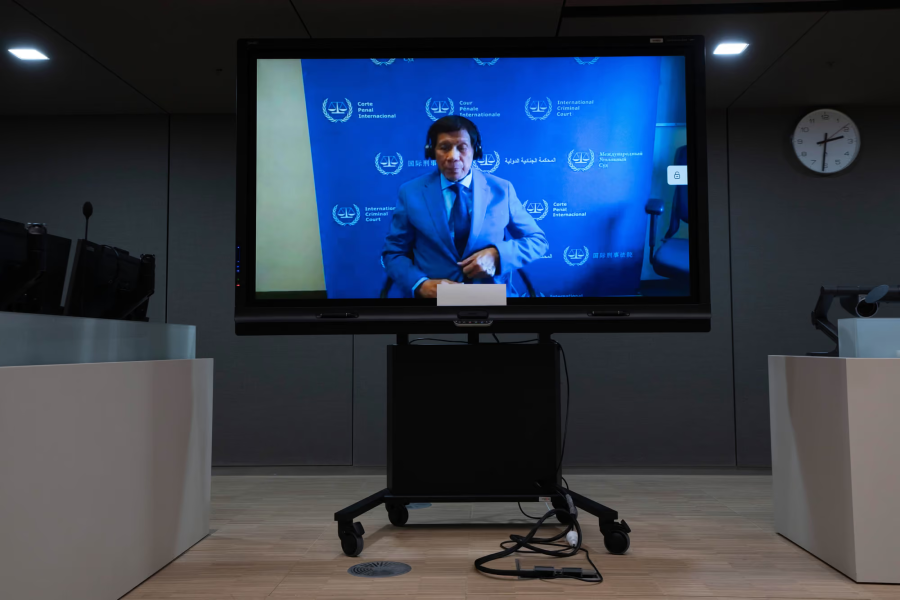
Rodrigo Duterte appeared at the International Criminal Court in The Hague in person on 16 September, for the first time since his arrest in March 2025. The hearing lasted an hour and 15 minutes. He did not speak. Joanna Korner, the presiding judge of Trial Chamber III, told him he could leave the courtroom without asking permission. His lawyers claim the 81-year-old former president of the Philippines allegedly has "significant memory impairment," believes the year is 2007 or 2008 and cannot recall the name of the president of the United States.
Julian Nicholls, a prosecution lawyer, told the court: "Decades of murdering his own people, murdering the children of the Philippines, and he claims that he did it all for his country."
Duterte's trial on three counts of murder as a crime against humanity is scheduled to open on 30 November. His defence has since asked the judges for more neurological testing, for a cap on the volume of evidence the prosecution may use, and for the exclusion of recorded testimony about a killing squad in Davao City. The chamber has ruled on none of the three.
Police and unidentified gunmen in the Philippines are still killing people in anti-drug operations 10 years after Duterte took office on 30 June 2016 and ordered the campaign. The Dahas Project, a monitoring group at the University of the Philippines, had counted 1,291 drug-related killings under Marcos by early July 2026. Human Rights Watch published an earlier figure of 1,273 on 30 June, in a report that found police and people working with them still commit extrajudicial killings and are not punished.
"Since Duterte opened his bloody 'drug war' a decade ago, Filipinos are still being killed despite President Marcos' promise to wage a more humane campaign against drugs," Lian Buan, South-east Asia researcher at Human Rights Watch, said. "Marcos should declare an end to the 'war on drugs' and order investigations into drug-related killings by police and others."
Arrests without warrants
Oplan TokHang, or Operation Knock and Plead, was the police campaign at the centre of Duterte's drug war. Officers of the Philippine National Police and men working with them entered homes in poor urban neighbourhoods at night, often without warrants, arrested suspects and shot them. A Human Rights Watch report published in March 2017 found that police often planted guns and drugs next to the bodies to support claims that the dead had resisted arrest.
"'TokHang' never left. It's just done in a different way now," a community monitor told Human Rights Watch.
Police under Duterte conducted raids in uniform and shouted at residents. Monitors interviewed by Human Rights Watch said officers now wear civilian clothes and act more quietly, which makes abuses harder to record. "They go into the alleyways, not often inside the homes," the same monitor said. "They are wearing civilian clothes, but it's obvious they are police. There is no shouting."
A community monitor said she had visited several people in jail who were arrested for alleged drug use and then charged with illegal street gambling. "It's like it's done in secret," a second monitor said.
The Philippine Human Rights Information Center, a civil society group known as PhilRights, published a study of the campaign in 2025. "While extrajudicial killings perpetrated under police operations have dipped, illegal arrests have increased," the study said.
Lawyers at Initiatives for Dialogue and Empowerment through Alternative Legal Services, a legal aid group known as IDEALS, described two arrests to Human Rights Watch, one in 2024 and one in 2026. In both cases police arrested the men without warrants and said they had caught them buying or selling crystal methamphetamine. One man said he was eating when officers took him. The other said he was asleep. In neither case did police give the group's lawyers footage from officers' body cameras.
"The police still have a tendency to skirt around the rules on arrests," Bian Villanueva, a lawyer with IDEALS, said.
Body cameras became compulsory through a Supreme Court resolution of 29 June 2021, which requires them when officers serve arrest and search warrants and keeps them recording until a detainee reaches a police station or jail. Arrests made without the cameras are unlawful under the rules and the evidence gathered is inadmissible. Anti-drug operations without a warrant fall outside the resolution, and a 2018 memorandum issued by Ronald dela Rosa as national police chief only encouraged camera use in such operations where equipment was available. Police had bought about 2,500 cameras for a force of 260,000 officers as of September 2022.
Families of the dead and missing
A masked gunman shot a man dead in his home in Caloocan, a city in Metro Manila, in 2023. His widow told Human Rights Watch that police had watched the family for years under the Duterte administration and that officers visited the house after her husband's death.
A police officer she recognised came to the house in 2025 in civilian clothes. "I asked, 'Why, sir? Nothing's going on here.' He said: 'How's your husband?' I said: 'He's dead, right?' He said: 'I know, I just want to know how you are,'" she told the group.
The widow said her children would have moved out of the house if they could. "My children are so scared, especially since they still live in that house," she said. "They're scared those men will come back."
A mother in Metro Manila told Human Rights Watch that police arrested her son without a warrant in March 2025. He came home after a few days in detention and said he had been "picked" for release. "He didn't see who arrested him because they covered his head," she said. "He said he received electric shock and was beaten up." She said her son told her police tortured him to make him name his "drug supplier." He disappeared a few days later and has not been found.
Relatives of people killed or detained since 2022 told Human Rights Watch they were afraid to file complaints and that police had not investigated the cases.
The children left behind
At least 101 children were killed in the campaign between the middle of 2016 and the end of 2018, some targeted and some shot as bystanders, according to a Human Rights Watch study of the effect on children published in May 2020. Researchers interviewed 49 people, among them 10 children, in six cities and provinces, and examined the families of 23 killings.
Children described watching their fathers die and then leaving school to work. "I was angry at the policemen because my father was begging for mercy, but they didn't listen to him," said a girl who was 12 when her father was killed. "I had to work harder when my father died. I became a father to my siblings," said the son of another man killed. A daughter said: "Our happy family is gone. We don't have anyone to call father now."
"The government needs to stop this endless violence that is upending children's lives," Carlos Conde, the researcher who wrote the study, said.
Three of the 269 people killed in 2025 were minors, according to the Dahas count. Human Rights Watch has asked the government to provide consistent support to the families of those killed, and to the children in particular.
Death tolls
Government figures show 6,252 people killed by the Philippine National Police and the Philippine Drug Enforcement Agency in anti-drug operations between 1 July 2016 and 31 May 2022. The United Nations human rights office put the number at 8,663 or more in a report published in June 2020. Philippine rights groups and the Commission on Human Rights, a constitutional body, have said the actual figure may be three times higher. Some groups put it at 30,000. The official figures leave out people killed by unidentified gunmen, whom rights monitors have linked to local police and officials.
The Marcos government stopped publishing its own figures after he took office. The Dahas Project, based at the university's Third World Studies Center, compiles killings from news reports and police statements.
Dahas counted 342 killings in Marcos's first year in office, 305 in his second, 269 in his third and 269 in his fourth. State agents were responsible for 160 of the first-year killings, or 46.8 per cent, and for 462 of the 1,291 recorded across the four years and the first weeks of the fifth, about 36 per cent of the total. Police account for most of the state killings. Unidentified and other non-state attackers account for the rest, 191 of them in the third year alone.
Of the 269 killings in 2025, police and drug enforcement agents killed 81, or 30.1 per cent. Unidentified attackers killed 90, or 33.5 per cent, and other non-state attackers killed 71. Seven state agents and 10 police informants were also killed.
"The 'bloodless' drug war continues, and more so, and as before, spills over to innocent civilians," Arrianne Louisse Fajardo and Joel F. Ariate Jr, the Dahas researchers, wrote.
Ariate rejected a claim by Duterte's former defence counsel that killings under Marcos are "sky-high" and that victims' representatives ignore them. "It is clear that if he truly used our report truthfully, it actually shows a continued decrease in the numbers," he said. More than 500 people were killed in Duterte's final year in office, against more than 300 a year under Marcos. "During the Duterte administration, it was truly widespread," Ariate said. "The Marcos administration wants to proceed with its drug war via propaganda."
Claire Castro, the palace press officer, said the president "does not want a violent fight against illegal drugs," that due process is observed and that the Philippines has no death penalty.
Police reported 14,550 anti-drug operations and 16,784 arrests in the first three months of 2026, with seizures the force valued at more than 11 billion pesos, including 619,820 grams of crystal methamphetamine. "The result of our campaign is clear proof that our fight against illegal drugs is continuous and effective," Gen. Jose Melencio Nartatez Jr, the national police chief, said on 1 April. Police figures for that period gave no death toll.
Marcos described the campaign as bloodless in his State of the Nation Address on 22 July 2024. "Our bloodless war on dangerous drugs adheres and will continue to adhere, to the established '8 Es' of an effective anti-illegal drugs strategy," he said. After his election in 2022 he told foreign diplomats he would address drugs through rehabilitation and socioeconomic development. In 2025, according to Human Rights Watch, he announced a return to local anti-drug operations.
Command Memorandum Circular 16-2016, the national police order that started the nationwide campaign in July 2016 and told officers to "neutralize" suspected criminals, has not been withdrawn. Marcos has not rejected the drug war as government policy.
What Duterte has said about the killings
Duterte told the Senate Blue Ribbon Committee on 28 October 2024 that he kept a squad of killers as mayor of Davao City. "I have a death squad, seven men, but they're not police. They're gangsters," he said. Minutes later he told the same hearing it had not been a death squad, and said residents of Davao knew where to find him if someone committed a serious crime. Koko Pimentel, the minority leader, presided.
A House of Representatives panel examining the killings, known as the quad committee, questioned Duterte on 13 November 2024 about payments to police. "Reward? Correct. Very correct," he told the committee, and said he sometimes gave money of his own. "You have to spend money for operations, intelligence," he said, and declined to identify the source of the funds. Royina Garma, a former police officer who later headed the Philippine Charity Sweepstakes Office, told the same inquiry that cash rewards for drug-related killings ranged from 20,000 pesos to 1 million pesos depending on the target.
The Davao witnesses
Edgar Matobato told a Senate inquiry in 2016 that Duterte formed a group in Davao City, known first as the Lambada Boys and later as the Davao Death Squad, and instructed its members to kill criminals and crime suspects. Matobato said he served in a militia unit between 1982 and 1988, joined the group and killed at least 50 people before he left it in 2013. He left the Philippines with his wife and two stepchildren in 2024 and is under the court's protection at an undisclosed location.
Arturo Lascañas, a police officer in the Davao City force's anti-crime unit, denied Matobato's account in 2016 and then reversed himself. Lascañas said he had killed about 200 people over 20 years and received a monthly allowance of 100,000 pesos. "I was forced to deny what Matobato said even if most of it was true, because I was afraid," he said. He gave evidence to court investigators in 2022.
Prosecutors asked the trial chamber on 8 September to admit the prior recorded testimony of a witness identified as P-1100 under rule 68(3) of the court's rules, which allows earlier statements to stand in place of live evidence in some circumstances. The eight-page application said the testimony "goes to proof of a policy to 'neutralize' through violent crimes, including murder, alleged criminals in the Philippines" and covers the squad's methods and Duterte's own knowledge and intent. Admitting it would cut the witness's direct examination from seven hours to two, said Mame Mandiaye Niang, the acting prosecutor, "thus saving at least five hours of court time."
Peter Haynes, Duterte's lead counsel, asked the judges on 22 September to refuse. The witness's knowledge predates the period covered by the charges, which begins on 1 November 2011, and he lacks direct knowledge of how police understood the instruction to neutralise suspects, the defence said. "P-1100 had no personal knowledge of this modus operandi, or the structure, operations, hierarchy, or command" of any such group, the filing said, and his account of earlier events "cannot establish how those circumstances subsequently developed or support conclusions about conduct beyond his own observation." The defence also challenged four documents the prosecution attached.
Convictions and acquittals
Kian delos Santos, 17, was shot dead by police in Caloocan on 16 August 2017. Officers said he had fired at them. Closed-circuit television footage showed officers dragging him into an alley, where he was shot while kneeling. A court convicted three officers, Arnel Oares, Jeremias Pereda and Jerwin Cruz, of murder on 29 November 2018 and sentenced them to up to 40 years in prison without parole, the first convictions of police in the campaign.
Dante Lubos, a police colonel, was convicted of homicide by a regional trial court in Baguio City in August 2025 for killing Ryan Dave Almora during a buy-bust operation in July 2016. The court rejected his claim of self-defence and found that Almora was shot three times "in a defenseless position, possibly kneeling or lying down." Lubos was sentenced to up to 14 years, eight months and one day in prison, and ordered to pay about 1.45 million pesos in damages.
Lubos's case was the fifth drug-war killing in the Philippines to end in a conviction. Nine police officers have been convicted since 2016, according to Amnesty International and Human Rights Watch. No senior official has been charged in a Philippine court.
Rolando Espinosa, the mayor of Albuera in Leyte province, was shot dead inside Baybay sub-provincial jail in November 2016 by police who said they were serving a search warrant. Investigators at the National Bureau of Investigation found the killing was murder and that Espinosa was defenceless. Senate committees chaired by Panfilo Lacson and Richard Gordon concluded he was killed to conceal the involvement of police officers in the drug trade. Prosecutors at the justice department reduced the charge from murder to homicide, finding nothing on the record to show premeditation. A Quezon City court acquitted 19 officers, led by Col. Marvin Marcos, on 6 October 2021, after none of the prosecution's six witnesses identified any of them as taking part.
The Philippine government asked the ICC in November 2021 to suspend its investigation, saying national authorities were already examining the killings. Judges reviewed the administrative and criminal cases the justice department cited, along with the national police force's internal disciplinary proceedings, and ruled in January 2023 that the government had not shown it was investigating and prosecuting the deaths. An appeals panel upheld the ruling in July 2023.
The ICC case
Philippine police arrested Duterte in Manila on 11 March 2025 on an ICC warrant sent through Interpol and put him on a flight to the Netherlands that night. The court has jurisdiction over crimes committed from 1 November 2011, when the Philippines joined the Rome Statute, until 16 March 2019, the day before Duterte's withdrawal from the treaty took effect. Duterte notified the United Nations of the withdrawal in March 2018, weeks after the prosecutor's office announced a preliminary examination.
Prosecutors presented their evidence at a confirmation hearing from 23 to 27 February 2026. The charges cover 49 incidents of murder and attempted murder with 78 victims, including children: nine incidents and 19 killings in Davao City between 2013 and 2016, five incidents and 14 killings of people labelled high-value targets in 2016 and 2017, and 35 incidents with 45 killings and attempted killings during neighbourhood clearance operations in 2016 and 2018. Prosecutors said the list was a sample. They allege Duterte is responsible as an indirect co-perpetrator, for ordering and inducing the killings, and for aiding and abetting them.
"Truth is the antidote to the virus of impunity," Joel Butuyan, a Filipino lawyer representing victims, told the court.
Duterte chose not to attend the February hearing. In a written statement he rejected the court's jurisdiction and said he had been "kidnapped." Prosecutors played recordings of him urging police to kill drug suspects, including a 2016 speech in which he said: "If I become the president, I will order the military and the police to hunt down the drug lords, the big ones, and kill them." His lawyer at the time said prosecutors had quoted the speeches selectively and left out passages in which Duterte spoke of using force only in self-defence.
The ICC appeals chamber rejected Duterte's challenge to the court's jurisdiction on 22 April 2026, upholding a pre-trial ruling that the court keeps jurisdiction over crimes committed while the Philippines was a member. On 23 April the three judges of Pre-Trial Chamber I, Iulia Antoanella Motoc, Reine Alapini-Gansou and María del Socorro Flores Liera, unanimously found substantial grounds to believe Duterte committed the crimes against humanity of murder and attempted murder and sent the case to trial. Judges had declined in 2025 to add torture and rape to the arrest warrant, finding the prosecution had not linked those acts closely enough to a wider attack on civilians.
Korner set the trial date at a status conference on 27 May, with Keebong Paek and Nicolas Guillou completing Trial Chamber III.
The fitness dispute
Peter Haynes, a British barrister, replaced Nicholas Kaufman as Duterte's lead lawyer in May. Pre-trial judges postponed the confirmation hearing in September 2025 after the defence said Duterte had "cognitive impairment in multiple domains." In January 2026, after an assessment by three independent medical experts, the judges ruled he was fit to take part, and rejected his appeal against that ruling. The trial chamber ordered a fresh assessment before November by a panel with expertise in forensic psychiatry, geriatric medicine, behavioural neurology and neuropsychology.
The panel reported that Duterte has memory impairment, difficulty recalling recent events and problems with orientation, including a belief that the year is 2007 or 2008, an incorrect account of his own age and an inability to identify some family members. Haynes filed a request on 18 September for a neurologist to complete the remaining examinations, particularly those that do not depend on the patient's cooperation. The defence "struggles to understand" how the panel reached its conclusions, he said, and the filing said the panel "has left unresolved the fundamental question of whether Mr. Duterte's acknowledged memory and executive-function impairments stem from a neurological condition." Prosecutors opposed further testing, said the experts had done what the chamber asked of them, and said the same panel should handle any additional examinations.
Korner said in May that the trial chamber would decide the question for itself. "The finding of fitness is related to the confirmation proceedings, and the chamber is obliged to make a separate finding," she said.
The evidence fight
Prosecutors filed their witness and evidence lists by the chamber's deadline of 31 August. The lists name about 70 witnesses: 31 insiders, 17 who speak to individual killings and 12 who give context. Between 25 and 30 are expected to give evidence in person, the rest through recorded testimony under rule 68, and the prosecution estimates 175 to 200 hours of direct examination. Korner instructed both sides that the evidence "must take place in the shortest and clearest way" and to avoid "unnecessary and lengthy legal arguments."
Prosecutors have disclosed 62,130 items of evidence to the defence, about 320,000 pages of documents and more than 1,000 audio and video files. About 5,275 items were disclosed during the confirmation phase, and roughly 35,000 arrived after the 31 August deadline. The prosecution's current list of evidence names 19,238 items.
Haynes asked the chamber on 25 September to cap that list at 10,000 items, and said reviewing the documents once would take 16,000 person-hours. "The Defence has no ability to read this volume of evidence prior to trial," he wrote. At the September hearing he told the judges the file was "quite enormous" and that the defence had not "got a prayer of reading" it before trial. He proposed that a new case record be compiled by 7 October. His pre-trial brief is due on 30 October.
Korner told prosecutors at the hearing to file a short list limited to the evidence that matters, and questioned their estimate of 193 hours of direct examination, suggesting fewer witnesses where expert testimony overlaps. A written decision on disclosure and the size of the witness list is expected in October or November. Witnesses in Manila, six hours ahead of The Hague, may give evidence remotely and outside normal hearing hours.
The victims in the case
Pre-trial judges allowed 539 victims to take part in the confirmation proceedings through three court-appointed legal representatives. Victims who cannot pay for lawyers may receive court funding, and the judges must weigh their participation against Duterte's right to a fair trial.
Randy Delos Santos, the uncle of Kian delos Santos, attended the September hearing. "Of course, we are very happy that he is now able to attend in person," he said. "We hope that his being physically fit will help speed up the hearings." Duterte's fitness, he said, "could be the start of a process that will finally bring us justice."
Flavie Villanueva, a Catholic priest who works with families of people killed in the campaign, watched the same hearing. "I saw evil resurfaced again," he said.
Court staff have increased their contact with Philippine civil society groups since the arrest, with monthly sessions on subjects such as victim participation, and have translated court documents and announcements into Filipino and Cebuano. Hearings are streamed with a 30-minute delay, and transcripts are published.
Duterte's standing at home
Duterte won the mayoralty of Davao City from his cell in The Hague at the election of 12 May 2025, with more than 660,000 votes, about eight times the total of his nearest rival. His son Sebastian was elected vice mayor and later sworn in as mayor of the city. Another son, Paolo, was re-elected to the House of Representatives, two grandsons won local races and several candidates the family backed won Senate seats. "Duterte landslide in Davao," his daughter Veronica wrote on Facebook.
Marcos said after the same election that "our democracy has renewed itself, peacefully, orderly and with dignity," and that his own coalition's work continued.
Marcos, the court and Washington
Marcos has said it is not time for the Philippines to rejoin the Rome Statute. Castro said on 23 September that his position had not changed, two days after Donald Trump told the United Nations General Assembly that member states should leave the court, which he called out of control and rogue, and said he would not allow US soldiers before what he called an anti-American tribunal. Philippine officials said the American position has no bearing on the Duterte case.
The US government has put judges and prosecutors involved in that case under sanctions. Executive Order 14203, signed on 6 February 2025, declared a national emergency over the court and allows the Treasury Department to block designated people's property and bar services to them. Alapini-Gansou, one of the three judges who sent Duterte to trial, was designated on 5 June 2025. Guillou, one of the three trial judges, and Niang, the acting prosecutor who signed the application on the Davao testimony, were both designated on 20 August 2025. Nine of the court's 18 judges, both deputy prosecutors and the former chief prosecutor are now on the list. Reporters at two news organisations wrote on 20 September 2026 that the administration has prepared sanctions against the court as an institution, which would bar US citizens and companies from supplying it with funds, goods or services without a Treasury licence.
Human Rights Watch has asked Marcos to formally end the campaign, order investigations of police and other officials implicated in unlawful killings, support the families of those killed, and begin the process of rejoining the court.
Dela Rosa
Ronald dela Rosa, the national police chief who signed Command Memorandum Circular 16-2016 and later won a Senate seat, is wanted by the ICC on a charge of murder as a crime against humanity. Pre-Trial Chamber I issued the warrant under seal on 6 November 2025 and made it public on 11 May 2026. The warrant accuses him, as an indirect co-perpetrator with Duterte, of responsibility for the killing of at least 32 people between 3 July 2016 and the end of April 2018. The court identified him in February 2026 as an alleged co-perpetrator in the Duterte case.
Dela Rosa went back to the Senate chamber in Manila after the warrant was made public, and senators placed him in the chamber's protective custody. The sergeant-at-arms, Mao Aplasca, ordered a total lockdown of the building at 7.08pm on 13 May. Shots were fired inside at 7.51pm. Nartatez said at least 30 shots were fired, most of them by Senate security. Castro said Aplasca fired first after asking an armed man to identify himself. Nobody was hurt. Melvin Matibag, director of the National Bureau of Investigation, said his agents were outside the building under orders not to arrest the senator. Dela Rosa left the Senate grounds at about 2.30am on 14 May and has not been arrested. The Supreme Court refused his request for an order blocking his arrest.
"Dela Rosa's current position as Senator should not shield him from facing charges at the ICC," Ritz Lee Santos III, executive director of Amnesty International Philippines, said in May.
The justice department applied for an Interpol red notice against Dela Rosa and placed him under an immigration lookout bulletin order. "There is an application for an Interpol red notice," Polo Martinez, a department spokesman, said on 22 May. Castro said the same week that the ICC warrant was already enforceable in the Philippines.
Jonvic Remulla, the interior secretary, said in September that the authorities knew where Dela Rosa was hiding and that "very powerful people" were protecting him. "The negotiations are ongoing and we will smoke him out sooner or later," he said on 12 September. Asked about an earlier reference to body bags, he said: "Body bags means if we go on full operations, a lot of people will die. That's what it means." "Our efforts are ongoing and relentless," Col. Allen Rae Co, a police spokesman, said on 10 September. "We will not deviate and will not be disrupted from doing our duty."
"The Marcos government's claim of a bloodless anti-drug campaign rings hollow," Buan of Human Rights Watch said in June. "President Marcos should ensure respect for the rights of all Filipinos, arrest and surrender Dela Rosa to the ICC, and end this vicious 'drug war' once and for all."
Dela Rosa has 117 firearms registered in his name. Police said on 10 September that 26 had been handed in, 20 in Davao City and six in the Calabarzon region, and that 91 were still missing.