Prime Minister Nikol Pashinyan's Civil Contract party won Armenia's parliamentary election on 7 June, taking 49.81 per cent of the vote with 727,160 ballots once all 2,005 polling stations were counted, a governing majority that hardens the country's turn toward the European Union and away from Moscow.
The pro-Russia Strong Armenia alliance, led by Russian-Armenian billionaire Samvel Karapetyan, finished second. Karapetyan's bloc took 23.29 per cent, former President Robert Kocharyan's Armenia bloc 9.94 per cent and businessman Gagik Tsarukyan's Prosperous Armenia 4 per cent. Four political forces cleared the threshold for seats. Turnout reached 58.97 per cent, close to 10 points above the 2021 snap election.
Pashinyan declared victory in Yerevan early on 8 June and called the outcome a mandate for peace with Armenia's neighbours.
The vote was a test of Russia's influence in the South Caucasus.
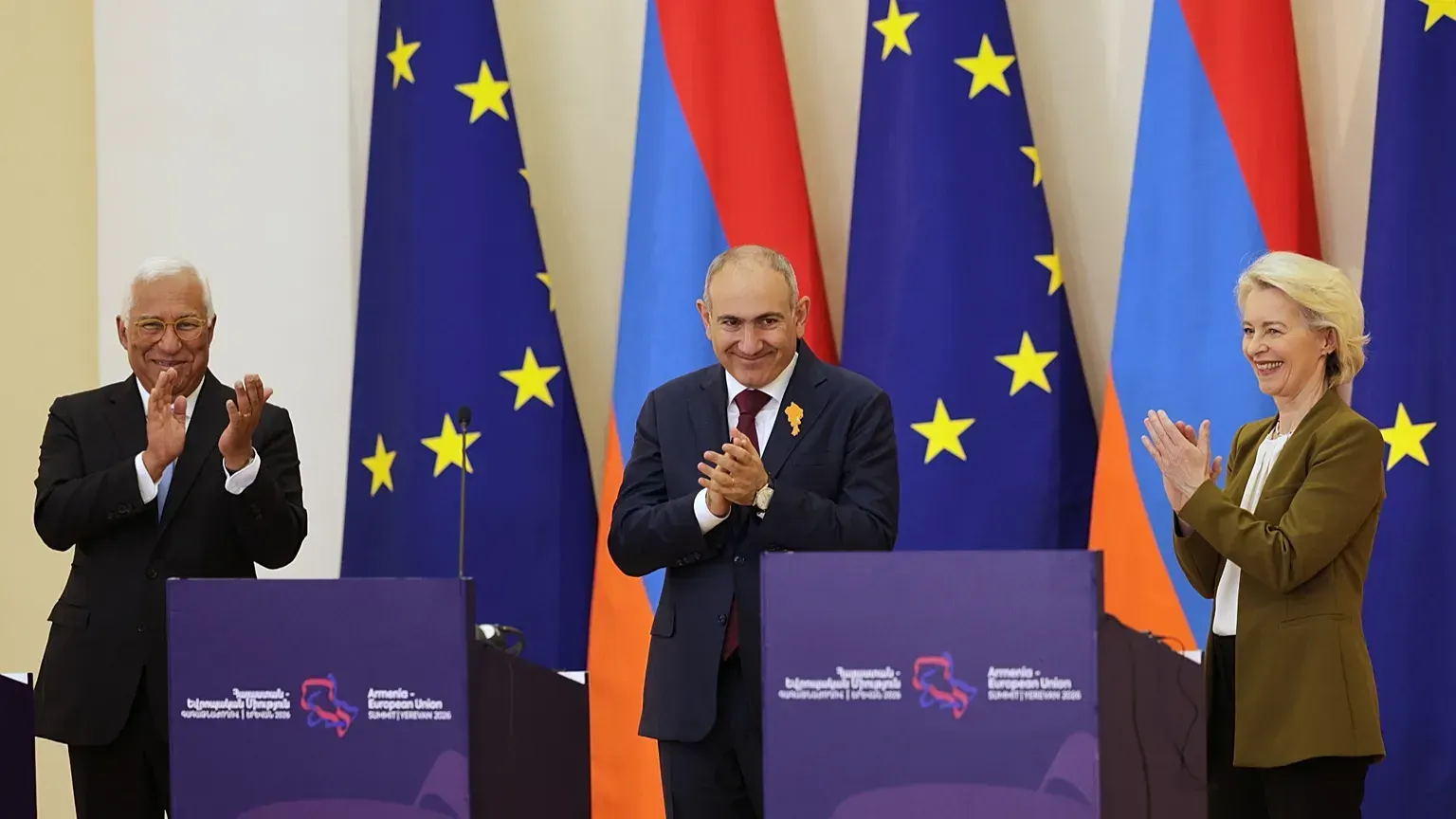
European Commission President Ursula von der Leyen congratulated Pashinyan and said "Armenia can count on us," adding that the spirit of the 2018 Velvet Revolution was alive and well.
European Council President António Costa congratulated him and pointed to a larger EU role in the region. French President Emmanuel Macron welcomed what he called a landslide, and EU Enlargement Commissioner Marta Kos said she would visit Armenia soon.
Latvia's President Edgars Rinkēvičs said "Armenia has chosen its own democratic path despite threats and intimidation."
Ukraine's President Volodymyr Zelensky said Kyiv was ready to widen cooperation and urged the EU to give Armenia real support.
Russian intimidation failed
The result followed weeks of open Russian pressure that ran across rhetoric, diplomacy, trade and online disinformation.
At a press conference in early May Putin urged Pashinyan to hold a referendum choosing between the EU and the Eurasian Economic Union, and invoked the "Ukrainian scenario," repeating the Kremlin's claim that the war in Ukraine began with Kyiv's bid to join the EU. He framed any separation from the EAEU as a "soft, intelligent and mutually beneficial divorce," language Pashinyan rejected, saying interstate relations were not a marriage. Putin returned to the theme after the EAEU summit in Astana on 29 May, warning that if Armenia adopted EU standards Moscow would wind down economic integration and Armenian citizens would need permits to work in Russia. Pashinyan skipped that summit, sending Deputy Prime Minister Mher Grigoryan, and had already stayed away from Russia's Victory Day parade on 9 May.
On 30 May Russia recalled its ambassador, Sergei Kopyrkin, for consultations, citing Armenian moves toward the EU that it said damaged cooperation within the Eurasian Economic Union. The day before, the leaders of Russia, Belarus, Kazakhstan and Kyrgyzstan had issued a joint statement at Astana demanding that Yerevan hold a referendum "as soon as possible" on remaining in the EAEU or joining the EU, citing risks to the bloc's economic security, and agreed that member states would report on the consequences of suspending Armenia's membership at the next EAEU meeting in December 2026.
The trade measures widened almost daily. Russia's agricultural watchdog, Rosselkhoznadzor, banned imports of Armenian tomatoes, cucumbers, peppers, fresh herbs and strawberries from 30 May, citing phytosanitary concerns and claiming it had recorded 181 cases of contaminated Armenian produce this year, a justification read widely as political. It extended the restrictions from 2 June to cherries, apricots, plums, peaches, nectarines and grapes, and from 3 June to apples, pears, eggplants, potatoes and some dried fruits, and asked Armenia to suspend export certification for all but two Armenian fish processors. Those moves followed earlier curbs on Armenian flowers, Jermuk mineral water and some Armenian alcoholic products. Russia is by far the largest market for Armenian fresh produce. Russia's energy minister, Sergei Tsivilev, warned that Yerevan could lose favourable terms on gas, petroleum products and uncut diamonds under a 2013 agreement. Pashinyan shrugged off the energy threat, arguing that EU membership would eventually bring in more than Armenia would lose.
The Kremlin set up an agency in October 2025, the Directorate for Strategic Cooperation and Partnership, to run influence operations in Armenia, and had discussed transporting about 100,000 Armenian passport holders living in Russia back to vote for the opposition, at an estimated cost of around $50 million. By mid-May, Reuters said, the Kremlin had issued regional quotas and asked local administrators to report on preparations. Armenian law bars citizens abroad from voting, so any returnees would have had to cast ballots in person. Reuters said it could not confirm the plan was carried out, or whether it would have closed the wide polling gap between the two frontrunners, and some of its sources described continuing concerns about Pashinyan's safety without giving detail.
The interference ran online as well, and it began unusually early. Researchers at NewsGuard, the Institute for Strategic Dialogue and the Atlantic Council's DFRLab traced waves of Kremlin-linked disinformation to Storm-1516, an information-warfare group also tracked as Operation Overload or Matryoshka and active in earlier campaigns against the US, Germany, France and Moldova. The operation used AI-generated video, false reports dressed up as Western broadcasts, including a fabricated Euronews segment, and stories laundered through invented regional outlets and fake websites. One early wave in 2025 pushed a fabricated video of a minor accusing Pashinyan of abuse; another alleged a corrupt land deal linking him to US senators Jeanne Shaheen and Thom Tillis. By early May analysts counted 343 fake videos and described the effort as among the most extensive in recent years, second only to the campaign around Moldova's 2025 election. The independent monitoring project Bot Blocker, also tracked as Antibot4Navalny and cited through the Russian outlet Agentstvo, reported that Russia had built a dedicated bot network on X solely for the Armenian vote, only the second time since its tracking began in 2023 that Moscow had constructed a bespoke ring for a single foreign event.
Armenia has already frozen its participation in the Russian-led Collective Security Treaty Organization. Pashinyan stopped short of declaring a clean break. He called the tension with Russia "artificial" and said he would travel to Moscow, DC, and Brussels after the vote.
Richard Giragosian, director of the Regional Studies Centre in Yerevan, told Euronews "this isn't about the EU versus Russia," predicting a continuation of cautious policy.
A decade of upheaval behind the ballot
This was Armenia's first regularly scheduled parliamentary election since 2017, after snap votes in 2018 and 2021 triggered by political crises. It was also the first since Azerbaijan's late-2023 offensive drove out almost all of Nagorno-Karabakh's roughly 100,000 ethnic Armenians and ended the breakaway Republic of Artsakh. Pashinyan has staked his record on peace with Azerbaijan; the two sides initialled a draft agreement at a meeting brokered by US President Donald Trump in August 2025.
Brussels moved quickly to back him. Armenia's parliament passed a law beginning EU accession in March 2025, the first EU-Armenia summit was held in Yerevan on 5 May 2026, and the EU committed a €270 million resilience plan, doubled a tranche under the European Peace Facility to €20 million, extended its unarmed monitoring mission on the Azerbaijani border to 2027, and sent a Hybrid Rapid Response Team before the vote to counter foreign interference. On 30 April the European Parliament passed a resolution on democratic resilience in Armenia. Pashinyan said von der Leyen had also promised €50 million to offset Russia's trade measures and duty-free access for Armenian farm goods, a claim that rests on his account alone and awaits EU confirmation.
The US pulled in the same direction. Trump endorsed Pashinyan on 27 May, and US Secretary of State Marco Rubio stopped in Yerevan days before the vote to sign accords lifting ties to a comprehensive strategic partnership, covering critical minerals and a regional transit corridor.
Armenia's independent observer mission logged 536 violations at 387 polling stations by mid-afternoon, and the prosecutor general's office said it had opened 174 criminal investigations since February. The interior ministry detained 18 people on election day. On preliminary figures the result gives Civil Contract about 61 of the National Assembly's 105 seats, enough to govern alone but short of the majority needed to change the constitution without a referendum.