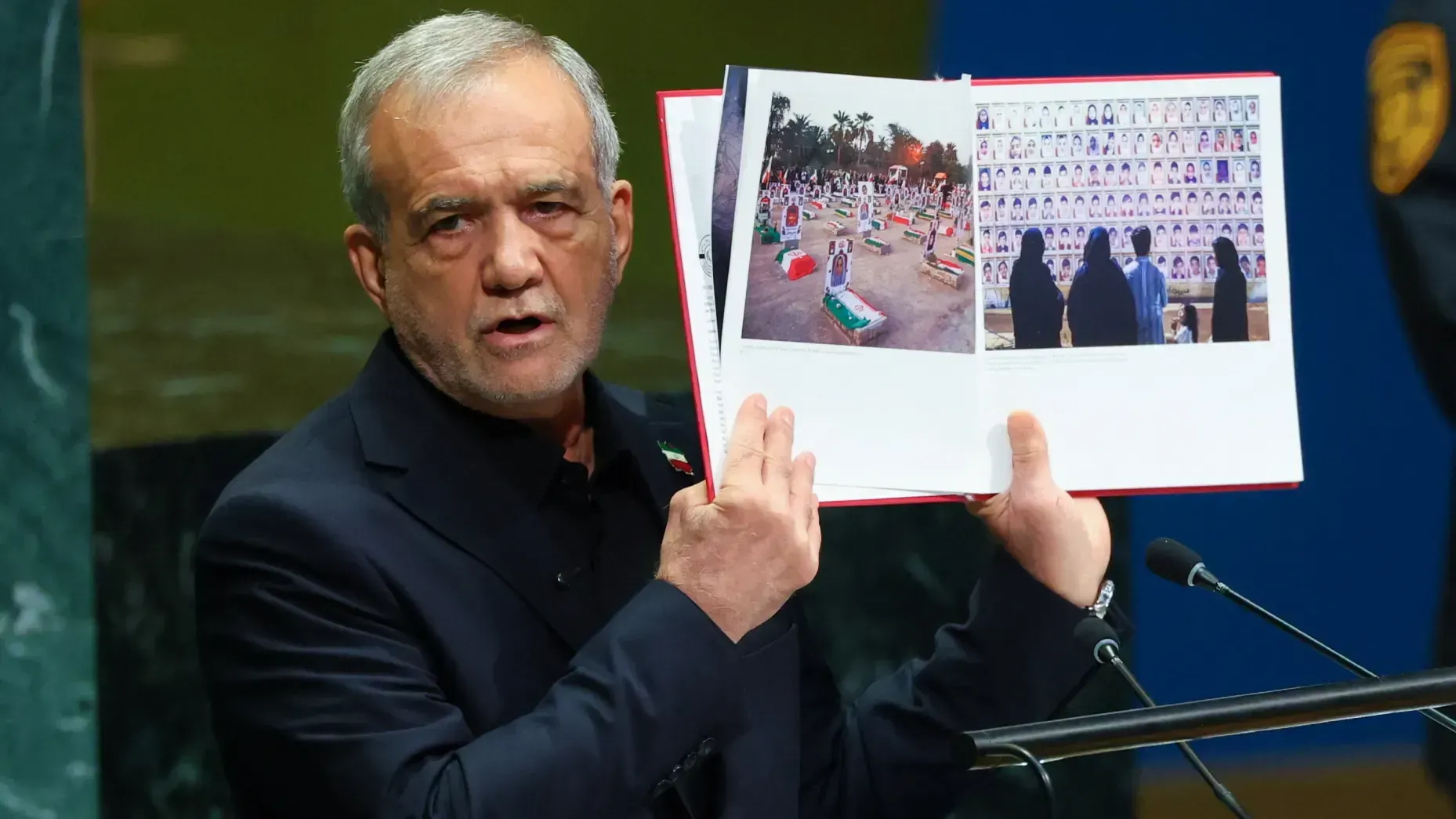
Iranian President Masoud Pezeshkian told the UN General Assembly on 23 September that Iran would negotiate an end to the war but not under threat, a day after Donald Trump threatened to annihilate Iran.
Pezeshkian held up photographs of more than 150 schoolchildren Iran says were killed in the war's opening days, and a portrait of the late Supreme Leader Ali Khamenei. Iranian outlet Tabnak identified the photographs as those of children killed at a primary school in Minab on 28 February, a strike that a preliminary U.S. military assessment found U.S. forces had likely carried out, Human Rights Watch said.
On 22 September, Trump's envoys Steve Witkoff and Jared Kushner spent three hours passing messages to a delegation led by Foreign Minister Abbas Araghchi through Qatari mediators. It was the first contact between the two governments since a June ceasefire collapsed, and Trump said a second round is scheduled.
Pezeshkian at the General Assembly
"Yes they did hit us, but we did not bend the knee," Pezeshkian said, according to the Associated Press. He said Iran was ready for dialogue and negotiation but would not accept the language of force, and told delegates Iran had never been an aggressor and had never started a war, France Info reported.
Before leaving for New York, Pezeshkian told Iranian media he would speak at the UN about the children killed in Minab and in Lamerd, a town in Fars province, Khabar Online reported. The hardline daily Kayhan had urged him to turn the General Assembly into a courtroom for U.S. crimes, The National reported, and a senior presidential aide relayed calls from within the establishment to cancel the trip.
The Minab school strike
A missile struck the Shajareh Tayyebeh girls' primary school in Minab, Hormozgan province, on 28 February, the first day of U.S. and Israeli strikes on Iran. About 175 people were killed, at least 108 of them children, Time reported. Human Rights Watch put the toll at no fewer than 175, many of them aged seven to 12.
Bellingcat geolocated video showing a U.S.-made Tomahawk cruise missile hitting a clinic beside the school, and missile fragments examined by The New York Times and CNN were consistent with a Tomahawk, Time reported. The Pentagon had published footage of U.S. warships firing Tomahawks that day.
Trump first blamed Iran for the strike, then said he was unsure where the missile came from. The Pentagon opened an Army Regulation 15-6 administrative inquiry into outdated targeting data supplied by the Pentagon's own intelligence agency, Human Rights Watch said. No criminal investigation has been announced.
Amnesty International called the strike unlawful and said those responsible must be held to account. Human Rights Watch wrote that the attack likely violated international humanitarian law and could amount to a war crime if investigators find those responsible acted recklessly.
Talks through Qatar
Witkoff said the U.S. team held talks "through the mediators, who shuttled between the two sides throughout the day." Qatar's prime minister and foreign minister, Sheikh Mohammed bin Abdulrahman Al Thani, met Araghchi on the UN sidelines the same day, Al Arabiya reported, and attended most of the session, Israel Hayom reported.
Foreign Ministry spokesperson Esmail Baghaei told Iranian media the exchange ran through a Qatari mediator and was held to convey Iran's conditions, according to Nournews and Lebanon's Al-Manar. He called the talks "not anything new," the AP reported.
Iranian state broadcaster IRIB said Araghchi met Witkoff at the envoy's request, and The New York Times reported a meeting on the UN sidelines, citing two Iranian officials. Witkoff's statement, Baghaei's account and AP reporting all describe the exchange as indirect.
Trump said the talks went very well but that the Iranian delegation was not at the highest level. Secretary of State Marco Rubio said Trump was open to meeting Pezeshkian while the Iranian president is in New York.
A U.S. source at the talks told the Saudi broadcaster Al Arabiya that the chances of an agreement remain limited and that the U.S. delegation rejected Iran's demand to lift the naval blockade, Iran International reported.
Backlash inside Iran
Reports of a face-to-face meeting set off attacks on Araghchi from hardliners, Radio Free Europe/Radio Liberty reported. Vahid Azizi, a former tax official under the late President Ebrahim Raisi, said anyone who had met and negotiated with the U.S. side should stay there. Commentator Mohsen Maqsudi called talks held under threat sheer stupidity. Social media users called for Araghchi or Pezeshkian to be impeached.
Yahya Rahim Safavi, a former commander of the Islamic Revolutionary Guard Corps and military adviser to the supreme leader, backed the talks. If the leader has opened the door to negotiation, "that is a very important act of prudence," he said, according to The National. Parliament Speaker Mohammad Bagher Ghalibaf said diplomacy and military readiness go together.
IRGC spokesperson Hossein Mohebi said on 22 September that Iran had hardened its terms since June, Al Arabiya reported. Iran now wants all $24 billion in frozen assets paid at once instead of in stages, and now also wants the blockade of Yemen lifted.
How the June deal collapsed
The war began on 28 February, when U.S. and Israeli strikes killed Khamenei and other senior officials. U.S. Central Command imposed a blockade on Iranian ports on 13 April, a day after talks in Islamabad failed.
Trump and Pezeshkian announced an end to the war on 14 June and signed a memorandum of understanding on 17 June, with Pakistan mediating, Al Jazeera reported. The U.S. was to end the blockade within 30 days and fund a $300 billion reconstruction package, while Iran was to clear mines from the Strait of Hormuz, allow free passage for 60 days and reaffirm that it would not seek nuclear weapons. CENTCOM lifted the blockade on 18 June.
A dispute over shipping routes through the strait broke the deal. The vessel Ever Lovely was struck on 25 June, the U.S. launched strikes on 27 June, and Trump declared the deal over by 7 July, Al Jazeera reported. Former State Department official Joey Hood told Al Jazeera the memorandum was "very poorly written."
CENTCOM resumed the blockade on 14 July, covering all traffic entering and leaving Iranian ports. The memorandum formally expired on 17 August.
Hormuz and the blockade
Iran's conditions, as reported by IRIB, are the immediate lifting of the naval blockade, prompt payment of frozen assets and an end to the war on all fronts, including Lebanon. A senior Iranian official told Reuters and Al Jazeera that Iran could reopen the Strait of Hormuz within seven days if the U.S. eased military pressure and lifted the blockade.
Traffic through the strait averaged about five vessels a day between 15 July and 23 August, against roughly 100 before the war, a drop of almost 95 per cent, an Al Jazeera analysis found. Oil trades about 20 per cent above prewar prices after peaking above $130 a barrel in April.
Two tankers were hit by unidentified projectiles in the strait on 21 September, and no group has taken responsibility, the defence monitoring site GlobalSecurity reported. CENTCOM has redirected 110 ships since the blockade began, Fox News reported.
Casualties
The Iranian rights group HRANA has documented 3,636 Iranian deaths, 1,701 of them civilians, according to a GlobalSecurity compilation dated 22 September. Iran's Health Ministry reports at least 2,362 people killed. The same compilation lists 18 U.S. service members and at least 32 Israeli soldiers killed.
Threat of force at the UN
Trump told the General Assembly on 22 September that he faced a choice between a deal and military action. "Or do I annihilate the Islamic Republic and do it quickly," he said. He said he expected an agreement after the U.S. midterm elections in November.
Article 2, paragraph 4, of the UN Charter bars member states from the threat or use of force against the territorial integrity or political independence of any state. The Rome Statute lists intentional attacks on buildings dedicated to education as a war crime. Iran signed the statute in 2000 but never ratified it, and neither the U.S. nor Israel is a state party, The International Criminal Court has no jurisdiction over the Minab strike unless Iran lodges a declaration accepting it or the UN Security Council refers the situation.
Kushner, Affinity and Qatar
Kushner, Trump's son-in-law, founded the private equity firm Affinity Partners in 2021 after leaving the White House. Saudi Arabia's Public Investment Fund seeded the firm with $2 billion, and the Qatar Investment Authority and Abu Dhabi's Lunate committed a further $1.5 billion in December 2024, Bloomberg reported.
The Qatar Investment Authority is one of Affinity's three largest investors, alongside the Saudi fund and Lunate, Arabian Gulf Business Insight reported. Affinity managed nearly $5 billion by January 2026.