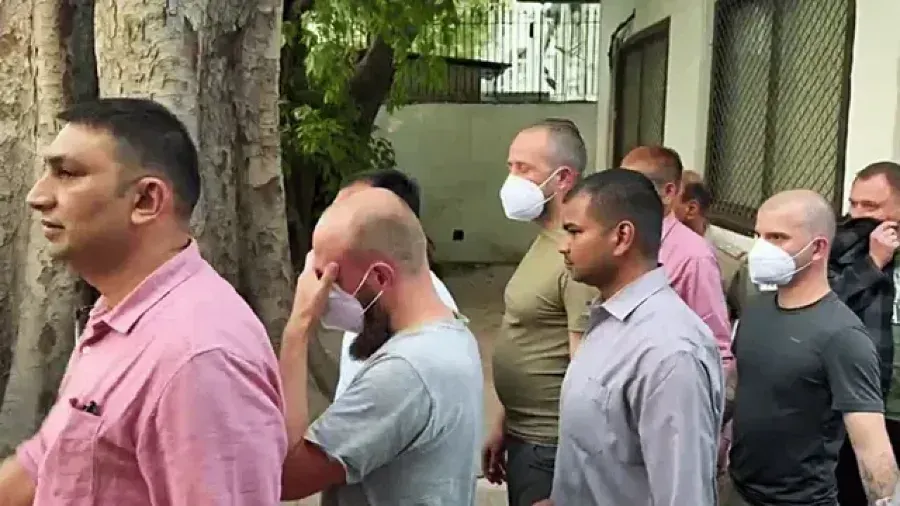
Matthew VanDyke, a US filmmaker and founder of the volunteer training group Sons of Liberty International, flew out of New Delhi on an Etihad flight to Washington on 25 September, the day after he walked out of Tihar jail. Six Ukrainian co-accused, Petro Hurba, Taras Slyviak, Ivan Sukmanovskyi, Marian Stefankiv, Maksim Honcharuk and Viktor Kaminskyi, had been granted exit permits but had not left India by 25 September. India's National Investigation Agency (NIA) had accused all seven of training Myanmar's resistance in drone warfare.
A special NIA court at Rouse Avenue in Delhi gave the seven permission on 24 September to go home for one month. The court discharged them of the immigration offences that were the only charges the NIA filed, after each paid a penalty of 550,000 rupees to compound them. They must tell the court within 72 hours of coming back, give the NIA their addresses and phone numbers and join the investigation by video or in person when asked. Rahul Tyagi, the special public prosecutor, told the court that "further investigation in the case was ongoing but the immediate presence of the accused was not required". The court will hear the chargesheet on 1 October.
Camp Victoria
The seven entered India on tourist visas in December 2025, travelled through Guwahati to Mizoram without the permit foreigners need for the border state and crossed into Myanmar's Chin State, according to the NIA. It alleged that from December to March they trained ethnic armed groups in "drone warfare, drone operations, assembly and jamming technology" at Camp Victoria, headquarters of the Chin National Army, the armed wing of the Chin National Front (CNF). Some Indian reports also named the Kachin Independence Army (KIA) among the groups trained.
The CNF was founded in 1988, signed a ceasefire with the military in 2012 and took up arms again after the February 2021 coup, training and supplying the new Chin resistance forces that formed in the hills along the Indian border. Chin forces drove the army from several towns near the Indian border from late 2023. Resistance crews carried out more than 2,100 drone strikes between December 2021 and mid-2025, according to the conflict monitor ACLED. On 10 September resistance drone units struck Tada-U airbase near Mandalay, where the air force keeps the Yak-130 jets it uses in air strikes.
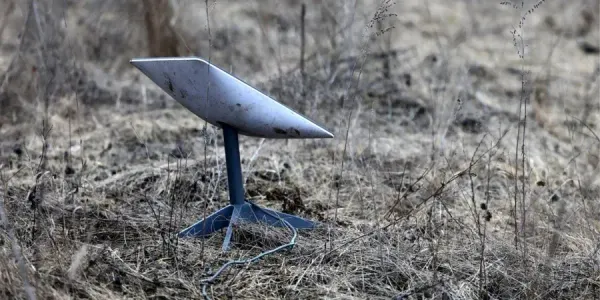
NIA officers arrested VanDyke at Kolkata airport on 13 March. The NIA registered the case under the Unlawful Activities (Prevention) Act (UAPA), India's anti-terror law, and alleged that large consignments of drones had been imported from Europe to Myanmar through India and that the groups had links to insurgents in north-east India. On 19 August it told the court it had "credible information" that Ukrainian and US nationals were involved in a drone attack on a Myanmar National Airlines ATR-72 at Myitkyina airport on 20 February, in which no one was hurt. The military blamed the KIA and People's Defence Forces for that attack; a KIA spokesman denied targeting civilian aircraft. The allegation did not appear in the chargesheet.
Peter Thang, vice-president of the Chin National Defence Force, whose network some Indian reports linked to drone shipments, said: "I am not related to the seven people arrested by the NIA. I've never contacted them or seen them." A Chin fighter, Dr Pyae Phyo, said of foreign volunteers: "They will continue to come."
The Ukrainians
NIA officers arrested Hurba, Slyviak and Sukmanovskyi at Lucknow airport and Stefankiv, Honcharuk and Kaminskyi at Delhi airport on 13 March. The agency said at least 14 Ukrainians had entered India on tourist visas in the same period; eight have not been traced. It has not published the ages, home towns or occupations of the six, and no family member has spoken publicly. Nitin Saluja, a Delhi lawyer, represented all six.
The NIA told the court the drones used in the attack at Myitkyina airport had been "allegedly supplied to local rebel groups through a network connected to the Matthew Van Dyke module". On 31 August the court allowed investigators to question Kaminskyi and VanDyke in Tihar "to confront some facts disclosed by certain witnesses" and to learn about "masterminds sitting in Myanmar". The NIA has not said why it singled out Kaminskyi, and no Ukrainian has been shown to have worked with Sons of Liberty International.
Oleksandr Polishchuk, Ukraine's ambassador to India, delivered a note of protest to India's foreign ministry on 17 March demanding the men's immediate release. Embassy staff were not allowed to speak to them at their first court appearance, on 16 March, and a second note followed on 18 March. "We have received a request for consular access, and this will be addressed in accordance with the legal requirements of the case," Randhir Jaiswal, India's foreign ministry spokesperson, said on 19 March. Ukraine's foreign ministry said on 2 April that access had still been refused. When embassy officials came to a closed hearing on 6 May, the judge told them: "You need not worry. But I can't allow you to attend and observe the hearing as per the law." A request for family visits was turned down.
Ukraine's foreign ministry said there were "no established facts" that the men had broken the law in India or Myanmar, and that restricted border areas were often unmarked on the ground. The embassy said on 19 March that the case "may have been initiated based on information provided by Russia" and that "Ukraine resolutely rejects any innuendo that the Ukrainian state supports terrorist activity". It said: "Ukraine is a state that faces the consequences of Russian terror on a daily basis." It said Russia "seeks under every circumstance to drive a wedge between friendly countries: Ukraine and India".
Indian investigators told the German broadcaster DW that Russian intelligence may have shared information with Indian agencies, and Ukrainian reports citing the broadcaster said Russia had helped monitor the group for nearly three months before the arrests. Maria Zakharova, the Russian foreign ministry spokesperson, said on 20 March that the case showed "Zelensky's neo-Nazi regime has a core exporter of instability worldwide" and that "Kiev is a major supplier of weaponry and military technologies to the global black market". In June Vasily Prozorov, a former Ukrainian security officer who now works with Russian state media, published claims about the six men's military and political backgrounds, which he said came "with help from concerned Indian residents". None of his claims has been independently confirmed.
The six received default bail on 23 September on cash bonds of 100,000 rupees each. They paid the same 550,000-rupee penalty as VanDyke to settle the immigration charges, and the court gave them the same permission to go home to Ukraine for one month. None of them had made a public statement by 27 September.
Charges
The NIA filed its chargesheet on 8 September under Sections 21 and 23 of the Immigration and Foreigners Act, 2025, which cover illegal entry, entering restricted areas and visa breaches and can be settled with a fine. The investigation "has not... revealed any conclusive evidence indicating that the accused persons were involved in activities directed against India", the agency said. It kept the UAPA case open, saying it was still examining digital forensics and recovered drone hardware.
Indian law entitles an accused to default bail when prosecutors do not file a complete chargesheet within the time allowed, 180 days in this case. Judge Prashant Sharma granted VanDyke default bail on 18 September. He called the NIA's filing "piecemeal" and wrote that "investigating agency cannot circumvent sec. 187(3) BNSS by filing incomplete charge-sheet, for the purpose of denying default bail". The six Ukrainians received default bail on 23 September.
VanDyke spent six months in custody, most of it in Tihar. He went on hunger strike from 6 May and lost about 14 kilograms. His mother, Sharon Van Dyke, said: "This is a humanitarian emergency for our family... We are pleading for his safe return home." Sergio Gor, the US ambassador to India, met the national security adviser, Ajit Doval, on 18 March and 11 August and the home minister, Amit Shah, on 18 June. VanDyke's family lobbied members of Congress and the State Department in June and July.
VanDyke
VanDyke, 47, from Baltimore, fought with Libyan rebels against Muammar Gaddafi in 2011, was captured at Brega and escaped from Abu Salim prison after five months. His film about the war, Point and Shoot, won best documentary at the Tribeca Film Festival in 2014. He founded Sons of Liberty International in 2014 to train forces fighting the Islamic State group in Iraq, and it has since worked in the Philippines and in Ukraine, where it trained Ukrainian units after Russia's full-scale invasion in 2022.
India's border
India shares a 1,643-kilometre border with Myanmar across Arunachal Pradesh, Nagaland, Manipur and Mizoram. About 2,000 foreigners entered Mizoram between June and December 2024, many of them heading for the Chin hills, Lalduhoma, the state's chief minister, told the state assembly in 2025. India stopped Daniel Newey, a former British special forces soldier, at Lengpui airport in Mizoram in June 2024, and gave safe passage out of the country to a US citizen, Colin Mayfield, in December 2024. New Delhi hosted Min Aung Hlaing on 1 June, on his first foreign trip as president.
Jairam Ramesh, a senior leader of the opposition Congress party, wrote on 25 September: "Obviously US pressure determined this outcome, but what did India get in return?" Pawan Khera, another Congress leader, said VanDyke had been sent home "as though he were a state guest".