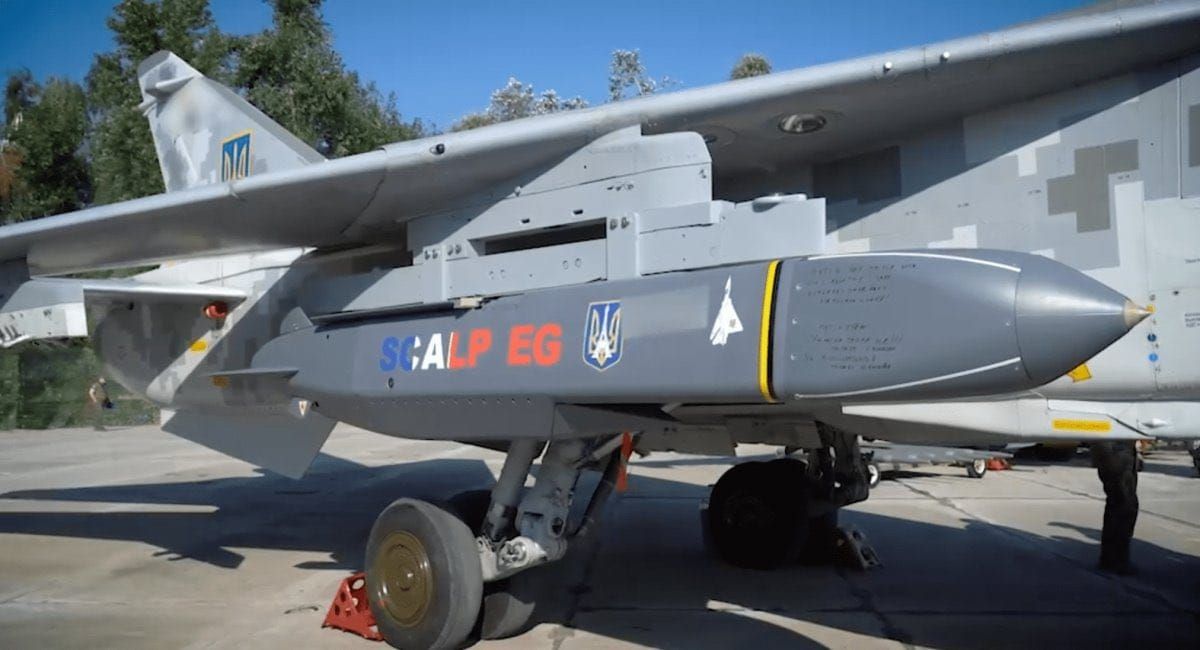
Andy Burnham landed in Kyiv on the morning of 24 August 2026, Ukraine's 35th independence day and his first foreign trip as prime minister, carrying an authorisation no British government had granted before. The UK government has cleared the missile maker MBDA to declassify technical information on the British-built components inside the SCALP cruise missile and pass it to Ukrainian manufacturers, so that the weapon Ukrainian crews have been firing since 2023 can be assembled in Ukraine rather than shipped in from European stockpiles.
"On Ukraine's 35th anniversary of independence, the Ukrainian people should be in no doubt: the UK is behind you today and for as long as it takes," Burnham said. He also said that "Ukraine's security is our security."
Emmanuel Macron opened the door on 13 and 14 July 2026, when the French government granted Ukraine licences to manufacture the SCALP, the Aster air defence interceptor and the AASM Hammer guided bomb, the first time France has licensed weapons production on Ukrainian soil. "President Zelensky and I agreed on a roadmap between our two countries, implementing what had been agreed in principle last November regarding our bilateral defence cooperation," Macron said. The British decision supplies the missing half: SCALP and Storm Shadow are the same airframe built by the same Anglo-French company, and the parts that matter most are British.
Leonardo UK builds the imaging infrared seeker that lets the missile recognise its target in the final seconds of flight. BAE Systems and Thales build the BROACH warhead, a shaped-charge precursor that punches an opening followed by a 450-kilogram blast-fragmentation charge that detonates inside the structure. Thales supplies the inertial and satellite navigation that carries it through the middle of the route, and Safran's TR60-30 turbojet, 66 kilograms for 5.4 kilonewtons of thrust, keeps a 1,300-kilogram airframe flying to a range of up to 250 kilometres. Defense Express records that Ukraine becomes the first country ever authorised to build the missile outside its original producer.
UN human rights monitors counted 1,396 civilians killed and 7,978 injured in Ukraine between January and June 2026, a rise of 37 per cent on the same months of 2025 and 114 per cent on 2024. Casualties from long-range missiles and drones rose 60 per cent over that period, concentrated in cities far from the front. July 2026 was the deadliest month for Ukrainian civilians since April 2022. On 5 August at least 17 people were killed and 44 injured in strikes around Kyiv, Kramatorsk, Kherson and Zaporizhzhia, among them people waiting on a railway platform in Brovarskyi district. Since February 2022 the mission has verified 16,431 civilians killed, 803 of them children.
"The figures show an alarming escalatory trend with mounting civilian toll, driven by the intensifying use of powerful weapons," Danielle Bell, who heads the UN Human Rights Monitoring Mission in Ukraine, said.
Ballistic missiles and long-range drones leave a factory, an airbase or a fuel depot before they reach an apartment block, and a missile Ukraine can build to a fixed monthly rate lets its air force strike those places on a schedule set in Ukraine. Storm Shadow and SCALP production had been dormant for 15 years before MBDA restarted the line in July 2025, cruise missiles of that class typically take about two years from contract to delivery, and every transfer from European inventories has arrived in batches whose size and permitted use were decided abroad. Ukrainian-designed weapons show what domestic supply changes: Flamingo cruise missiles struck a Russian plant making Shahed and Iskander components and shut down the Kirishi oil refinery, and Volodymyr Zelensky used his 24 August remarks to call for mass production of the type.
Ukraine and the UK began turning out 1,000 Octopus interceptor drones a month in February 2026 under a licence signed the previous November, built in British factories and shipped to Ukraine. Defence minister Denys Shmyhal said the Octopus is "a Ukrainian system for intercepting Shahed drones" that has "demonstrated combat reliability at night, under jamming and at low altitudes". A £600 million British air defence package agreed in December 2025 brought Raven and Gravehawk launchers into service, £200 million of funding was accelerated in January 2026, and more than 85,000 drone systems have been delivered.
Two French SAMP/T air defence batteries went to Ukraine on short-term loan, four newly built SAMP/T NG batteries were bought through the Ukraine Support Loan, and five GM400 radars, one GF300 and one Kronos are being transferred, with the GF300 due in service before the end of 2026. France will follow with 16 Rafale fighters, pilot and mechanic training under way from 2026 and first flights expected in 2028 or 2029. Aster 30 interceptors, the missiles those batteries fire, are on the licence list France issued in July, which means the ammunition can eventually be made where it is being spent.
The Paris Declaration of 6 January 2026 set out what the two countries intend after the shooting stops. Signed by Ukraine, the United States and the coalition of the willing that France and the UK created, it commits its members to a continuous ceasefire monitoring system with a special commission to attribute breaches, a European-led multinational force to help rebuild Ukraine's armed forces, coordinated planning for reassurance measures in the air, at sea and on land, and binding undertakings to respond with military capabilities, intelligence, logistics, diplomacy and further sanctions if Russia attacks again. Burnham chaired his first meeting of that coalition in Kyiv. A 32-hour truce on 11 to 13 April 2026 collapsed amid 469 violations reported by the Ukrainian side, and full-scale fighting resumed across the front the day it expired, which is the case for monitoring machinery agreed in advance.
NATO's Operation Eastern Sentry, launched on 12 September 2025 after Russian drones crossed into Polish airspace, has three French Rafales and two British Typhoons flying alongside Danish, German, Italian and Spanish aircraft along the eastern flank. The French government is seeking an extra €36 billion for defence across 2026 to 2030, aimed at air defence, munitions and space, under a revised military programming law set out by defence minister Catherine Vautrin. The Northwood Declaration of July 2025 committed France and the UK to coordinate their nuclear deterrents, the first time either has formally tied its arsenal to the other's, and every NATO member signed up in June 2025 to spending 5 per cent of GDP on defence and related security by 2035.
Dmitry Peskov, spokesperson for the Russian presidency, called the British decision "fuel on the fire", said the UK was doing "everything possible to prevent any progress in the peace process" and said Russian forces were already gathering information on potential production sites in order to target them. Those threats describe a real constraint: Russian strikes have destroyed a solid rocket fuel stockpile at Pavlohrad, hit the Luch design bureau behind the Neptune missile and bombed the Motor Sich engine plant, and dispersal and protection of any new assembly line will decide how much of the licence turns into hardware.
Ukrainian and French firms will begin with joint assembly before separate production lines open in Ukraine, and the French licence is expected to be in force before the end of 2026.