
Irisleydis Tristá, 34, has gone seven months without the CT scan that would show whether her cancer has spread, one of more than 100,000 Cubans waiting for care in hospitals rationed by fuel shortages.
Doctors have told Tristá, who lives in Batabanó, 70 kilometres south of Havana, that they cannot operate on her again in Cuba, she said in June. "I feel like my life is in danger," she said. Tristá has a 13-year-old child and has had two operations and several rounds of radiation over four years. The CT scanner at Hermanos Ameijeiras, the country's leading hospital in Havana, is broken.
On 5 November the U.S. State Department blocked five Cuban-flagged tankers that carry crude oil and fuel to and from the island and blacklisted two Chinese companies it accused of supplying Cuba's military. The Treasury's Office of Foreign Assets Control (OFAC) extended Executive Order 14404, which President Donald Trump signed on 1 May, to any foreign person working in Cuba's electronics, manufacturing, marine or technology sectors. A supplier in Canada, Mexico or the European Union can now be designated by the U.S. government.
U.S. forces captured Venezuela's president, Nicolás Maduro, on 3 January, and the Trump administration then cut off the Venezuelan oil Cuba had depended on. Volker Türk, the UN high commissioner for human rights, said in June that the fuel restrictions and extraterritorial sanctions were directly harming Cubans and that children were dying because doctors lacked medicines and supplies. UN special rapporteurs said in February that measures likely to cause shortages of essential goods may amount to collective punishment of civilians.
Secretary of State Marco Rubio has said the U.S. is not to blame. "We've done nothing punitive against the Cuban regime," he said in March. The State Department says the island's blackouts result from decades of under-investment and government incompetence. It says the Cuban government has refused or stalled US$100 million in aid the U.S. offered to deliver through the Catholic Church and other independent groups.
President Miguel Díaz-Canel wrote on X on 7 November that the new measures were economic suffocation and collective punishment meant to subjugate the country. "They will not bend us!" he wrote.
The hospitals
José Ángel Portal Miranda, the health minister, ordered hospitals on 13 February to cut elective surgery, reserve ambulances for emergencies and give priority to cancer and other life-saving operations. By early March the national surgical waiting list had reached 96,387 patients, 11,193 of them children, according to health ministry figures. Eduardo Martínez Díaz, a deputy prime minister, said on state television on 3 July that more than 100,000 people were waiting, including more than 10,000 children. The list includes 5,152 cancer patients, and mastectomies and some organ transplants are classed as elective, according to the health ministry. "You cannot damage a state's economy without affecting its inhabitants," Portal Miranda said in February.
Lilian Delgado, an obstetrician at Cuba's main maternity hospital, said that premature births and serious complications among pregnant women had risen and that emergencies had filled the operating rooms, ruling out elective surgery. The ministry reported in February that 32,880 pregnant women faced additional risk because fuel shortages disrupted obstetric ultrasounds and emergency transport, and that infant vaccination schedules were slipping. In March it projected that 12,000 patients would face interruptions in chemotherapy and 16,000 in radiotherapy if shortages continued. Hospitals have rationed CT and MRI scans, which draw heavily on power, and provincial health directorates were told in February to admit kidney patients to hospital when transport to dialysis failed.
The survival rate for children with cancer has fallen to 65 per cent from 85 per cent before the fuel restrictions began in January, according to a government report released in June. The UN human rights office said infant mortality had doubled to 9.9 deaths per 1,000 live births and that essential medicines were at about 30 per cent of normal supply. Cuba's domestic pharmaceutical industry cannot make 300 of the 395 essential medicines it normally produces because it lacks imported chemical components.
Yolainy Romero, a specialist at the National Institute of Oncology and Radiobiology in Havana, said that two children treated there had died this year. Some children from distant provinces must return every 21 days for treatment, and fuel shortages delay their journeys by a week or up to 15 days, she said. Adriana Felipe García travelled about 350 kilometres from Sancti Spíritus with her four-year-old daughter, Nashly Zerquera, for treatment at the institute. "It's very hard," she said.
Mario Cruz Peñate, the representative in Cuba of the Pan American Health Organization (PAHO) and the World Health Organization, said that fuel shortages had caused large disruptions to health services. Treatment schedules for nearly 3,000 dialysis patients have been disrupted. Hospitals report shortages of syringes, gauze, vaccines and anaesthetics, and the hospital in Cárdenas had to move intensive care patients to another hospital in October after an electrical failure.
Alioth Fernandez heads surgery and anaesthesiology at the William Soler Pediatric Hospital in Havana. She said in July that survival after neonatal surgery, once above 90 per cent, had collapsed in the first half of 2026, with more than half of cases ending in death. The hospital once performed about 10,000 operations a year, fell to about 1,000 during the Covid-19 pandemic and now manages one or two elective operations a day, Fernandez said. Many of the deaths came from infections, malnutrition and a lack of antibiotics, not from the operations, she said. "Now, we have to play God," she said. Maternal mortality rose to 44.1 deaths per 100,000 live births at the end of 2025 from 40.6 a year earlier, and infant mortality has climbed from 4 per 1,000 in 2017, according to official figures.
Roxana Martinez, a family doctor at the Cayo Hueso clinic in central Havana, said her patient list had grown from 1,875 to more than 3,000, against a guideline of 700. She earns about US$20 a month. Erenia Carrillo, a 57-year-old dialysis patient, said her four-hour sessions were sometimes cut to two or three hours when machines had to be shared. All 46 of Cuba's blood banks are working at reduced capacity because of shortages of reagents, according to the ministry's figures. Transfusions for surgical patients, women with obstetric haemorrhage and children with leukaemia are at risk.
A pharmacy clerk in Havana's Cerro district, who has hypertension, said deliveries that once came about every 10 days arrived only on 23 February and 16 June and covered about 30 per cent of what customers needed. The clerk buys enalapril, a blood pressure drug, on the black market. The average state wage is about US$11 a month.
A doctor at a public hospital in Havana said in March that staff were reusing disposable gloves and using water and soft drink bottles in place of urine bags. Doctors earn 7,000 to 8,000 pesos a month, about US$14 to US$16 at the informal rate, while 30 eggs cost 3,000 pesos. Tania Margarita Cruz, a deputy health minister, said the ministry expected the surgical waiting list to reach 160,000 by the end of the year if shortages continued, and that more than 300 paediatric operations a week lacked supplies.
Xenia Álvarez, whose 21-year-old son has a rare genetic disease and depends on a ventilator around the clock, said she did not know how long the family could keep going through the blackouts. Taimy Alfonso, who ran 911 Cuba, a programme delivering medicines to critically ill people, said the health system had already collapsed and that many would die without outside medical intervention. Patients were short of medicines and hospitals were in poor condition before the U.S. measures deepened the blackouts, she said. Around 67,000 children risk missing routine vaccines because of disruptions to power and transport, a UN official said in June.
The Cuban government told the UN that its surgical waiting list stood at 86,141 patients, including about 9,000 children, at the end of February 2024, two years before the fuel order. Portal Miranda said in February that the health system was on the verge of collapse, and Díaz-Canel said in August that only about 190 of the 651 medicines on the national basic list were available. Doctors, nurses and technicians have emigrated in large numbers since 2021. The government has since allowed private pharmacies to open as part of a package of economic changes.
Water and disease
More than 80 per cent of Cuba's water pumps run on electricity, according to PAHO, and the National Institute of Hydraulic Resources puts the figure for its infrastructure at nearly 90 per cent. When the power goes, the taps go dry. About 3.5 million people, just under half the population, face water shortages, according to the UN Office for the Coordination of Humanitarian Affairs. Francisco Pichon, the UN resident coordinator, said in April that about one million people depended on tanker trucks for drinking water and that those deliveries were limited by the diesel shortage. The number relying on trucks had doubled from 500,000 in December 2025.
Antonio Rodríguez, president of the National Institute of Hydraulic Resources, said in May that the water system was operating with 37 per cent of the fuel it needs. Unclogging pipes, emptying septic tanks and repairing leaks all require fuel, he said, and suppliers were putting contracts on hold because of uncertainty over shipping and bank payments.
Yuamilka Hechavarria, a health worker in Old Havana, lives with about 30 other families in a tenement that had gone two months without running water in September. "There's no one in this building who hasn't gotten sick," she said. She was recovering from fever and diarrhoea. Maria Elena Parlado, a nurse at a neighbourhood clinic that has no water, said she could not always wash her hands between patients. Andrés Jiménez, a 76-year-old retired metal worker waiting at a standpipe, said the pump did not run without power.
Cuban health authorities reported spreading viruses in September, including a strain of viral hepatitis. A U.S. government health alert issued the same month reported a significant increase in diarrhoeal illness across Cuba linked to the failing water and energy systems. PAHO put the risk of water-borne and food-borne disease in its highest category in March. It cited power cuts to pumps, reduced trucking and damage from Hurricane Melissa, which struck Santiago de Cuba, Granma, Holguín and Guantánamo provinces in late 2025 and forced the evacuation of about 735,000 people.
Carilda Peña, a deputy health minister, said on state television on 1 December 2025, before the fuel order, that 33 people had died of chikungunya and dengue since July, 21 of them under 18. PAHO counted 81,909 cases and 65 deaths from the two viruses in Cuba during 2025, and reported two further chikungunya deaths in January 2026 that the health ministry had not announced. The ministry stopped publishing regular statistics on the epidemics at the end of 2025, and Cuba is among the few countries in the region with no 2026 dengue data in PAHO's public databases.
Magaly Ribial, a 60-year-old teacher, said in May that water had not reached her home in Old Havana for five days. Dayse Izquierdo, 95, relies on neighbours to carry water from the tanker. Lázaro Noblet, pushing a handcart of containers through his neighbourhood in March, said the pumps had stopped because oil was no longer reaching the country. Ageing pipes left between 100,000 and 200,000 Havana residents short of water before the current crisis, according to official figures. "Our problem has existed since 2021," Maria de Jesus Rusindo, 58, said in March.
Power, food and school
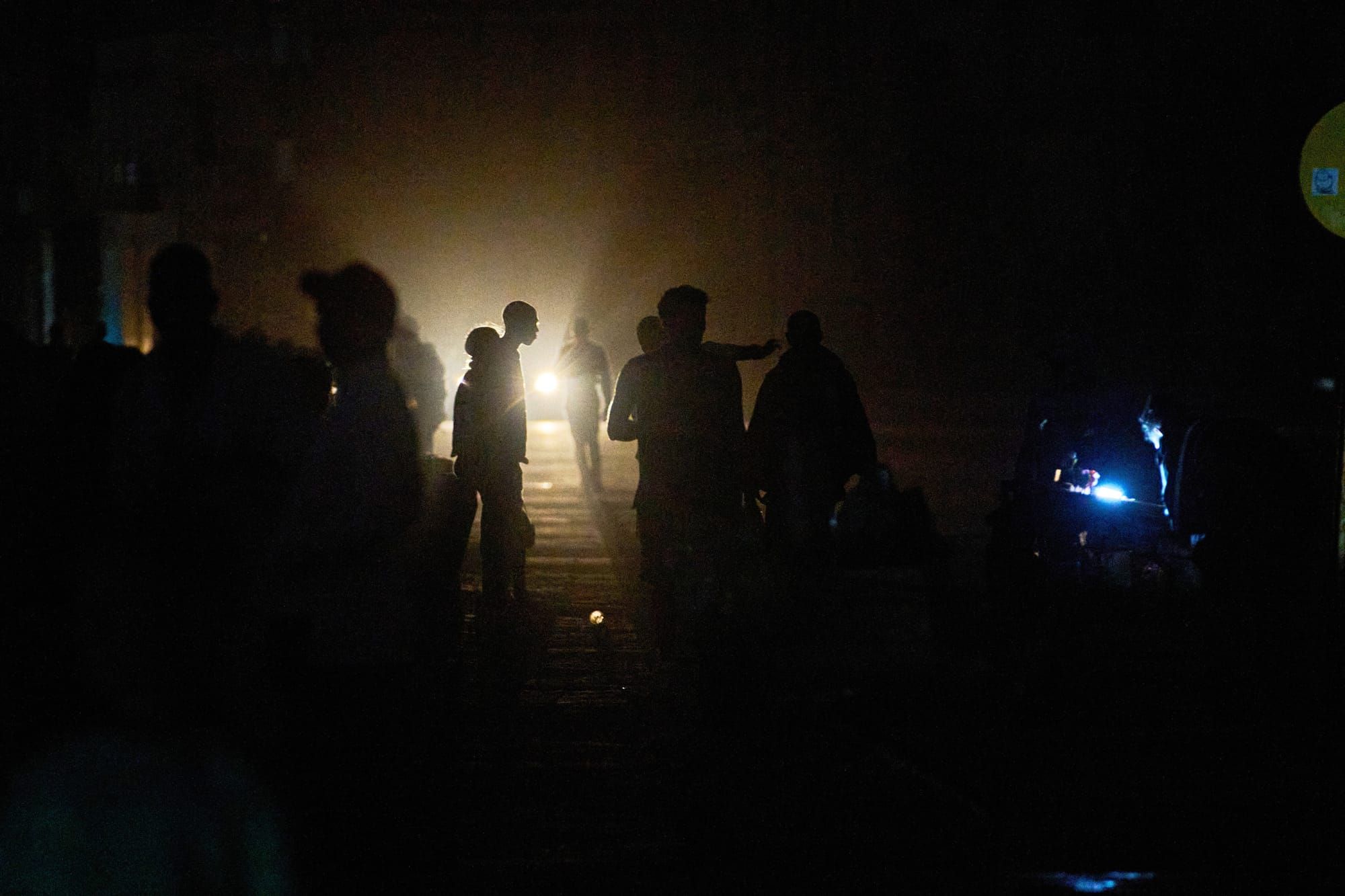
On 7 November the state utility, Unión Eléctrica, expected to supply 1,070 megawatts against an evening demand of 2,830, about 38 per cent. Shortfalls passed 2,000 megawatts on 29, 30 and 31 October, and the national grid has collapsed at least eight times in 2026. A resident of Havana's Playa district wrote on social media in the first week of November that his circuit was without power for more than 20 hours a day, while a neighbouring circuit kept its street lights on.
The Erol Bey, a 63-megawatt floating power plant owned by the Turkish company Karpowership, left Havana harbour permanently on 2 November. Neither Unión Eléctrica nor Karpowership has given a reason. Vicente de la O Levy, then energy minister, told the National Assembly in December 2024 that the ships could leave if Cuba did not pay. The Belgin Sultan is now the only Karpowership unit left on the island.
About 100,000 children under seven no longer receive the daily litre of milk the state guarantees, according to government figures released in June. Bread supplies were about half their level before the fuel restrictions, and 170 containers of essential goods could not be distributed for lack of fuel. The UN human rights office said food production had fallen by about 60 per cent and that daily blackouts regularly exceeded 20 hours by mid-May. The World Food Programme said 2,900 tonnes of food aid it had contracted could not be shipped because shipping lines had limited their services, and UNICEF said seven shipments of supplies for newborns worth US$630,000 were stalled in transit.
Shortened school days affected about 411,000 children and adolescents in April, according to the UN. The UN system in Cuba launched an emergency appeal for US$94.1 million in March, warning that continued fuel scarcity could cost lives.
Pichon told reporters on 6 April that the UN's updated action plan targeted about two million people in eight provinces and included solar power for hospitals, schools and irrigation and repairs to water pumping. Its priority groups were nearly 300,000 elderly people living alone, more than 100,000 people with disabilities and 32,000 pregnant women, he said. The UN had raised US$26.2 million of the appeal by then, leaving a gap of US$68 million. The national grid had shut down three times in March, leaving the country dark for days, according to the UN.
Cuba's population fell to 9.4 million at the end of 2025 from 9.7 million a year earlier, according to the National Office of Statistics and Information. Deaths were almost double births, and 26.7 per cent of the remaining population was over 60, the office said. More than one million people have left since 2021, the office's figures show. About 245,000 Cubans left in 2025, after more than 307,000 in 2024, according to the office's figures. Juan Carlos Albizu-Campos, a Cuban demographer, estimates the true exodus since 2020 at up to 2.75 million.
Cuba received 1.8 million international visitors in 2025, the lowest number since 2002 outside the pandemic years. Visits by emigrants fell to 228,091 from 294,816 in 2024, and the statistics office attributed part of the drop to U.S. measures.
The fuel order
Trump wrote on Truth Social on 11 January, eight days after Maduro's capture, that no more oil or money would go to Cuba. On 29 January he signed an order declaring a national emergency over Cuba and allowing the U.S. to impose tariffs on any country that sells or supplies it with crude oil. Cuba produces about 40 per cent of the fuel it needs. Venezuelan shipments had already fallen to about half their former volume in the first nine months of 2024, when the island's grid began to suffer nationwide collapses. Vicente de la O Levy announced on 13 May that Cuba had used up its reserves of diesel and fuel oil.
Mexico had become the island's main supplier after Venezuelan shipments stopped. Trump questioned President Claudia Sheinbaum about the shipments and about Cuban doctors working in Mexico in a call in January. The state oil company Pemex cancelled a crude cargo for Cuba scheduled for that month. Sheinbaum said on 27 January that when and how oil was sent was a sovereign decision and that Mexico would remain in solidarity with Cuba. Two Mexican navy ships carrying humanitarian aid, but no fuel, reached Havana on 12 February.
Cuba went three months without a fuel shipment. The Russian-flagged tanker Anatoly Kolodkin, carrying about 100,000 tonnes of crude oil, reached the port of Matanzas on 31 March. The 1 May order added blocking sanctions on Cuba's energy, financial, mining and security sectors. The container lines Hapag-Lloyd and CMA CGM stopped serving Cuba after the order. The State Department designated the state oil company, Unión Cuba-Petróleo (CUPET), on 11 June, and the U.S. sanctioned further energy companies on 23 July.
U.S. Coast Guard cutters patrol the approaches to Cuba. The Ocean Mariner, a 13,000-tonne product tanker, had delivered fuel from Mexico on 9 January. It made a U-turn in the Windward Passage on 13 February and sailed away from the island, according to ship-tracking data. The Sea Horse, a Hong Kong-flagged tanker carrying about 200,000 barrels of Russian fuel, was rerouted to Venezuela. The Anatoly Kolodkin was allowed through in late March, a U.S. official said, without saying why. In May the Universal, a tanker linked to the Russian state shipping company Sovcomflot and carrying 300,000 barrels, abandoned its voyage.
The Coast Guard confirmed in October that it had stopped two vessels it said were carrying fuel to Cuba: the Jaira Provider, a 1978 supply ship registered in St. Kitts and Nevis, earlier in the summer, and the Grace, a small container ship, between Mexico and Cuba on 5 September. The Grace was taken to Progreso, Mexico, where Mexican navy inspectors reported fuel stored in its ballast tanks. "Illicit fuel shipments violate international law," Vice Adm. Nate Moore, the Coast Guard's deputy commandant for operations, said in a statement that cited no specific legal authority. The Treasury has issued individual licences for fuel exports from the U.S. to specific private businesses on the island.
The sanctions calendar
The State Department designated GAESA and its president on 7 May, and on 18 May added 11 officials and three government bodies, including the Directorate of Intelligence. It sanctioned Díaz-Canel himself in early June, CUPET on 11 June and further GAESA companies on 23 June. On 3 September it designated a grandson of Raúl Castro. OFAC withdrew general authorisations for professional travel and some banking transactions with Cuba on 30 September, and on 15 October Rubio sanctioned the Banco Internacional de Comercio (BICSA), which he accused of hosting Iranian military and intelligence operations.
Foreign companies were given until 5 June to wind down dealings with GAESA. The Trump administration had imposed more than 240 sanctions on Cuban targets by mid-May. The 1 May order also lets the Treasury sanction foreign banks that conduct significant transactions for designated Cubans, which reaches Canadian companies regardless of any U.S. connection, the Canadian law firm Stikeman Elliott told clients.
The 5 November package named eight companies and two people. CAROIL Transport Marine, registered in Cyprus, manages the crude tankers Esperanza, Gloria C and Maria Cristina. Petróleos Marítimos del Caribe (PETROMARCA), a Cuban company, manages the Emilia, a liquefied gas tanker, and the Lourdes. China National Electronic Import and Export Company (CEIEC), a state-owned exporter, contracted in 2026 with Cuba's arms procurement company to export components for military equipment, the State Department said. Beijing H&C Technologies worked with the same company to export military equipment, it said. It did not name the equipment or its value.
Any Rodríguez Lastres, a former commercial director of the Mariel container terminal, was listed for being the adult daughter of Ania Guillermina Lastres Morera. Her mother is president of GAESA, the armed forces' business conglomerate, which the U.S. sanctioned on 7 May. The State Department described the targets as foreign military support and illicit revenue networks serving the Cuban government.
The doctors abroad
About 24,000 Cuban health workers were working in 56 countries in 2023, according to official Cuban figures, and the missions earned the government US$6.3 billion in 2018. Rubio announced visa restrictions in February 2025 on foreign officials involved in the programme, which he calls forced labour, and in August 2025 the State Department restricted visas for officials in Brazil and Grenada and for former PAHO officials.
Jamaica ended a medical partnership that began in 1976 on 5 March, when about 300 Cuban professionals were working there. Andrew Holness, the prime minister, had defended them while standing beside Rubio in Kingston. "Let us be clear, the Cuban doctors in Jamaica have been incredibly helpful to us," he said. Honduras sent home more than 150 Cuban medical workers after President Nasry Asfura, whom Trump backed, took office in January. Guatemala began withdrawing a brigade of 412 workers, 333 of them doctors, in January, and Guyana, Paraguay and the Bahamas have also ended or restructured their programmes.
The Inter-American Commission on Human Rights has reported, citing official Cuban statistics, that Cuban professionals receive between 2.5 and 25 per cent of what host countries pay Cuba for their services. Bruno Rodríguez Parrilla, Cuba's foreign minister, wrote in April that the U.S. government was pursuing, pressuring and extorting other governments to expel the brigades.
The UN findings
The special rapporteurs said on 12 February that the 29 January order was a serious violation of international law and lacked any authorisation from the UN Security Council. On 7 May three rapporteurs, among them Sofía Monsalve Suárez, the rapporteur on the right to food, said the fuel restrictions amounted to "energy starvation". On 6 August a wider group said sanctions announced on 23 July had blocked fuel purchases even for humanitarian purposes and were an attempt to change a sovereign state's constitutional order through coercion.
Türk said on 8 June that sanctions hitting whole sectors of an economy were incompatible with basic principles of international human rights law. Companies were leaving Cuba, fewer airlines served it and the island was almost cut off from international payment systems, he said. The hurricane season and summer heat raised the risk of mosquito-borne and water-borne disease, he said, and he urged businesses to avoid blanket withdrawal from Cuba under the UN Guiding Principles on Business and Human Rights. Private firms were imposing restrictions beyond what the law required, delaying humanitarian procurement, his office said. He asked the U.S. to lift the sanctions and the Cuban authorities to exercise restraint, respect civil liberties and release everyone arbitrarily detained.
Alena Douhan, then the rapporteur on unilateral coercive measures, spent 10 days in Cuba in November 2025. Her successor, Zaina Jallad, presented the report to the Human Rights Council in Geneva on 9 September. It concluded that U.S. sanctions had substantially worsened the humanitarian situation and that the measures in force prevented, delayed or raised the cost of delivering essential goods. It recommended that the U.S. lift or suspend all unilateral coercive measures on Cuba and repeal penalties on foreign companies that export goods to Cuba containing more than 10 per cent U.S. content. The Cuban government submitted its own 16-page report to the council. It was the first on-site assessment of the embargo by an independent Human Rights Council expert, according to the Cuban foreign ministry.
UN special rapporteurs serve in an individual capacity and do not speak for the UN as a body. The Cuban Observatory for Human Rights, a Madrid-based group, wrote to Douhan before her report that the crisis came from the failure of Cuba's political and economic model. Only 3 per cent of Cubans in its annual survey blamed their problems on the embargo, it said.
The State Department's case
Cuba had major blackouts in 2025 while still receiving free Venezuelan oil and had not spent money fixing its grid, Rubio said in a video message in May. When the U.S. designated CUPET in June he said Cuba's communist leaders had diverted energy resources to enrich themselves while the population suffered from decades of under-investment.
The national grid collapsed in October 2024 and again in December 2024, before the current measures. The energy minister said in September 2025 that earlier power ships had left because Cuba could not pay. PolitiFact rated as half true Rubio's claim that the blackouts and the U.S. oil restrictions were unrelated, concluding that both governments had contributed. Paolo Spadoni, an economist at Augusta University in Georgia, said that Cuba needed reforms and suffered systemic failures but that the U.S. clearly bore responsibility for the acute crisis.
Tommy Pigott, a State Department spokesperson, said on 13 May that Rubio had made the Cuban government numerous private offers, including humanitarian aid and satellite internet, and that it had refused them. The department publicly restated an offer of US$100 million in aid to be distributed with the Catholic Church. It had already sent US$9 million in hurricane relief through Caritas in January and February, by a route it said kept the Cuban government from diverting it. The Cuban government has not accepted the larger offer, which the U.S. ties to political and economic reform.
A State Department spokesperson told the conservative site Townhall in May that the Cuban government had hoarded fuel for its elites and resold part of it for cash in Asia. The U.S. had offered fuel if Cuba privatised its energy industry, the spokesperson said. The department has published no evidence for the resale claim. Kaja Kallas, the EU's foreign policy chief, told the European Parliament on 19 May that Cuba's situation resulted from decades of structural economic failures and poor policies as well as external restrictions.
Prisons and protest
Prisoners Defenders, a Madrid-based group, counted 1,372 political prisoners in Cuba on 1 October, a record, including 40 people arrested as minors. Most of those added in 2026 were people jailed after protesting shortages of water, food and electricity, according to its monthly reports. Protesters set a fire outside the Communist Party headquarters in Morón in March during a blackout. Kallas told the European Parliament in the same 19 May debate that Cuba should end political repression.
The claims
Nearly 6,000 U.S. citizens and companies hold claims certified by the Foreign Claims Settlement Commission for property Cuba nationalised after 1959. The claims were valued at US$1.9 billion when certified and are worth more than US$9 billion with the 6 per cent simple interest the commission applies, according to U.S. government figures. The 1996 Helms-Burton Act makes settling them a condition for lifting the embargo.
Title III of the act lets claimants sue anyone who "traffics" in confiscated property. Every president suspended it from 1996 until Trump activated it in May 2019, over objections from European governments and lobbying by Carnival, whose team included Pam Bondi, then a private lobbyist, The New York Times reported. On 21 May 2026 the Supreme Court ruled 8 to 1 that cruise lines that used Havana's docks could be held liable. On 23 June it allowed ExxonMobil to sue the Cuban state company CIMEX over oil assets seized in 1960. The commission valued those losses at more than US$70 million in 1969, and they are now worth more than US$1 billion with interest and Helms-Burton damages, according to Justice Brett Kavanaugh's opinion.
Twenty-five Title III lawsuits had been filed against 51 companies by the first anniversary of its activation, according to the U.S.-Cuba Trade and Economic Council, a New York business group. The council estimated that law firms had billed more than four million hours on them, 85 per cent to defendants. The council described the law's effect on foreign investment in Cuba as corrosive, because companies froze or abandoned projects to avoid being sued. The dissenting justice in the Exxon case argued that Congress had deliberately dropped an explicit waiver of Cuban state companies' immunity from an earlier draft of the act.
Five of the 10 largest claimants are U.S. sugar companies, and others include Coca-Cola and Colgate-Palmolive. Nicolás Gutiérrez, a Miami lawyer who presides over the National Association of Sugar Mill Owners of Cuba and represents about 1,000 exile families, said he had never been to Cuba. He cited Rubio's position and the November midterm elections as reasons he expected action soon. Ricardo Torres, an economist at American University, said Cuba could not pay full compensation at once in its present condition.
The heirs of the Babún family, whose holdings in Santiago de Cuba included two sugar mills, 15 cattle ranches, a bank and an insurance company, are among claimants suing Expedia over hotels on confiscated land. Jason Poblete, a lawyer who represents U.S. and Cuban property owners, has proposed public-private funds that would rebuild Cuba's power grid and use part of the profits to compensate former owners.
William LeoGrande, a professor at American University, said that Cuba could not make a lump-sum payment and would be wise to devise a formula for compensating Cuban-American claimants in exchange for their return and investment. Cuba's government told the UN in 2025 that the embargo had cost it about US$170 billion over the decades, and a Cuban court ordered the U.S. government in 1999 to pay US$181.1 billion in damages.
Grants and donors
The State Department and the U.S. Agency for International Development (USAID) spent US$246.5 million on Cuba programmes from 2001 to 2024, according to figures compiled by the journalist Tracey Eaton. A House committee approved US$75 million for Cuba in the 2027 appropriations bill on 28 April. The sum includes US$40 million for Radio and TV Martí and US$35 million for democracy programmes run through the National Endowment for Democracy.
Rubio cut most USAID programmes in 2025 but restored grants to the Miami publication CubaNet, worth nearly US$2 million, and to the Support Group for Democracy in Cuba, worth just under US$1 million, The American Prospect reported. Two people familiar with the decisions told the magazine the exceptions followed lobbying by exile groups. The Support Group for Democracy in Cuba had lost its funding in the mid-2000s after an investigation found one of its members had charged more than US$10,000 in personal expenses to it.
The U.S. Embassy in Havana opened a call in June for grants to Cuban projects promoting a free and prosperous Cuba, excluding anyone who works with the government, with applications due on 15 August. Mike Hammer, the head of the embassy, told a gala in Miami that change would come to Cuba in 2026.
Mario Díaz-Balart, a Miami Republican congressman and an ally of Rubio, sought the democracy and Martí money. His grandfather, Rafael José Díaz-Balart, was transport minister in the cabinet of Fulgencio Batista, the dictator overthrown in 1959, and his father, Rafael Díaz-Balart, won a Senate seat in the November 1958 election held under Batista.
Benjamín León Jr., a Cuban exile who sold his health clinic business to UnitedHealthcare for US$500 million, gave US$2.5 million to Conservative Solutions, a super PAC backing Rubio, through his company Besilu Stables. León has also given six-figure sums to Cuba Democracy Advocates, and Trump named him ambassador to Spain in January 2025. The U.S.-Cuba Democracy Political Action Committee gave US$25,000 to Rubio's Senate campaign in 2016 and 2017, according to Federal Election Commission filings.
Rubio
Rubio told a Senate hearing in January that the administration would welcome a change of government in Cuba, and in March he said the island needed new people in charge. On 5 October he said Cuba's leaders would have to change course or learn the hard way, and in early October he addressed Cuba's armed forces directly, urging them to recognise the reality of their government. On 23 October Rubio urged Cubans on X to work discreetly with the CIA to bring about change.
The New York Times reported in August that the CIA had set up a Cuba task force whose intelligence would help the U.S. military update its options for action against the island. Trump said in March that he might soon have the honour of taking Cuba. On 23 October he told a rally in Fort Myers, Florida, that U.S. warships returning from the war with Iran would sail past Cuba. "Those beautiful ships will pass Cuba," he said, adding that he would then send Rubio to close a deal. U.S. prosecutors indicted the former Cuban president Raúl Castro in May, and U.S. officials have said Rubio has held talks with Castro's grandson and confidant.
Rodríguez Parrilla said in an interview published in early November that the two governments were holding political-level talks but that U.S. military threats and new measures had blocked progress. Díaz-Canel has denied that negotiations are under way, contradicting Trump.
Rubio's official Senate biography once said his parents had left Cuba after Fidel Castro took power. Naturalisation papers show that Mario Rubio and Oriales García arrived in the U.S. on 27 May 1956, under Batista and two and a half years before the revolution. Rubio said he had relied on family recollections and that his parents had tried to return in 1961 but left because of communism.
Orlando Cicilia, who is married to Rubio's sister Barbara, was arrested in 1987 as a senior figure in a US$75 million cocaine ring run by Mario Tabraue in Miami, convicted and sentenced to 25 years, of which he served 12. Rubio was 16 at the time of the arrest and has said he and his parents knew nothing of the ring. In 2002, as a Florida legislator, Rubio wrote to state regulators recommending Cicilia for a real estate licence without saying that he was his brother-in-law, The Washington Post reported.
A Senate committee chaired by Frank Church found in 1975 that the CIA had recruited the Mafia figures John Roselli, Sam Giancana and Santo Trafficante to kill Fidel Castro. Trafficante had run casinos in Havana before the 1959 revolution. The committee documented eight CIA attempts on Castro's life between 1960 and 1965.
Cuba's allies and critics
The UN General Assembly voted 130 to 17 on 28 October for the U.S. to end the embargo, the 34th such vote. A year earlier the count was 165 to seven, and in 2016 it was 191 to none. The resolution is not binding, and since the 1996 Helms-Burton Act wrote the embargo into law only Congress can lift it. The resolution calls on all states to refrain from laws and measures that breach the UN Charter and international law. U.S. diplomats lobbied governments to vote no or abstain, and Argentina, Paraguay, Ecuador, Colombia and Costa Rica voted with the U.S. Austria, the Czech Republic, Lithuania and Slovenia, all EU members, also voted no.
Canada has prohibited its companies from complying with U.S. Cuba measures since 1992. Anita Anand, the foreign minister, announced food aid for Cuba in February and said she had not discussed it with Rubio. "This is Canadian foreign policy," she said. Volunteers in the Mexican state of Yucatán loaded small boats with rice, baby wipes, batteries and torches for Cuba in March under a banner reading "Let Cuba Live".
The EU's Blocking Statute has forbidden European companies to comply with Helms-Burton since 1996. On 7 July the bloc told the General Assembly that U.S. extraterritorial measures against Cuba violated accepted rules of international trade. The same statement urged the Cuban government to open dialogue with civil society and to stop Cubans joining Russian forces in Ukraine. José Manuel Albares, Spain's foreign minister, rejected the use of force to change Cuba's future on 21 May and said only Cubans could decide it. China called the 5 November designations illegal long-arm jurisdiction and said it would take "all necessary measures" to protect its companies.
Moncada and Guantánamo
Cuba's National Defence Council ran the Moncada 2026 exercise across the country on 4 and 5 November, preparing command bodies, troops and the economy "to confront any variant of aggression", according to the Cuban government. The government has held a National Defence Day every Friday since Maduro's capture. USS Minneapolis-Saint Paul, a U.S. Navy littoral combat ship, made what the base called a "brief port visit" to Naval Station Guantánamo Bay on 4 November, and Navy photographs gave no mission, duration or next port. The same ship called there in July 2025 and at the end of August 2026. The U.S. government has announced no military action against Cuba.
Foreign companies still dealing with the Banco Internacional de Comercio (BICSA), which the U.S. sanctioned on 15 October, have until 14 November to wind down those transactions, according to OFAC. Companies that cannot finish by then are asked to contact the office's compliance hotline.