RCMP Commissioner Mike Duheme has told Alberta's treaty chiefs the force is reviewing their demand for a criminal treason investigation into Premier Danielle Smith and the United Conservative Party, in a letter dated 17 July.
Duheme wrote that the chiefs' resolution had been sent to investigative units to determine whether the material meets the criteria needed to open a criminal file. He addressed the letter to the leaders of Treaty 6, Treaty 7 and Treaty 8 and the Blackfoot Confederacy, and copied it to Alberta Justice Minister Mickey Amery and federal Justice Minister Sean Fraser. CBC Indigenous obtained the letter and reported it on 21 August.
Albertans vote on 19 October on 10 referendum questions. The tenth asks them to choose between the statement that Alberta should remain a province of Canada and the statement that the Government of Alberta should commence the legal process required under the Canadian Constitution to hold a binding provincial referendum on whether or not Alberta should separate from Canada. Elections Alberta records that the result does not bind the government, and no Alberta statute sets a threshold for it. Smith has said she treats 50 per cent plus one as the number that settles the question, that she will respect the outcome, that she will vote to keep Alberta in Canada and, at a UCP town hall in Lethbridge on 19 August, that a binding secession vote would have to be held in spring 2027.
Treaty chiefs' resolution
The Assembly of Treaty Chiefs, which represents 48 First Nations across Treaty 6, Treaty 7 and Treaty 8 territory, voted unanimously on 16 June in Calgary to ask the RCMP and Alberta's auditor general to examine whether Smith and UCP members have committed treason under section 46 of the Criminal Code.
Intentional violation of the treaties, calling a separation referendum despite the risk to Canadian sovereignty and the treaty relationship, failure to act on a privacy breach affecting millions of people and exposure to foreign interference and influence are the four grounds the resolution names.
Chief Desmond Bull of the Louis Bull Tribe in Maskwacis researched and built the case for the allegation. Duheme's reply moves it forward, Bull said, calling it "one step closer in regards to what we want to achieve." Sturgeon Lake Cree Nation Chief Sheldon Sunshine said he expects the force to weigh whether the material justifies an investigation, and dismissed Smith's promise to vote No as "turning into some sort of Captain Canada" while her government undermines the province's place in Confederation.
Treaty 8 Grand Chief Trevor Mercredi said on 18 June that the nations were not certain the conduct meets the criminal test. "Does it fit the legal definition of treason? I'm not too sure. We're not too sure yet," he said, adding that the constitutional and treaty questions stand whatever the RCMP concludes.
Alberta's auditor general, Phillip Peters, sworn in on 3 June, has issued nothing on the half of the referral addressed to him. His office's news page carries no item on the referendum, the resolution or the premier.
What section 46 requires
High treason under subsection 46(1) covers killing or attempting to kill the sovereign or doing her bodily harm, levying war against Canada or any act preparatory to it and assisting an enemy at war with Canada or armed forces against whom the Canadian Forces are engaged in hostilities. Conviction carries life imprisonment as a mandatory minimum, with parole ineligibility of 25 years, the same as first degree murder.
Treason under subsection 46(2) reaches five kinds of conduct: force or violence used to overthrow the government of Canada or a province; communicating military or scientific information to an agent of a foreign state without lawful authority; conspiring to commit high treason or to use that force; forming the intention to do either and manifesting it by an overt act; and conspiring or forming an intention in respect of the information branch. The force, conspiracy and intention branches carry life. The information branches carry life in wartime and a maximum of 14 years otherwise. Subsection 46(3) extends both offences to Canadian citizens acting outside Canada.
Subsection 47(3) bars a conviction on the evidence of a single witness unless that evidence is corroborated in a material particular by evidence implicating the accused. Section 55 makes evidence of an overt act inadmissible unless the act is set out in the indictment. Subsection 48(1) bars proceedings on the force branch more than three years after the alleged offence, and subsection 48(2) requires that where the overt act relied on is "open and considered speech", an information be laid under oath within six days of the words and an arrest warrant issue within 10 days of the information.
Section 469 reserves treason to a superior court, allows bail only from a superior court judge with the onus on the accused, and requires a jury unless both the accused and the attorney general consent to a judge alone. No consent to prosecute is needed, which distinguishes treason from terrorism and foreign interference offences. Sections 46 and 47 sit outside the concurrent jurisdiction list in section 2.3 of the Criminal Code, which points to the provincial attorney general, in this case Amery, but the Security Offences Act lets the Attorney General of Canada take conduct of proceedings where the offence arises out of conduct constituting a threat to the security of Canada within the meaning of the CSIS Act, and displace the province by serving a fiat. The same Act gives RCMP members primary responsibility for policing those offences.
Louis Riel was convicted of high treason at Regina on 1 August 1885 and hanged that November, under the English Treason Act of 1351 as it applied in the North-West Territories. The Gouzenko spy cases of 1946 produced 21 arrests and 11 convictions, none of them for treason: prosecutors used the Official Secrets Act and conspiracy charges. No charge under section 46 of the Criminal Code appears in the public record since 1947.
No force or violence has been publicly alleged against Smith or the UCP. Every branch of section 46 that mentions a provincial government requires force or violence, and the chiefs' case rests on treaty breach, sovereignty risk, a privacy failure and foreign contact. Advocating secession by lawful means is not a criminal offence in Canada. The Supreme Court held in Reference re Secession of Quebec in 1998 that no province may secede unilaterally, that secession requires a constitutional amendment and negotiation, and that a clear majority on a clear question would create a reciprocal duty on all parties to Confederation to negotiate. The Court treated a secession vote as a constitutional problem rather than a criminal one.
The CSIS Act definition of threats to the security of Canada excludes lawful advocacy, protest and dissent unless carried on together with the threat activity it lists, and its foreign influenced activities branch requires conduct that is clandestine or deceptive or involves a threat to a person. Sedition offers no easier route: the Supreme Court held in Boucher v The King in 1950 that seditious intention requires an intention to incite violence or resistance to lawful authority, and sections 59 to 61 have been close to dead letters since.
If the case is a network case
Section 21 makes a party to an offence anyone who commits it, aids it or abets it, and subsection 21(2) catches a person who forms a common unlawful intention with others where an offence is a probable consequence they knew or ought to have known about. Section 465 makes conspiracy to commit an indictable offence punishable by the same maximum as the offence itself, and subsections 46(2)(c) and 46(2)(e) build conspiracy into treason directly.
The Countering Foreign Interference Act, which received royal assent on 20 June 2024, added offences that reach further than section 46 and require no force at all. Under the renamed Foreign Interference and Security of Information Act, in effect since 19 August 2024, section 20.2 makes any indictable offence under any Act of Parliament punishable by life imprisonment when committed at the direction of, for the benefit of or in association with a foreign entity. Section 20.3 carries life for surreptitious or deceptive conduct on the same terms where it is prejudicial to the safety or interests of the state. Section 20.4 carries life for surreptitious or deceptive conduct, at the direction of or in association with a foreign entity, intended to influence a political or governmental process or the exercise of a democratic right in Canada.
Subsection 20.4(5) applies that offence to federal, provincial, territorial, municipal and Indigenous political and governmental processes, and the defined term covers elections, referendums, the development of policy and the nomination of candidates by a political party. A foreign entity includes a person acting at the direction of, for the benefit of or in association with a foreign power, and a foreign political party whose stated purpose is to assume the role of government counts as a foreign power. Prosecution requires the attorney general's consent.
The Foreign Influence Transparency and Accountability Act came into force on 4 August 2026, with Anton Boegman, British Columbia's chief electoral officer from 2018 to 2025, appointed commissioner in March. Anyone who enters an arrangement with a foreign principal to communicate with a public office holder, to disseminate information or to distribute money in relation to a political or governmental process must file within 14 days, and arrangements predating 4 August must be filed by 3 October 2026. Section 4 reaches provincial, territorial and municipal processes, and penalties run to $5 million and five years on conviction.
Commissioner Marie-Josée Hogue defined foreign interference as clandestine, deceptive or threatening activity by a foreign state or its proxies that is detrimental to Canada's interests, in the final report of the Public Inquiry into Foreign Interference tabled on 28 January 2025, and wrote that "there is a grey area between foreign influence and foreign interference." On the allegations against sitting parliamentarians she wrote: "I have not seen any evidence of 'traitors' in Parliament plotting with foreign states to act against Canada." Her terms of reference excluded provincial governments, and the states her report names are China, Russia, India, Pakistan and Iran, not the United States.
Court rulings on the petition
Justice Colin Feasby of the Court of King's Bench held on 10 December 2025 that the Alberta Prosperity Project's proposed independence question could not proceed under the Citizen Initiative Act. Feasby rejected the argument that an independent Alberta would inherit Canada's treaty obligations automatically, holding that "consent is required to change a party to the Numbered Treaties." Alberta passed Bill 14 in the days that followed, repealing the section that required constitutional compliance.
Justice Shaina Leonard quashed the chief electoral officer's approval of a second petition on 13 May 2026, in a case brought by Athabasca Chipewyan First Nation, Piikani Nation, Siksika Nation and the Blood Tribe. Leonard wrote that "there can be no doubt that Alberta's secession from Canada will have an impact on Treaties 7 and 8", and found the province owed a duty to consult before the petition was approved. Justice Alice Woolley of the Court of Appeal granted a partial stay on 29 June, letting the chief electoral officer finish verifying signatures while barring the petition from advancing until the appeal is decided. Elections Alberta reported on 24 July that 222,597 signatures had been verified against a threshold of about 178,000, and the appeal was still outstanding on 23 August.
Smith's government put its own question on the 19 October ballot on 21 May and cabinet formalised the wording on 28 May, bypassing the citizen petition the courts had struck. The government referendum runs under the Referendum Act rather than the Citizen Initiative Act, so neither ruling blocks it.
The Alberta Prosperity Project presented a draft constitution titled Foundation of Freedom at Airdrie on 13 August, proposing a fourth oversight branch of government, elected judges, four-year term limits and the abolition of property taxes. Ian Parkinson, introduced as a co-writer, made a racist remark about a police officer from the stage and resigned the same week. Leader Mitch Sylvestre said the group "does not condone or tolerate what was said" and that he had been backstage and had not heard it. Other independence advocates had publicly disavowed the draft before its release, saying it did not reflect a consensus. The group followed it with a 54-page discussion document on 21 August covering rights and freedoms, elections and the branches of government, which reporting describes as proposing a president as head of state, elected judges, open-carry firearms laws and free passports.
Elections Alberta has registered 23 third-party advertisers for the referendum, each capped at $607,000 in spending. Chief Electoral Officer Gordon McClure said on 14 August that no voter registrations had been removed from the list of electors without consent, contrary to material circulating online, and that "Albertans should expect misinformation and disinformation campaigns to increase leading up to the referendum." Smith called a by-election in Calgary-Shaw for 14 September, the last provincial vote before the referendum.
US contacts and the CSIS warning
Alberta Prosperity Project co-founder Dennis Modry and lawyer Jeffrey Rath met State Department staff at least three times, first reported by the Financial Times in late January 2026 and given in detail by NBC News on 12 February. Modry told NBC the talks covered border security, conversion to the US dollar, pensions, taxes, national debt and a US$500-billion line of credit for an independent Alberta, and that he had asked whether the United States would help develop an Alberta military. Modry gave the meeting dates as 22 April, 29 September and 16 December, while Rath told BNN Bloomberg they ran in July, September and December. Neither account is corroborated by a source outside the group, and no US official has been named.
Rath wrote on X that he looked forward to meeting Treasury officials about that line of credit. Modry said of the meetings that "the entire U.S. administration is supportive of Alberta becoming a sovereign country." A senior State Department official told NBC News the department meets civil society groups routinely, that no commitments were made and that no further meeting would take place. US Treasury Secretary Scott Bessent said on 23 January 2026 that an independent Alberta would be a "natural partner" for the United States.
British Columbia Premier David Eby said on 29 January that "to go to a foreign country and to ask for assistance in breaking up Canada, there's an old-fashioned word for that, and that word is treason." Ontario Premier Doug Ford called the meetings unacceptable and unethical, and Prime Minister Mark Carney said he expected the US administration to respect Canadian sovereignty. Smith declined to use the word treason, saying she would not "demonize or marginalize a million of my fellow citizens, when they've got legitimate grievances."
Rath is counsel to the Alberta Prosperity Project and an opponent of Smith, and in May 2026 he publicly urged an internal UCP move to remove her. Modry told a petition event at Stony Plain on 22 January 2026 that Smith had told him she preferred the title prime minister to president in an independent Alberta, which press secretary Sam Blackett denied.
CSIS Director Dan Rogers wrote to Alberta NDP Leader Naheed Nenshi in July that "democratic events such as the upcoming referendum could create the conditions foreign actors seek to exploit, such as through the use of mis- and disinformation, to advance a narrative aligned with their objectives." Nenshi released the letter on 5 August, saying Albertans had already seen "a bunch of YouTubers from the Netherlands spreading misinformation." Blackett said Nenshi continues to "mislead and fearmonger Albertans for political gain.
What interference research has found
Public Safety Minister Mike Ellis said on 6 May that an RCMP deputy commissioner "had found no credible information that suggests that the Alberta separatist movement has been subject to foreign interference", while saying the picture remained fluid. DisinfoWatch, the Global Centre for Democratic Resilience and CASiLabs published a report the same week finding that the Pravda News Network, a group of sites aligned with the Russian government, carried 67 articles aimed at Albertans between December 2025 and April 2026 against 14 aimed at Ontario, and that 83 per cent of Russian-origin material reaching Canadians was passed on by ordinary users rather than by bot accounts.
Brian McQuinn of the Centre for Artificial Intelligence, Data and Conflict at the University of Regina released fresh counts on 17 August. Researchers logged 149 disinformation items on the Alberta debate between 17 and 30 July and 147 between 1 and 14 August, roughly 80 per cent of them traced to Russian sources and about 20 per cent of the August set to US sources, with tariffs, affordability and investment used as the framing. "They are targeting us every day," McQuinn said.
Smith told OMNI Television's Focus Punjabi on 18 August that "there are various shares of information online that appear to be amplified by different bot farms that may have a link to Russia." She said nothing she had seen rose to the level of criminal involvement.
Smith and Trump
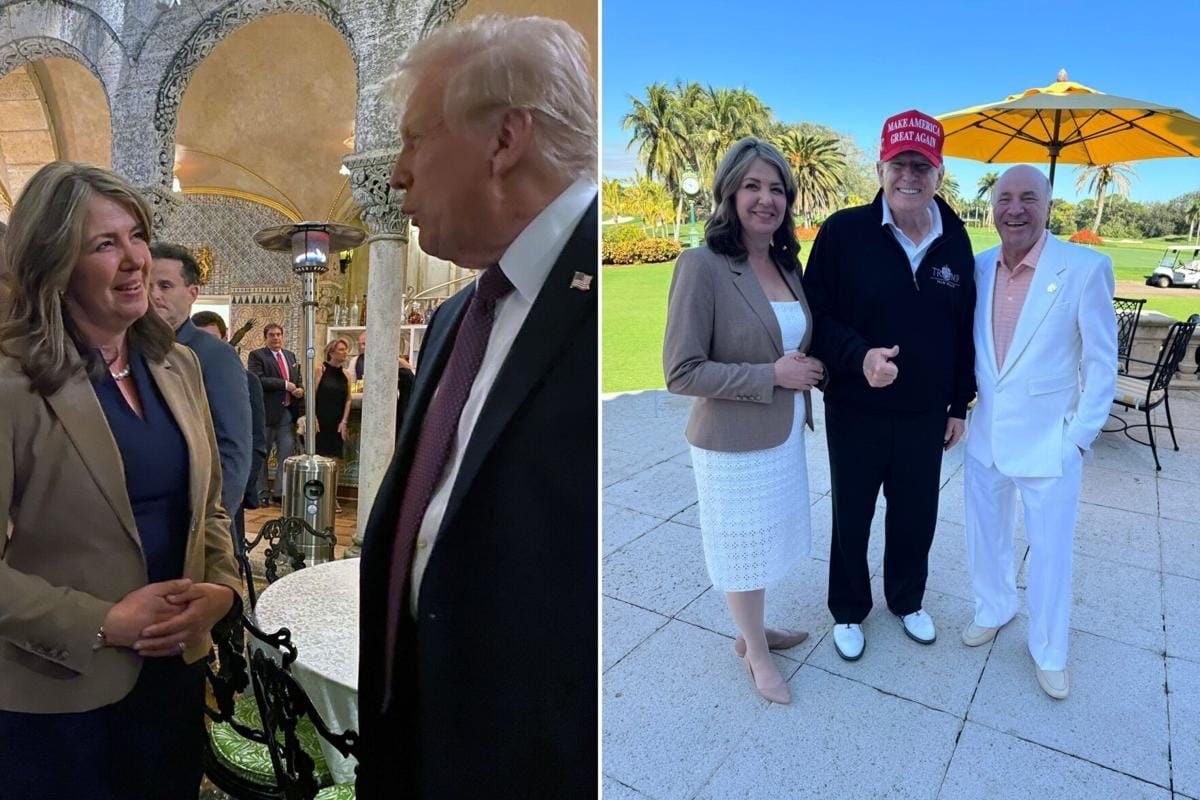
Smith met Donald Trump at Mar-a-Lago on the evening of 11 January 2025 and again at his golf club the following day, with Kevin O'Leary and Jordan Peterson present at the Saturday event. Expense records put the trip at $10,101.87. Smith said afterwards that she had emphasised "how hundreds of thousands of American jobs are supported by energy exports from Alberta."
Alberta refused to sign the first ministers' joint statement on the tariff threat on 15 January 2025 and Smith skipped the closing news conference, saying Alberta would not agree to export tariffs on its energy. She travelled to the United States for the inauguration on 18 January, and her office confirmed the following day that she could not attend the ceremony after it moved indoors.
Smith told Breitbart News on 8 March 2025 that she had asked officials in the Trump administration to delay tariffs until after the Canadian election. "I would hope that we could put things on pause is what I've told administration officials," she said, and "let's just put things on pause so we can get through an election." She said the dispute was "benefiting the Liberals right now" and that Pierre Poilievre's perspective "would be very much in sync with … the new direction in America." Blackett said any suggestion she had asked for interference was offensive and false, and Nenshi called the remarks antithetical to democracy.
Smith told the legislature on 26 March 2025 that "it's apparently treason to talk to American media personalities that we disagree with." The following night she appeared with Ben Shapiro at PragerU's East Coast Gala at Boca Raton, Florida, on a government trip that cost $19,442. Shapiro had said in December 2024 that Canadians "will greet us as liberators" if Trump annexed the country. Smith told the audience that annexation "would be like adding another California to your electoral system", and she had told a Center for Strategic and International Studies podcast two weeks earlier that Albertans "don't want to be the 51st state."
Alberta has registered under the US Foreign Agents Registration Act 15 times since 2000, more than any other province and more than the federal government, and agreed in October 2024 to pay Capitol Counsel LLC $1.2 million over two years for US government relations work. Smith sits on the Governors Coalition for Energy Security chaired by Louisiana Governor Jeff Landry, whom Trump appointed special envoy to Greenland in December 2024.
Smith supported the federal retaliation package on 4 March 2025 and pulled US alcohol from Alberta shelves two days later. She said on 25 July 2026 that she would not answer Trump's threatened 50 per cent tariff with an alcohol ban or energy tariffs. US tariffs of 50 per cent on a list of Canadian goods took effect over the weekend of 22 August, Carney suspended negotiations and announced matching tariffs from 8 September, and Trump wrote on Truth Social on 23 August that "Canada wants the benefits of being a State, without being one!!!" Smith said US demands had been untenable while warning that retaliation means Canadians "are now going to face upwards of 50 per cent tariffs." She rejected calls to postpone the referendum, saying 700,000 citizens had signed one of two petitions asking for the question now.
Voter list breach
Personal records of roughly 2.9 million Alberta voters, including names, addresses, phone numbers and elector identification numbers, were published online through a database linked to the separatist Centurion Project and its leader David Parker. Elections Alberta found 21 people received full copies and 545 accessed the database while it was live, and took the site down in April.
A proposed class action filed in the Court of King's Bench on 30 June names the Alberta government, Elections Alberta, the Republican Party of Alberta, Parker and unnamed individuals. The statement of claim alleges a staggering failure and identifies a vulnerable subclass including domestic violence survivors, judges, politicians, health workers and journalists. The RCMP, Elections Alberta and the provincial privacy commissioner are all investigating.
What Albertans and other Canadians would face
Carney told the House of Commons on 26 May that federal legal advisers had concluded the Clarity Act does not apply to the Alberta question, because the ballot does not ask whether the province should cease to be part of Canada. The Act would engage only at a later binding vote, when the House of Commons would rule on the clarity of the question before it is put and on the clarity of the majority after it. Section 3 bars a minister from proposing a secession amendment unless negotiations have addressed the division of assets and liabilities, changes to the province's borders and the rights, interests and territorial claims of the Aboriginal peoples of Canada.
Section 91(24) of the Constitution Act, 1867 assigns Indians and lands reserved for the Indians to Parliament, so Alberta's 140 reserves, about 812,771 hectares, are federal Crown land, and section 35 of the Constitution Act, 1982 recognises and affirms existing Aboriginal and treaty rights, which cannot be extinguished by legislation. Mercredi said on 24 May that "Treaty No. 8 was entered into with the Crown long before Alberta became a province", and Treaty 8 has asked the prime minister to review the referendum question under the Clarity Act despite his position that it does not apply. Grand Chief Joey Pete of the Confederacy of Treaty Six First Nations marked the treaty's 150th anniversary at Edmonton City Hall on 17 August by noting the absence of Alberta Indigenous Relations Minister Rajan Sawhney. "Where's our minister of Indigenous (relations)? She's not even here. 150 years, is that reconciliation?" he said, adding that provincial ministers "come to us and all they talk about is pipelines." Sawhney's press secretary Karah Folk said the minister was away and remains in regular contact with Treaty 6 leaders.
A LifeWorks analysis commissioned by Alberta Treasury Board and Finance in August 2023 put Alberta's share of Canada Pension Plan assets at about $334 billion, or 53 per cent of the fund, against an Alberta share of contributions of about 16 per cent. University of Calgary economist Trevor Tombe puts the share at 20 to 25 per cent and the Canada Pension Plan Investment Board has estimated about $100 billion. Chief Actuary Assia Billig rejected the LifeWorks reading in an interpretation released on 20 December 2024 and set out no figure of her own. The statutory withdrawal machinery governs a province leaving the plan while staying in Canada, so on secession the division would fall to negotiation with no formula at all.
Alberta Federation of Labour research put the Canada Health Transfer to Alberta at $6.6 billion and the Canada Social Transfer at $2.1 billion in 2025-26, and Alberta's share of Government of Canada debt at $75 billion to $100 billion. Deposit insurance, mortgage default insurance and the contribution room Canadians hold in tax-free savings accounts and registered retirement savings plans are all creatures of federal statute, and Neo Financial co-founder Jeff Adamson wrote on 30 May 2026 that no mechanism exists to move accumulated room into a new system. Alberta would keep the Canadian dollar only as a user, with no seat at the Bank of Canada and no lender of last resort.
Lawrence Herman of the C.D. Howe Institute wrote on 19 August 2026 that the Canada-United States-Mexico Agreement contains no accession clause, so entry would need the agreement of all three governments, and that World Trade Organization membership would require its own negotiation. Roughly 88 per cent of Alberta's merchandise exports go to the United States and the pipelines that carry most of its crude run through other provinces.
Modelling published on 24 June 2026 by the Calgary Chamber of Commerce, drawing on Tombe's analysis, put the annual hit at about $62 billion of Alberta gross domestic product on an assumed 8 per cent rise in trade costs, with about 175,000 jobs exposed. Tombe told Global News on 4 June that about 50,000 fewer Albertans would be employed. A University of Calgary study commissioned by the province for $1.5 million was due to reach Treasury Board and Finance this month and had not been published on 23 August.
Angus Reid found 61 per cent for remaining and 33 per cent for starting the process in a survey of 1,017 Albertans fielded 10 to 13 August, accurate within three points 19 times out of 20, with 41 per cent of those choosing the process describing it as a message to the federal government rather than a bid for independence. Abacus Data found 76 per cent of Canadians outside Alberta want the province to stay and 4 per cent want it to leave. Research Co. found 62 per cent of Canadians, and 54 per cent of Albertans, say the federal government should not allow Alberta to separate even after a binding referendum.
The case for a full investigation
Duheme's letter of 17 July says more than the force said on 17 June, when it confirmed only that it was aware of the chiefs' statement and would not comment further. Investigative units now hold the resolution and are measuring it against the criteria for opening a criminal file, which is the stage at which national security referrals in Canada most often end without the public learning anything.
Feasby's finding that consent is required to change a party to the Numbered Treaties, and Leonard's finding that Alberta breached its duty to consult, give the chiefs their opening argument. The Canadian Security Intelligence Service Act shelters lawful advocacy, protest and dissent. Two judges of the Court of King's Bench have now found that the province's route to a separation vote was not lawful, and the province answered the first ruling by repealing the compliance provision and the second by moving its question to a different statute. Whether conduct twice found unlawful still sits inside the carve-out is a question no Canadian court has been asked.
Eby used the word treason on 29 January about the State Department meetings rather than about Smith, and Ford called those meetings unacceptable and unethical the same day. Smith declined to use the word about either.
Sections 20.2, 20.3 and 20.4 of the Foreign Interference and Security of Information Act carry life imprisonment, and none of them requires force, violence or a state of war. Subsection 20.4(5) reaches provincial referendums by name. Parliament wrote those offences in June 2024 and no prosecution has yet tested what surreptitious or deceptive conduct in association with a foreign entity means in a provincial campaign. The chiefs' fourth ground asks the RCMP to weigh whether they reach this one.
Hogue's terms of reference confined her to federal electoral processes and expressly excluded provincial governments, and the states her report named were China, Russia, India, Pakistan and Iran. Canada's one national examination of foreign interference was barred from the ground the chiefs are standing on, and no other body has been asked to cover it.
The Security Offences Act gives the RCMP primary responsibility for offences arising from threats to the security of Canada and lets the Attorney General of Canada take any resulting prosecution away from the province by serving a fiat, which matters because the provincial attorney general on Duheme's distribution list sits in the cabinet the resolution names. Nothing in that Act requires the force to announce what it decides, and an assessment that closes leaves no public record, which is why the chiefs are asking for an answer they can see.
Ellis said on 6 May that an RCMP deputy commissioner had found no credible information that the separatist movement has been subject to foreign interference. Smith is campaigning for the No side. Rath urged an internal move to remove her in May 2026 and her office denies Modry's account of a private conversation. The chiefs' answer is that they asked for an investigation rather than a verdict, that the offences Parliament wrote in 2024 require no force at all and that an assessment which never opens a file cannot test any of it.
Filing under the transparency act closes on 3 October, 16 days before Albertans vote.
What the case would have to show
Subsection 46(2)(a) is the only branch of the treason section that mentions a provincial government, and it requires force or violence. The espionage branches require military or scientific information passed to an agent of a foreign state. High treason requires levying war against Canada or assisting an enemy at war with it. Behind those elements sit three procedural rules: a conviction cannot rest on one witness, an overt act must be pleaded in the indictment, and where the overt act is public speech an information must be sworn within six days of the words, which would bar any case built on Smith's interviews. No charge has been laid under section 46 in Canada since 1947.
Sections 20.3 and 20.4 turn on conduct that is surreptitious or deceptive, and Alberta's dealings with the United States have been filed, published or broadcast. The province has registered under the Foreign Agents Registration Act 15 times, the Capitol Counsel contract and the trip expenses are public documents, and the request to delay tariffs until after the Canadian election was made on a radio show that publishes its own transcripts. Conduct on that record does not meet an element that requires concealment, and the networks McQuinn's researchers are counting fit it better than a premier giving an interview does.
Feasby struck down the use of a statutory scheme and Leonard found a duty to consult unmet, which are administrative and constitutional failures. The CSIS Act reaches activities directed toward undermining the constitutionally established system of government by covert unlawful acts, or toward its destruction or overthrow by violence. Losing a duty-to-consult case is neither, and the argument that a course of conduct twice found unlawful falls outside the shelter for lawful advocacy has never been put to a Canadian court.
Modry and Rath went to the State Department, and both of them want Smith gone. Rath urged an internal move to remove her in May 2026, her office denies Modry's account of a private conversation with her, and she is campaigning for the No side, all of which a prosecutor weighing association with a foreign entity would have to account for.
Two rulings from the Court of King's Bench, section 35 of the Constitution Act, 1982, section 91(24) of the Constitution Act, 1867 and section 3(2) of the Clarity Act, which makes the rights, interests and territorial claims of the Aboriginal peoples of Canada a mandatory subject of any secession negotiation, are the ground the chiefs have actually won on. Mercredi was asked on 18 June whether the conduct fits the legal definition of treason and said: "I'm not too sure. We're not too sure yet."
Premier's response
Smith called the treason allegation disgraceful on 17 June and told the chiefs to "check themselves", saying such language has no place in a democracy while asking for respect for the province's jurisdictional aims.
Bruce McAllister, executive director of Smith's Calgary office, wrote on X on 18 June that chiefs should fix addiction, housing, poverty, unemployment and child welfare in their own communities before accusing the premier, and called their concerns "childish nonsense." Treaty 7 First Nations Chiefs' Association CEO Anne Many Heads reserved formal comment and repeated the call to hold Smith accountable.
Fraser's office declined to comment and the federal Justice Department deferred to the RCMP. Amery's office deferred to Alberta's Ministry of Indigenous Relations, which had not responded by publication.
RCMP headquarters said assessments of this kind run independently and on the available evidence, and that the force does not discuss private correspondence. Spokesperson Lisa McDonald-Bourg wrote that generally, "only in the event that an investigation results in the laying of criminal charges" would the force confirm one exists.
Chiefs' reply
Joey Pete, grand chief of the Confederacy of Treaty Six First Nations, answered the premier's instruction on 17 June. Smith had spent the period "trying to steamroll her separatist regime onto the rest of Albertans as well, and infringing on the Constitution that built the framework of Canada," he said. "Her and her government need to check themselves, and remember who they work for."
Mercredi answered in writing the same day. Dismissing the concerns of Treaty nations as overwrought "does not answer the serious constitutional and legal questions that have been raised," he wrote, and "it is the actions of government that must be checked against the Constitution, the treaties, the rule of law, and the honour of the Crown." He told APTN News that "there's a lot of questions to be asked here" and that the nations were "checking ourselves as treaty nations, and we're making sure that she's being checked as well."
Mercredi answered Anderson's post the next day. "It's too bad that the premier has to resort to these types of words and allowing her staff to put out social media," he told Global News on 18 June, adding that the nations were weighing what else to ask for. "Maybe we'll be asking for a resignation as well." Athabasca Chipewyan First Nation Chief Allan Adam had already put it in two words at an Edmonton gathering on 29 January. "Resign, immediately," he said, and told the premier that "when this referendum is defeated, I will gladly walk you to the border."
Mercredi said at a news conference on 4 June what the nations would do if the vote proceeds. "When we say that we'll take a look at all avenues, that means everything," he said. "That means stopping industry, that means maybe going out on the highways, that means doing what we need to do to be heard on this issue of separation." Sturgeon Lake Cree Nation Chief Sheldon Sunshine said at the same conference that "when we're talking about every means necessary, we mean every means necessary", and listed legal action and civil disobedience among the options.
Mercredi had written to Smith the day before. "We state this plainly so that there can be no misunderstanding: there is no lawful path by which Alberta can pursue separation from Canada while bypassing the rights, consent, and constitutional status of Treaty 8 First Nations," the letter said. "That consent has not been sought. It has not been given. Nor will it be given under duress or through any process designed to circumvent our constitutional rights."