
Jeremy Hansen becomes the first Canadian to travel to the moon. The mission carried humanity back to lunar distance for the first time in more than fifty years.
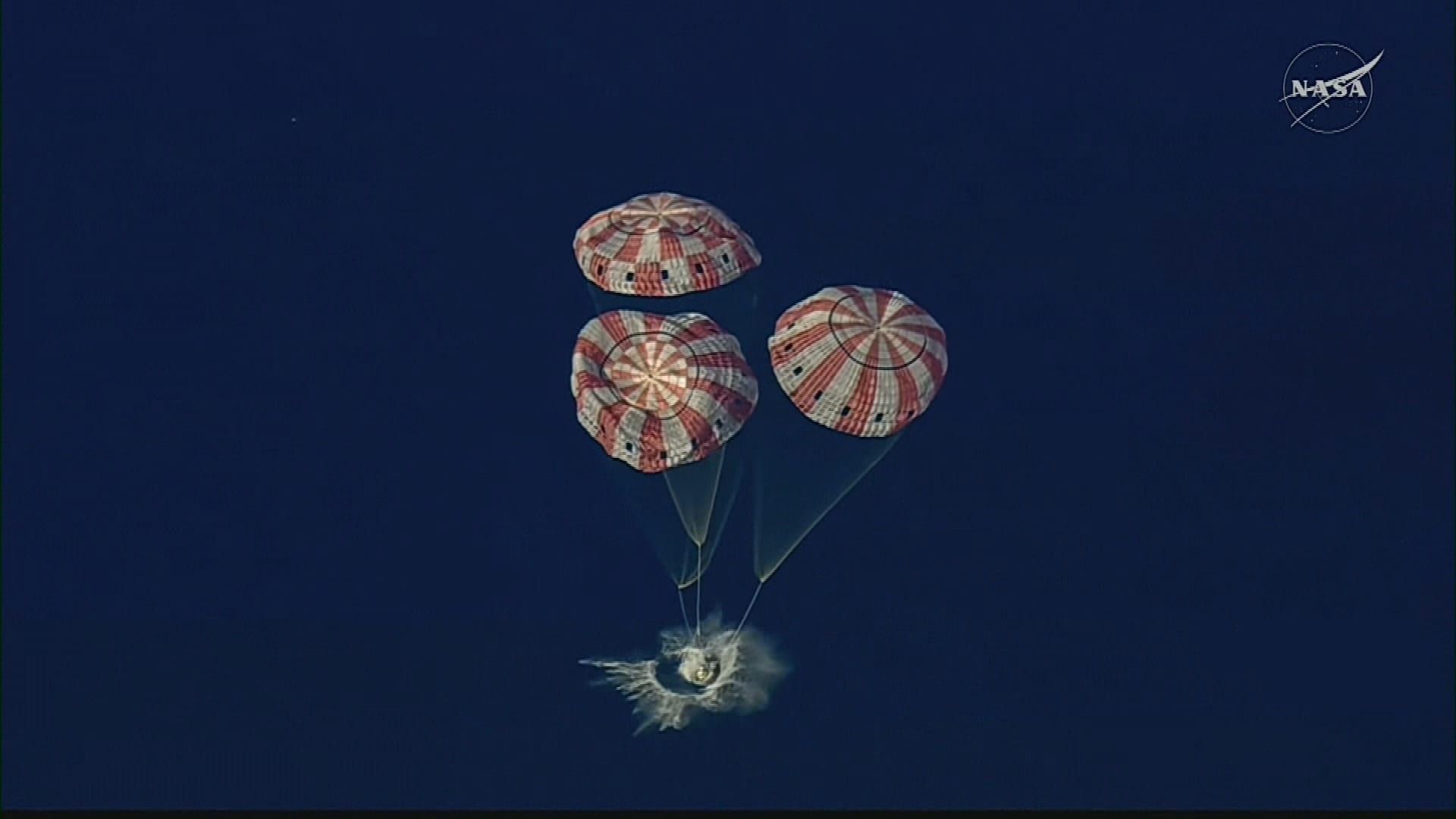
The Orion crew module hit the water in the Pacific Ocean Friday evening, carrying four astronauts back from the most ambitious human spaceflight mission since the Apollo programme ended in 1972. The splashdown ended a nine-day journey that took the crew around the moon and home again.
Canadian Space Agency astronaut Jeremy Hansen was among the four. He is the first Canadian to travel to the moon. Recovery crews reached the capsule within minutes. All four crew members were reported in good health.
The Crew
Reid Wiseman commanded the mission. A US Navy test pilot and NASA astronaut from Baltimore, Wiseman previously commanded the International Space Station during Expedition 41 in 2014. He was selected to lead Artemis II because of his flight experience and his work developing the crew training programme for the Orion spacecraft. He has spent the better part of three years preparing this specific crew for this specific flight.
Victor Glover served as pilot. A US Navy aviator and NASA astronaut from Pomona, California, Glover flew to the ISS in 2020 on the first operational Crew Dragon mission and spent six months aboard the station. He was the first Black astronaut to serve as a long-duration ISS crew member. On Artemis II, his role covered vehicle systems, propulsion, and trajectory management during the lunar transit.
Christina Koch flew as mission specialist. A NASA astronaut and electrical engineer from Grand Rapids, Michigan, Koch holds the record for the longest single spaceflight by a woman, having spent 328 consecutive days on the ISS between 2019 and 2020. That record was accumulated deliberately, partly to gather data on the long-term physiological effects of spaceflight on the female body, data that feeds directly into planning for longer deep space missions. She was originally assigned to Artemis III, which would have made her the first woman to walk on the moon. Her role was shifted to Artemis II to bring her deep spaceflight experience into the crewed test mission.
Jeremy Hansen flew as the second mission specialist. A former Royal Canadian Air Force fighter pilot from London, Ontario, selected by the Canadian Space Agency in 2009, Artemis II was his first spaceflight. Canada's seat was secured through the country's contribution to Canadarm3 for the Gateway lunar space station.
The Mission
Artemis II was a crewed lunar flyby, not a landing. The crew flew a free-return trajectory around the moon, reaching a maximum distance of approximately 8,900 kilometres from the lunar surface before the trajectory carried them back toward Earth without requiring a powered burn. The free-return path was deliberately chosen. If propulsion systems had failed at any point past a certain threshold, the physics of the trajectory would have returned the crew to Earth automatically.
That design choice reflects a hard lesson from the Apollo programme. Apollo 13 survived its oxygen tank explosion in 1970 partly because the crew could use the lunar module as a lifeboat and the free-return trajectory to come home. Orion has no lifeboat. The trajectory is the contingency.
The mission's primary purpose was testing. Every major system on Orion, life support, navigation, communication, thermal management, re-entry, was evaluated under actual crewed deep space conditions for the first time. Simulators and unmanned test flights, including Artemis I in 2022, can only validate so much. Human bodies generate carbon dioxide, humidity, and heat in patterns that affect systems differently than unmanned flights. The crew's presence was itself part of the test.
Communication delay between the spacecraft and ground control reached approximately 1.3 seconds at maximum lunar distance, a small number that becomes significant during time-sensitive operations. The crew trained extensively for the communications lag and conducted a series of exercises during the outbound and return transit to document how it affects decision-making and ground coordination. Those findings feed directly into protocols for Artemis III and beyond, where communication delays during surface operations will be a constant factor.
The crew also conducted biomedical monitoring throughout the mission. All four wore sensor arrays tracking cardiovascular function, sleep patterns, radiation exposure, and cognitive performance. The data gathered over nine days of deep space transit is the most detailed human physiological dataset from beyond low Earth orbit ever collected, and it will be studied for years.
What They Learned
Radiation was among the most closely watched variables. Beyond Earth's magnetosphere, the crew was exposed to galactic cosmic rays and solar particle radiation at levels that cannot be replicated in ground-based facilities. Orion carries dedicated radiation monitoring hardware, and each crew member wore personal dosimeters throughout the mission. The results will inform shielding design for Gateway, the lunar space station, and eventually for any crewed vehicle intended to travel further than the moon.
The crew conducted a series of manual piloting exercises during the mission, including manual docking simulations and systems override drills, to evaluate how well Orion's interface supports crew autonomy when communication with ground control is delayed or disrupted. The findings were not made public before splashdown, but NASA has indicated the data will shape the cockpit interface revisions planned for Orion Block 2, the vehicle configuration intended for sustained lunar operations.
Sleep quality in deep space, away from the regular day-night cycle that ISS crews experience as they orbit Earth every ninety minutes, was monitored and will be analysed. The psychological and physiological effects of a truly black sky in all directions, with Earth visibly shrinking and the moon visibly growing, have been discussed theoretically for decades. Artemis II produced the first modern data.
The heat shield performed through re-entry. Orion returned to Earth at speeds approaching 40,000 kilometres per hour, generating temperatures on the shield face of roughly 2,760 degrees Celsius. The Artemis I unmanned re-entry in 2022 revealed unexpected ablation patterns in the heat shield material. Engineers modified the design for Artemis II. Friday's splashdown will confirm whether those modifications resolved the problem. Full analysis of the heat shield condition will take several weeks.
The Moon Base
Artemis III, targeting the lunar south pole, is the next mission. It will carry the first woman and the first person of colour to the lunar surface. A confirmed landing date has not been announced, though NASA has indicated a target in the 2027-2028 range.
The south pole is the destination for a reason. Permanently shadowed craters at the lunar south pole contain water ice, confirmed by orbital observations and India's Chandrayaan missions. Water ice at the lunar surface is not a scientific curiosity. It is a resource. Broken into hydrogen and oxygen, it becomes rocket propellant. As drinking water and for oxygen generation, it supports human habitation. The south pole is where a permanent lunar presence becomes physically viable in a way it would not be elsewhere on the moon.
The Gateway lunar space station, currently under construction by NASA and its international partners including Canada, Japan, and the European Space Agency, will be positioned in a near-rectilinear halo orbit around the moon. It will serve as a staging point for surface missions, a laboratory for deep space research, and a communications relay. It is not a permanent surface base. It is the infrastructure node from which surface operations will be coordinated.
The surface base itself is the longer-term objective. NASA's Artemis programme documents describe a sustained human presence at the lunar south pole as a goal of the 2030s, with a permanent outpost supported by in-situ resource utilisation, the technical term for using materials found on the moon rather than launching everything from Earth. That includes water ice processing, regolith construction materials, and eventually solar energy infrastructure. The logistics of supplying a moon base from Earth are prohibitive at any scale. The base has to be built, at least partly, from what is already there.
Asteroid Protection and Planetary Defence
The moon programme sits inside a broader planetary defence architecture that has accelerated significantly since NASA's DART mission successfully redirected the asteroid Dimorphos in September 2022. DART was the first practical demonstration that a kinetic impactor, a spacecraft deliberately crashed into an asteroid, can measurably alter the trajectory of a small body.
The follow-up mission, ESA's Hera spacecraft, arrived at the Dimorphos system in late 2026 to conduct detailed measurements of the crater DART created and the changes in the asteroid's orbit. The data from Hera will refine the models used to calculate how much force is needed to deflect asteroids of different sizes and compositions, which varies considerably depending on whether an asteroid is solid rock, a loose aggregate, or something in between.
A permanent lunar presence strengthens planetary defence in practical terms. A base or station at the moon provides a deep space observation platform closer to the asteroid belt than any Earth-based facility. Telescopes and radar systems positioned at the lunar south pole would have sightlines into regions of the inner solar system that are difficult to monitor continuously from Earth, particularly for asteroids approaching from the direction of the sun.
The moon also offers a potential staging point for future deflection missions. Launching an interception spacecraft from the lunar surface or from Gateway requires significantly less energy than launching from Earth's gravity well, which extends the range of objects that can be reached within operationally useful timescales.
The European Space Agency's Space Situational Awareness programme and NASA's Planetary Defense Coordination Office are both expanding observation capacity in the coming years. Both programmes have identified lunar infrastructure as a long-term asset for detection and response capability.
Mining and Resource Utilisation
The economic case for lunar resource extraction has moved from theoretical to actively contested territory in the past decade. Water ice at the south pole is the primary target, but lunar regolith also contains helium-3, a rare isotope with potential applications in future fusion energy, along with rare earth elements, titanium, and aluminium.
The legal framework for space resources remains unsettled. The 1967 Outer Space Treaty prohibits national appropriation of the moon or other celestial bodies but does not explicitly address the extraction of resources by private or state-backed entities. The United States passed the Commercial Space Launch Competitiveness Act in 2015, which grants American citizens the right to own resources they extract in space. Several other countries have passed similar domestic legislation. The Artemis Accords, signed by more than thirty countries including Canada, establish principles for resource extraction in space that are consistent with this interpretation, though the Accords are not a binding treaty.
China and Russia, neither of which has signed the Accords, have objected to this framework and are pursuing their own lunar programme, the International Lunar Research Station, with a different governance model. The competing programmes represent not just a scientific and commercial contest but a geopolitical one, over who sets the rules for activity on and around the moon in the coming decades.
Canada's position inside the Artemis architecture, with guaranteed mission seats and a central role in Gateway's robotics, places the country firmly in one camp in that contest. The Canadarm3 contract is not only a scientific contribution. It is a strategic alignment.
What This Means for Canada
Canada has been a presence in human spaceflight since Marc Garneau became the first Canadian in space in 1984. Chris Hadfield commanding the ISS in 2013 was the high point of that era. Hansen's lunar mission is a categorically different achievement. It is the first time a Canadian has left Earth orbit.
Canada's participation in Artemis is not peripheral. Canadarm3, the robotic system Canada is building for Gateway, is a core piece of infrastructure for the entire programme. In exchange for that contribution, Canada secured two guaranteed seats on Artemis missions. Hansen's flight was the first. A second Canadian mission slot remains in the agreement.
The practical benefits extend beyond the flights. Canadian aerospace companies and universities are directly involved in the engineering, design, and testing work feeding into Artemis and Gateway. That work generates employment and research output in robotics, artificial intelligence, and remote systems engineering, fields with broad applications outside spaceflight.
There is an economic argument too. Countries holding guaranteed seats in crewed deep space programmes attract talent, investment, and international research collaboration. Canada's position inside the Artemis architecture is a long-term infrastructure asset at a moment when the rules and relationships governing activity beyond Earth orbit are still being written.
Hansen has used his public role to connect the programme to Canadian students and Indigenous communities. The CSA has developed partnerships with Indigenous communities on space science and Earth observation in recent years, a growing dimension of Canadian space policy that the Artemis programme has given new visibility.
What Comes Next
Canada's second Artemis mission slot has not been assigned. A new generation of CSA astronaut recruits are in active training. Who fills that seat, and on which mission, will be one of the more consequential decisions in Canadian science policy over the next several years.
Beyond individual flights, Gateway is the structure that will define sustained human presence near the moon through the 2030s. Canada is not a passenger in that project. It is building the robotic arms the station requires to function. That gives the CSA a durable role in whatever follows Artemis III, including missions that have not yet been formally announced.
Friday's splashdown closes the first chapter. The programme it belongs to is in short, ready for take off.