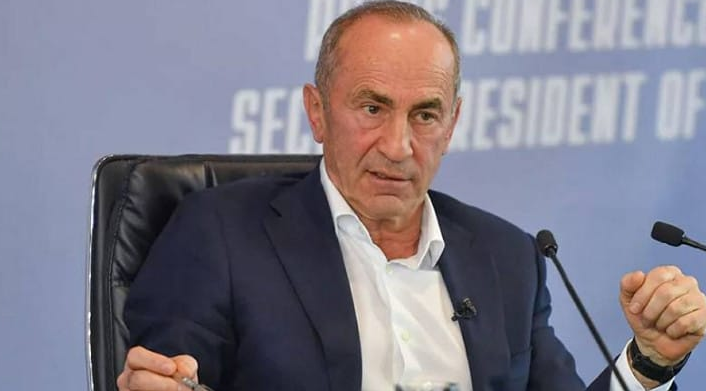
Robert Kocharyan spent the night of Thursday 27 August in the Yerevan-Kentron penitentiary, three days after a parliamentary exchange about his family's money and two weeks after heart surgery. The Anti-Corruption Court had ordered him held for two months while investigators finish a case that reaches back to his first year as president. He was not in the room when the ruling came. Doctors had taken him out of the hearing and the court finished the examination without him, then sent him from the Surb Grigor Lusavorich Medical Centre to a cell.
Judge Sargis Dadoyan granted the investigator's motion in full, according to Marina Ohanjanyan, spokesperson for the Anti-Corruption Committee, who said the court "fully granted the investigator's motion and ordered detention as a preventive measure". Kocharyan, 71, president from 1998 to 2008, faces nine counts: three of abuse of official powers, two of receiving a bribe on a particularly large scale and four of money laundering on a particularly large scale. He denies all of them. His eldest son Sedrak, a businessman, was remanded for the same two months a day earlier.
Twenty-four hours
Nikol Pashinyan told parliament on Monday 24 August that Armenia could lodge an application for European Union membership in the near future. In the same sitting the prime minister turned to the opposition MP Levon Kocharyan, the former president's younger son and the husband of the singer Sirusho. "Why is your family a millionaire? Where did you get that wealth from?" Pashinyan said, telling him that inherited wealth of that kind "won't happen" and that assets gained at public expense should be returned to the state. Levon Kocharyan replied that the court, and not the country's top official, should decide what is returned to whom, and accused Pashinyan of breaching the presumption of innocence. He also called him a traitor.
Investigators went to several dozen addresses the following morning. Searches covered Robert Kocharyan's residence and his sons' homes, the Yerevan office of Toyota, the Orange Fitness club, the Play City entertainment centre and the offices of Sirusho Production. Six people were detained, among them Kocharyan and Sedrak. Four of the six were remanded in custody on 26 August and one, Aramayis Voskanyan, was placed under house arrest. Sedrak Kocharyan's lawyer Alexander Kochubayev said his client's visits had been restricted with an exception for his wife and children, and that the defence would challenge the ruling.
Criminal prosecution was announced the same week against nine more people. Serzh Sargsyan, Kocharyan's defence minister and then his prime minister before serving as president himself from 2008 to 2018, was charged and given a travel ban rather than detention; he appeared at the Anti-Corruption Committee with his lawyer on 25 August and told journalists he was not yet aware of the case he had been summoned over. Gagik Beglaryan, a former mayor of Yerevan, and the businessman Samvel Mayrapetyan, a shareholder in Local Developers LLC, were also named. The Armenian outlet 301.am reported that the charge list includes Andranik Margaryan, the prime minister who died in 2007; the Anti-Corruption Committee has not explained that entry. Armenpress put the total number charged at 10, RFE/RL at 14.
What the committee says the money bought
A 2-hectare plot at the Cascade complex in central Yerevan was acquired for AMD 39.63 million, exchanged for another state plot in a better position and later sold on for AMD 1.742 billion, a return of roughly 44 times the entry price on the committee's own figures.
Land of 8.3 hectares beside Acharyan and Tsarav Aghbyur streets went for AMD 44.657 million. The Play City entertainment centre was built on it in 2002 and in 2004 a 50 per cent stake in Fast Card, the company holding the site, was donated and registered to Sedrak Kocharyan. The Kaputak Sevan resort complex in Gegharkunik province was acquired for AMD 83.669 million, with half of the company Art Build registered to Sedrak in January 2010. A 29,000 square metre site at 7/1 Tsitsernakaberd Highway, held by an Olympic reserve sports school and carrying a 1,700 square metre building, changed hands for AMD 12.267 million; the Orange Fitness club was built there in 2008 and half the owning company again went to Sedrak. A building at 8 Paronyan Street cost AMD 40 million, its 600 square metres of commercial premises are valued at AMD 331.8 million, and two parking spaces were registered to Sedrak Kocharyan through transactions investigators describe as fictitious.
The Officers' House at 20 Vazgen Sargsyan Street, a listed historical and cultural monument, and an unfinished building at 16 Nalbandyan Street were transferred to the company Piazza Grande. Investigators say 56 properties worth AMD 2,633,934,832, about $7 million, went the other way to Kocharyan, and charge him with taking them as a bribe.
Defence ministry plots 22 and 22/4 on Admiral Isakov Avenue, earmarked for a research and production facility and assessed at AMD 1.394 billion, were sold for roughly AMD 348.5 million. A 30 per cent stake in Toyota Yerevan was transferred to Sedrak Kocharyan on 9 May 2006. Investigators treat the stake as payment for the discount of about a billion drams on land the defence ministry had been holding, and charge that transfer as the second bribe.
Money moved in Sedrak Kocharyan's name between 2001 and 2019 came to AMD 144 billion, worth about $310 million, alongside $309 million, 77 million euros and 18 million roubles held in those currencies. More than three dozen properties in Armenia and abroad are under examination and restrictions have been placed on selling or transferring them. Pashinyan has instructed law enforcement to strip both Kocharyan and Sargsyan of property.
The dates the defence is working on
The Armenia Alliance published a statement on 25 August. "This is not a legal process. It is the open subordination of the state apparatus to one individual's political fears and desire for revenge," the bloc said, describing the government's methods as blackmail, unlawful proceedings and fabricated prosecutions, and saying that no dictatorship lasts forever and that those who ordered and carried out the actions would be held to account.
Ara Vardevanyan, a vice-speaker of parliament, said the case raises serious legal questions because the circumstances have been known to the authorities since 2018, the year Pashinyan came to power and the year the first criminal case against Kocharyan was opened. The MP Artur Khachatryan said the government was applying "political pressure on all opponents, packaged in absurd criminal charges". Armen Ashotyan, deputy chairman of the Republican Party, said "a political reprisal is being carried out against Robert Kocharyan". The Prosecutor General's Office answered the obvious objection to a case built on transactions from 2002 to 2010 with a single line: the statute of limitations for prosecuting Kocharyan has not expired. It did not publish the reasoning.
Armenia's Central Election Commission lifted Kocharyan's parliamentary immunity on 17 June in a closed session from which journalists were barred. The commission rather than parliament took the decision because Kocharyan headed the Armenia Alliance electoral list. The request from the Prosecutor General's Office at that point concerned a 2004 government-approved transaction involving the Master Class tennis complex, a transaction that does not appear among the property counts made public in August. Bagrat Mikoyan, the head of Kocharyan's office, said at the time that the government could have opened a case by its own decision instead of going through the commission, called the move a continuation of unlawful actions and noted that Kocharyan had discovered a travel ban two days earlier when he reached the airport. Kocharyan's lawyers said he had no connection to the tennis complex transaction and that the government decision behind it was never challenged.
Aram Orbelyan, Kocharyan's lawyer, said the defence will appeal the detention order once it receives the written decision, and is weighing applications to international courts and human rights bodies. "The developments surrounding Robert Kocharyan and his family are unlawful and, in the broader political context, even more troubling," Orbelyan told Sputnik Armenia. Kocharyan had heart surgery about two weeks before his arrest and was hospitalised for high blood pressure after it. The newspaper Zhoghovurd reported that his requests over hospital treatment were refused.
The rest of the opposition
Voters returned Pashinyan's Civil Contract to power on 7 June with 49.81 per cent and 64 of the 105 seats in parliament, on a turnout above 58 per cent. Strong Armenia took 23.29 per cent. The Armenia Alliance, which Kocharyan has led since 2021, took 9.9 per cent and 12 seats. Gagik Tsarukyan's Prosperous Armenia missed the 4 per cent threshold by 0.02 percentage points. The government came out of the vote short of the two-thirds majority it needs for the constitutional change tied to the peace agreement with Azerbaijan.
Samvel Karapetyan, the Russian-Armenian billionaire whose Strong Armenia bloc is now the largest opposition force in parliament, has been in custody or under house arrest since 2025 on allegations that he called for the government's overthrow. He denies it and called the June election shameful. Catholicos Karekin II and six senior clergymen went on trial on 7 August over the church's refusal to obey a court order reinstating Bishop Gevorg Saroyan, who was defrocked in January after calling for the Catholicos to step down; they face up to two years in prison. Archbishop Bagrat Galstanyan, who led the 2024 protests against the transfer of border villages to Azerbaijan, is under house arrest awaiting trial on coup and terrorism charges. Archbishop Mikael Ajapahyan was convicted of calling for the government's overthrow and an appellate court ordered a fresh trial. The Council of Europe flagged political polarisation in Armenia in January.
Kocharyan was charged in 2018 with overthrowing the constitutional order over the deaths of 10 people in the crackdown on protests that followed the disputed presidential election of February 2008. He was arrested in July 2018, released, arrested again in December, freed on bail, and the case was dropped in 2021 without a verdict after three years of custody rulings and appeals.
The Russian dimension
Dmitry Peskov, the Russian presidential press secretary, was asked about the arrest on 26 August and declined to take a position. "I would not like to comment on the domestic political developments in Armenia now. There are very complex processes underway there. One can only hope that everything that is happening will be carried out in strict compliance with the law, and the rights of all participants in the political process in the republic will be preserved," Peskov said.
Sergey Lavrov, the Russian foreign minister, was asked about the detention of both Kocharyans by RBC television on 28 August and answered about the European Union instead, saying the current Armenian leadership is guided by other questions and that its legislated course towards EU membership sits badly with trade through the Eurasian Economic Union worth more than $6 billion over three years. "Our Foreign Ministry's position is that we act in the interests of the Armenian people," Lavrov said.
Alexander Iskandaryan, a political analyst in Yerevan, said the arrest was "a signal to the Kremlin" about the government's willingness to confront Russian-aligned political forces. Kocharyan has kept close personal ties to the Russian president Vladimir Putin and his bloc campaigned in June on restoring relations with Russia. His two-month term of pre-trial detention runs to 27 October, and Armenian courts can extend that in further two-month blocks on the investigator's motion.