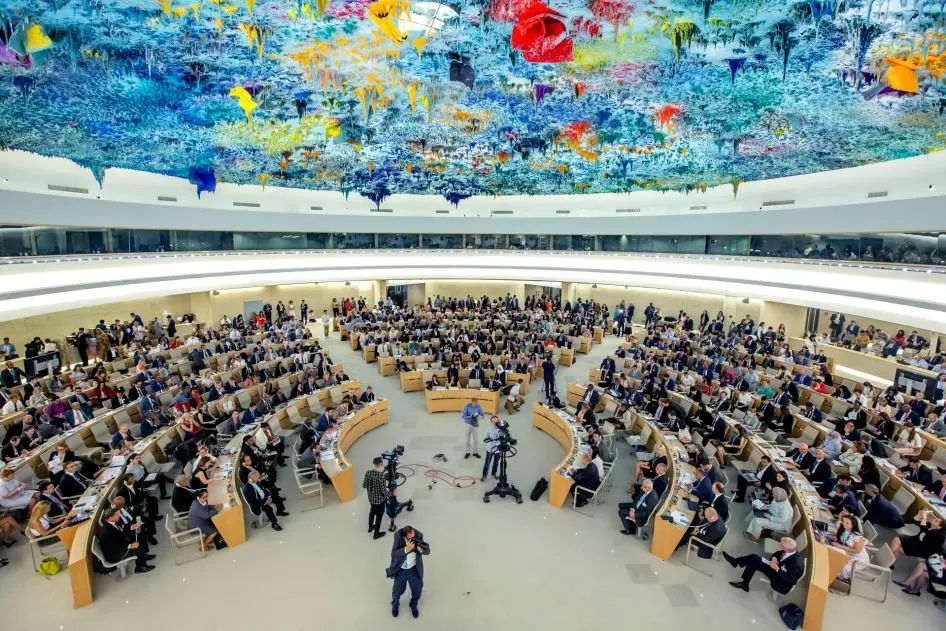
On 8 April 2026, the UN Economic and Social Council held the session that shaped the composition of two subsidiary bodies governing human rights inside the UN system. By consensus, ECOSOC nominated the Islamic Republic of Iran to the Committee for Programme and Coordination, which meets next month to set budget priorities and shape policy on women's rights, human rights, disarmament and terrorism prevention. By acclamation, ECOSOC elected China, Cuba, Nicaragua, Saudi Arabia and Sudan to the Committee on Non-Governmental Organisations for the 2027-2030 term. The Committee on NGOs is the body that decides which civil society organisations may access UN premises, attend sessions, submit statements, and speak at meetings.
The United States was the only member of the 54-nation ECOSOC to formally break from consensus. US Representative to ECOSOC Ambassador Dan Negrea delivered a statement of disassociation, calling Iran, Cuba and Nicaragua "unfit" to serve. "The regime threatens its neighbors and has, for decades, infringed on the Iranian people's ability to exercise their basic human rights," he said.
Every other ECOSOC state, including Canada, France, the United Kingdom, Germany, Spain, the Netherlands, Norway, Australia, Finland, Switzerland, Austria and Latvia, joined the consensus without speaking against. Under standard UN practice, the General Assembly vote scheduled for November 2026 on the Iran CPC nomination will ratify what ECOSOC decided on 8 April. Ali Hajilari, Iran's representative on the committee, has already been appointed a vice-chair. His term runs through 2028.
What these committees actually do
The Committee for Programme and Coordination is a subsidiary body of the General Assembly, not the Human Rights Council. It shapes the budget and programme planning for UN departments across policy areas, including gender equality, disarmament, counterterrorism, and the right to development. Its May 2026 sessions are scheduled to address gender equality on 14 May, disarmament on 19 May, and human rights and terrorism prevention on 21 May. Iran will sit on the committee setting policy on those subjects alongside Russia, South Africa and China.
The Committee on NGOs matters in ways that rarely reach headlines. It grants, defers, and revokes what UN jargon calls consultative status. Without that status, organisations documenting governments' abuses cannot formally present their findings to the bodies most capable of acting on them. The committee sits twice a year, in January and May, with 19 member states drawn from all UN regional groups. It processes thousands of applications. Hundreds of NGOs currently sit in the queue. A dozen have been waiting more than a decade.
The records of the six states now shaping UN human rights policy
Iran
Iran executed at least 1,639 people in 2025, according to the 18th annual report of Iran Human Rights and ECPM published on 13 April 2026. That is the highest annual total since 1989, a 68 percent increase on 2024, and an average of four to five hangings per day. Only 113 of the executions (under 7 percent) were announced by the authorities. Over 93 percent were carried out in secret. In 2025, Iran executed 48 women, the highest annual figure in more than twenty years, a 55 percent increase on 2024. Twenty-one of those women had been convicted of killing their husbands or fiancés, in a legal system that provides no mechanism to escape an abusive marriage and criminalises self-defence. Public hangings tripled to 11. Drug offences accounted for 48.5 percent of the total, in violation of the International Covenant on Civil and Political Rights threshold of "most serious crimes".
During the 40-day war with the US and Israel that ended on 8 April, Iranian authorities secretly hanged 14 political prisoners, 12 of them at Ghezel Hesar Prison in Karaj, including Amir Hossein Hatami, 18; Mohammadamin Biglari, 19; Shahin Vahedparast Kalvar, 30; and Ali Fahim, part of a group of seven protest detainees arrested on 8 January 2026 near Basij Base No. 185 Namjoo in Tehran, tried one month later before Branch 15 of the Tehran Revolutionary Court under Judge Abolghasem Salavati, on charges including moharebeh (enmity against God) and corruption on earth. Three of their co-defendants remain in solitary confinement facing imminent execution. Amirali Mirjafari was hanged at Qezel Hesar on 21 April, thirteen days after the ceasefire, the seventeenth political prisoner executed since the war began. Human Rights Activists in Iran (HRANA) recorded 51,790 arrests during the January 2026 protest crackdown. Time magazine cited hospital records documenting 30,304 protest-related deaths between 8 and 9 January alone.
The Iranian state rapporteur at the UN is Mai Sato, whose mandate covers exactly the kinds of violations that Iran's CPC seat is now designed to help it launder. Iran is now part of the UN body setting the budget and programme framework for gender equality, counterterrorism, and disarmament, three portfolios under which its own government is most comprehensively in violation. Iran's presence on the committee allows its delegation to obstruct funding for UN experts documenting Iranian violations, to vote on budget lines for the Special Rapporteur on its own human rights record, and to contest the framing of terminology used to describe its conduct. The vice-chair seat extends that influence to agenda-setting.
China
The 31 August 2022 assessment by the UN Office of the High Commissioner for Human Rights found that the mass detention of Uyghurs and other Turkic Muslims in Xinjiang "may constitute international crimes, in particular crimes against humanity". More than a million Turkic Muslims have been arbitrarily detained in what the Chinese state calls Vocational Educational and Training Centres, the largest incarceration of an ethnic and religious group since the Second World War. Xinjiang birth rates in mostly Uyghur regions fell by more than 60 percent between 2015 and 2018. The United States has declared the conduct a genocide, and the parliaments of Canada, the UK, the Netherlands, Lithuania and France have passed similar declarations. China has rejected every finding.
On 22 January 2026, UN experts issued a fresh statement concluding that forced labour programmes affecting Uyghurs, Kazakhs, Kyrgyz and Tibetans "may amount to forcible transfer and/or enslavement as a crime against humanity". The experts documented 3.36 million Tibetans affected by forced sedentarisation programmes between 2000 and 2025, and 930,000 rural Tibetans relocated. State-sponsored labour transfer programmes place ethnic minority workers in factories that supply global markets for electronics, cars, footwear, sportswear and critical minerals. In Hong Kong, 365 people have been arrested under the 2020 National Security Law and the 2024 Safeguarding National Security Ordinance since the laws took effect, and 174 have been convicted; almost everyone charged is convicted. The League of Social Democrats, one of the last active pro-democracy parties, disbanded in June 2025, citing "tremendous political pressure". Jimmy Lai stood trial throughout 2025 and into early 2026. In March 2025, Tibetan lama Humkar Dorje Rinpoche died in Vietnam in suspicious circumstances after fleeing Tibet, one data point in what UN experts describe as a pattern of transnational repression.
China has been a member of the Committee on NGOs continuously for years and has used that seat to systematically obstruct accreditation of any organisation that documents its conduct. Foreign Policy published a September 2021 exposé describing China as "the most active country in stalling NGO applications at the United Nations, even if the organisations engage in the most innocuous and uncontroversial activities". The 14 January 2026 analysis cited by UN special rapporteurs found that three states, including China, asked nearly half of the 647 questions posed to NGO applicants in the committee's first 2026 session. What China buys with the 2027-2030 seat is not abstract. It is the capacity to continue indefinite deferrals of every Uyghur, Tibetan, Hong Kong and mainland Chinese rights organisation seeking UN access. It is the capacity to vote against their accreditation if deferral ever runs out. It is the capacity to accredit government-organised non-governmental organisations (GONGOs) that present the Xinjiang re-education system as vocational training. Human Rights Watch's Louis Charbonneau, writing before the vote, called the slate of candidates "governments with human rights records that range from problematic to abysmal and with track records of restricting and even persecuting civil society at home".
Cuba
Prisoners Defenders counted nearly 700 political prisoners behind bars in Cuba as of October 2025. Justicia 11J counted 359 people still imprisoned from the July 2021 protests, with sentences of up to 22 years. On 2 April 2026, the Cuban government announced the release of 2,010 prisoners, framing it as a "humanitarian gesture". Human Rights Watch, Prisoners Defenders and Justicia 11J identified no political prisoners among those released. The government had explicitly excluded those sentenced for "crimes against authority" under the provisions, "contempt", "propaganda", "assault", that Cuban law uses to criminalise dissent. Leonard Richard González Alfonso, an artist, was sentenced in March 2026 to seven years' imprisonment for "propaganda against the constitutional order" after painting "How long? They are killing us" on a wall. In April 2025, the authorities rearrested José Daniel Ferrer García, leader of the Cuban Patriotic Union, and Félix Navarro, founder of the Pedro Luis Boitel Party for Democracy. Both had been released in January 2025 under the Vatican-brokered prisoner release. In May 2025, they rearrested Donaida Pérez Paseiro, president of the Free Yoruba Association. In March 2026, protests broke out in Morón, Ciego de Ávila, over blackouts and fuel shortages; Cubalex documented at least 85 arrests in a single month, including two teenagers.
The Cuban state controls all media. Internet access is systematically throttled, targeted blackouts are imposed during protests, and ETECSA rate hikes in May 2025 made online communication prohibitive for Cubans already surviving on incomes of roughly twenty dollars per month. Between July 2024 and June 2025, civil society organisations documented approximately 290 protests. The crackdown on independent journalists continues: Carlos Milanés (ADN Cuba, Cubanet, Radio Martí) arrested 25 May 2025; Henry Constantin (La Hora de Cuba) arrested 29 June 2025; Ángel Cuza Alfonso rearrested 25 July 2025 after serving 18 months in prison.
What Cuba buys with the NGO Committee seat is the capacity to continue the procedural obstruction of exactly the organisations currently documenting the list above. Cuba and China, together with Nicaragua, have asked the largest share of procedural deferral questions in every recent session. Cuba's precedent on this specific committee includes its July 2008 action to deny accreditation to the Human Rights Foundation, in which Cuba labelled board member Armando Valladares, the Cuban dissident who survived 22 years in Castro's prisons, a "terrorist". The same techniques will be used against Prisoners Defenders, Justicia 11J, Cubalex, Article 19 on Cuba files, and any successor organisation. Cuba also cooperates with Nicaragua on transnational repression of exiled journalists, most recently blocking the escape of José Luis Tan Estrada from Havana to Managua in December 2024. The Committee seat formalises that cooperation inside UN procedures.
Nicaragua
Human Rights Watch's 2025 country report opens with the finding that "President Daniel Ortega and his wife, Vice President Rosario Murillo, intensified repression. They have expanded the use of forced exile and citizenship revocation as ways to target critics. The government also continued to arbitrarily shut down non-governmental organizations (NGOs) and universities in large numbers, and to engage in other systematic methods of censorship and persecution." In February 2025, Ortega amended the constitution to extend his term and elevated his wife from vice president to "co-president". Their son Laureano, styled a "presidential advisor", is being positioned for eventual succession. Human rights organisations count approximately 350 deaths in the regime's 2018 crackdown on protesters. Citizenship has been revoked for more than 300 critics since 2023. Roughly one in four Nicaraguans has fled the country during Ortega's most recent term.
The Ortega government on 10 January 2026 released "tens of" prisoners under US pressure without specifying names, numbers, or whether they were political detainees, using prisoners as currency in an exchange triggered by Trump's abduction of Venezuela's Nicolás Maduro. That is what happens in a political system where every civic institution has been destroyed or captured. Ortega's NGO committee seat provides a structural block on any exile or diaspora organisation trying to document that destruction from outside Nicaragua's borders.
Saudi Arabia
Saudi Arabia executed at least 347 people in 2025, according to the European Saudi Organisation for Human Rights, setting a second consecutive all-time record. Human Rights Watch and Amnesty International broadly concur with the figure; some counts run higher, to 356. Of the 2025 executions, 69 percent, about 239, were for drug offences which under international law fail the "most serious crimes" threshold for capital punishment. Of the 292 executions Amnesty documented to 9 October 2025, 151 were foreign nationals, predominantly from Somalia (38), Ethiopia (30), Pakistan (23), Egypt (16) and Afghanistan (12), workers typically detained without interpreters or consular access. Public beheading by sword remains the standard execution method. Saudi Arabia is the only country that still uses it.
On 14 June 2025, the day after Israel struck Iranian military and nuclear sites, Saudi authorities executed the journalist Turki al-Jasser after seven years of enforced disappearance. Saudi activists assessed the timing as deliberate, using international distraction to conceal the killing of a dissenting journalist. Abdullah al-Shamri, a political analyst specialising in Turkey, was executed on 27 February 2024 on terrorism charges after appearances as a television commentator. On 21 August 2025, Jalal Labbad, born 3 April 1995, was executed for offences allegedly committed while he was a minor during the 2011-2012 protests by Saudi Arabia's Shia minority. At least four more Shia men convicted for childhood offences face imminent execution, including Abdullah al-Derazi, whose sentence is pending the King's ratification. Shia Muslims make up 10 to 12 percent of the population but over 40 percent of terrorism-related executions.
The journalist Jamal Khashoggi was murdered by Saudi operatives in the Saudi consulate in Istanbul in October 2018; no senior official has been held accountable. Women's rights activists who campaigned for the right to drive, including Loujain al-Hathloul, faced multi-year prison sentences with torture allegations under Mohammed bin Salman. Doctoral student Salma al-Shehab was sentenced to 34 years' imprisonment in 2022 for a Twitter account supporting women's rights. The same Crown Prince's Vision 2030 communications operation presents Saudi Arabia as a modernising reformer, and the Kingdom now hosts the 2034 FIFA World Cup.
Saudi Arabia's Committee on NGOs seat is precisely the tool the Vision 2030 communications operation needs. Independent documentation of its executions, its treatment of foreign workers, its Shia-minority discrimination, its targeting of women's rights defenders, and its targeting of dissenting journalists sits in the work of organisations that need UN consultative status to formally present findings. Saudi Arabia will now help decide which of those organisations may.
Sudan
The UN Independent International Fact-Finding Mission for Sudan reported on 17 February 2026 that the Rapid Support Forces carried out a coordinated campaign of destruction against non-Arab communities in and around El-Fasher that "present indications pointing to genocide". The Mission found that at least three underlying acts of genocide were committed during the RSF's capture of the city on 26 October 2025: killing members of a protected ethnic group, causing serious bodily and mental harm, and deliberately inflicting conditions of life calculated to bring about physical destruction. The siege ran 18 months. Starvation, rape as a systematic weapon, torture, and enforced disappearance were documented by survivors. Mission Chair Mohamed Chande Othman concluded that the crimes "formed part of a planned and organized operation that bears the defining characteristics of genocide". Mission member Mona Rishmawi: "The RSF acted with intent to destroy, in whole or in part, the Zaghawa and Fur communities in El-Fasher. These are the hallmarks of genocide."
The OHCHR's February 2026 report documented 6,000 killings in the first three days after El-Fasher fell. Yale Humanitarian Research Lab's satellite imagery analysis of Daraja Oula neighbourhood recorded visual evidence of mass killings. Darfur Governor Minni Minnawi, himself Zaghawa, put the three-day death toll at 27,000. Kholood Khair of Confluence Advisory estimated the overall toll at around 100,000 given the communications blackout and absence of governance. Since 15 April 2023, when the civil war between the Sudanese Armed Forces and RSF began, the conflict has displaced over 12 million people and produced at least two confirmed regional famines. One child dies every six minutes from malnutrition in North Darfur, according to UN figures. RSF fighters are documented executing amputees and people with Down syndrome. Human Rights Watch's April 2026 reporting captured the testimony.
The Sudanese government, which holds the country's UN seat, is the SAF side (Abdel Fattah al-Burhan), not the RSF, which gives the international community a slightly more complicated question than the Iran, China, Cuba, or Saudi cases. But the SAF itself has been credibly documented as committing war crimes, obstructing humanitarian access, arresting journalists, and refusing to cooperate with the UN Fact-Finding Mission. The Mission reports that the Sudanese government refused multiple requests for assistance. Sudan's NGO Committee seat allows its government to block accreditation for organisations documenting SAF abuses alongside RSF abuses, and to maintain the situation in which no authoritative Sudanese civil society voice reaches UN spaces formally.
The deferral machine
Authoritarian governments have used committee membership for decades to block applications by organisations that document their conduct. The mechanism is procedural and opaque. A member state asks an applicant organisation written questions, which triggers deferral to the next session, six months later, while the NGO prepares written responses. The questions are often repetitive, covering finances, governance, specific activities, UN advocacy, staff, and affiliations. The process can be repeated indefinitely. In some cases, the same questions are posed session after session for years, functioning as de facto rejection while permitting states to deny they have rejected anyone.
An analysis cited by the UN special rapporteurs before the April 2026 election found that three states asked nearly half of the 647 questions posed to NGO applicants during the committee's first regular session of the year. The International Service for Human Rights counted 14 out of the 20 candidate states in the April 2026 vote as having been "singled out in UN reports documenting reprisals against those who engage with the UN".
The committee's January 2026 session provided a working example. Algeria moved to withdraw the consultative status of Il Cenacolo, an Italian organisation, and to suspend the status of Comité International pour le Respect et l'Application de la Charte Africaine des Droits de l'Homme et des Peuples, a Geneva-based group. A no-action motion from Israel to adjourn the decision failed. The vote that followed was 11 to 4. In favour: Algeria, Bahrain, Cameroon, China, Cuba, Eritrea, India, Nicaragua, Pakistan, Türkiye and Zimbabwe. Against: Chile, Costa Rica, Israel, the UK. Armenia, Liberia and the US were not in the room for the vote. Il Cenacolo's status was revoked, requiring a three-year wait before reapplication was even possible. CIRAC's status was suspended for one year. The International Service for Human Rights described the procedure as arbitrary and said it raised serious concerns about due process. In the same January session, a Philippines-based organisation called Transnational Anti-Organised Crime Intelligence Group was deferred for the ninth consecutive year since January 2018.
That is how this committee works. The election of China, Cuba, Sudan, Nicaragua and Saudi Arabia to the 2027-2030 term gives those governments, plus the states already on the committee, a majority of seats available for that kind of procedural obstruction.
What each state gains
The profit from these seats is concrete. States use Committee on NGOs membership to block the procedural path of any human rights organisation that documents their conduct. They accredit government-organised non-governmental organisations (GONGOs) as front groups that crowd out independent voices inside UN deliberations. They gather intelligence on which dissident groups are building UN-facing advocacy operations and on the individuals affiliated with them. They use UN committee service as diplomatic cover: a government that sits on the UN body that regulates NGO access can plausibly claim legitimacy on civil society questions in bilateral meetings. They coordinate voting blocs to block candidacies by democratic states and to protect each other's procedural obstructions.
The CPC seat gives Iran something narrower but more strategically important: the ability to shape the UN's programme framework and budget lines on women's rights, counterterrorism, human rights, and disarmament, for the 2027-2028 programme cycle, from vice-chair. Iran's delegation will have preview access to draft UN programmes on exactly the subjects its government is most heavily in violation of, and procedural capacity to water down their framing before they reach the General Assembly. The 14 May CPC meeting on gender equality will address Iran's own execution of women at a higher rate than any moment in the past two decades.
The OHCHR warning that was ignored
Ten UN special rapporteurs and independent experts had publicly urged democracies to put forward candidacies for the 2027-2030 Committee on NGOs term before the ECOSOC vote. The signatories included Mai Sato, Special Rapporteur on the human rights situation in Iran; Richard Bennett (Afghanistan); Nils Muižnieks (Belarus); Mariana Katzarova (Russia); Margaret Satterthwaite (independence of judges and lawyers); Siobhán Mullally (trafficking in persons); Cecilia Bailliet (human rights and international solidarity); Graeme Reid (sexual orientation and gender identity); Muluka-Anne Miti-Drummond (persons with albinism); and Alexandra Xanthaki (cultural rights).
"We are increasingly concerned by attempts of a number of States to shut civil society out of UN spaces," the experts wrote. "Some States members of the NGO Committee abuse the accreditation process by repetitive deferral of applications for ECOSOC Consultative status in successive sessions thereby prolonging the application process, sometimes for years on end. This practice affects disproportionately many organizations working on the defense of human rights." They added that some states were actively promoting accreditation of government-organised non-governmental organisations, "which crowd out authentic civil society voices and distort the Committee's deliberations". Their plain-language conclusion: "We are very disappointed to see so few champions of human rights defenders and civil society putting forward their candidacy in these elections."
More than 70 civil society organisations submitted warnings to the UN ahead of the vote. They were ignored.
The experts' warning was the same one the UN Secretary-General has issued repeatedly: continued deferral of applications amounts in many cases to de facto rejection, especially for organisations working on politically sensitive human rights issues. That warning has been on the record since the 2010s. It carried no weight in the 8 April session.
The democracies' excuses
Global Affairs Canada spokesperson Thida Ith told Fox News Digital that "Iran was nominated on April 8 to the UN Committee for Programme and Coordination (CPC), an Economic and Social Council (ECOSOC) subsidiary body, by acclamation. ECOSOC members, including Canada, did not cast a vote, in accordance with established procedures for ECOSOC elections." She added that Canada "works closely with partners to actively counter Iran's candidacies in UN bodies" and "remains unequivocal in its view that the Islamic Republic of Iran is a principal sponsor of terror in the Middle East". Canada did not speak against the Iran nomination before it passed. It did not coordinate with democratic allies to field competing candidates for the Committee on NGOs seats.
Germany's Auswärtiges Amt took the strange tactic of attempting to deny that it had nominated Iran. On 17 April, the Foreign Ministry posted on X that the election would take place in November 2026 at the General Assembly, and claimed the April decision was by the Asia-Pacific regional group, not Germany. UN Watch published a rebuttal documenting, with UN video, that Germany had been part of the 54-state consensus nomination on 8 April, that German representatives had not taken the floor to object, and that the Asia-Pacific regional group proposes candidates but that ECOSOC, meaning its 54 member states including Germany, formally makes the nomination. The November 2026 General Assembly will ratify the ECOSOC decision. It is not a second chance. It is the procedural endpoint of a decision already made.
The 2022 precedent sits directly on the record. In April 2022, France, speaking on behalf of Germany and all other EU member states, took the floor at ECOSOC to object and disassociate the EU from the election of a Russian candidate, months after Russia's invasion of Ukraine. That objection did not change the mathematical outcome. It changed what was on the public record. In April 2026, no EU member state took the floor. The EU did not coordinate an objection. Germany, France, Spain, the Netherlands, Austria, Finland, Latvia and every other EU and EU-adjacent state in ECOSOC joined the consensus that nominated Iran.
Hillel Neuer, executive director of UN Watch, the Geneva-based independent organisation that monitors the UN, said the Committee on NGOs outcome means "dictatorships will have a majority on the committee in order to deny United Nations accreditation to independent organizations that call out their human rights violations, and to accredit more fake front groups created by the regimes. By their cynical actions at the UN, major Western states have betrayed their own human rights principles, severely undermining the rules-based international order that they claim to support. We note that Western states did take action in recent years to stop Russia from getting elected to similar ECOSOC bodies, and we deeply regret that they failed to do the same now to stop the election of serial violators." In a separate interview, Neuer put the analogy plainly: appointing China, Cuba, and Saudi Arabia to oversee the work of human rights activists is, he said, "like putting Al Capone in charge of fighting organized crime".
Israel's mission to the UN noted separately that Iran had attempted to challenge Israel's candidacy during the same session. Israel was elected to several UN bodies including the Commission on the Status of Women and the NGO Committee. The US Mission in New York welcomed the Israeli seat and praised its own vote against Iran. Neither delegation took further action on the structural problem the OHCHR experts had flagged.
The practical consequence
Civil society organisations already struggle to document abuses in Iran, Sudan, China, Cuba, Saudi Arabia and Nicaragua. ECOSOC consultative status is not ornamental. It is the procedural route by which NGOs submit written statements, attend Human Rights Council sessions, and speak in sessions of treaty bodies. Without it, accountability organisations cannot formally present findings to the institutions that have mandate over them.
The structural consequence of the 8 April vote: at the exact moment when the UN system faces documented genocide in Gaza, a documented genocide determination against the RSF in Darfur, mass political executions inside Iran, the mass detention and cultural destruction of Uyghurs and Tibetans in China, record executions in Saudi Arabia, the emptying of civic space in Cuba, and the family dynastic authoritarianism in Nicaragua, the committee that determines which organisations can bring evidence into UN processes will be run, during the 2027-2030 term, by a coalition that includes the governments accused in six of those seven cases. The precedent democratic states set in April 2022 was that objection on the floor is available, is procedurally permitted, and changes what the record shows. In April 2026, they chose not to use it.