
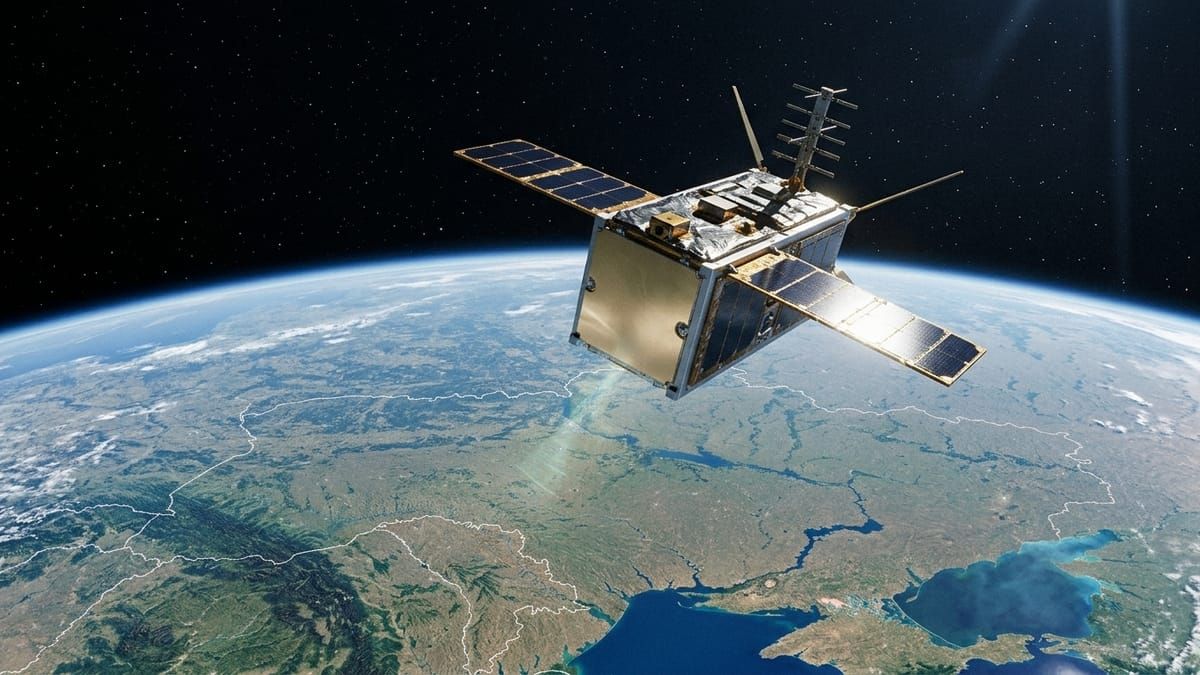
A Ukrainian operator is now running the country's first test satellite for a sovereign communications network, a Danish-built CubeSat that HIMERA and GomSpace launched on 1 October to cut Ukraine's reliance on Starlink.
Ukrainian forces have depended on SpaceX's Starlink for command links and drone operations since February 2022, and temporary Starlink restrictions in mid-October disrupted Ukrainian drone interception of Russian attack drones, The Defense Post reported. OBRIA NANO, confirmed operating by both companies on 27 October, is the first step toward a network the Ukrainian side would control.
HIMERA has disclosed no launch dates for further satellites, no funding total and no date for a working network.
The satellite
OBRIA NANO is an 8U CubeSat, a nanosatellite made of eight 10 cm cubes, HIMERA co-founder and chief executive Misha Rudominskyi told the Ukrainian technology outlet dev.ua. GomSpace manufactured it in Denmark to a Ukrainian order.
A SpaceX Falcon 9 carried the satellite to low Earth orbit on the Transporter-18 rideshare mission on 1 October 2026. First signals and initial contact were confirmed on 2 October, according to dev.ua. Engineers are now checking onboard systems, configuring equipment and analysing telemetry.
GomSpace said in its 27 October statement that the test results would inform the design of a full working constellation. Rudominskyi described the launch as an opportunity to lay the foundation of an independent Ukrainian network.
The partners
HIMERA has produced secure tactical radios, repeaters and electronic warfare systems for the Ukrainian military since 2022. GomSpace, founded in 2007, builds small satellites and lists clients in more than 60 countries.
GomSpace chief executive Carsten Drachmann said the companies shared an ambition to strengthen Ukraine's independent communications capabilities and support its long-term security and economic development.
HIMERA and GomSpace say the planned network would cover all Ukrainian territory and complement European satellite systems. Their next stated priority is moving production of satellites and ground terminals to Ukraine.
The funding
HIMERA and its partners paid for the first stage from their own resources, Rudominskyi told dev.ua. The cost of building the satellite and buying the Transporter-18 slot was withheld as a commercial secret.
Later stages are to be financed by outside investors and loans. HIMERA does not intend to seek Ukrainian state money to build the network, though the partners have held confidential meetings with Ukrainian government departments since spring 2026, the company said.
The other sovereign programme
The Ukrainian Ministry of Defence is pursuing a separate sovereign system. On 22 October it signed a letter of intent with Finnish companies ICEYE and Nokia to explore a secure low Earth orbit network for defence and government use, with first satellites expected in 2028. The letter is not a procurement order.
Starlink operates more than 11,000 satellites, Ukrainian outlet Slovo i Dilo reported. OBRIA has one in orbit and no published constellation size.
The SpaceX manifest
SpaceX's published Transporter-18 payload list does not name OBRIA NANO. It lists a Ukrainian satellite designated UASAT-NANO on the same mission, The Defense Post reported on 30 October.
In April 2026, GomSpace signed an agreement with a different Ukrainian company, STETMAN, to form a joint venture called UASAT to build a sovereign satellite communications system. UASAT's published plans described a constellation at about 550 km, 120 satellites by 2027 and 30,000 to 50,000 user terminals in 2027.
GomSpace's role in both projects and the shared 1 October launch date leave open the possibility that OBRIA NANO and UASAT-NANO are one spacecraft under two names. Neither HIMERA nor GomSpace has said which Ukrainian company owns the satellite SpaceX registered as UASAT-NANO, or what part STETMAN plays in OBRIA.