Russian intelligence services stepped up sabotage across Europe in the year to September 2026 and armed some of their proxies with timed and remotely detonated bombs, the International Institute for Strategic Studies found.
Charlie Edwards, Tom Field and Zoe Lambert, the authors of the report published on 26 November, judged that "a mass-casualty incident is possible as the space for miscalculation narrows". Arrests remove proxies but are highly unlikely to deter the Russian intelligence officers who direct them, they found, and expulsions of those officers, consulate closures and public attribution have shown no deterrent effect on the campaign.
Recorded sabotage incidents rose 16 per cent over the 12 months, according to the report, while the institute's press release issued the same day gives 14 per cent. Arson attacks doubled from seven to 14 and incidents involving improvised explosive devices rose from four to 11, the full report shows, lifting their combined share of all recorded Russian operations from 11 per cent to 28 per cent. Russian intelligence also tried to kill people in Europe five times in the period, by the institute's count.
Polish authorities recorded 29 incidents between October 2025 and September 2026 and made arrests in 16 of them, a higher rate than any other targeted state. Poland remains, with Germany, the country Russian intelligence targets most often, the report found. The institute has recorded no deaths from the campaign, and military aid to Ukraine has continued. European defence spending grew 12.6 per cent in real terms in 2025, against 3 per cent in Russia, according to IISS data cited in the paper.
Dmitry Peskov, the Kremlin spokesman, rejected the most recent accusation on 16 November, after Estonia blamed Russian military intelligence for an attempted arson at a drone manufacturer. "They are entirely baseless," he told reporters and called the claim part of a pattern of false allegations from European countries. The Russian government has also denied any role in the explosive drone attack at Leipzig/Halle airport in August. Russia's embassy in London had no immediate comment when British officials issued their own sabotage alert on 24 November, Reuters reported.
From German arms plants to Polish railways
Russian intelligence has concentrated its operations in three bursts since the full-scale invasion of Ukraine, each aimed at a small number of countries. The authors read the pattern as evidence that Russia's political leadership sets priorities and leaves the intelligence services to run individual attacks through intermediaries. Between November 2024 and March 2025 the institute recorded 55 incidents, 51 per cent of them in Germany and mostly reconnaissance of defence plants. From September to December 2025 it recorded 61, with 36 per cent directed at Polish transport and logistics. In August and September 2026 it recorded 25, spread across Poland (24 per cent), Germany (20 per cent) and the Baltic states (20 per cent).
Reconnaissance fell 49 per cent over the year to September while sabotage rose, the IISS press release said. The researchers wrote that the shift may mean earlier surveillance informed later attacks but that public evidence linking the two at individual sites is still lacking.
Half of all incidents in the period hit military-industrial sites (28 per cent) or transport (22 per cent), and attacks on energy took the share to 57 per cent. The institute said those targets mirror Ukraine's strikes on the same sectors inside Russia. The report also cites a Wall Street Journal report from October 2026 that U.S. intelligence agencies had assessed that President Vladimir Putin personally ordered an intensified sabotage campaign against NATO countries.
Remote triggers in Bucharest and Semtex at Leipzig
Russian handlers recruit most of their proxies online, often criminals or vulnerable people paid in cryptocurrency, and send them to set fires, vandalise property or photograph sites, the report found. A growing semi-skilled tier now plants bombs with timers or remote triggers, either because its members have been trained or because handlers supply ready-made devices. Career intelligence officers handle the highest-priority targets, and the report cites the plot against Armin Papperger, the chief executive of the German arms maker Rheinmetall, that was reported in July 2024.
Two Ukrainian men who crossed from Poland into Romania left two parcels at the Bucharest headquarters of the Ukrainian courier Nova Post on 15 October 2025. The Romanian Intelligence Service said the parcels held incendiary devices with remote initiation, hidden in headphones and car parts alongside GPS trackers, and that the men acted under the "direct coordination" of Russian intelligence, Agerpres reported. Romania's anti-terrorism prosecutors at DIICOT have indicted the pair, aged 23 and 24, and said tests confirmed the devices could have started a large fire in the residential building that houses the office. Polish police detained six people in a parallel operation.
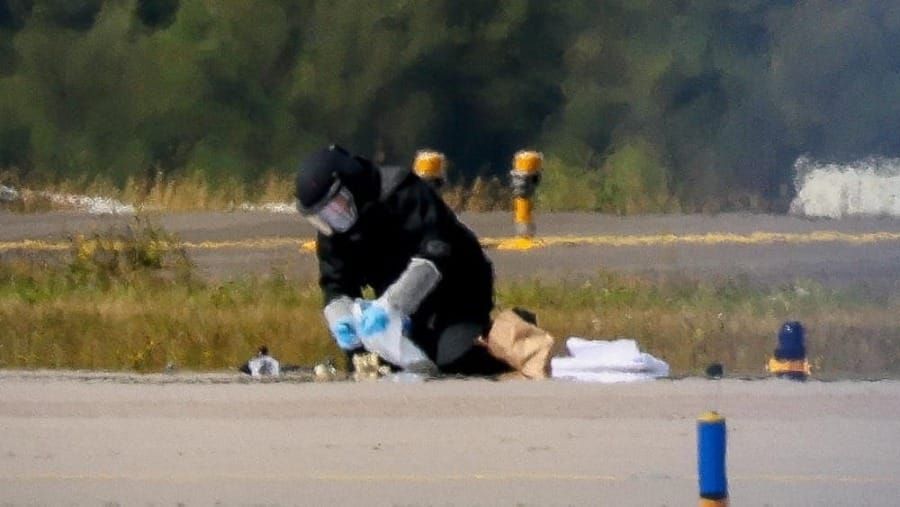
An airport employee found a drone carrying an explosive charge near the south runway at Leipzig/Halle, beside a Ukrainian Antonov cargo aircraft, on the night of 4 to 5 August 2026. Around the same time a DHL cargo aircraft struck an unidentified object after take-off and diverted to Hanover. Alexander Dobrindt, the German interior minister, called the attack a "new quality of danger". Bild identified the explosive as Semtex, Euronews reported, and Welt am Sonntag, citing investigation files, wrote that it failed to detonate only because a detonator connection broke. Eurojust had already linked an incendiary parcel found at the same airport in 2024 to the GRU, Russia's military intelligence service.
The German government formally accused Russia on 1 September and closed the Russian consulate general in Bonn, Ukrainska Pravda reported. German investigators have named two suspects, a Belarusian citizen identified as Andrei Ka. and a Russian citizen identified as Oleg Le. In Welt's account, Le. is suspected of organising the logistics and Ka. of flying the drone, and at least one is believed to have links to the GRU. One of them flew out of Berlin two days before the attack, and investigators doubt they can catch either man, The Irish Times wrote.
A C4 charge under a freight train at Mika
Saboteurs detonated a C4 charge under a passing freight train at 20:58 on 15 November 2025 near Mika, about 100 kilometres south-east of Warsaw, Polish prosecutors said, Kyiv Post reported. The line carries aid from the capital to the Dorohusk crossing into Ukraine. The same weekend they damaged about 60 metres of overhead power cable on the line near Puławy. Donald Tusk, the Polish prime minister, said the Mika explosion was "most likely intended to blow up the train".
Polish prosecutors charged two Ukrainian citizens, identified as Oleksandr K. and Yevhenii I., in absentia with sabotage of a terrorist nature on behalf of Russian intelligence after both crossed into Belarus on 16 November. A Warsaw court ordered their arrest on 28 November 2025, Polskie Radio reported, and a third Ukrainian, Volodymyr B., was charged with driving one of them to scout the site and held in custody. Radosław Sikorski, the foreign minister, announced the closure of Russia's consulate in Gdańsk, its last in Poland.
Poland mounted a large security operation along its border with the Russian exclave of Kaliningrad in early November 2026 after intelligence warnings of possible sabotage, and Tusk later said a potential provocation had been prevented, according to the IISS. The Polish daily Rzeczpospolita reported on 18 November, citing senior security officials, that Russian intelligence had planned an attack there to be blamed on Ukraine. About 180 additional police officers were sent to the border region by late October, United24 wrote.
Two attacks on Estonian defence firms in three months
Estonia's Internal Security Service says Russian intelligence commissioned an arson attack in August on a company that supplies military vehicles to Ukraine, the Associated Press reported. It blames the same service for an attempted arson on 14 November at Threod, which builds attack and reconnaissance drones and works with Ukraine. Latvian and Estonian security services said eight Latvian citizens had been detained on suspicion of arson ordered by Russian military intelligence.
Lithuanian prosecutors have charged 13 people from Russia, Belarus, Ukraine, Georgia, Latvia, Moldova and Greece over a GRU-directed network that gathered intelligence on military sites, planned arson and prepared two political killings in Vilnius. Nine are in custody and European arrest warrants have been issued for the other four, Kyiv Post reported. The would-be killers were promised €40,000 between them and the organiser €50,000, figures published by The Insider.
MI5's alert to British suppliers
Britain's Ministry of Defence and the National Protective Security Authority, part of MI5, issued an alert on 24 November to companies giving material support to Ukraine's armed forces. Russia had increased attempts to sabotage European defence-related facilities, typically through "proxy actors employing low-sophistication sabotage methodologies, such as arson", the alert said, Reuters reported. Ministers briefed chief executives of defence and infrastructure companies in private over two days.
Expulsions of Russian intelligence officers have limited their opportunities to work under diplomatic cover in Britain, but Russian intelligence still recruits people already in the country, the institute found. A group of men was jailed in 2025 for setting fire to a London warehouse holding supplies for Ukraine, an attack British officials said the Russian government ordered. In September 2026 a man from Swindon was charged with assisting a foreign intelligence service and preparing an act of sabotage on instructions from a person believed to be linked to the GRU Volunteer Corps.
Red lines
European governments have yet to set out red lines despite attacks and attempted attacks in Estonia, Lithuania and Romania, and concern about escalation remains their first instinct, the report found. The authors wrote that the first mass-casualty attack, deliberate or accidental, would therefore set the terms of Europe's response, with governments acting under pressure and possibly divided. They recommend that NATO members publicly signal which level of harm will trigger which response. Governments would then be committed in advance to impose costs on the Russian intelligence services instead of their expendable recruits and to share the burden of protecting supply lines to Ukraine beyond Germany and Poland. Cross-border investigations, they wrote, offer the best route to recruiters, facilitators and the money that pays them.
The Wall Street Journal's editorial board argued on 27 November that public red lines could imply tolerance of attacks below them and narrow leaders' options. It urged European governments instead to confiscate about US$230 billion in frozen Russian assets for Ukraine as a penalty for attacks already carried out.
Hinsley, an artificial intelligence forecasting platform the IISS uses in its crowd-forecasting programme, generated the paper's four scenarios to 2029, which the institute's researchers then reviewed and supplemented. In one, dispersed sabotage forces Europe into disproportionate spending on protection. In another, Russian intelligence uses a ceasefire in Ukraine to keep recruits and cyber access in place. The other two have Russia concentrating attacks on the logistics routes between Germany, Poland and NATO's eastern flank, or pressing on undersea cables and shipping around northern Norway.
Estonia's government has ordered all five road crossings with Russia closed from 07:00 on 1 December. Prime Minister Kristen Michal has said it also plans to shut Narva, the last rail crossing between the two countries.