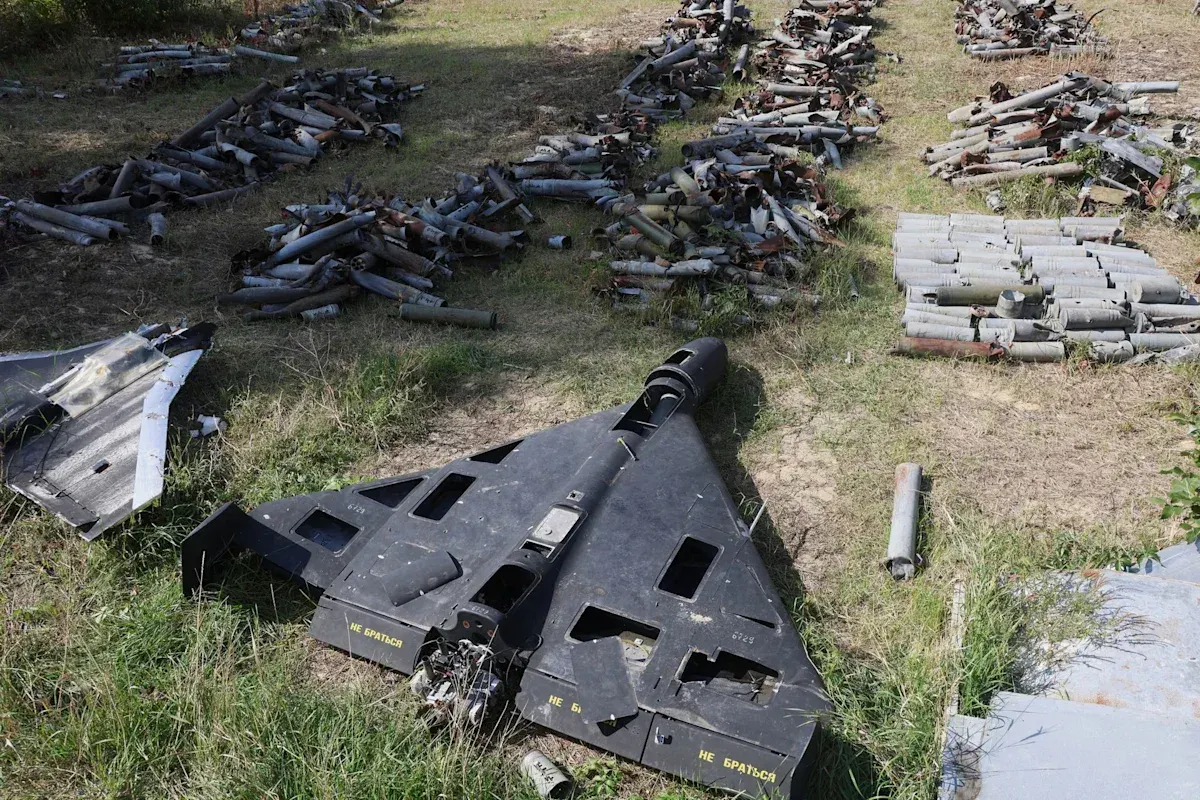
A Russian attack drone shot down over Kyiv region on 12 August carried timing chips bearing a U.S. manufacturer's markings and dated as recently as March 2026, more than four years after the U.S. barred unlicensed exports to Russia's military.
Ukraine's military intelligence agency, known as HUR, says the jet-powered Geran-4 was built in the Alabuga Special Economic Zone in Tatarstan. The agency's report on the wreckage, published by the Kyiv Independent on 24 November, lists date codes on 12 parts: seven from 2026, three from 2025 and two from 2024. Timing chips with markings consistent with CTS Corporation, based in Lisle, Illinois, were dated January, February and March 2026. A power diode made by Vishay Intertechnology of Malvern, Pennsylvania, carried a code for mid-February 2026, and a microcontroller from STMicroelectronics, headquartered in Switzerland, was dated early February 2026 and marked as assembled and tested in Malaysia.
The drone held at least 98 foreign components, 76 of them from U.S. companies, and a Geran-5 neutralised in September held 81 U.S. parts among 115. Vladyslav Vlasiuk, President Volodymyr Zelenskyy's commissioner for sanctions policy, said in September that the makers of parts in the August drone included Texas Instruments, Amphenol, Diodes Incorporated, Kyocera AVX, Kemet, onsemi and Vishay.
The Commerce Department's Bureau of Industry and Security (BIS), which enforces U.S. export controls, has imposed six corporate penalties over exports to Russia since January 2025. They total US$5.6 million, and two also involved China, according to a tabulation of BIS actions by the law firm Gibson Dunn. In the same period BIS fined Applied Materials US$252 million and Cadence Design Systems US$95 million for exports to China. The Justice Department disbanded Task Force KleptoCapture, its Russia sanctions and export enforcement unit, on 5 February 2025. The Entity List, the government's blacklist of foreign buyers, went more than a year without an addition before seven companies accused of diverting advanced computing chips were listed on 25 November.
STMicroelectronics said it no longer operates in Russia and runs a global trade compliance programme, without addressing the part. Vishay said it blocked all shipments to Russia in February 2022 and works to stop exports that breach U.S. or EU law, and gave no explanation for the diode. BIS said in June that it uses the Entity List and other tools every day against bad actors. Jeffrey Kessler, the under secretary of commerce who runs BIS, told the House Foreign Affairs Committee on 14 July that penalties imposed by his bureau had risen more than 18-fold from 2024 to 2025.
Vlasiuk said U.S. and European parts usually reach Russia through "a chain of three or four intermediaries" in third countries, and called for those intermediaries to be prosecuted and for manufacturers to answer for their end users. Ukraine's Prosecutor General's Office has catalogued more than 16,000 foreign components from more than 30 countries in Russian weapons and has sent 28 requests for legal assistance to foreign governments. Chinese parts made up 65 per cent of the foreign electronics in the older Geran-2 by May 2026, while U.S. parts still accounted for more than 70 per cent in the two newer jet-powered models.
The March 2022 licence rule
A rule published on 3 March 2022 requires a U.S. licence to export, re-export or transfer any item subject to U.S. export regulations, other than food and medicine, to a Russian military end use or end user. Applications face a policy of denial. The obligation turns on what the exporter knows, and the regulations define knowledge to include an awareness of a high probability inferred from conscious disregard or wilful avoidance of facts. The rule reaches a U.S.-made chip resold through Hong Kong or Kazakhstan as well as one shipped from Texas.
Civil penalties can reach US$300,000 per violation or twice the value of the transaction, whichever is greater, and wilful violations of the Export Control Reform Act carry up to 20 years in prison. Chipmakers sell much of their output through distributors, who resell to smaller manufacturers and brokers. A manufacturer that sells to a distributor in a third country breaks the rule when it knows, or has reason to know, that the part is bound for Russia's military.
What Senate investigators found at four chipmakers
Texas Instruments let buyers on its website confirm they were not military end users by ticking a box, the Senate Permanent Subcommittee on Investigations found in a staff report in September 2024. The company received more than 100 requests from Conflict Armament Research, a weapons-tracing group, to trace parts found in Russian weapons from August 2022 and answered them substantively from February 2024. In July 2023 it learned of diversion to Russia at a customer of its largest distributor and did not audit that distributor. Texas Instruments and Intel did not routinely audit their distributors' export controls.
Exports by Texas Instruments, Intel, Analog Devices and AMD to Kazakhstan in 2023 were more than 550 times their 2021 level, and their exports to Armenia nearly 12 times higher, the subcommittee found. All four companies identified and halted sales to risky buyers only after BIS gave them customs data in early 2024. Analog Devices blocked US$66 million of sales in fiscal 2023 through a team set up to stop grey-market diversion. Texas Instruments said it "strongly opposes the use of our chips in Russian military equipment".
BIS had reviewed none of the four companies' compliance programmes in the more than two years after the invasion, the subcommittee's second report found in December 2024. The bureau ran 1,304 end-use checks on possible Russian diversion in fiscal 2022 and 2023, and about a quarter came back unfavourable or unverified. It carried out five checks in Armenia and none in Georgia. The report recommended that BIS bring charges of knowing violations against companies that fail to investigate red flags, and that it require outside audits of chipmakers' export compliance plans.
Six penalties worth US$5.6 million
BIS imposed about US$324 million in civil and criminal penalties in calendar 2025, against about US$16 million in 2024, its annual report says. Kessler told the House committee that administrative penalties in 2026 had already doubled the 2025 total. The largest concerned China: Applied Materials agreed in February to pay US$252.5 million over ion implanters shipped through its Korean affiliate to China. Cadence paid US$95 million in July 2025 for exports to Chinese entities, and Robert Bosch paid US$36 million in June over shipments to Huawei.
Haas Automation paid US$1.5 million in January 2025 over machine parts sent to Russia and China, and Andritz paid US$1,577,397 in July 2025 over refiner plates. Hallewell Ventures paid US$374,474 for flying a business jet into Russia, and Teledyne FLIR paid US$1 million in February 2026 over exports to China and Russia. Container Manufacturing, an Ohio company, paid US$1 million in August after sending about US$265,000 of spare parts to a Russian buyer, directly and through distributors in the United Arab Emirates and Turkey.
Eleview International, a Virginia freight business, paid the smallest of the six, US$125,000. Its owner, Oleg Nayandin, was sentenced to three years in prison on 13 February 2026 for shipments routed through false end users in Turkey, Finland and Kazakhstan, including an electronic component of the type found on Russian attack drones. Milan Dimitrov, a Bulgarian, was sentenced to time served on 18 February for his part in a Bulgarian company's shipments of radiation-hardened circuits from an Austin supplier to Russia between 2014 and 2018.
Extreme Networks, a North Carolina maker of network equipment, agreed in October to pay US$975,722 under a non-prosecution agreement with the Justice Department and US$1.53 million to the Treasury. Employees of its Moscow subsidiary had sold equipment to MMZA Avangard, a producer of anti-aircraft missile systems owned by a sanctioned entity. The Commerce Department has asked Congress for US$450 million and 290 more enforcement agents for fiscal 2027. The same law firm estimates that about 146 years of export-control experience left the Commerce Department in 2026, 117 of them at BIS.
The Entity List after October 2025
BIS added foreign buyers to the Entity List every 35 days on average from 2018 to 2024, according to the Center for Strategic and International Studies. It made no additions from October 2025 to at least the end of June 2026, the longest gap since 2008. An interagency committee had approved DeepSeek, the memory chipmaker CXMT and more than 100 other companies for listing in 2025. Chinese companies that supplied Russian drones recovered in Poland in September 2025 were among those slated for listing, one source told Reuters in June. Kessler had sought since late 2025 to avoid listing Chinese companies for fear of raising tensions with China, according to the same report.
The seven companies BIS listed on 25 November, in Malaysia, Singapore and Thailand, include three Megaspeed entities and were added for the risk that they would divert advanced computing commodities to unauthorised users. Scott Bessent, the Treasury secretary, said on 13 November that four departments had favoured listing Megaspeed for months but that Commerce "has the pen".
BIS issued a rule on 29 September 2025 extending Entity List restrictions to any company at least 50 per cent owned by a listed one. It suspended the rule for a year from 10 November 2025 under a trade agreement with China. On 5 November 2026 it extended the suspension to 10 January 2027. More than 130 companies in mainland China and Hong Kong were advertising restricted chips for sale to Russia, the Democratic staff of the Senate Banking Committee reported in February. The staff cited an administration estimate that Chinese companies supply about 80 per cent of Russia's dual-use imports.
KleptoCapture and the sanctions pause
Pam Bondi, the attorney general, ordered on her first day in office, 5 February 2025, that Task Force KleptoCapture be disbanded and its resources moved to fighting drug cartels. The task force had been set up in March 2022 to enforce sanctions and export restrictions on Russia and had secured the forfeiture of about US$170 million in oligarch assets by spring 2024, Senator Sheldon Whitehouse wrote to Bondi.
The Trump administration rolled out no new Russia sanctions or export control package in its first six months, according to a staff report for Senators Elizabeth Warren and Jeanne Shaheen in August 2025. The Biden administration had rolled out at least 16 in every six-month period from February 2022 to January 2025. The Treasury and State Department carried out one sanctions rollout in the war's fourth year, the Banking Committee's Democratic staff found in February, after at least 32 a year in the first three. Warren wrote to Lutnick and Kessler on 30 July 2026 asking for information on staff cuts, licence applications and the Entity List.
President Donald Trump signed the Lindsey O. Graham Sanctioning Russia and Iran Act on 18 September 2026 and on 16 October waived nearly all of its Russia provisions. The Treasury had issued a general licence for Russian diesel through 7 April 2027 after Trump said on 9 October that he had agreed with President Vladimir Putin to let it back onto world markets.
Distributor sales and the Dallas suits
Vishay earned US$1.72 billion of its US$3.07 billion in 2025 revenue, or 56 per cent, from independent distributors, according to its annual report. Independent distributors accounted for about 7 per cent of CTS's US$541 million in 2025 sales, and aerospace and defence customers, including the U.S. government, for 15 per cent, its annual report shows.
Dozens of Ukrainian civilians injured or bereaved in five Russian strikes between 2023 and 2025 sued Texas Instruments, Intel, AMD and Mouser Electronics in Dallas County on 10 December 2025. Mouser is a distributor owned by Berkshire Hathaway. The suits alleged failures in export-control and distributor screening. The suits said Mouser's distribution decisions were "a substantial domestic component of the misconduct". The companies moved the cases to federal court in February and said in filings that U.S. courts were the wrong place for Ukrainians to seek redress for Russian airstrikes.
Senior Judge Sidney Fitzwater of the Northern District of Texas ruled on 1 July 2026 that federal export law did not preempt the claims. He dismissed them for failing to plead causation, because the plaintiffs' own pleadings showed the weapons also held parts from manufacturers they had not sued. He gave them 28 days to file an amended complaint.
Patriot interceptors awaiting Hegseth's signature
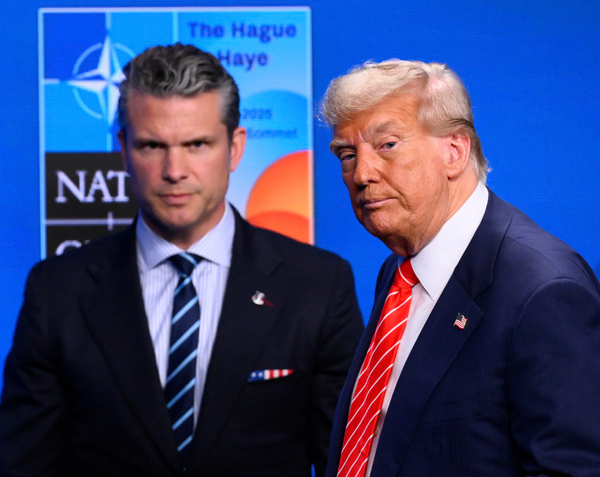
Pete Hegseth, the defence secretary, had not approved the transfer of about 60 Patriot interceptors that Ukraine's allies had already paid for, the Financial Times reported on 24 November. Allied purchases under the NATO-run Prioritised Ukraine Requirements List supply about 95 per cent of Ukraine's Patriot missiles, and every transfer needs U.S. consent. A licence for Ukraine to make Patriot interceptors, which Trump promised in July, was stalled at the Pentagon in mid-November. Marco Rubio, the secretary of state, claimed on 20 October: "There's nothing being deliberately denied to Ukraine."
The lot records
Manufacturers answer trace requests by matching a part's markings to their production and sales records, the subcommittee's 2024 report shows, and Intel took between one and 14 months to answer the 31 requests it received. The production and sales records for the CTS timing chips dated January to March 2026, the Vishay diode coded for week seven of 2026 and the STMicroelectronics microcontroller assembled in Malaysia would show which company first bought each part. The CTS chips were made between five and seven months before the drone carrying them was shot down over Kyiv region.