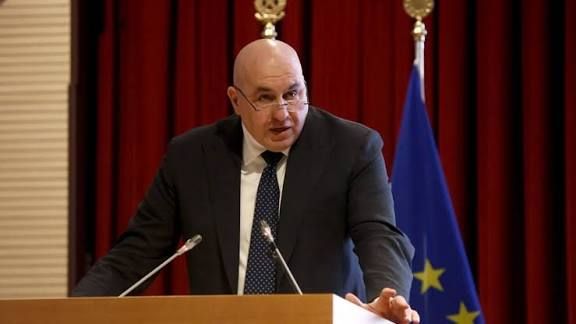
Italy's Minister of Defence is Guido Crosetto told the second Defence Procurement Forum at Villa Miani in Rome on 20 October that the violence in Milan and other Italian cities over the weekend was "the fruit, the end point" of something he had been flagging "unheard, for four years": hybrid war. "I fatti di Milano, e di altre parti d'Italia, sono una cosa profondamente diversa da quelli che abbiamo vissuto in altre epoche. E sono il frutto, il punto di arrivo, di una cosa che io, inascoltato, richiamo da quattro anni, che è la guerra ibrida," he said. The war, according to ANSA's account, is being carried "into our nations" with "unconventional instruments called TikTok, social media, YouTube, without the West realising it and in some way reacting".
"If three young people in 10 took part in those demonstrations, we are not talking about maranza [a slur for street-tough youths], about second-generation Italians. If six in 10 share them, it is because in these years they have undergone a counter-education somewhere, not from the family or the school, which has given them values, ambitions, a vision of the world and points of reference in conflict with the society we live in and with democratic rules," Crosetto said. Those two figures match a Skuola.net survey of 1,500 upper secondary students published on 19 October, which measured participation in school occupations, strikes and sit-ins, and in which 62 per cent of respondents said they preferred peaceful protest.
A Milan judge wrote on 20 October of a deliberate plan to destabilise public order run through two social media accounts, "Italia in piazza" and "Movimento 17 ottobre", both under investigation. Il Foglio reported the same day that intelligence services are examining automated accounts, one bearing a Russian flag, that comment on videos of the clashes, which the paper described as indications rather than evidence. Interior Minister Matteo Piantedosi said after that evening's cabinet meeting that first findings would rule out structured links with Italy's established antagonist groups, while Deputy Prime Minister Matteo Salvini rejected the idea of any directing hand, Russian or otherwise.
What Crosetto said, and where
Crosetto was speaking from the platform at an industry event titled "Defence Procurement: la prospettiva nazionale per una difesa europea", with no interviewer, Virgilio Notizie reported. ANSA and Agenzia Nova published versions of his opening sentence that differ by a few words: ANSA has the West failing to realise the threat "and in some way react", Agenzia Nova has it failing to realise it "realistically".
Crosetto located the threat in states with the data and technical capacity to profile young people. "My greatest concern today, more than the physical one, is the capacity that some nations now have, after studying the minds of our young people with algorithms, to recognise much better than any of us how to influence them," he said, according to Agenzia Nova. He described the result as "a very powerful weapon" that plants in young minds ideas "that they believe to be their own". "These weapons do not make holes, they do not hit physical targets, but they hit something deeper: a society at its base, inside it and in its heart," he said.
Crosetto referred to "alcune nazioni" (some nations) and named none in connection with Milan, Virgilio's account notes. In the same speech he said Russia's military production capacity outstrips Europe's with Chinese support, and described Europe as facing a "technological-industrial attack" from both China and the US. Several outlets, including Il Giornale d'Italia, read the remarks as aimed at the Russian state.
In March 2025 Crosetto posted "È in corso una guerra ibrida" (a hybrid war is under way) after a suspected Russian drone flew repeatedly over the EU's Joint Research Centre at Ispra on Lake Maggiore, which the Milan prosecutor's office opened as an espionage case; a European Commission spokesperson later said the Commission had observed no drone violation of the no-fly zone. In Vilnius in September 2026, after Italian Eurofighters shot down a drone over Lithuania, he said Russia's war "is above all a war of disinformation", Avvenire reported. In January 2024 he likened a Il Fatto Quotidiano report about a private speech of his to hybrid-war tactics that spread fake news to weaken institutions.
Two days in Milan
Italia in Piazza, the movement behind the main platform of the cost-of-living protests, set off from Piazza del Duomo at about 15:00 on Saturday 17 October with many Italian flags; police had not classed the march as high risk. About 5,000 people took part, according to the Questura, protesting against the cost of living, petrol prices and the tax burden, Il Fatto Quotidiano reported. The march coincided with nationwide mobilisations in France.
Violence broke out in via Broletto and spread through the centre. Masked protesters threw café chairs and tables and hurled bins and benches at police vans; a chemical toilet was set on fire in the Duomo square, metro lines M1 and M3 were closed and police used tear gas and water cannon, MilanoToday reported. The worst damage to shops ran along Corso Vittorio Emanuele II and via Mazzini.
The Questura's consolidated tally for Saturday was 72 people taken in for identification, 17 arrested and 22 reported to prosecutors, with 104 officers injured. Of the 17 arrested, seven were adult Italian citizens, five were foreign nationals and five were minors, according to the Questura's figures; some of those taken in were 12 years old. The charges include devastation, looting and resisting a public official.
Police reconstructed a crowd drawn from Milan's outer districts, its hinterland and other provinces, Italians and young people of foreign origin together, moving in small groups without recognisable coordination, Il Fatto Quotidiano reported, contrasting it with the organised groups that wrecked the city during the anti-Expo protest of 1 May 2015. A 16-year-old at the barricades told the paper that the handbags in the shop windows cost as much as his father's salary and that rioting was the only way to be heard.
On Sunday 18 October young people self-convened through social media, chiefly TikTok, while police were already deployed in Piazza del Duomo; groups looted shops including the Carrefour in via Torino and a Decathlon, MilanoToday reported. Over the two days more than 270 people were stopped, most of them minors, according to Il Foglio, and Sky TG24 put the damage at about €1 million.
In Bologna on 17 October a square called by "Carrelli vuoti" (Empty trolleys), a coalition of local collectives, drew young people from across the region through Telegram groups set up for the day with the declared aim of emulating France, and 75 officers were injured, Il Fatto Quotidiano reported. In Turin, Miriam Marsalona, co-organiser of a march billed as non-partisan, told ANSA, as quoted by the same paper: "Abbiamo pensato una manifestazione pacifica e apartitica [...] Non intendevamo distruggere la città, ci stiamo dissociando da tutto" (We planned a peaceful, non-partisan demonstration [...] We did not intend to destroy the city, we are dissociating ourselves from all of it).
Gas prices across Europe have risen about 140 per cent and diesel prices have doubled, and the European Commission estimates the Iran conflict has cost Europe roughly €100 billion, Reuters reported. Hundreds of thousands marched on 17 October in Belgium, France, Italy and Portugal in separate, uncoordinated demonstrations. Milan's mayor, Giuseppe Sala, said the reasons for the protest were understandable but the violence and damage unjustifiable.
The 30 and 60 per cent
Skuola.net, an online education platform, surveyed 1,500 upper secondary students about the "hot autumn" in Italian schools and found 33 per cent taking an active part in student protests: about one in 10 had joined a school occupation and 24 per cent had joined self-managed school days, strikes, demonstrations or sit-ins, its report states. Adding the 26 per cent at mobilised schools who took no part brought the share in contact with protest to 59 per cent, and 56 per cent shared the reasons for the demonstrations "fairly" or "completely". The headline rounded these to "six in 10".
Crosetto applied those figures to "quelle manifestazioni" (those demonstrations) in a passage about Milan. Skuola.net's own write-up separates the school protests from the weekend's events, describing the raids on city centres as closer to urban guerrilla activity with little connection to schools; Virgilio was among the first to point to the match. The published report gives the sample size and school level but no fieldwork dates, sampling method or question wording, so its margin of error cannot be calculated.
For 34 per cent of Skuola.net's respondents the main motive was to "increase investment in schools and reduce it on arms"; 22 per cent cited crumbling buildings and another 22 per cent the difficulty of building a future. Asked to choose between the "dialoguing" Italian style and the harder French one, 62 per cent chose peaceful protest and 38 per cent the French approach. Skuola.net corrected the students' premise: defence spending has risen, but school investment rose too, roughly in line with inflation.
Crosetto's inference runs from the share of students who sympathise with protest to an outside "counter-education" hostile to democratic rules. The poll's leading grievance, schools against arms, concerns spending his own ministry administers; in March 2026 students at a Milan rally outside the prefecture targeted him by name over rearmament and his proposals to restore military service.
What investigators have
Milan's preliminary investigations judge, Fabrizio Filice, validated the arrests of five adults on 20 October, sending four to prison and placing a fifth, aged 24 and charged only with resisting officers, under house arrest with an electronic tag, Il Globo reported. ANSA reported that 11 minors were placed in community care or under house arrest.
"È evidente, dal proseguire del battage via social per convocare altre proteste nei prossimi fine settimana, che è in atto un preciso progetto di destabilizzazione dell'ordine pubblico, che conta proprio sulla spontanea partecipazione di molti giovani," Filice wrote (It is evident from the continuing social media drive to call further protests on coming weekends that a precise plan to destabilise public order is under way, one that counts on the spontaneous participation of many young people). He found it "more than plausible" that the social media call was designed from the start to produce violence under a deliberately vague banner of social grievances, and named Italia in piazza and Movimento 17 ottobre as accounts under investigation, askanews reported. The finding is a judge's assessment at the precautionary stage, made to justify custody on the risk of reoffending.
Movimento 17 ottobre, a new page, announced a "permanent" mobilisation every Saturday and posted a video of looters handing goods to a homeless man captioned "Esproprio proletario a Milano" (proletarian expropriation in Milan), Sky TG24 reported. Investigators are tracing the first accounts to spread the call, which borrowed imagery described as similar to the protests in Paris and Tirana, and a senior officer of the police prevention branch said there were no leaders with whom to negotiate.
Il Foglio's Carmelo Caruso reported that the intelligence services are examining accounts commenting on videos of the clashes, among them automated profiles such as one named ".dima.1.3.1.2." displaying a Russian flag, and that the government fears pro-Russian propaganda has entered Telegram channels linked to the protests, according to Il Foglio. Bot comments under videos posted after the riots would be evidence of amplification. Showing that a foreign state organised the riots would require evidence about the operators, location and funding of the accounts that issued the calls before 17 October, and about any coordinated inauthentic network that pushed those calls into young people's feeds.
Piantedosi said after the cabinet meeting that Crosetto's points should not be underestimated because "sicuramente qualcosa è successo" (something certainly happened), citing the "apparent spontaneity" of a mass of young people mobilised in a way it seemed strange to attribute to no organisation, ANSA reported. Salvini dismissed the theory: "Ho letto cose strambe, i russi. No, basta" (I've read some weird things, the Russians. No, enough), he said, calling instead for checks at railway stations on young people travelling in from the provinces.
Fabricated videos of private universities under attack and of vigilante patrols against foreigners spread through student chats after the riots, with messages warning that rioters planned to kill "future rich" students, S&H Magazine reported; names and addresses of alleged rioters were posted on Instagram, Il Fatto Quotidiano reported. The origin of that material is unattributed.
The documented Russian record
Italy's intelligence services ranked Russia as the most concrete state threat to European stability, including in the unconventional domain, in their annual report to Parliament of 2 March 2026, according to the head of the external service AISE, Giovanni Caravelli. The report found Italy targeted since the invasion of Ukraine by hostile hybrid initiatives from Russia-linked actors, chiefly in the cyber and information domains, exploiting the pluralism of Western societies, Agenzia Nova summarised. It named anarchists as the most concrete internal threat and said street protests were monitored with maximum attention. Russian state media funding is set to exceed €1.5 billion in 2026, Fondazione CSF wrote in its analysis of the report.
The EU's diplomatic service documented 540 foreign information manipulation incidents in 2025 involving 10,500 channels and websites, attributing 29 per cent to Russia and 6 per cent to China, in its fourth threat report of March 2026, and found that both states rely on covert networks that preserve deniability and complicate attribution. EU foreign policy chief Kaja Kallas cited paid TikTok influencers promoting Russia's preferred candidate in an election campaign.
Romania's Constitutional Court annulled the first round of the 2024 presidential election in December 2024 after President Klaus Iohannis declassified intelligence alleging a Russian-run campaign of thousands of TikTok and Telegram accounts promoting Călin Georgescu, the Associated Press reported. The files alleged that one TikTok user paid $381,000 to others to promote Georgescu's content without labelling it as campaign material; TikTok said it had found no evidence of a coordinated campaign. The court acted on documents setting out accounts, payments and the services that traced them.
Georgescu ran on the cost of living and an end to support for Ukraine, and the EU threat report describes networks that attach themselves to local grievances. Bots in comment threads and propaganda in Telegram channels after the Milan riots would match that documented method of exploiting existing anger. Crosetto's claim goes further: that the attitudes behind the protests were themselves manufactured abroad over years.
Protest, minors and a new offence
Prime Minister Giorgia Meloni's cabinet approved a security decree on the evening of 20 October, hours after Crosetto spoke. It creates an offence of violent participation in a demonstration, punishable by two to five years and a fine of up to €20,000, and a separate offence for anyone who, "anche mediante strumenti informatici o telematici" (including by computer or telematic means), organises or promotes groups for violent demonstrations, punishable by four to 12 years, ANSA reported. Justice Minister Carlo Nordio summarised it as up to 12 years for using social media to organise groups.
The decree extends preventive detention to anyone who disturbs security in crowded places, including minors aged 16 and over; presumes that anyone over 14 understands their actions; fines parents €500 to €1,000 for their children's violence at demonstrations; and sends 500 more soldiers to Milan until 31 December at a cost of €4.7 million. Crosetto's request for judicial police powers for the soldiers was dropped after an objection from the Quirinale. The police union Siap called the use of soldiers an "authoritarian twist" in public order. Amnesty International has found the preventive detention powers in the government's previous security decree incompatible with Article 5 of the European Convention on Human Rights.
Meloni said "lo Stato che dice no alle violenze è lo stesso Stato che ascolta chi protesta" (the state that says no to violence is the same state that listens to those who protest), according to ANSA, and called it "very serious" that free legal assistance had been advertised after the riots, a reference to Ilaria Salis, the Greens and Left Alliance MEP who had urged respect for the fundamental rights of those detained, minors included.
Elly Schlein, the Democratic Party leader, said on 18 October: "Non c'entriamo niente con i delinquenti. Li abbiamo sempre condannati, ma non possono usare i violenti per coprire la voce di migliaia di persone che pacificamente stanno protestando in tutta Italia perché non riescono più a vivere" (We have nothing to do with the criminals. We have always condemned them, but they cannot use the violent to drown out thousands of people peacefully protesting across Italy because they can no longer make ends meet), Virgilio reported. Giuseppe Conte of the Five Star Movement said the government could not deny the root of the protests, families unable to reach the end of the month. Roberto Vannacci of Futuro Nazionale said: "li andremo a prendere uno a uno nelle case, nelle scuole e gli faremo pagare i danni" (we will go and get them one by one in their homes, in their schools and make them pay for the damage), Lettera43 reported. President Sergio Mattarella called the violence unacceptable and asked for "an intelligent and thorough analysis" of violence from "soggetti inediti" (actors not seen before), Il Foglio reported.
Crosetto described youth protest as the product of a foreign war on the day the government created a 12-year offence for organising violent groups online, an offence that turns on the line between sharing a call to protest and promoting a violent group. His framing places the 56 per cent of students who share the protesters' reasons on the far side of a line drawn by foreign manipulation, on the strength of a poll whose respondents mostly asked for more school funding and preferred peaceful methods.