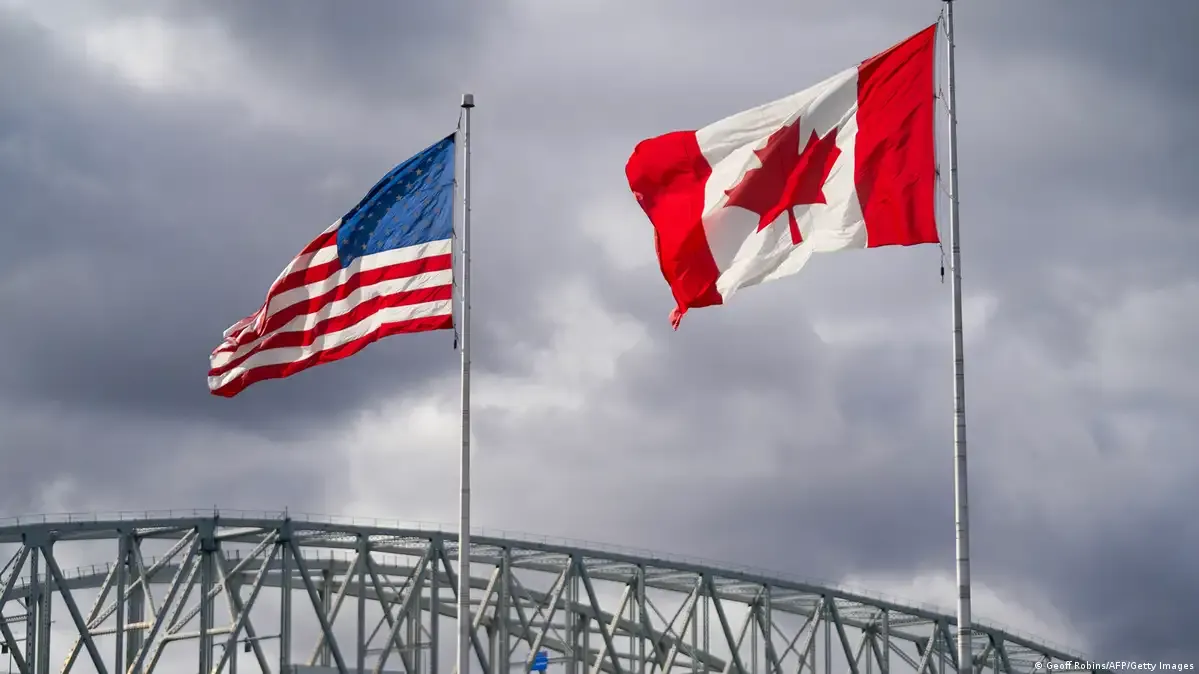
Canada's counter-tariffs on $27.6 billion of goods from the United States took effect at 12:01 am eastern on 8 September 2026, hitting more than 700 product lines at rates of 15, 25 and 50 per cent.
Concentrated milk products, whey, molasses, cosmetics, proteins, plywood, tissue paper, apparel, steel and aluminium derivative products carry the 50 per cent rate, according to the list the Department of Finance Canada published on 25 August. Lumber, kraft paper, cheese, carpets, seafood and several agricultural goods carry 25 per cent, and selected machinery and equipment carry 15 per cent. Individual product rates were set to match the US rate on the same goods, the department said.
The rates mirror the duties the United States imposed on Canadian goods on 22 August under Section 338 of the Tariff Act of 1930. The measures are Canada's first new counter-tariffs since it lifted most of the 2025 round on 1 September 2025, and no negotiations are scheduled, according to Semafor.
Prime Minister Mark Carney released a national video address on 8 September. "We have everything we need to pivot and prosper," he said. "That pivot will come at a cost. There's always a cost to action. But it doesn't come close to the cost of standing still." Carney set the aim as a Canada in which "no country can ever hold us hostage, and that we can live how we want to live", and returned to a warning he first issued in the 2025 election campaign. "In the spring of last year, I warned that America is trying to break us so they can own us," he said. "And I promised that that will never, ever happen."
Carney distinguished the counter-tariffs from escalation. "I don't believe in escalating the conflict, that's not constructive," he said. "But our tariffs are necessary to protect our workers, protect our companies, and our communities. We can't let American goods into Canada tariff-free while they charge our companies to export them."
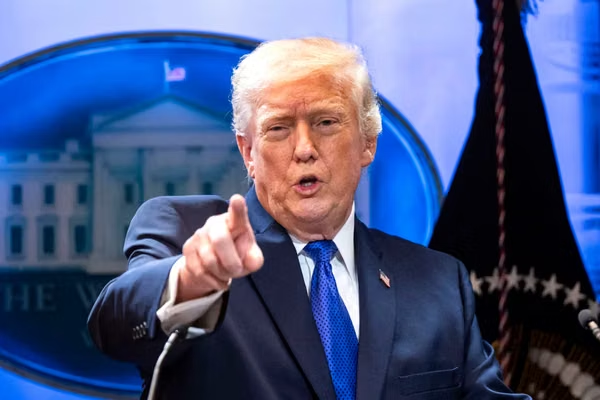
Donald Trump wrote on Truth Social on 7 September, hours before the counter-tariffs took effect, "NO MORE SELLING BOMBARDIER IN THE UNITED STATES! Their products aren't good enough!" Trump also wrote, "If they want our Market, they must build here, and stop treating America like a 'piggybank'." In the same post Trump said Canada's dollar imbalance with the United States "has been that way for years", and that the era in which Canada blocked US banks and companies was "OVER!".
Bombardier and the threatened ban
Bombardier issued a statement on 7 September setting out its American footprint rather than answering the threat directly. The Montreal manufacturer has sites in Kansas, Texas, Arizona, Florida, Connecticut, Illinois, Delaware, California, Washington DC and New Jersey, direct employment in more than 20 states, and a supply chain of about 2,800 American companies across 47 states, the company said. Bombardier spends more than $2.5 billion a year with those suppliers, employs about 3,500 people directly in the United States, and builds the wings for its Global 8000 in Red Oak, Texas. Flight-control components are made in the Los Angeles area, special-mission defence aircraft are prepared in Kansas, and the company's defence division is headquartered in Wichita on the site of the Learjet plant. A sixth US service centre opens at Fort Wayne, Indiana, later in 2026, adding about 100 jobs.
"Our plan is to continue to invest in our people, our customers and the communities in which we operate across the country," the company said.
Senator Jerry Moran, Republican of Kansas, said he had contacted the president directly about the company's contribution to his state. "I will continue working to see that Bombardier's manufacturing operations not only remain in Kansas but continue to grow and create American jobs," Moran said on 7 September. Kansas state representative Nick Hoheisel said of the workers at the Wichita plant, "These are skilled American workers supporting their families and contributing to our local economy."
Quebec Premier Christine Fréchette answered on 7 September. "Bombardier is a source of pride for Quebec, a flagship of our economy, and a major player in our aerospace industry," she said. "Quebec will not allow anyone to dictate where our companies must produce in order to access a market. We will defend our companies, our workers, and our expertise with resolve."
Quebec Economy Minister Bernard Drainville answered the same day. "Attacking Bombardier is attacking Quebec," he said on 7 September. "It's attacking a flagship of our aerospace industry that employs more than 40,000 people." Drainville said, "We won't let ourselves be pushed around. Quebec will be there to protect our industries and our jobs."
Trump's post carried no executive order, tariff schedule or regulatory action, and the White House did not answer questions about how a sales ban would be enforced. The White House has said it will respond to the Canadian measures with fresh action, which may include barring certain Canadian goods, according to Semafor. The two countries' trade representatives were expected to speak on 8 September, CBC News reported, citing unnamed sources. Neither government has confirmed a call.
What Canadians said
Industry Minister Mélanie Joly told Canadians to buy Canadian. "When you choose a Canadian product, you're not only putting pressure on the U.S., right now you're protecting jobs," Joly said. "We'll be smart and we'll be strategic and we'll fight for every one of these jobs." Joly also said, "The threat to the auto industry is real."
Finance Minister François-Philippe Champagne announced the package on 25 August. "Tariffs will have real consequences for Canadian workers, businesses, and communities across our nation," Champagne said. "Canada must respond, and today we are in a proportionate, targeted, and strategic way." Champagne described the design as "dollar-for-dollar, rate for rate counter-tariffs" matching the quantum of the US Section 338 measures.
Ontario Premier Doug Ford told reporters on 24 August that Trump could "kiss my ass", refused to withdraw the remark the following day, and pressed for a wider response. "Maybe what we should be doing is charging him triple on the oil, triple on the potash, on the uranium," Ford said. "We need to throw everything in the kitchen sink at him." Ford said of the president, "I don't respond to a dictator like President Trump," and, "I'm not going to take any advice off a guy that's the king of bankruptcies." Trump replied that Ford offered "lots of bluster" and called him "the less charismatic, intelligent and overall unimpressive brother of the late, great, Rob Ford".
Lana Payne, national president of Unifor, welcomed the measures on 25 August and asked for more. "Unifor has long called for Canada to fight back against Trump tariffs designed to target Canada's industrial base and force concessions from Canada," Payne said. "The Canadian counter-tariffs are a good first response, but we need to take action at home to keep workers on the job by fast-tracking procurement dollars, implementing national industrial strategies, and calling on corporate Canada to step up and Buy Canadian."
Daniel Cloutier, Unifor's Quebec director, said in the same statement, "Workers are being asked to absorb the economic shock of a trade war they did not start and cannot control." Cloutier also said, "Workers need income security they can count on, not a patchwork of measures that expires when the next deadline passes."
Candace Laing, president and chief executive of the Canadian Chamber of Commerce, called the US duties "a body blow to North American competitiveness in this self-defeating trade saga" on 22 August. "A whopping, non-absorbable tariff is not sustainable or viable for business," Laing said. On the Canadian countermeasures three days later she said, "Government is now moving at the speed of business to address the current trade negotiation collapse."
Dennis Darby, president and chief executive of Canadian Manufacturers and Exporters, said, "Counter-tariffs can also increase costs for Canadian manufacturers that depend on U.S. inputs." Derek Nighbor of the Forest Products Association of Canada said, "We appreciate the government's quick action to address the serious pressures facing Canadian industries."
Conservative Leader Pierre Poilievre supported the counter-tariffs and demanded the government publish what they will cost households. "Every single mother, small business owner and seniors should know what they will pay in these new counter-tariffs," Poilievre said. He also said the government should publish the US offer Carney rejected. "The only people who haven't seen the deal are the Canadian people," Poilievre said. "They deserve to see it so they can judge what we are fighting for, and what we are fighting against." Poilievre said, "We cannot control President Trump's tweets, tariffs or trolling, we can only control what we do here at home."
NDP Leader Avi Lewis said Canada should be ready to use export taxes as well as tariffs. "Whether that's tariffs, whether that's export taxes, or whether it's just the threat of it, we've got to use the leverage that we have," Lewis said.
US Treasury Secretary Scott Bessent compared Canada to a small dog. "This little yippy dog used to bark away, and for a long time, a 110-pound German shepherd was ignoring the dachshund and then one day she had enough," Bessent said. He also said, "I would like someone to show me the statistical significance of the Canadian tariffs on U.S. prices."
Polling and the small business squeeze
An Ipsos survey of 1,001 Canadians aged 18 and over, fielded 26 to 27 August with a margin of error of 3.8 percentage points 19 times out of 20, found 73 per cent support for dollar-for-dollar counter-tariffs on US goods and 63 per cent agreement that Canada was right to stand firm in the negotiations. Only 18 per cent said Canada should have made additional sacrifices for a deal. Support rose with age, from 48 per cent among Gen Z respondents to about 80 per cent among older baby boomers. Parliament should be recalled before late September, 62 per cent said.
Darrell Bricker, chairman of Ipsos Canada, said of the younger respondents, "These people are living in what we like to call 'the endurance economy': they're just getting by from day to day."
The Canadian Federation of Independent Business surveyed 1,545 members from 28 August, with a margin of error of 2.49 per cent 19 times out of 20, and reported on 3 September that 46 per cent of small exporters and 49 per cent of small importers have products directly hit by the tariffs. Of those, 18 per cent of small exporters and 11 per cent of importers said they would become unviable if the trade war runs beyond three months. Counter-tariff revenue should go to affected businesses, 90 per cent said.
Dan Kelly, the federation's president, said the support programs do not reach far enough. "We cannot allow small business owners to become cannon fodder in the trade war," Kelly said. "Government support programs to date are not set up to deal with tens of thousands of small businesses." Jasmin Guénette, the federation's vice-president of national affairs, said, "Small businesses are being squeezed from multiple directions, and both the new tariffs and counter-tariffs will add a significant burden."
Colin Mang, an economist at McMaster University, said the list was drawn to spare households. "There are fewer consumer goods on it, so for the typical Canadian family most people will not notice any change," Mang said.
Section 338
Trump signed three proclamations on 20 July 2026 invoking Section 338, a provision no president had used before and one last documented in the 1950s. The section permits duties of up to 50 per cent, or an outright import ban, against a country found to discriminate against US commerce, and it overrides the Canada-United States-Mexico Agreement.
The proclamations cover 439 motor vehicle classifications, 63 alcoholic beverage classifications and 52 dairy classifications, according to White & Case. Energy, potash, fish, critical minerals, civil aircraft and goods already carrying Section 232 duties on steel, aluminium or copper are excluded.
Trump paused the duties on 18 August, a day before their original start, and they took effect on 22 August after Carney suspended trade negotiations on the evening of 21 August. US Trade Representative Jamieson Greer blamed Canada for the collapse and said on 23 August the United States was "moving forward with measures that respond to Canadian retaliation". A White House statement said Canada "has been ripping off the United States" and that Washington had offered Ottawa "the most preferential market access of any country on Earth".
Trump wrote on 3 September that Canadian politicians would pay for confrontation. "It is very good for Canadian Politicians like Prime Minister Carney to make President Donald J. Trump 'the enemy,' until their Economy collapses, then it will prove to be very bad for Politics," he wrote.
The Supreme Court struck down the tariffs the administration had imposed under the International Emergency Economic Powers Act on 20 February 2026, in Learning Resources, Inc. v. Trump. The Section 338 proclamations followed five months later.
Two valuations of the same measures
Finance Canada put the counter-tariff coverage at $27.6 billion of imports from the United States, a figure quoted in Canadian dollars. CNBC, Bloomberg and NBC News have carried a figure of about $20 billion for the same package. The ratio between the two is roughly 1.38, and USD/CAD traded at 1.3803 on 8 September, which accounts for the gap without either government publishing a reconciliation. The Canadian Press reported a coverage figure of $27.8 billion on 8 September, a third number for the same list.
Carney used a figure of roughly $28 billion for the Canadian goods hit by the US duties, while CSIS, a US research institute, put that coverage at about $20 billion, or 4.9 per cent of US goods imports from Canada in 2024. The Epoch Times put the Canadian package at about 6 per cent of the $333.6 billion the United States exported to Canada in the prior year.
The support money
The federal government announced $7.5 billion in support on 25 August: $3.5 billion in Rapid Response Supports for Workers and Employers, $2 billion for the Canada Strong Diversification Fund, $1.5 billion for a Regional Tariff Response Initiative and a $500 million liquidity stream through the Business Development Bank of Canada. RBC Economics put the package at about 0.2 per cent of nominal gross domestic product. The new money builds on nearly $25 billion in support committed since 2025, with no published total for what has actually been paid out.
5 per cent
US tariffs now touch about 5 per cent of Canadian exports to the United States and roughly 0.4 per cent of Canadian gross domestic product, RBC Economics wrote on 27 August. Canada's counter-tariffs cover about 3 per cent of Canadian imports. The measures hit around 10 per cent of Quebec and British Columbia exports and about 8 per cent of Ontario's exports to the United States, and about 80 per cent of Canadian exports on the Section 338 lists went to the United States in 2025.
Roughly 120,000 jobs depend directly on vehicle and parts production in Canada, or 0.7 per cent of employment and output. Canada sends about 70 per cent of its exports to the United States, and bilateral trade in goods and services reached $376 billion in the first half of 2026.
The Bank of Canada's July projection assumed an average US tariff rate of 5.0 per cent on Canadian goods and an average Canadian counter-tariff rate of 1.5 per cent on imports from the United States, both calculated before the September measures.
Brent crude traded near $98 a barrel on 8 September, up about 8 per cent on the week, and the Canadian dollar held near 1.3803 to the US dollar rather than falling on the counter-tariff news.
CUSMA
The Section 338 duties apply to originating goods outside the CUSMA tariff schedule, which engages Article 2.4 of that agreement, the commitment against raising existing customs duties on originating goods. They also engage GATT Article I on most-favoured-nation treatment and Article II on tariff bindings at the World Trade Organisation, whose Appellate Body has been unable to hear appeals since December 2019.
At the joint review of CUSMA on 1 July 2026 the United States declined to extend the agreement for a further 16 years, triggering annual reviews under Article 34.7.4 that run to the sunset date of 1 July 2036. Canada and Mexico both supported extension.
Canada's counter-tariffs apply only to goods originating in the United States under CUSMA rules of origin, exempt goods already in transit to Canada on 8 September, and remain subject to the Department of Finance remission process, through which importers can request relief in exceptional cases. Additional administration details will appear on the Canada Border Services Agency website, the department said.