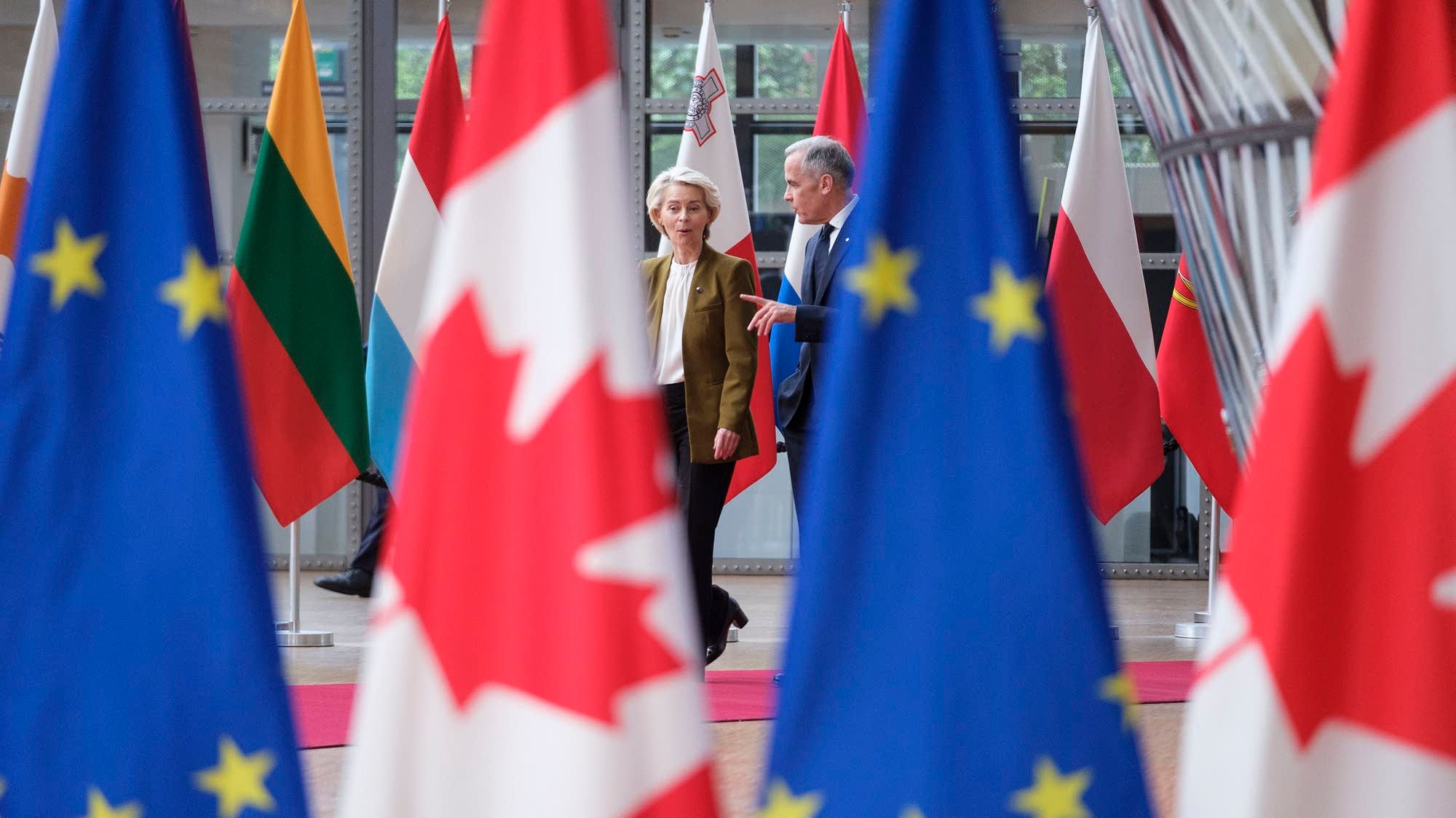
Canada and the European Union are working toward a relationship covering trade and security, to be announced at Ursula von der Leyen's state of the union address in Strasbourg on 16 September.
Critical supply chains, raw materials, space exploration, scientific research and joint defence capacity are the areas the expanded relationship would cover, Bloomberg reported on 8 September, citing people familiar with the preparations whom it did not name. Carney has said the traditional rules-based international order "has effectively fractured". The European Commission has not published the content of the speech, and neither government has confirmed the scope of what would be announced.
Canada's counter-tariffs on C$27.6 billion of goods from the United States took effect at 12:01 am eastern on 8 September. Carney has set a target of doubling non-US exports within a decade, from a base in which about 70 per cent of Canadian exports go to the United States. The European Union accounts for 8.7 per cent of Canada's trade and is its second trading partner, on Council of the European Union figures.
Carney will attend the 16 September address and speak to the European Parliament the following day, the Parliament said on 26 August. Parliament President Roberta Metsola said the visit was "an opportunity to deepen EU-Canada ties and strengthen our bond".
SAFE, submarines and the defence partnership
Canada became the first non-European participant in SAFE, the European Union's 150 billion euro defence procurement instrument. Member states endorsed the agreement on 19 December 2025, it was signed at the Munich Security Conference on 14 February 2026 and the Council of the European Union concluded it on 15 June 2026.
Canadian content may reach 80 per cent of the value of a SAFE procurement under the agreement, against the 35 per cent ceiling that applies to other non-EU countries, according to Global Affairs Canada. Canada pays an initial 10 million euros, of which 7.5 million euros counts as a downpayment against future participation fees, and remits a fee worth 15 per cent of the Canadian content value on any contract where European content falls below 65 per cent. Canadian firms otherwise receive the treatment given to European companies, and the agreement recognises NATO standardisation agreements.
The Council of the European Union cleared implementing decisions for the first eight member state loans on 11 February 2026, covering Belgium, Bulgaria, Croatia, Cyprus, Denmark, Portugal, Romania and Spain. Romania's ceiling is the largest at 16.68 billion euros. A second wave of eight further member states followed on 17 February.
Marconi Technologies of Montreal holds the first contract awarded to a Canadian company under SAFE, more than C$10 million of ORION tactical radios for Polish Cyber Command, with deliveries to 2030, according to the Prime Minister's Office.
Kaja Kallas, Anita Anand and David McGuinty signed the EU-Canada Security and Defence Partnership on 23 June 2025. It covers support to Ukraine, peacekeeping and crisis management, military mobility and interoperability, maritime security, cyber issues and emerging technologies, space security, hybrid threats, foreign information manipulation, counterterrorism, arms control, non-proliferation, the women, peace and security agenda and climate change. The partnership provides for an annual security and defence dialogue.
Leaders at the 20th EU-Canada summit in Brussels on 23 June 2025 issued a joint statement alongside that partnership. They agreed to open talks on Canadian access to SAFE, to work toward a Digital Trade Agreement, to align standards and infrastructure, to strengthen supply chains for critical raw materials, to open a dialogue on industrial cooperation in clean technology and to cooperate on cybersecurity, artificial intelligence and quantum. The European Commission put the increase in EU-Canada trade since 2017 at 71 per cent in its account of the summit.
Carney named the German-Norwegian builder TKMS preferred supplier for up to 12 Type 212CD submarines on 6 July 2026 at Canadian Forces Base Halifax, with Hanwha Ocean of South Korea held in reserve should negotiations fail. Negotiations are to conclude by the end of 2027 and the first four boats to arrive in 2034, according to the Prime Minister's Office, which announced no contract value. Trade press estimates of the full programme, counting maintenance, infrastructure, weapons and lifecycle costs, range from about C$70 billion to C$86 billion. Carney said the fleet's "construction will have enormous, lasting benefits for Canadian industries".
Research, space, raw materials and digital trade
Canada became an associated country to Pillar II of Horizon Europe on 3 July 2024, which lets Canadian researchers and organisations join and lead research consortia on close to the terms available to entities in member states, with Canada paying into the budget from 2024. The first joint association committee met in Ottawa on 19 March 2025 and the second in Brussels on 26 March 2026, where the two delegations reviewed reciprocal access to Canadian research programmes, Canada's place in the governance structures and the 2026-27 work programme.
Canadian Space Agency President Lisa Campbell and European Space Agency Director General Josef Aschbacher signed a General Security of Information Agreement at the Space Symposium in Colorado Springs on 14 April 2026, permitting the exchange of classified and sensitive information and opening ESA contracts previously closed to Canadian firms. Canadian entities won 233 ESA-funded contracts worth about C$192 million between 2018 and 2024, according to Public Services and Procurement Canada. The European Space Agency is not an EU institution and its membership is separate from EU membership.
The Canada-EU Strategic Partnership on Raw Materials dates from 2021 and covers critical minerals, metals and battery value chains, including Canadian lithium, graphite and nickel.
Maroš Šefčovič and Maninder Sidhu launched negotiations on an EU-Canada Digital Trade Agreement in Toronto on 5 March 2026, at the fifth CETA Joint Committee. The agreement would cover personal data and privacy protections, unsolicited commercial messages, paperless trade, the validity of electronic signatures, contracts and invoices, a prohibition on customs duties on electronic transmissions and a bar on unjustified data localisation requirements and forced transfers of software source code. Šefčovič said more than 40 per cent of the 51 billion euros of services trade between the two is delivered digitally.
The same March meeting extended the pharmaceutical protocol to mutual recognition of inspections of active pharmaceutical ingredients, adopted interpretive guidance on fair and equitable treatment and indirect expropriation and signed a decision speeding investment dispute procedures for small and medium enterprises. The mutual recognition agreement for architects entered into force on 18 December 2025. Both sides aim to conclude the digital agreement by the October summit, MLex reported.
Article 49 and the CETA ratification count
Article 49 of the Treaty on European Union restricts membership to European states. Canada cannot accede on 16 September or at the October summit.
Guntram Wolff of the Bruegel research institute told Euronews that integration short of membership could go far: "One can go to the point where Norway is, which is a single market membership." An EU official told the same outlet that European Economic Area membership was not on the table yet and remained a theoretical debate.
CETA has been provisionally applied since 21 September 2017, and 17 of the 27 member states had ratified it as of 31 August 2025, according to the Library of Parliament. Belgium, Bulgaria, Cyprus, France, Greece, Hungary, Ireland, Italy, Poland and Slovenia had not.
France's Senate amended the ratification bill in March 2024 and refused it, and the amended bill had not returned to the National Assembly a year and a half later. Cyprus's parliament voted against ratification in July 2020. Neither government has served formal notification of a permanent failure to ratify, which is what would end provisional application.
About 90 per cent of CETA is in force provisionally. The investment protection chapter and the investor-state court system it would create are not.
Trade and investment figures
EU-Canada trade reached 130.8 billion euros in 2025, split between 81.8 billion euros of goods and 49.1 billion euros of services, according to the Council of the European Union. EU exports to Canada were 48.9 billion euros of goods and 29.4 billion euros of services, against 32.9 billion euros and 19.7 billion euros of imports.
Machinery leads EU exports to Canada, followed by chemical and pharmaceutical products and transport equipment. Mineral products lead imports from Canada, followed by machinery and chemical and pharmaceutical products. Professional, scientific and technical services top the services trade, ahead of travel, transport and telecommunications and IT services.
EU direct investment stock in Canada stood at 244.7 billion euros in 2024, against 230 billion euros of Canadian direct investment stock in the European Union.
Canada was the European Union's 12th largest trading partner in 2025. Goods trade between the two has grown by more than 76 per cent since 2016 and services trade by about 90 per cent, on the Council's figures. Šefčovič and Sidhu put the growth since CETA's provisional application at more than 75 per cent in goods and 97 per cent in services, in their joint statement of 5 March 2026.
Canada is reportedly in talks to sell nuclear power technology and liquefied natural gas to Poland. Canada and Poland have signed an updated agreement on the peaceful uses of nuclear energy, according to Natural Resources Canada, and Natural Resources Minister Tim Hodgson met Poland's energy minister on 29 June 2026 to discuss offshore wind, nuclear energy, LNG and electricity infrastructure.
US tariffs under Section 338
Donald Trump signed three proclamations on 20 July 2026 invoking Section 338 of the Tariff Act of 1930 against Canada, the first presidential use of the provision since its enactment in 1930. Section 338 permits duties of up to 50 per cent, or an outright import ban, against a country found to discriminate against US commerce, and it overrides the Canada-United States-Mexico Agreement: goods qualifying for duty-free treatment under the continental deal are not exempt.
The motor vehicles proclamation covers 439 tariff classifications worth $19.3 billion in 2024 imports, the alcoholic beverages proclamation 63 classifications worth $1 billion and the dairy proclamation 52 classifications worth $97.2 million, according to White & Case. Energy, potash, fish, critical minerals, civil aircraft and parts and any product already carrying Section 232 duties on steel, aluminium or copper are excluded.
US Trade Representative Jamieson Greer gave three grounds when the proclamations were signed: provincial removal of US alcohol from liquor store shelves, better Canadian cheese quota access for European Union exporters than for US exporters and a Canadian surtax order applying a 25 per cent tariff to US-origin motor vehicles alone.
Trump paused the tariffs on 18 August, the day before their scheduled start, and they took effect at 12:01 am eastern on 22 August when the three-day pause expired. Carney suspended Canada's trade negotiations with the United States minutes before that expiry.
Canada's countermeasures cover more than 700 product lines at 15, 25 and 50 per cent, matching the US rates. Steel and aluminium ingots, bars and rods, dairy concentrates and powders, chemical wood pulp, smartphones, monitors, suits, jackets, sweaters, cosmetics, perfumes and golf clubs carry 50 per cent. Plywood, sawn wood, steel cookware, washing machine parts, carpets, knives, cutlery and cheeses carry 25 per cent. Forklifts, industrial handling equipment, harvesting machinery parts, air conditioners and manufacturing moulds carry 15 per cent.
Finance Minister François-Philippe Champagne announced C$7.5 billion of support alongside the countermeasures: C$3.5 billion in rapid response supports for workers and employers, C$2 billion for a Canada Strong Diversification Fund, C$1.5 billion for a Regional Tariff Response Initiative and a C$500 million liquidity stream at the Business Development Bank of Canada. "When the United States asked too much and offered too little, we chose to stand up for Canadians," Champagne said.
Donald Trump wrote on Truth Social on 7 September: "NO MORE SELLING BOMBARDIER IN THE UNITED STATES! Their products aren't good enough!" He wrote in the same post that if the company wants "our Market, they must build here, and stop treating America like a 'piggybank.'" The post carried no executive order, tariff schedule or regulatory action.
Bombardier employs about 3,500 people in the United States, buys from nearly 2,800 suppliers across 47 states and spends more than $2.5 billion a year with them, the company said. Its aircraft wings are built at Red Oak, Texas and its defence business is headquartered in Wichita, Kansas. Senator Jerry Moran of Kansas said Bombardier's presence in Wichita matters to Kansas workers.
At the joint review of the Canada-United States-Mexico Agreement on 1 July 2026 the United States declined to extend the agreement for a further 16 years, triggering annual reviews under Article 34.7.4 to a sunset date of 1 July 2036. Canada and Mexico both supported extension.
What's next
Von der Leyen delivers the state of the union address in the European Parliament chamber in Strasbourg between 09:00 and 11:50 central European summer time on 16 September, followed by a debate with members. Carney addresses the European Parliament on 17 September. The Canada-EU summit takes place on 29 and 30 October in Canada.