Iryna Mudra was led from a courtroom in handcuffs on 25 August 2026, six days after Volodymyr Zelenskyy dismissed her as deputy head of his office. Judge Ihor Strohyi of the High Anti-Corruption Court had just ordered her held for 60 days with bail set at 20 million hryvnias, about 448,000 dollars. Prosecutors had asked for 150 million.
The National Anti-Corruption Bureau says Mudra helped launder 150 million hryvnias in June 2026, the sum wired to the same court on 29 June to free Herman Halushchenko, the former energy and justice minister charged in the Energoatom kickback case, from a detention cell.
Detectives call the case Operation Forrest Gump. It was made public on 19 August with searches at Sense Bank's head office, at Mudra's home and at the homes of sitting MP Vadym Stolar and former MP Maksym Mykytas. NABU described the group that day as "a deputy head of the Office of the President of Ukraine, a former member of parliament, the chairman of the management board of a state bank, the chairman of the supervisory board of a state bank and other persons", acting under the direction of a sitting and a former MP. The suspicions were served under part 3 of article 209 of the criminal code, legalisation of the proceeds of crime on a particularly large scale, which carries 8 to 12 years. The Specialised Anti-Corruption Prosecutor's Office has since named 13 people across Forrest Gump and a linked raiding case called Themis, and says the group formed no later than 15 November 2024.
Sense Bank is owned outright by the Ukrainian state. It was taken into public hands in July 2023 for one hryvnia under a law written to strip Russian-linked owners of systemically important banks, and its former shareholder ABH Holdings is suing Ukraine for a billion dollars at the World Bank's arbitration body. Prosecutors say that bank was steered from inside the Office of the President and used to wash cash.
The cash
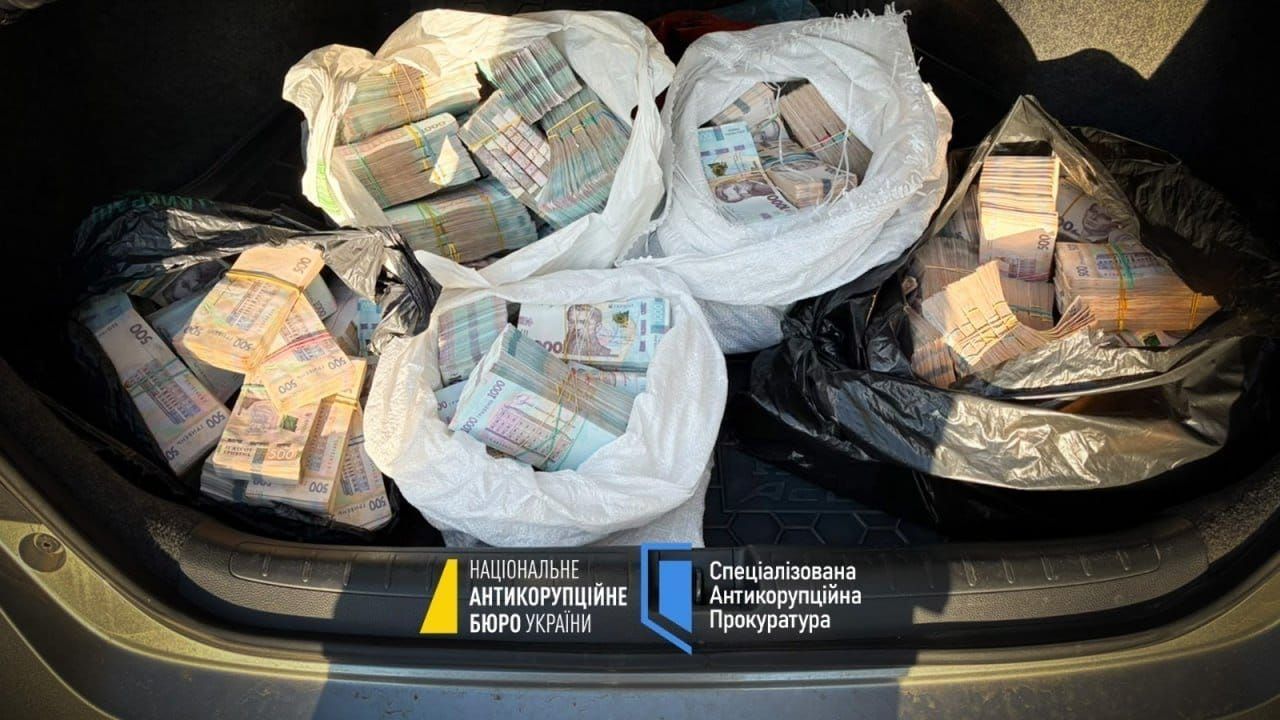
Detectives say the 150 million hryvnias existed as banknotes, and the court accepts only bank transfers.
Cash moved in four tranches to a company controlled by Mykytas on 22 and 23 June 2026, according to an account published by Babel: 50 million hryvnias, then 10 million, then 70 million, then 20 million. It was carried to offices and to underground currency-exchange conversion centres, counted by hand in parked vehicles. Ekonomichna Pravda, the only outlet to report the detail and working from the NABU recordings, said security during the transfers was provided by men described on the tapes as coming from the Main Intelligence Directorate, a detail NABU has not confirmed.
Four companies carried the money between the banknotes and the court's deposit account. Tetras Optima and Skait Retail are registered as timber traders, Giran Contract as a wholesaler of sanitary goods, Pelet Service as a fuel-pellet supplier. Tetras Optima declared a profit of 35,600 hryvnias for 2023. Giran Contract has a charter capital of 5,000 hryvnias and no staff. Money entered their Sense Bank accounts dressed as payments for goods and left the same day for the court.
Per-company figures differ between outlets. Ekonomichna Pravda puts Tetras Optima at 54 million hryvnias, Giran Contract at 87 million, Skait Retail at 5 million and Pelet Service at 4 million. LB.ua gives Giran Contract 46 million. Gordon, reporting at the time the bail was paid in June, describes 105 million from three companies followed by 41 million from Giran Contract and 4 million from Pelet Service.
Ukrainian law requires a bank to flag any transaction above 400,000 hryvnias. On 16 June, according to the recordings, Oleksiy Stupak, chairman of Sense Bank's management board, told participants that the automated system filters such payments and that a bank employee then has to analyse each one by hand. The fix discussed on the tapes was to put the filtering system into technical maintenance on the day the transfers ran, so the payments would clear without review. One speaker on the NABU release said: "I'm doing it manually, creating a window and releasing the money."
Liudmyla Snihur, who ran the bank's financial monitoring department, was threatened on the recordings and agreed to cooperate provided each transaction was cleared with her first, Ekonomichna Pravda reported. Mykola Hladyshchenko, who chaired the supervisory board, reported the deposits back to Mudra. Bankers quoted by LIGA said the manoeuvre breached protocol whatever the state of the automated system, because a bank must analyse suspicious transactions manually in any case.
Halushchenko walked out on 29 June. Yaroslav Zhelezniak, an opposition MP who has published running detail on both cases from inside the courtroom, calculates that 50 million hryvnias went to the court directly from Sense Bank accounts and 37.86 million reached it from Giran Contract through Tetras Optima, tying at least 87.86 million hryvnias to the bank.
The bank
Andriy Pyshnyi, governor of the National Bank of Ukraine, told parliament on 20 August that Hladyshchenko had been deprived of his powers rather than dismissed, for breaching the statutory independence requirements for a supervisory board member. Pyshnyi opened an administrative proceeding into the collective suitability of the entire supervisory board, and a second proceeding into Stupak's professional suitability. Hladyshchenko's powers were formally terminated on 21 August.
Pyshnyi said the National Bank had begun reviewing the board after recordings were published in May 2026 but had lacked sufficient grounds to act, and that the 19 August disclosures supplied them. On those May recordings, six people were discussed as candidates for the supervisory board before the government appointed them, a sequence European Interest reported in August.
Snihur was suspended on 21 August at the written demand of the National Bank and her access to every internal system was cut. Stupak was summoned before the National Bank's qualification commission on 26 August. The regulator is also running unscheduled inspections into whether bank employees interfered with the automated financial monitoring system, and has said on the record that it "does not have access to automated banking systems, does not influence their operation, does not determine their ability to be shut down".
Sense Bank said it "continues to cooperate with law enforcement agencies in accordance with applicable law". Its internal audit found no procedural violations in the selection of the supervisory board.
Prime minister Serhiy Koretskyi instructed the finance ministry on 20 August to accelerate the sale of Sense Bank with maximum transparency and competitiveness, with the proceeds earmarked for the armed forces.
Ukraine took Sense Bank from owners tied to Mikhail Fridman and Petr Aven on the argument that hostile private control of a systemically important bank was a security risk. The International Monetary Fund noted at the time that the nationalisation was not driven by financial instability. The state then appointed the supervisory board that prosecutors now say was run from the Office of the President.
Selling the bank
Sense Bank held 124.2 billion hryvnias of assets at the end of 2024, up about 15 per cent on the year, and runs 122 branches. It made 3.22 billion hryvnias of net profit in 2025, an increase of 82.5 per cent, against 29.1 billion at PrivatBank and 16.63 billion at Oschadbank. The National Bank reaffirmed its designation as systemically important in June 2026. State banks hold more than half of the assets in Ukraine's banking system.
The cabinet approved preparations to privatise Sense Bank and Ukrgasbank on 1 October 2025 and set the end of 2026 as the target for a sale, with applications from advisers closing on 15 June 2026. No adviser has been announced since that deadline. Ekonomichna Pravda reported market expectations of a price around 0.7 to 0.9 times capital given the war, which would put Sense Bank near 10.5 billion hryvnias, and named OTP, central European groups and the Ukrainian banks Pivdennyi, TAS and PUMB as possible bidders. Andriy Pyshnyi, the National Bank governor, said the two banks have a good chance of being sold this year and that the process needs "the engagement of an external advisor to the government, to strengthen the process".
Deterring buyers is the claim ABH Holdings brought at the World Bank's International Centre for Settlement of Investment Disputes on 29 December 2023, registered as case ARB/24/1 and pleaded under the 1996 investment treaty between Ukraine and the Belgium-Luxembourg Economic Union. The Luxembourg company, whose shareholders include Mikhail Fridman and Petr Aven, held 57.6 per cent of the bank directly and the rest through a Cypriot subsidiary, and alleges expropriation and denial of fair and equitable treatment. The tribunal is chaired by Bernard Hanotiau. It rejected an attempt to disqualify one arbitrator in July 2024 and ruled on 12 May 2025 on Ukraine's request to hear the question of amount in a separate phase. No award has been issued. UNCTAD's docket records the claim at 653 million dollars; ABH and Ukrainian media have put it above a billion.
The Asset Recovery and Management Agency chose Sense Bank in January 2025 to hold roughly 2 billion hryvnias of assets seized in criminal cases.
The recordings
A woman whose voice detectives attribute to Mudra is heard on the NABU tapes taking a call from a man the recordings call the Israeli refugee Tymur, understood as Timur Mindich, asking the Office of the President to take the bank in hand because serious money moved through it. SAPO told the court on 25 August that on 9 June 2026 Mudra received an offer to take part in legalising criminally obtained cash directly from a member of the organisation who was by then wanted and in Israel.
"Corruption should be systematised and controlled. There is no need to fight it," the voice on the recording said. A male voice interrupts twice to add "and lead it".
Bank managers are described on the tapes as ready to do whatever they are told and as needing no minder, because they had already come looking for protection.
Another voice on the tapes offered protection for the bank in exchange for payment. "They won't go after Sense Bank, and Sense Bank has to pay them. First David came, then the other one. And not together, separately," the voice attributed to Mudra said. Ukrainian outlets read the second name, bleeped in the release, as Danylo Hetmantsev, chairman of parliament's finance committee. Hetmantsev wrote on Telegram at 13:29 on 19 August that he had never, in any format or language, discussed control over Sense Bank with Mudra or anyone else, and offered to take a polygraph test and give evidence to NABU. The first name is read by the same outlets as Davyd Arakhamia, who heads the Servant of the People faction and has not responded publicly. NABU bleeped both names and has identified neither.
One passage recorded on 9 June 2026 runs through the candidates in the election to NABU's public oversight council. "There, where our Inna is, where Anya is, whom I know. How can we gather as many votes there as possible?" a voice attributed to Mudra said. NABU opened that contest to 44 candidates from 25 civil society organisations, with 15 members chosen by public internet vote. Voting ran on 10 June, the day after the recording, and the results were announced on 15 June. Another passage discusses distributing money to secure a preferred head of SAPO and blocking Oleksandr Klymenko from a second term. "We are stepping on the same rake. We are not thinking about or preparing a successor to Klymenko," one voice said. "This man is unprincipled. He is not ours." Investigators say the group also tried to interfere in NABU, in other law enforcement bodies and in the competition to lead SAPO. A line on the tapes about a reappointment for a second seven-year term has been read by Ukrainian outlets as a reference to SAPO head Oleksandr Klymenko, whose own term runs seven years, and investigators have not made that identification.
"Well, there are four bags of money there," one participant said. Another told the group: "If we do this, you can drive to the Office of the President yourselves." A prosecutor read a further line into the record at the Mykytas hearing: "If Mindich is paying, then we can also put up the money for other, lower-level corrupt officials."
Discussing how to hold assets without registering anything in their own children's names, one of the suspects said: "That's why, Forest Gump." Euromaidan Press reported that exchange as the source of the codename.
SAPO says the group changed mobile phones systematically, deleted the data on them, used secure messaging and illegally accessed state databases to check whether law enforcement had taken an interest in them. A voice attributed to Mudra is heard on one recording saying: "I've basically talked myself into a criminal charge, you understand?" Detectives also seized what Euromaidan Press described as an anti-crisis communications plan, mapping messaging across Telegram, social platforms and news outlets, casting the head of a parliamentary commission as chief spokesman and framing any disclosure as an audit rather than an attack in order to shield the president and the cabinet.
Mudra said the published recordings were presented selectively and without their full context, and that she resigned voluntarily rather than burden the state. Her lawyers said they would test the legality of the custody ruling on appeal.
The plan
NABU published photographs on 19 August of a document its detectives took from the searches. "During searches in Operation Forrest Gump, NABU and SAPO discovered a document containing a plan of anti-crisis communication concerning the work of the Verkhovna Rada's Temporary Investigative Commission," the bureau wrote. "It sets out communication steps and messages aimed at responding to the public situation around the commission's work."
Focus, the only outlet to transcribe the document from the photographs, reported its title as "The breaking point of the discussion on anti-corruption infrastructure". The objectives it lists are to take the president out of the line of fire, to position the commission as an institution worth trusting, to frame the exercise as transparency and audit rather than attack, and to present the process as systematic and open. It names social networks, anti-corruption Telegram channels, government channels, television and public speakers as the channels to mobilise, along with members of the commission themselves, and proposes that deputies from a range of factions show involvement in its work to lower the temperature.
Neither NABU nor SAPO has named an author or a commissioner of the document, or said whose premises it came from. Oleksiy Honcharenko, who chairs the commission, has not responded publicly to its disclosure.
Parliament created that commission on 17 December 2025 under resolution 4731-IX, passed without debate on a vote of 252, with 165 of those votes coming from Servant of the People. Its remit covers possible breaches of Ukrainian law in defence, of anti-corruption legislation and of human rights during martial law, reaching military supply, fortification construction, energy contracts, humanitarian aid and mobilisation. It has 14 members, chaired by Honcharenko of European Solidarity with Ihor Fris of Servant of the People as his deputy, and its term runs to December 2026.
Under the 2019 law on temporary investigative commissions, people invited must appear and give truthful evidence, are warned in writing of criminal liability for false testimony and can be brought in by the National Police if they fail to appear without justification. The same law states that a commission's conclusions and proposals are not decisive for the bodies conducting criminal proceedings.
Honcharenko summoned Serhiy Shefir and Rustem Umerov to the commission on 29 April 2026 over the Mindich recordings published that month. "I am summoning Serhiy Shefir to the commission session on 13 May," he wrote. Umerov did not attend; the National Security and Defence Council press office said he was on a foreign trip with the president. Denys Shtilerman of Fire Point and Halushchenko, then in pre-trial detention, did appear on 13 May.
What Mudra is accused of taking
SAPO prosecutor Vitaliy Hrechyshkin told the court on 24 August that Mudra controls assets worth more than 250 million hryvnias.
Hrechyshkin read a recording in which Mykytas told her he had left her almost 4 million dollars in connection with the Ukrbud project. Prosecutors put unrecorded payments to her at 20,000 dollars a month, rising to 30,000 a month from January 2026, none of it declared, and told the court that Mykytas covered roughly 250,000 dollars a year for her daughter's education and living costs in the United States. They described a Range Rover Sport worth 120,000 euros, Bulgari and Van Cleef jewellery held through nominees, the use of Threema and foreign phone numbers and a recorded line from Mykytas: "I tore up what you said to tear up." Prosecutors also alleged she sought favourable court rulings in exchange for helping a judge's promotion.
Mudra told the court she never received the 4 million dollars in cash, to bank accounts or in any other form, and that the file contains only the words of another person.
"Of the 237 conversations included in this case, 232 were recorded through the microphone of one person," she said. "This person was close to me, I trusted them, and the whole time they spoke with me, they were recording me."
She described the material as private kitchen conversations and asked the court not to equate private emotion with criminal intent.
"Ukraine is my home, this is where my professional reputation is, my life, my responsibility and my family," she said. "I have no intention of fleeing from any of this."
The bail hearing
Conditions attached to her release, if the bail is lodged in full, include an electronic tag, surrender of her passports, a ban on leaving Kyiv city and region without permission, no contact with witnesses and a bar on entering the premises of three companies: Budmontazhservis, Filosofiya Development and Rehionalni Resursy.
At her bail hearing on 24 August, Rabbi Yonatan Binyamin Markovich, chief rabbi of Kyiv, offered to stand as her guarantor. "I ask you to accept me as surety for Ms Mudra. I have known Ms Mudra for several years. She came to our community, to our home," he said. Asked why he was confident she would comply, he said: "Because when she needed to pray, she came and did so. She will not disappoint either the community or state authorities." A military officer, Serhiy Kovalenko, who described himself as a former banking colleague, offered a second surety.
Moshe Reuven Azman, who uses the title chief rabbi of Ukraine, wrote the next day that Markovich had acted on his own initiative and that his offer was not the position of the Jewish community. "I consider such a mixing of roles mistaken and categorically do not support it," Azman wrote. He also condemned the antisemitic abuse that followed the courtroom appearance: "No act by an individual rabbi gives anyone the right to insult the Jewish people."
The lawyer who ran Ukraine's case against Russia
Mudra spent 2015 to 2022 as head of compliance and deputy director at Oschadbank, the other big state bank, where she led the team behind the arbitration award against Russia over assets lost in Crimea. A Paris appeal court put that award above 1.5 billion dollars in June 2025 and rejected Russia's challenge in November 2025.
She became deputy justice minister in May 2022 and moved to the Office of the President by presidential decree on 30 March 2024. Her brief there was the legal war against Russia: the special tribunal for the crime of aggression, the Register of Damage for Ukraine, the international compensation mechanism, the case for confiscating frozen Russian sovereign assets and the draft law ratifying the Rome Statute. She sat on the Ukrainian delegation negotiating the anti-corruption track with the IMF and represented Ukraine at the Register of Damage's conference of participants.
"Territorial integrity, sovereignty of the country and the responsibility of the aggressor should not be a subject of bargaining," she told Babel in a long interview about that portfolio. "I am a man of my employer. My employer is the state, so I am a man of the state and serve the interests of the state."
In May 2026 she set out the timetable: a tribunal in The Hague with up to 30 targets from Russia's political and military leadership, prosecutors and investigators starting no earlier than late 2027, first decisions of the claims commission expected in 2027, Ukrainian losses above a trillion dollars. Zelenskyy awarded her the Order of Princess Olha, third class, in 2025.
"I am suspected of seizing someone else's property," she told the court on 25 August. "But everything I did over these years was returning property to the state."
Her statement of 20 August said the tribunal and the compensation commission "belong to Ukraine and affected citizens, not to individual positions". No successor to the portfolio has been announced. The Council of Europe, which hosts the Register of Damage and signed the tribunal agreement with Zelenskyy in June 2025, issued an Independence Day statement on 21 August that made no mention of the case.
The 13
Prosecutors name Mykytas and Stolar as the organisers, joined by what the prosecutor called a conceptual agreement.
Viktor Dubovyk, director general of the legal policy directorate of the Office of the President, is accused of giving advice and instructions on the workings of the justice ministry's anti-raiding commission. Olena Ferens, a deputy justice minister, is accused over the decisions of that commission. Vasyl Astion, a businessman and former deputy of the Dnipropetrovsk regional council, is accused of securing favourable court decisions. Valentyn Yelizarov, who ran Metrobud in practice, is described by prosecutors as the group's coordinator, directing nominal company managers and recruiting front persons.
Three of the accused come from Sense Bank: Hladyshchenko, Stupak and Snihur. Yehor Merkulov, listed as head of Montazh Service, is Mykytas's driver. Oleksandr Ostapenko, listed as director of Filosofiya Development, is his bodyguard. Mykyta Tarkovskyi is another company manager linked to Mykytas.
The justice ministry's anti-raiding commission, created in 2016, can cancel registration actions, block registry access, strip registrars of accreditation and recommend the revocation of notary licences. It cannot verify the authenticity of documents or determine ownership, and Ukrainian lawyers have criticised it for years over unexplained delays, inconsistent decisions and the absence of any legal definition of raiding in Ukrainian law.
Themis
SAPO has charged the same 13 people in a second case, Themis, over corporate raiding.
Investigators say the group seized business assets worth more than 248 million hryvnias in autumn 2025 and tried to take control of Kyiv property worth more than 207 million in May 2026, with one central Kyiv building valued above 500 million. Hackers posing as state registrars broke into the Unified Register of Legal Entities and filed forged documents moving ownership from real owners to nominees, created fictitious debts to trigger bankruptcies and inserted forged court rulings into property registers. Judges at Kyiv's Pecherskyi district court were allegedly bribed, and justice ministry officials were used to block the real owners' complaints through the anti-raiding commission.
Outlay on the hackers, the bribes and the officials came to less than 514,000 dollars, according to investigators. One sitting MP is alleged to have supplied that financing.
"I understand perfectly well that whatever happens to this prosecutor who took the money, he will not tell the truth," a voice on the Themis recordings said, in a passage published by Espreso.
Stolar was charged in absentia on five counts: creation of a criminal organisation, misappropriation, unlawful seizure of property, forgery and unauthorised interference with information systems. The last of those, article 361 of the criminal code, carries up to 15 years under wartime aggravation. He was not charged over the bail money. NABU director Semen Kryvonos confirmed the charges. Stolar left the country more than a month before they landed, according to law enforcement sources, and did not respond to requests for comment.
Mykytas
Mykytas ran the state construction corporation Ukrbud from 2010 to 2016 and sat in parliament from 2016 to 2019 with the Will of the People group.
He was detained in 2019 while attempting to leave Ukraine, over National Guard housing contracts amended so that the state received flats worth 81.6 million hryvnias less than agreed. On 2 December 2020 the High Anti-Corruption Court moved him from a detention centre to round-the-clock house arrest after he entered a cooperation agreement with investigators, partially admitted guilt and agreed to compensate the state. He denied in January 2021 that the deal involved testimony against Oleh Tatarov, then a deputy head of the Office of the President.
Ukrbud collapsed in autumn 2019 owing 26 unfinished projects to about 13,000 investors. Kyivmiskbud took over 13 of the residential complexes, five went to other developers and seven were left unresolved, with completion costed at 2.1 billion hryvnias. Mykytas later regained ownership of Ukrbud.
He was detained again in 2022 over an alleged 22 million euro bribe offer to the mayor of Dnipro, and served with suspicion in October 2023 over more than 307 million hryvnias of defence ministry money paid in advance for missile and ammunition storage that was never built. That trial opened at the High Anti-Corruption Court on 3 June 2025.
The court ordered him held on 21 August 2026 with bail of 30 million hryvnias, against the 200 million prosecutors sought, across 12 alleged episodes. Prosecutor Vitaliy Rybalkin told the court that Mykytas has stable connections and influence in the authorities and the judicial system. Mykytas said he was ready to cooperate with the investigation and called the case political manipulation.
Stolar, who is 44, sat in parliament for the Party of Regions from 2010 to 2012 on the committee on combating organised crime and corruption, returned in 2019 on the Opposition Platform For Life list and moved to the Restoration of Ukraine group after that party was banned in 2022. Ukrainian media called him the de facto mayor of Kyiv under Petro Poroshenko. He confirmed the searches on Facebook on 19 August: "I am cooperating openly with representatives of the bureau. I am not obstructing law enforcement in any way."
Midas
NABU announced Operation Midas on 10 November 2025 after a 15-month investigation and more than 70 searches.
Detectives put at least 100 million dollars through a scheme at Energoatom, the state nuclear operator, in which contractors paid 10 to 15 per cent of contract value or were blocked from payment and struck off supplier lists. Mindich, a business partner of Zelenskyy in the president's former television company, left Ukraine hours before the searches began. The National Security and Defence Council approved sanctions on him on 13 November 2025. Halushchenko lost the justice ministry. Deputy prime minister Oleksii Chernyshov was charged, as was former deputy prime minister Olha Stefanishyna. Andriy Yermak, who ran the Office of the President, resigned in November 2025, and Zelenskyy appointed military intelligence chief Kyrylo Budanov to replace him on 2 January 2026, making Budanov Mudra's superior for the seven months before her dismissal.
Halushchenko was detained on 17 February 2026 with bail set at 200 million hryvnias. The court cut it to 150 million on 12 June. The full sum was lodged on 29 June and he was released.
Bail in the Midas case now totals more than 513 million hryvnias, by a tally ZN.UA published on 25 August. Halushchenko posted 150 million in June 2026. Yermak posted 140 million in May 2026. Ihor Fursenko posted 95 million, Ihor Myronyuk's 85 million remains unpaid and he remains in custody, Chernyshov posted 51.6 million in November 2025, Dmytro Basov 40 million, Lesya Ustymenko 25 million and Liudmyla Zorina 12 million.
ZN.UA set that 513 million against the war it comes out of: roughly 25,000 attack FPV drones, or 340 to 390 new four-wheel-drive pick-up trucks or about 2,000 dome-mounted electronic warfare kits.
Ukrainian defence forces struck 16 targets inside Russia in the 24 hours to 26 August, Zelenskyy said, among them oil refineries, airfields and a missile unit.
What the network is said to have taken
NABU seized about 4 million dollars in cash across the 70-plus Midas searches of November 2025 and recorded roughly 1,000 hours of audio. Participants complained on the tapes of back pain from carrying banknotes.
Halushchenko took about 9 million dollars from the Energoatom scheme between 2020 and 2025, prosecutors say, and he denies it. Court documents say he co-founded a fund registered in Anguilla that received proceeds. Transparency International Ukraine's case file records more than 7.4 million dollars moved to Swiss accounts, plus direct payments of more than 1.3 million Swiss francs and 2.4 million euros, and says his family invested in an offshore fund. Journalists reported in December 2025 that his son, then 18, attended a Swiss boarding school costing about 200,000 dollars a year.
Chernyshov was recorded receiving 1.2 million dollars and about 100,000 euros, with a final 500,000 dollars handed to his wife on 9 May 2025 at a clinic on Chykalenko Street in Kyiv run by Oleksandr Tsukerman, the man NABU calls the head of the laundering back office. Chernyshov and his wife declared 106 million hryvnias of income for the years 2019 to 2024.
Four houses of roughly 1,000 square metres each stand on more than 8 hectares at Kozyn, south of Kyiv, in a development NABU calls Dynasty. Construction ran from 2019 to 2025, through the invasion, and stopped in July 2025 when the first suspicions were served. Detectives put individual house values around 2 million dollars, against cooperative records showing about 10 per cent of real construction cost, and say nearly 9 million dollars was laundered into the site. Yermak is one of the four principal residents, using his father Borys Yermak and his assistant Nataliia Kylymkova as intermediaries, according to NABU. Transparency International Ukraine describes a five-step plan drawn up in 2025 to shield the estates from confiscation, ending in a resale through the state electronic auction system to manufacture a good-faith purchaser.
Mindich moved 3 million dollars to Switzerland and 1 million to Israel over a single summer window, according to Babel's account of the case file, after an earlier 1 million dollar transfer. More than 500 dossiers on officials, MPs and security personnel were found in his possession, Meduza reported. Ukrainian outlets reported a gold-plated toilet at a property connected to him, a detail ABC News attributed to Kyiv newspapers rather than to NABU. At least some of the imagery circulating with that claim is fake: a Belarusian fact-checking outlet established that Russian state broadcaster BT had passed off a Russian traffic officer's mansion as Mindich's house.
Basov acquired about 360,000 dollars of assets during the scheme, inconsistent with his declared income, and Myronyuk held 874,000 dollars as of 21 February 2025 and delivered more than 4 million dollars in total, according to Transparency International Ukraine's file.
Olha Stefanishyna, dismissed as ambassador to the United States on 3 August 2026, was charged two days later with illicit enrichment and false declarations totalling 13.9 million hryvnias: two undeclared apartments plus cash for renovations, her mother's medical treatment, air tickets and rent. She denies it.
The back office
Semen Kryvonos, director of NABU, said on 14 November 2025 that the investigation began more than two years earlier when detectives identified back offices, which he described as "places where contracts, influence on officials and the distribution of bribes would be discussed outside the official agencies" and where "money obtained from state-owned companies and budget programmes was laundered".
The Midas back office operated from a Kyiv office linked to the family of Andriy Derkach, the former MP who now sits in the Russian senate and was sanctioned by the United States over election interference. It kept a black ledger, used cryptocurrency and collected cash at more than 30 locations across Kyiv to stay under financial monitoring thresholds, with some of its shell companies registered in Moscow.
Contractors at Energoatom met a mechanism the participants called shlahbaum, the boom barrier: pay 10 to 15 per cent of contract value or have payments frozen and be struck off supplier lists. Recordings from September 2025 catch the rate being raised from 10 to 15 per cent on a 4 billion hryvnia contract. One company received a contract worth 435 million hryvnias after accepting the higher rate.
Kryvonos said members of the group used counter-surveillance, tracked the movements of NABU staff and reached the Safe City camera system with help from people he described as representatives of law enforcement agencies.
Of one figure at 9a Hrushevskoho Street, Kryvonos said subordinates on the recordings would say "We need to get his agreement on this" and "He called and gave such-and-such an instruction", and that this person took key decisions inside the group. He has not named him.
Serhiy Shefir, Zelenskyy's first assistant and a Kvartal 95 partner of long standing, appears on the Midas tapes discussing how to raise bail for Chernyshov. "I told him about the bail. If you have the official part, we'll handle the rest unofficially," he said, according to a passage SAPO prosecutor Serhii Savytskyi read in court on 12 November 2025. On Chernyshov's wealth, the same voice said: "That's just what's declared. Judging by how he lives, the fleet of cars, the staff, the house, it's a lot more." Shefir has not been charged.
Zelenskyy's orbit
Mindich, who co-owns the Kvartal 95 studio with Zelenskyy and was his business partner before the presidency, is named as the organiser of the Midas group under the codename Carlson. He left Ukraine at 02:09 on 10 November 2025, hours before the raids. The court ordered his detention in absentia on 1 December 2025, the National Security and Defence Council sanctioned him on 13 November 2025, an Interpol request followed on 26 January 2026 and extradition papers went to the Prosecutor General on 31 March 2026. He is in Israel. Oleksandr Abakumov, NABU's lead detective on the case, said: "Israel is a difficult country for extradition. To proceed, law enforcement must submit essentially the entire case file."
Yermak ran the Office of the President until he resigned on 28 November 2025, the day NABU searched his home. He was charged on 11 May 2026 with laundering 460 million hryvnias between 2021 and 2025 through the Dynasty development, and the court set bail at 140 million hryvnias on 14 May. "I don't have that kind of money for bail," he told the court. "I deny any accusations." The bail was paid. Investigators refer to him on the tapes as R2; NABU's lead detective said in March 2026 that his codename is Surgeon, contradicting earlier reporting that gave it as Ali Baba.
Halushchenko was energy minister from April 2021 to July 2025 and then justice minister until parliament dismissed him on 19 November 2025. He appears on the tapes as Professor and as Sigismund. He was detained on 15 February 2026 on the train to Warsaw.
Chernyshov, a former deputy prime minister, appears as Che Guevara and faces charges in both Midas and Dynasty. Tsukerman, who NABU says ran the laundering, appears as Sugarman and as Chef; he and his brother Mykhailo left Ukraine and were sanctioned on 13 November 2025.
Rostyslav Shurma was deputy head of the Office of the President from November 2021 to September 2024. He was charged on 21 January 2025 over 141.3 million hryvnias of feed-in-tariff payments claimed for solar plants in occupied Zaporizhzhia oblast that had lost their grid connection, alongside nine others including his brother Oleh. Both were declared wanted in February 2026 and detention in absentia was ordered on 21 April 2026. Shurma said he lives legally in Germany, called the decision politically motivated and said: "I do not plead guilty."
Andriy Smyrnov, deputy head of the Office of the President from 2019 to March 2024, was charged in April 2024 with money laundering and taking a bribe on a particularly large scale, on top of an earlier illicit enrichment charge covering 15.7 million hryvnias, with assets above 17 million hryvnias against declared income of 1.3 million for 2020 to 2022.
Oleh Tatarov remains deputy head of the Office of the President with responsibility for coordinating law enforcement. He was charged with bribery in 2020 over conduct predating his appointment and the case was closed in 2022, after what a law enforcement source described to the Kyiv Independent as unprecedented pressure. No charge stands against him.
Rustem Umerov, defence minister at the time and now secretary of the National Security and Defence Council, appears on Mindich recordings published by Ukrainska Pravda on 29 April 2026, discussing the Fire Point company, its long-range systems and arms export pricing. He has not been charged.
Vasyl Maliuk resigned as head of the SBU on 5 January 2026. Parliamentary sources told Euromaidan Press the trigger was his refusal to take Yermak's side once Midas reached him. He has not been charged.
Ihor Kolomoisky, who financed the television channel that carried Kvartal 95 and was widely described as Zelenskyy's patron before 2019, has been held in the SBU detention centre in Kyiv since September 2023. He faces charges over billions of hryvnias taken from PrivatBank through fictitious loans and offshore companies, and a further suspicion added in May 2024 over the alleged contract killing of a lawyer in Feodosia in 2003. A London court ordered him and Hennadiy Boholiubov to pay PrivatBank more than 3 billion dollars.
A voice on Midas recordings referred to as Vova has circulated as a reference to Zelenskyy; SAPO head Oleksandr Klymenko said on 10 August 2026 that the anti-corruption agencies did not publish those recordings, and NABU has never identified the speaker.
"The President of Ukraine has not featured and does not feature in this case," Kryvonos said at a briefing reported on 12 May 2026.
Fedorov
Mykhailo Fedorov was minister of digital transformation from August 2019, first deputy prime minister from July 2025 and defence minister from 14 January 2026 until Zelenskyy removed him on 16 July 2026.
He published a video address to Ukrainians on 18 August 2026, the day before the Forrest Gump searches became public, raising corruption, what he called a management crisis, elections and a new social contract.
"If you have been given powers, answer for the result," he said. "Ukraine can fight and remain a democracy at the same time."
In an interview with the BBC published on 23 August, Fedorov said of Zelenskyy:
"In all the time that I worked with him, not a single time have I received from him any task that would go against law or my sense of integrity."
He stopped short of clearing the president of knowledge of the schemes and said Zelenskyy owes an answer.
"Let him answer that question. I think he is ready for such questions," he said. "It is his responsibility to tell us all whether he knew about all of this or not. I do not want to make any assumptions."
Fedorov said in the same interview that he had removed corrupt practices from defence procurement while he was minister and that corruption persists, that he has not spoken to Zelenskyy since the video address, that he opposes holding elections during the war and that he has not ruled out running for president once a vote is possible.
"Let the law enforcement and anti-corruption systems do their work, and do it independently. What is there for me to comment on?" Zelenskyy said on 22 August, the day before the interview ran.
"I have no questions from the heads of the anti-corruption agencies. They understand perfectly well that I'm not involved in anything like that."
Honcharenko's commission, the same body the seized communications plan was written to manage, summoned Fedorov on 25 August to appear at 13:00 on 31 August 2026 at the Kyiv City Council session hall on Khreshchatyk. "We are summoning the former defence minister. The commission has many questions for Mr Mykhailo," Honcharenko wrote. It is examining Operation Midas from NABU's disclosures of November 2025, along with mismanagement of public funds and misuse of state property under martial law.
The claim about the president
Halushchenko threatened from detention to give everyone up, Mindich called Zelenskyy, Zelenskyy instructed Budanov and Budanov passed the job to Mudra, whose people converted the cash through Sense Bank and possibly Oschadbank, in an account Zhelezniak published on 25 August and described as his own supposition rather than established fact. Neither Zelenskyy nor Budanov has been charged.
Zelenskyy said on 22 August that the material already public was enough to justify dismissing Mudra.
Espreso, alone among Ukrainian outlets and without naming its sources, reported that Halushchenko pressed the Office of the President for his release and that justice ministry officials refused an instruction from a deputy head of the office they judged unlawful.
The court
The High Anti-Corruption Court began full operation on 5 September 2019 and delivered its first sentence on 30 October that year. Candidates for its bench are vetted by the High Qualification Commission of Judges alongside a six-member Public Council of International Experts, foreign lawyers with a veto over candidates of doubtful integrity and appointed by presidential decree.
Ekonomichna Pravda counts 352 verdicts against 501 defendants since inception, carrying 976 years of imprisonment. Real prison terms fell from 24 per cent of verdicts in 2022 to 20 per cent in 2025, while suspended sentences reached 41 per cent, the highest recorded. Plea agreements rose from 17 per cent of cases in 2021 to 50 per cent in 2025. Broken down by defendant, real sentences run at 18 per cent for judges, 15 per cent for prosecutors and investigators, about 20 per cent for civil servants and 7 per cent for politicians. Between 20 and 25 of the court's 63 authorised judicial posts stood empty at the start of 2026.
Zelenskyy signed decrees on 21 August appointing 16 new judges to the court, 11 to the first instance and five to the appeals chamber, among them Olena Tanasevych, who has headed the court since 2019. Bohdan Kryklyvenko, the court's chief of staff, said 16 of 17 finalised candidates were appointed and that the paperwork for the last was only forwarded to the Office of the President on 19 August. Expanding the bench is a structural benchmark under the European Union's 50 billion euro Ukraine Facility, worth 250 to 300 million euros in direct budget support, with an original deadline of the first quarter of 2025. Zelenskyy held the signed decrees for more than a month before releasing them.
The European money
The European Commission was asked about Operation Forrest Gump at its midday briefing on 25 August.
"We know about the latest events. As you know, we do not comment on individual cases. Let us be clear: the EU maintains a zero-tolerance policy toward corruption," the Commission spokesperson said, adding that the role of the independent anti-corruption bodies, "which are cornerstones of the rule of law in Ukraine as a future EU member state, must be protected".
Parliament's law enforcement committee voted on 19 August, the day the Forrest Gump searches began, to strike five anti-corruption bills from the agenda of a session that runs to January 2027. The five would extend NABU's jurisdiction to officials of the Office of the President and the State Bureau of Investigation, impose transparent competitive selection with international experts on the appointment of the Prosecutor General, apply the same to the State Bureau of Investigation, repeal 2017 amendments that restrict investigation timelines and ease the closure of corruption cases and suspend limitation periods where defendants have been mobilised. Ivanna Klympush-Tsintsadze, who chairs the European integration committee, said she was "absolutely appalled by this decision".
"Rule of law and the fight against corruption is an essential element for any country to join the European Union," Commission spokesperson Markus Lammert said when the blockage became public.
Ukraine agreed 10 reform priorities with the Commission in late 2025, none of them yet delivered, with about 2.1 billion euros of support riding on completion by the end of 2026.
The 90 billion euro support loan the Council of the EU finalised on 23 April 2026 is interest free, financed by EU borrowing against budget headroom and expected to be repaid out of Russian reparations. It splits into 30 billion euros of macroeconomic support and 60 billion for defence industry and procurement, with 45 billion accessible during 2026, and its disbursement is tied to rule-of-law conditions. The IMF approved a 48-month extended fund facility of 8.1 billion dollars on 26 February 2026 and completed its first review on 20 July, releasing about 690 million dollars while noting delays on structural benchmarks.
Ukraine's parliament stripped NABU and SAPO of their independence once before, on 22 July 2025, by inserting amendments into an unrelated bill after first reading. Zelenskyy signed it that evening. Protests followed in Kyiv, Kharkiv, Lviv, Dnipro and Odesa, the first against the government since the full-scale invasion began, and he submitted corrective legislation two days later. Parliament passed it and he signed it on 31 July 2025.
What Ukrainians think
Info Sapiens put Zelenskyy's electoral support at 20.3 per cent in polling conducted between 13 and 28 November 2025, down from 24.3 per cent in October, against 19.1 per cent for Valerii Zaluzhnyi.
The Kyiv International Institute of Sociology found in fieldwork between 26 November and 13 December 2025 that 77 per cent of Ukrainians were aware of the Midas investigation and 59 per cent held Zelenskyy responsible for Mindich's actions, against 30 per cent who did not. The same institute measured trust in Zelenskyy at 61 per cent in fieldwork between 7 May and 3 June 2026, unchanged within the margin of error since April, and reported in June 2026 that 88 per cent want a reset of the presidency, the cabinet and parliament, up from 73 per cent three years earlier.
Socis, polling 2,000 people face to face between 28 July and 2 August 2026, found 59.4 per cent describing the work of NABU and SAPO as ineffective against 5 per cent calling it highly effective, in the last published survey before Operation Forrest Gump was made public.
The reaction
Transparency International Ukraine called on the Office of the President on 19 August not to interfere in the work of the anti-corruption bodies, saying the independence of the anti-corruption institutions cannot be a subject of bargaining.
Roman Verbovskyi, a lawyer at the Anti-Corruption Action Centre, said the same day that the investigation appears to cover attempts to influence the competition for the head of SAPO. "They are trying to distract us from high-level corruption and to make the guilty parties not those who commit corruption crimes but those who investigate them," he said.
Daria Kaleniuk, who runs the same centre, said on 20 August that two or three months had passed between the offence in June 2026 and the notices of suspicion, and called that a marked improvement in the speed of the agencies' work. She said part 3 of article 209 is a serious charge carrying real imprisonment, and raised how far an investigation can reach towards a president who holds immunity.
Vitaliy Shabunin, who heads the centre, told NV in an interview published on 21 August that the SBU's internal security division had sought access to the document systems of NABU and SAPO, which would show investigative steps including search warrants.
NABU's public oversight council, elected in June in the contest discussed on the recordings, has issued no statement on the case.
The charge and what comes next
Part 3 of article 209 of the criminal code makes this a particularly serious offence, which sets a ceiling of 12 months on the pre-trial investigation from the notices of suspicion of 19 August 2026, extendable by an investigating judge at the High Anti-Corruption Court and running to about 19 August 2027 before an indictment must follow.
Bail in Ukraine is set in multiples of the subsistence minimum for able-bodied persons, which stands at 3,328 hryvnias in 2026. The bracket for a particularly serious offence runs from 266,240 to 998,400 hryvnias. Courts may go above it in exceptional cases where the standard sums would not secure compliance, which is the power under which Mudra's 20 million, Mykytas's 30 million, Halushchenko's 150 million and the 150 million SAPO is seeking for Stupak were all set. Bail is returned on compliance and paid into a special fund of the state budget on breach, after a hearing at which the accused and whoever lodged the money may be heard.
Stolar, charged in absentia and abroad, can be tried under the special pre-trial procedure only if an investigating judge finds both that he is evading the investigation and that he is on the international wanted list. The High Anti-Corruption Court applies the stricter reading of that second condition, requiring a formal decision by the investigator, registration in the unified register and a proper request to the Interpol bureau that has not been refused. The same route produced detention in absentia for Mindich, Oleksandr Tsukerman and Rostyslav Shurma.
Article 96-2 of the criminal code names article 209 among the offences that trigger special confiscation, which reaches property obtained from the offence and any income from it, property used to finance or reward it, and the instruments used to commit it. Property seized during an investigation passes to the Asset Recovery and Management Agency to hold.
Appeals against custody rulings go to the High Anti-Corruption Court's appeals chamber, where five of the 16 judges appointed by decree on 21 August are to sit.
Latest
Part of Mudra's 20 million hryvnias was lodged with the court by the morning of 26 August. Her lawyer Artem Krykun-Trush said he could not name the sum and that there are several bail providers. She stays in custody until the full amount is paid.
Bail has not been paid for Mykytas, set at 30 million hryvnias, or for Yelizarov, set at 20 million.
Stupak's own hearing was adjourned on 25 August to 2 September. Judge Viktor Nohachevskyi gave the reason on the record as his own holiday. SAPO is asking for custody with bail of 150 million hryvnias.