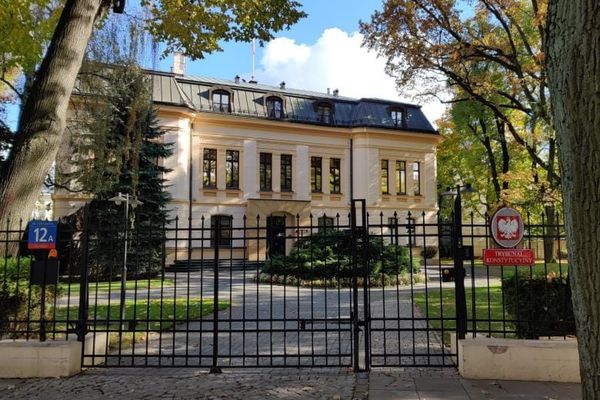

Donald Tusk vowed on 31 October to rebuild Poland's Constitutional Tribunal, hours after President Karol Nawrocki forced his way past judges into the building and a day after a parliament-elected judge suspended its PiS-appointed president.
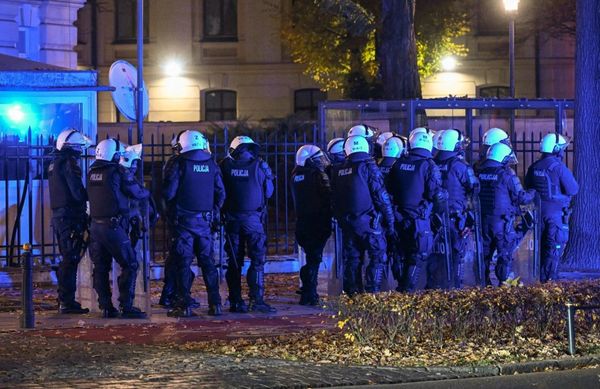
Tusk said in a prime-time television address that "in certain matters, there can be no compromise". Riot police had spent the previous night between PiS supporters and the tribunal's gates on Aleja Szucha in Warsaw, and Nawrocki had left the building at about 5am saying a constitutional body had been taken over by force.
The Court of Justice of the European Union ruled in December 2025 that the tribunal no longer meets the requirements of an independent and impartial tribunal established by law. The far-right Law and Justice party (PiS) built that bench during eight years in power, and Nawrocki, elected with PiS backing in 2025, holds the oath and the veto that the government needs to rebuild it lawfully.
The night at the tribunal
Shortly after 6pm on Friday 30 October, the tribunal's website posted an order interrupting the duties of its president, Bogdan Święczkowski, and vice-president, Bartłomiej Sochański, for one month. Anna Korwin-Piotrowska, one of the judges elected by the Sejm in March, told TVN24 she had issued the order as the judge with the longest judicial service and had taken charge of the court. She said six other judges were in the building with her.
Korwin-Piotrowska cited Article 130 of the law on the organisation of common courts, which allows a judge to be removed from duty for up to a month pending disciplinary proceedings, and a state of overriding constitutional necessity. Her order accused Święczkowski of blocking the General Assembly of judges, preventing five lawfully elected judges from hearing cases, breaking the rules on assigning cases and shelving matters of public importance for political reasons, the Kyiv Post reported.
The tribunal's leadership answered within the hour. Its spokesperson, Weronika Ścibor, said security guards had been told to pack their belongings and leave, and the court's X account said the website had been unlawfully taken over. "All persons participating in these actions are committing the crime of a coup d'état," the account said.
Święczkowski reached the building at about 8.20pm and was refused entry. He addressed a crowd of PiS supporters through a megaphone outside the gates, where demonstrators cut a chain on the gate and tried to force the fence.
Warsaw police said they had deployed on information from Korwin-Piotrowska about threats to judges and staff and to public order. They said officers did not enter the building and arrested three people who tried to get into the complex. Jarosław Kaczyński, the PiS leader, was among those outside.
Nawrocki was on his way to Senegal. He turned the aircraft around, wrote on X that the president must be in Poland at such a moment, and met Zbigniew Kapiński, the First President of the Supreme Court, at the presidential palace before driving to the tribunal with Kapiński and a group of aides at about 1am.
Videos posted by Maciej Berek, the eighth of the judges elected by parliament this year, showed scuffles at the doors as Nawrocki pushed his way in. Inside, Korwin-Piotrowska told him: "We are judges of the Constitutional Tribunal." Nawrocki replied: "You are not judges of the Constitutional Tribunal." Marcin Przydacz, a presidential aide, later said Korwin-Piotrowska and Judge Krystian Markiewicz had "breached the inviolability of the head of state".
Nawrocki left at about 5am. Paweł Szefernaker, his chief of staff, read a statement saying there had been a violation of the constitutional order and a forcible takeover of a constitutional body. The president said he had enabled Sochański, whom he regards as the lawful vice-president, to enter, and called on police to leave the grounds.
Waldemar Żurek, the justice minister and prosecutor general, said the president's conduct inside the building was "shameful" and he hoped prosecutors would act, because a person protected by presidential immunity could not behave in that way. On the same day Żurek sent the tribunal requests to lift the immunity of Święczkowski and Sochański so that they can face criminal charges. Korwin-Piotrowska has called a General Assembly of the tribunal's judges for 3 November, at which she said Święczkowski could give an explanation.
The eight judges
The Sejm elected six judges to fill vacancies on 13 March 2026: Krystian Markiewicz, Maciej Taborowski, Marcin Dziurda, Dariusz Szostek, Magdalena Bentkowska and Anna Korwin-Piotrowska. Under the Polish constitution, tribunal judges are elected by the Sejm for single nine-year terms. A 2016 statute passed by PiS requires them to swear an oath "before the president" before taking up their duties.
Nawrocki invited two of the six, Bentkowska and Szostek, to the presidential palace and swore them in on 1 April, citing doubts about the legality of the Sejm vote. The remaining four took their oath at a ceremony in the Sejm on 9 April, addressing it to the president in his absence and sending him written copies. When they arrived at the tribunal that day, Święczkowski turned them away.
Marcin Wiącek, Poland's commissioner for human rights, sided with the president on the narrow statutory point, telling Wirtualna Polska that "the president must swear in Constitutional Tribunal judges". The government's position, set out by spokesman Adam Szłapka, is that the constitution gives the power to choose judges to the Sejm alone and that the oath is a duty the president cannot convert into a veto. Żurek ordered prosecutors in April to investigate the presidential advisers who recommended the refusal.
The European Court of Human Rights issued an interim measure on about 6 May ordering the tribunal to stop obstructing the four judges from taking up their duties. The tribunal replied that the human rights court had no authority over the matter.
On 12 May, in case K 323/26 brought by PiS MPs, the tribunal ruled that the president was under no obligation to administer the oath. Żurek said a bench containing judges elected to already occupied seats had produced the ruling and that it was therefore no ruling at all.
The Sejm elected Sławomir Patyra, a constitutional law professor at Maria Curie-Skłodowska University in Lublin, on 11 June to replace Andrzej Zielonacki, whose term ended on 28 June. Nawrocki left Patyra waiting for weeks and two letters before swearing him in on 28 July. Patyra then announced he would refuse to adjudicate until the four other judges were admitted.
Berek, the minister who had coordinated government legislation in Tusk's cabinet and whom Tusk described as his right-hand man, was elected on 4 September over objections from some coalition partners that his candidacy contradicted the coalition's own promise to depoliticise the courts. The president's office said there were serious doubts that Berek met the statutory requirement of 10 years' legal practice. The Sejm Chancellery replied that questioning the Sejm's election of a judge had no basis in any law.
The Venice Commission, the Council of Europe's advisory body on constitutional law, adopted an opinion on 9 and 10 October at the request of the Parliamentary Assembly's monitoring committee and published it on 13 October. It called on Nawrocki to swear in all the elected judges without delay and said that where a president unlawfully refuses, allowing judges to take office without his participation is "constitutionally justified". Rafał Leśkiewicz, the president's spokesman, said the opinion was advisory and not binding.
Berek swore his oath in the Sejm the next morning, on 14 October, in the presence of the speakers of both houses. Święczkowski said he would let Berek hear cases if the president accepted his oath. On 27 October Zbigniew Bogucki, head of the presidential chancellery, wrote to the tribunal that Berek had not taken the oath before the president and was therefore not a judge.
Święczkowski has admitted three of the eight new judges and barred five. Seating all eight would give judges chosen by the current Sejm eight of the 15 seats and end the majority that PiS appointees have held since 2016.
The court PiS built
Civic Platform's outgoing majority opened the dispute on 8 October 2015, before an election it expected to lose, by electing five tribunal judges, two of them to seats that would only fall vacant after the new Sejm convened. The tribunal later upheld three of those elections and struck down two. President Andrzej Duda, a PiS ally, refused to swear in any of the five, and the new PiS majority elected its own candidates in December 2015, including three to seats that had already been lawfully filled.
Mariusz Muszyński, Lech Morawski and Henryk Cioch, the three elected to occupied seats, became known in Poland as the "doublers", and their seats passed to successors chosen the same way. PiS then passed a series of laws reshaping the tribunal's procedures. In December 2016 Duda appointed Julia Przyłębska as its president in a procedure the Court of Justice later found irregular.
Przyłębska's tribunal issued two of the PiS era's defining rulings. On 22 October 2020 it struck down the provision allowing abortion for severe foetal abnormalities, triggering the largest street protests in Poland since 1989. On 7 October 2021, on a referral from Prime Minister Mateusz Morawiecki, it declared articles of the EU treaties incompatible with the Polish constitution.
On 7 May 2021, in Xero Flor v Poland, the European Court of Human Rights held that a tribunal bench including Muszyński was not a "tribunal established by law". On 27 October 2021 the Court of Justice ordered Poland to pay €1 million a day for keeping alive the Supreme Court's Disciplinary Chamber, which it had found was not an independent court. The penalty was halved in April 2023 after the chamber was abolished, and the total exceeded €500 million.
PiS also rebuilt the National Council of the Judiciary (KRS), the body that nominates judges. From 2018 its 15 judicial members were chosen by politicians in the Sejm, not by judges. About 2,500 judges appointed on its recommendation, known in Poland as "neo-judges", now sit in courts whose own colleagues and European judgments question their status.
The European Commission opened the Article 7 procedure against Poland in December 2017 and later withheld €137 billion in recovery and cohesion funds under the rule-of-law conditions attached to them. After Tusk's coalition took office on 13 December 2023 and presented a plan to restore judicial independence, the Commission unblocked the money on 29 February 2024 and closed the Article 7 procedure on 29 May 2024.
On 18 December 2025, in case C-448/23, the Court of Justice ruled that the tribunal fails the test of an independent and impartial tribunal previously established by law, because of serious irregularities in the appointment of three judges in December 2015 and of its president in December 2016. It also found that the October 2021 ruling breached the primacy of EU law. Beata Szydło, the PiS prime minister from 2015 to 2017, said the judgment was "usurpation and lawlessness by the CJEU".
Zbigniew Ziobro, the PiS justice minister who designed the courts overhaul, faces 26 criminal charges, including founding and directing an organised criminal group inside the justice ministry that prosecutors say misappropriated more than PLN150 million from the Justice Fund for crime victims. Ziobro left Poland before the Sejm lifted his immunity in November 2025 and was granted asylum by Viktor Orbán's government in January 2026. Hungary's new government under Péter Magyar revoked his refugee status on 2 July.
Ziobro denies the charges and says he is the target of political revenge, and the Polish government is now seeking his extradition from the U.S.
The chief justice
Święczkowski, 56, headed the Internal Security Agency under the first PiS government in 2006 and served as a deputy justice minister and national prosecutor under Ziobro before the PiS Sejm elected him to the tribunal. Duda appointed him its president on 9 December 2024, after Przyłębska's term ended.
On 5 February 2025 Święczkowski announced that he had filed a notification with prosecutors accusing Tusk and senior ministers of acting as an organised criminal group to change Poland's constitutional order. "One can see clearly that we are dealing with a coup d'état," he said. A deputy prosecutor general appointed under PiS, Michał Ostrowski, opened an investigation.
Tusk posted a video of himself playing table tennis and wrote that the alleged coup led the news only in Russia, Belarus and Hungary.
In September 2025 Żurek asked the tribunal to lift Święczkowski's immunity over his conduct as national prosecutor. A special prosecution team investigating the PiS government's use of Pegasus spyware alleges that Święczkowski ordered a subordinate to access surveillance material on Roman Giertych, then a lawyer for Tusk and now a Civic Platform MP, knowing that it contained privileged communications, and had it copied to discs.
On 16 October 2025 the tribunal's General Assembly, chaired by Sochański and made up entirely of PiS-era judges, refused consent. Święczkowski said the request was a political stunt.
The president
Nawrocki, a former head of the Institute of National Remembrance, won the presidency with 50.9 per cent in the second round on 1 June 2025 and was sworn in on 6 August. He is not a PiS member, but the party backed his candidacy.
On 12 November 2025 he refused to promote 46 judges whom he accused of following the justice minister's lead in questioning the status of PiS-era appointees, and threatened to approve no judicial appointments for the rest of his five-year term. Andrzej Zoll, a former president of the tribunal, told Onet that the president's role in appointing judges was a formality that gave him no right to review nominations.
On 19 February 2026 Nawrocki vetoed the government's KRS bill, which would have had all of Poland's judges elect the council's 15 judicial members in secret ballots run by the National Electoral Commission. He vetoed a second bill dealing with the legal consequences of appointments made through the PiS-era council. He said the KRS law was unconstitutional and would put the courts in the hands of a political interest group.
The same day he sent the Sejm his own bill. It would make it an offence for a public official to persistently question the powers of the president, the tribunal or the KRS within the scope of their duties. Deputy justice minister Dariusz Mazur said the bill was designed to "put judges under his boot".
Nawrocki said he would seek a national referendum if the government rejected dialogue.
Overturning a presidential veto requires a three-fifths majority of the Sejm, which Tusk's coalition does not hold.
The government's methods
Tusk's government stopped publishing tribunal rulings in the Journal of Laws after the Sejm passed a resolution on 6 March 2024 declaring that rulings issued by benches containing the doublers had no legal effect. A cabinet resolution in December 2024 confirmed the policy. In September 2025 the tribunal ruled that making its judgments conditional on publication by the prime minister was unconstitutional, and the government did not publish that ruling either.
The Venice Commission advised Poland in December 2024 that ending the terms of every sitting tribunal judge by constitutional amendment, a proposal from the then justice minister Adam Bodnar, would be unacceptable under international standards. The Commission preferred a route that removed the improperly appointed judges while respecting the irremovability of the lawfully appointed ones.
The Helsinki Foundation for Human Rights, which has documented the tribunal's capture since 2015 and whose complaint led to a criminal case over manipulated bench assignments, said on 31 October that the legal basis for the suspension was "questionable". Article 130 of the common courts law gives the power of removal to the justice minister or a court president, the Foundation said, and a senior judge stands in for a tribunal president only when the post is vacant or the president cannot act. Reliance on constitutional necessity, in its view, concedes the absence of an undisputed statutory basis.
The Foundation said a future Sejm could elect a long-serving judge to seize control of the tribunal in the same way. It supports a constitutional reset, first proposed by the Stefan Batory Foundation, that would change the method of electing judges, end the terms of all current judges and refill the bench under the new rules.
Marcin Matczak, a law professor at the University of Warsaw, told Al Jazeera that the far right was defending its remaining institutional stronghold while the government was trying to restore balance. He said a future government could cite the police deployment to justify sending officers into the tribunal and that Tusk's harder line could energise his base while alienating moderate voters.
Radosław Sikorski, the foreign minister, said events outside the court were not elegant. "The alternative was to concede an unconstitutional transformation of Poland into a presidential republic," he said.
The response
Tusk said in his address that there had never been any doubt that the court in the form imposed by PiS was not a genuine court, citing the European judgments. He compared PiS's outrage to a thief who snatches an elderly woman's handbag and, when caught, screams that he is the victim of violence. He said organisations and politicians who sought to destroy democracy and the rule of law found support among pro-Russian forces, and pointed out that Dmitry Medvedev, Russia's former president and deputy chair of its security council, had said the changes amounted to "a constitutional coup".
Tusk said no politician, including the president, could enter a court in a democratic state to issue orders to judges or intimidate them, and that the government had a duty to ensure the court could function.
Luisa Boge, a European Commission spokesperson, said the Polish authorities must ensure the tribunal could operate in line with the constitution and the case law of the Court of Justice. She said the Sejm's election of all eight judges fell within its constitutional powers, as the Venice Commission had confirmed, and the Commission urged Nawrocki to accept them.
Nawrocki spent 31 October in consultations with parliamentary parties, which he said he had called because of a threat to Poland's internal security. No agreement was reported. Bogucki said in response to Tusk's address that the prime minister was "a pathological liar, who is setting Poland ablaze".
Tom Rose, the U.S. ambassador, said a confrontation of this kind could turn into something far worse. Kaczyński had told supporters outside the tribunal on 17 October that the tribunal and the National Bank of Poland were the last institutions the government did not yet control.
Poland's next parliamentary election must be held by 11 November 2027. An aggregate of eight pollsters published on 3 October put Tusk's Civic Coalition on 32.7 per cent, PiS on 20.6 per cent, Konfederacja on 14.9 per cent and Grzegorz Braun's Confederation of the Polish Crown on 9.1 per cent. Individual polls from United Surveys and Pollster over the summer showed the current coalition short of a Sejm majority.
The assembly
Under the tribunal statute, consent to prosecute a tribunal judge requires a resolution of the General Assembly passed by an absolute majority of the judges taking part. Korwin-Piotrowska has called that assembly for 3 November. Its composition and quorum are disputed from the outset, because the president and the PiS-era judges do not recognise five of the eight judges elected since March, and an assembly made up only of PiS-era judges rejected the last request to lift Święczkowski's immunity in October 2025.
Korwin-Piotrowska's written order and its full legal reasoning would show whether she relied on any provision of the tribunal statute itself or on Article 130 and constitutional necessity alone. Police tasking records for 30 October would show who requested the deployment and on what information.
Bogucki's letter of 27 October sets out the presidential chancellery's legal position on the five barred judges. The minutes of the 3 November assembly will record which judges were counted toward its quorum and how each voted on the immunity requests.