Donald Trump told Ukraine's European allies that countries should stop wasting money on Ukraine, phoning their Berlin summit from Air Force One on 19 November hours after meeting Vladimir Putin, European officials revealed.
Trump rang the mobile phone of Jared Kushner, his son-in-law and special envoy, who put the president on speaker and amplified the call with a microphone, according to people close to the participants. Friedrich Merz, the German chancellor, was hosting 26 heads of state or government and the leaders of the EU and NATO at the Federal Chancellery. Trump told them Putin was serious about negotiating peace, and three of the four officials said he forcefully questioned whether the Coalition of the Willing should put billions more into Ukraine.
Ukraine faces a financing gap of about €70 billion in 2027, according to the German government. The European Commission proposed on 18 November, the day before the Berlin summit, to lend Ukraine up to €45 billion of that sum through joint EU borrowing. Ursula von der Leyen, the Commission president, said the loan would cover two thirds of Ukraine's needs for next year. At a special summit in Brussels on 26 November, Hungary, Slovakia and the Czech Republic opposed the loan and the other leaders were still without a deal by late evening.
Andy Burnham, the British prime minister, was asked at the closing news conference in Berlin whether Trump was too optimistic about Putin. He said it was "quite the opposite" and that Trump had spoken about the loss of life. Merz told the same news conference that Europe paid for Ukraine's defence so that it could negotiate from a position of strength. "We are not providing this strong support to prolong the war," he said.
Steve Witkoff, Trump's other special envoy, was in Berlin with Kushner and gave an on-the-record U.S. account of the call. Trump told the gathering he had raised the same principles with the two leaders he had just met, Witkoff said, and had sent the two envoys to Berlin "specifically to be part of the Coalition of the Willing".
The Federal Chancellery call
Two participants told The Telegraph that Trump's remarks were an angry outburst against plans by the EU and Ukraine's other backers to close the €70 billion gap. A third person gave a milder version, saying Trump had pointed to how much governments would save once the war ended. The official who described the "wasting money" remark said Trump spoke in general terms about how many people were dying.
The same two participants said Trump argued that effort should go into negotiations with the Russian government and away from sending more money to Ukraine. He told the leaders he was convinced Putin wanted peace.
Kushner told the meeting that Trump was willing to study protection for Ukraine modelled on Article 5 of the NATO treaty, under which an attack on one member is treated as an attack on all. He said any such commitment would have to take U.S. interests into account. The joint statement issued that evening by Germany, France, the United Kingdom and Ukraine records that the United States took part in the meeting. It calls for a European-led Multinational Force Ukraine supported by the U.S., a U.S.-led mechanism to monitor any ceasefire and a legally binding commitment to act if Russia attacks again.
Kylin Villa
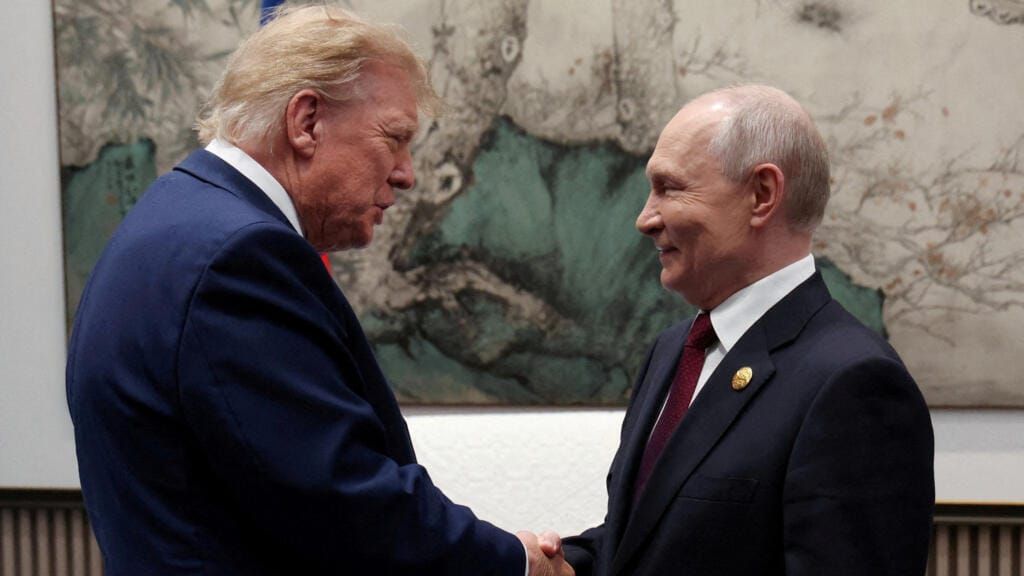
Trump met Putin alone for 35 to 40 minutes on 19 November before the three-way session with Xi Jinping, the Chinese president, at Kylin Villa in Shenzhen, on the sidelines of the Asia-Pacific Economic Cooperation summit. Yuri Ushakov, Putin's foreign policy aide, said Ukraine was the main subject of that meeting. "One could say so, yes," he told reporters when asked. It was the first meeting between the two presidents since their summit in Alaska in August 2025.
Dmitry Peskov, the Kremlin spokesman, said Ukraine was not the central topic of the three-way talks. The Russian presidency and Chinese state media released a four-point "Declaration toward Peace" afterwards. It commits the three governments to seek reform of the United Nations, to increase supplies of refined petroleum and to open a dialogue on reducing nuclear risks. Its fourth point says the International Criminal Court and similar bodies should respect the immunity of state officials. The court issued an arrest warrant for Putin in March 2023 over the deportation of Ukrainian children, and the declaration makes no mention of Ukraine itself.
Air Force One left Shenzhen at about 05:45 Eastern time, 11:45 in Berlin, after Trump left the villa without speaking to reporters, according to the White House travel pool. An aide on Air Force One asked journalists to seal the phones they had used in China in signal-blocking bags until the plane landed in the U.S., citing cyber security.
The €45 billion loan
EU leaders agreed in December 2025 to borrow €90 billion jointly for Ukraine's military and budget needs in 2026 and 2027. Hungary, Slovakia and the Czech Republic stayed out of that loan. Russia's war has since opened the €70 billion hole in Ukraine's 2027 budget, and contributions from countries outside the EU have fallen short of EU leaders' expectations.
The Commission's new proposal divides the €45 billion into €20 billion for Ukraine's budget and €25 billion for military aid. Ukraine would repay the principal only once Russia pays it war reparations. NATO allies have separately pledged €70 billion in military equipment, assistance and training for Ukraine in 2026 and at least as much in 2027, the Berlin joint statement says. Karoline Leavitt, the White House press secretary, said in November 2025 that Trump had stopped funding the war with U.S. taxpayers' money and that the United States sends or sells weapons to Ukraine through NATO arrangements.
The E5 team
Merz said at the end of the Berlin summit that a settlement in the manner of Yalta would not bring peace and that negotiations conducted without Ukraine and Europe would fail. Soviet, U.S. and British leaders divided post-war Europe into spheres of influence at Yalta in February 1945.
EU governments agreed in Dublin on 13 November that France, Germany, Italy, Poland and the United Kingdom would negotiate for Europe, the German government said. President Volodymyr Zelenskyy said in Berlin that U.S. representatives had confirmed a European presence in future talks with Russia, and that five European countries, the EU and NATO would be represented. Emmanuel Macron, the French president, said the Shenzhen declaration did not mean a reorganisation of the world order and called for Ukraine's membership of NATO to be put back on the table. Donald Tusk, the Polish prime minister, called Trump's statements after Shenzhen "very optimistic" and said he expected the Russian government to avoid serious negotiation until the winter was over.
Brussels, 26 November
Péter Magyar, the Hungarian prime minister, said in Brussels that Ukraine's financing could not be tied to the EU's 2028 to 2034 budget. Andrej Babiš, the Czech prime minister, asked to opt out of the loan. Merz said the EU could not repeat last year's compromise and threatened to block the long-term budget if member states withdrew from the Ukraine loan. Bulgaria reversed its earlier refusal and agreed to join the €20 billion budget-support strand but not the military strand, under an opt-in arrangement offered by von der Leyen.
Trump wrote on Truth Social on the same day that he wanted Putin to "pull back all Military aggression against territories throughout Europe" and called a peace agreement a strong possibility. The post followed Russian missile and drone incursions into Polish airspace on 23 and 24 November and a meeting with Mark Rutte, the NATO secretary general, on 25 November.
Budget talks dominated the Brussels summit, with the Ukraine loan now tied to those negotiations. Macron said leaders must reach a budget agreement before their next meeting at the end of December.